Building or outfitting an off-grid cabin in the woods or mountains is an exciting dream. But nothing ruins off-grid serenity faster than dead batteries at 8 PM when you want lights, water pressure, and refrigeration.
Too many builders guess their power needs by buying whatever all-in-one solar kit is on sale. Within two weeks, they discover the system cannot keep up with real-world electrical demands.
Engineering a bulletproof off-grid power system is not guesswork—it is basic electrical arithmetic.
Below is the step-by-step 5-stage blueprint used by off-grid electrical engineers to size battery storage, inverter capacity, and solar arrays for 100% reliable year-round power.
To size an off-grid cabin power system: (1) Total your Daily Watt-Hours by multiplying each appliance’s running watts by operating hours per day. (2) Multiply by 1.25 to account for system conversion losses. (3) Multiply by Days of Autonomy (typically 2 to 3 days) to establish total required LiFePO4 battery capacity. (4) Size your solar array by dividing daily energy demand by your location’s Winter Peak Sun Hours (typically 2.5 to 3.5 PSH).
Stage 1: The Daily Load Audit (Watt-Hours per Day)
Electricity is consumed in Watt-hours ():
Sample Moderate Off-Grid Cabin Daily Energy Budget:
| Appliance / Circuit | Operating Watts | Daily Run Hours | Daily Energy (Wh/day) | Notes |
|---|---|---|---|---|
| LED Lighting (8 Fixtures) | 60W total | 5.0 Hours | 300 Wh | 100% LED bulbs only. |
| Kitchen Refrigerator | 140W (Cycle) | 24 Hours (35% duty) | 1,200 Wh | See our refrigerator duty cycle guide. |
| Starlink Internet & Wi-Fi | 50W | 12.0 Hours | 600 Wh | Put in sleep mode overnight. |
| 12V DC Shurflo Water Pump | 80W | 0.75 Hours | 60 Wh | Pressurizes kitchen and shower. |
| Laptop & Phone Charging | 65W | 4.0 Hours | 260 Wh | Charge via native USB-C PD. |
| Ceiling Fan (Summer) | 35W | 8.0 Hours | 280 Wh | Brushless DC motor. |
| Kitchen Blender / Microwave | 1,000W | 0.25 Hours (15 min) | 250 Wh | Short, high-power bursts. |
| Inverter Tare Loss (24/7) | 25W | 24 Hours | 600 Wh | See our tare loss engineering benchmark. |
| TOTAL DAILY CONSUMPTION | — | — | 3,550 Wh/day (3.55 kWh) | Baseline Cabin Load |
Stage 2: Factoring System Losses & Inefficiencies
No electrical system is 100% efficient. Energy is lost as heat across multiple conversion stages:
- DC-to-AC Inverter Efficiency: (drops lower under light loads; see our inverter efficiency curve guide).
- Battery Round-Trip Efficiency: for LiFePO4.
- Wiring Resistance (): .
Stage 3: Sizing the Battery Storage Bank
Your battery bank must sustain your cabin through consecutive cloudy or rainy days without running a noisy backup generator. This buffer is known as Days of Autonomy.
- Standard Cabin Autonomy: 2.0 to 2.5 Days
- Target Depth of Discharge (DoD): 80% (To ensure 10-year battery lifespan; see our 80% DoD rule guide).
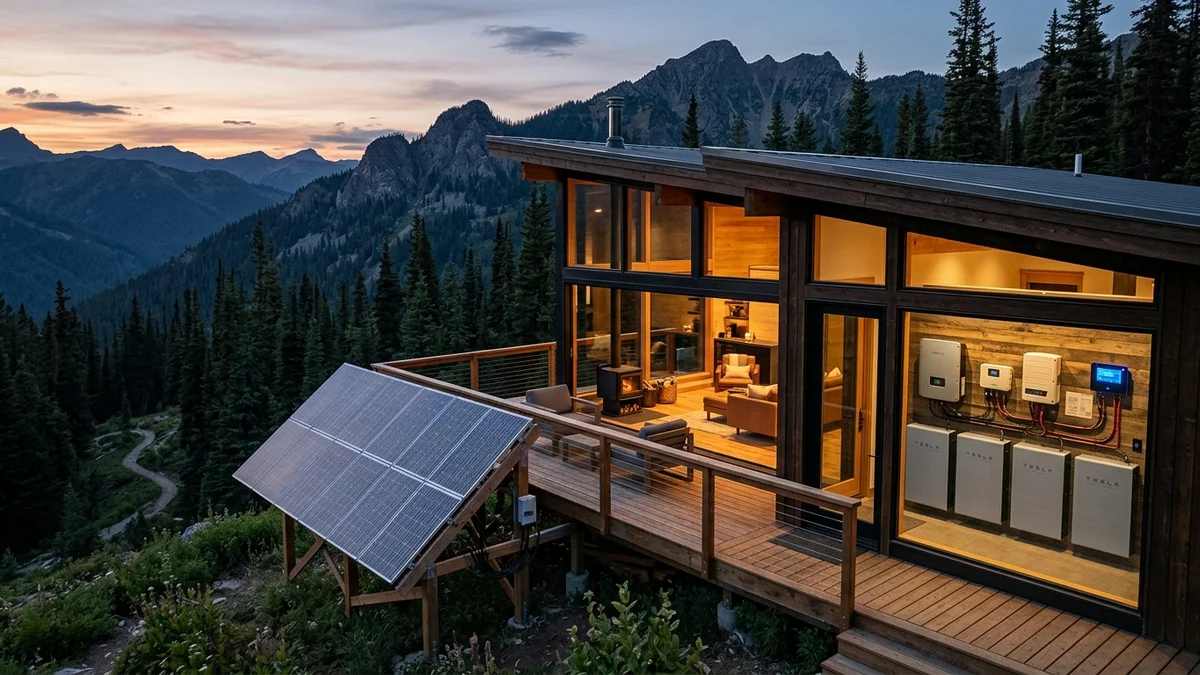
A 10 kWh LiFePO4 battery bank (e.g., two 5kWh server rack batteries, or a modular system like the Anker Solix F3800 with expansion packs or EcoFlow Delta Pro Ultra) provides rock-solid 48-hour independence.
Stage 4: Sizing the Solar Array for Winter Sun
To determine how many solar panels you need, do not design for sunny June days. Design for December and January, when the sun sits low on the horizon and days are short.
- Peak Sun Hours (PSH): The equivalent number of hours per day when solar irradiance averages .
- Most of the continental US receives 2.5 to 3.5 Peak Sun Hours in winter.
Rounding up to standard panel sizes: Five 400W solar panels (2,000W array) or six 350W panels.
If you are mounting panels on ground racks in snowy regions, install bifacial ground-mount panels to harvest an extra 15%–25% winter albedo yield. Always verify cold-weather string voltage with our Voc safety calculator.
Stage 5: Sizing Inverter Continuous & Surge Capacity
Your inverter must handle two distinct metrics:
- Continuous Wattage: The sum of all appliances that might run simultaneously (e.g., Refrigerator [150W] + Lights [60W] + Microwave [1,000W] + Water Pump [80W] = ). A 3,000W continuous inverter provides comfortable headroom.
- Instantaneous Motor Surge (LRA): High inductive loads (well pumps and water pressure systems) demand 5x–7x running wattage for 200ms. If you have a deep-well pump, verify starting surge with our motor inrush current and LRA sizing guide or use our sump pump surge calculator.
Anker Solix F3800 Home Backup
Expandable from 3.84 kWh up to 26.9 kWh with modular LiFePO4 batteries, featuring 6,000W split-phase 120V/240V output and 2,400W dual MPPT solar input—ideal for turnkey off-grid cabins.
6. Frequently Asked Questions
Should my off-grid cabin use a 12V, 24V, or 48V battery system?
For any cabin consuming more than 1,500 Watt-hours per day, always choose 48V. At 48V, electrical current is 1/4th the amperage of a 12V system for the exact same wattage (). Lower amperage allows thinner, cheaper copper wiring, prevents voltage drop, and drastically reduces fire risk.
Can I run electric space heating or an electric stove on solar?
It is strongly discouraged. Pure electrical resistance heating devours immense power (a single space heater draws 1,500W continuously, consuming 12,000Wh over an 8-hour night). In an off-grid cabin, use wood stoves or propane for space heating, cooking, and domestic hot water. Save your battery bank for lights, refrigeration, electronics, and water pumps.
Do I need a backup generator if I have a large solar array?
Yes. Every robust off-grid system includes a dual-fuel (propane/gasoline) inverter generator as insurance. If an unexpected 5-day blizzard blankets your solar panels with deep snow, running a quiet inverter generator for 2 to 3 hours will rapidly recharge your battery bank through its AC fast-charge port.