When shopping for high-wattage solar panels to charge an off-grid cabin or home backup battery, you will see panels labeled Bifacial Dual-Glass.
Manufacturers claim these panels produce “up to 30% bonus power” from the back side. But when homeowners install them flat against their asphalt shingle roof, they notice zero difference compared to standard monofacial panels.
Are bifacial claims just marketing hype, or does rear-side generation deliver tangible results?
Below is the engineering reality behind bifacial ground-mount performance, how surface reflectivity (Albedo) dictates rear yield, and why proper elevation is required to unlock real gains.
Bifacial solar panels generate real energy from both sides, producing 10% to 25% more daily Watt-hours—but only when mounted on elevated ground racks or open pergolas. On a rooftop installed flush against dark shingles, rear light is physically blocked, reducing rear gain to near zero. On ground mounts over highly reflective surfaces (such as fresh snow or white crushed quartz gravel), rear gain significantly accelerates battery charging.
1. What Is Albedo and How Does It Power the Rear Glass?
Albedo is the measure of diffuse reflectivity of a surface, expressed as a percentage of incoming sunlight reflected back into the atmosphere:
- : The Bifaciality Factor of the solar cells (typically on modern monocrystalline PERC and TOPCon cells, meaning the rear cells produce 70%–85% of front-face efficiency under identical irradiance).
- When sunlight hits the ground beneath and behind the array, light bounces upward onto the rear transparent glass, exciting electrons and pumping additional current into your MPPT solar controller.
Real-World Surface Albedo & Resulting Rear Yield Gain
2. The Mounting Height Rule: Avoiding Self-Shading
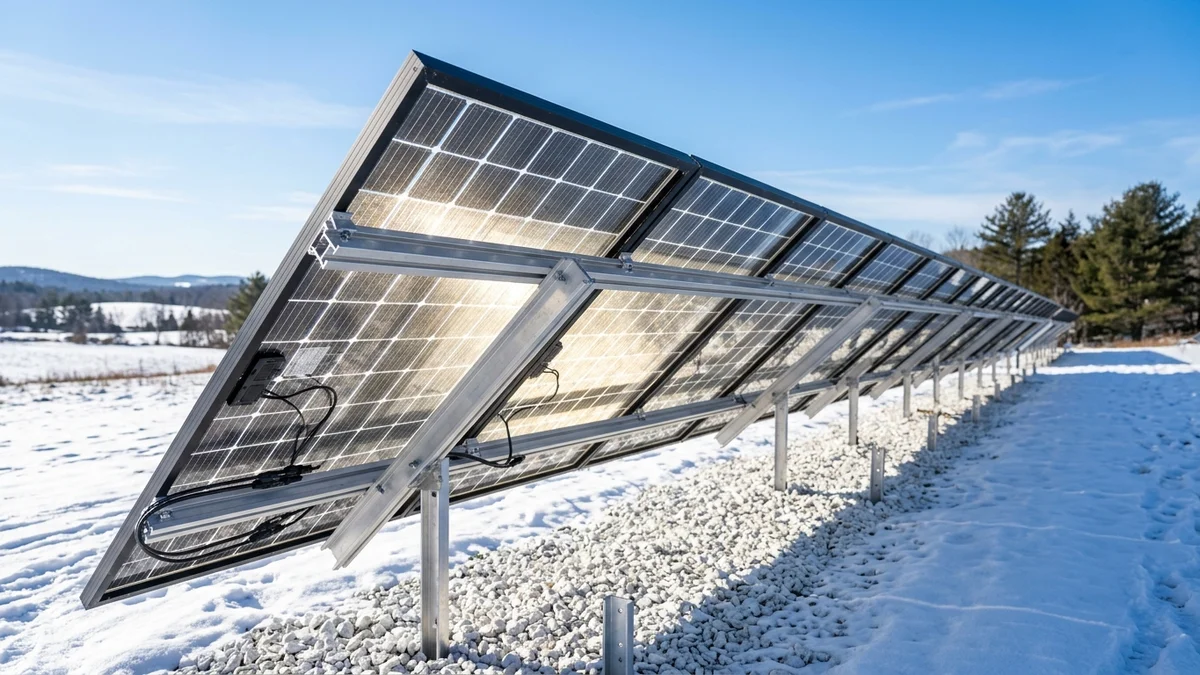
To harvest reflected light efficiently, photons must have room to bounce under the array:
- The Error: Installing bifacial panels with their bottom edge resting directly on the dirt (0 to 6 inches high). The panel’s own shadow blankets the ground directly behind it, choking off rear illumination.
- The Best Practice: Elevate the bottom edge of the ground rack at least 24 to 36 inches (0.6m to 1.0m) above the ground surface. This elevation allows ambient diffuse light from surrounding ground areas to reflect evenly across the entire rear surface.
3. Winter Snow Advantage: The Natural Snow Shedding Bonus
Bifacial panels exhibit a major winter advantage in cold climates: accelerated self-clearing.
- During a heavy blizzard, snow accumulates on the front glass face, completely blocking generation.
- However, the rear glass face hangs downward at a tilt angle and remains completely free of snow.
- Sunlight reflecting off the brilliant white snowbanks hits the rear glass, generating 10%–20% of rated electrical current.
- This electrical current flows through the silicon wafer, gently warming the panel cells.
- That modest internal heat melts the micro-layer of ice bonding snow to the front glass, causing the entire snow sheet to slide off hours or days earlier than on standard monofacial panels.
(Note: In freezing weather, ensure your array respects voltage limits. Review our guide on cold temperature Voc voltage spikes and use our Voc safety calculator).
4. Electrical Sizing Alert: Account for Bifacial Boost
Because a 400W bifacial panel can produce 460W to 480W in real-world ground conditions, you must account for this extra current when sizing your wiring and charge controller:
- Short-Circuit Current () Multiplier: National Electrical Code (NEC Article 690.8) recommends applying a 1.15 to 1.25 multiplier to the panel’s rated to ensure wire ampacity and inline fuses don’t overheat on high-albedo days.
- Wiring Configurations: Decide whether series or parallel best matches your controller limits by reviewing our series vs parallel solar wiring guide.
If you are pairing a bifacial array with heavy split-phase home backup generators, explore our Anker Solix F3800 hardware audit or our Anker F3800 vs. EcoFlow Delta Pro Ultra comparison.
Calculate Your Total Daily Harvest
Input your solar array wattage and battery capacity to predict total recharging time.
Open Solar Sizing Tool →
5. Frequently Asked Questions
Are bifacial solar panels more durable than standard panels?
Yes. Most bifacial panels feature Dual-Glass construction (2.0mm tempered glass on front and back) rather than a fragile polymer backsheet. Dual-glass panels are significantly more rigid, virtually impervious to moisture ingress, and offer superior resistance to micro-cracking during heavy hail or wind storms.
Can I install bifacial solar panels on my RV roof?
Only if the panels are mounted on raised brackets (at least 4–6 inches above a bright white fiberglass or TPO RV roof membrane). If mounted flush to a dark roof, the rear generation benefit is negligible, though you still benefit from dual-glass durability.
Do bifacial panels produce higher voltage or higher amperage?
Bifacial gain primarily increases current (amperage), not voltage. The Open-Circuit Voltage () remains virtually identical to factory STC specifications because voltage is governed by cell bandgap chemistry, while amperage scales linearly with total photon absorption.