When a severe thunderstorm, blizzard, or heatwave knocks out your neighborhood’s power grid, anxiety quickly sets in. Will your food spoil in the refrigerator? Can you run a medical CPAP overnight? Will your sump pump keep the basement dry? And if you drive an electric vehicle, are you stranded if the outage lasts days?
The Anker Solix F3800 was specifically engineered to eliminate those worries. Unlike smaller camping battery packs that only power laptops and small lamps, the F3800 is a heavy-duty home backup station that delivers true 120V and 240V split-phase power at up to 6,000 continuous watts.
In this practical, real-world review, we cut through the marketing buzz to examine how the Anker Solix F3800 performs in everyday emergencies, how easily you can maneuver it, and whether it’s the right choice for your family.
The Anker Solix F3800 is one of the most versatile and user-friendly high-output home backup batteries available. With 3,840Wh of LiFePO4 battery storage, native 240V split-phase power, built-in rolling luggage wheels, and a direct plug for electric cars and RVs, it delivers massive peace of mind without requiring a permanent wall installation.
Check Latest Price →
1. What You Get Out of the Box
Setting up the Anker Solix F3800 doesn’t require an electrician just to get started. While you can connect it directly to your home’s breaker panel via a manual transfer switch, you can also roll it right into your kitchen or living room and plug appliances directly into its front ports:
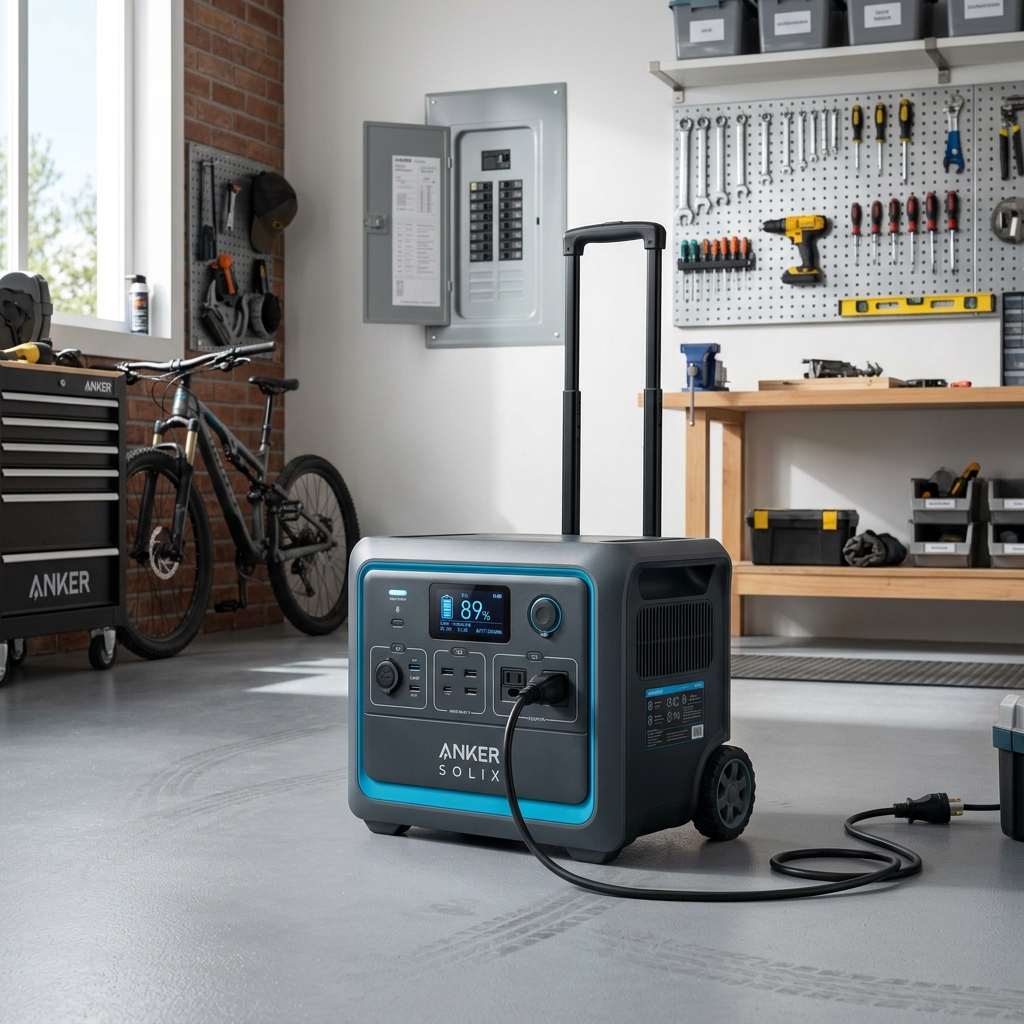
The front panel includes every outlet format you might need in a modern household:
- 6x Standard 120V AC Outlets (20A): For your refrigerator, microwave, televisions, laptops, and lamps.
- 1x NEMA 14-50R (240V / 50A outlet): The exact plug used for Level 2 EV chargers, central air conditioners, and heavy workshops.
- 1x NEMA L14-30R (120V/240V twist-lock): The standard plug used by home generator inlet boxes to back up multiple home circuits.
- Fast USB-C and USB-A Ports: Delivering up to 100W PD charging for laptops and smartphones without turning on the AC inverter.
2. Real-World Blackout Performance: What Can It Actually Run?
When evaluating a backup battery, nominal wattage numbers can be confusing. What matters is: how many hours of comfort and safety does your family get?
The F3800 holds 3,840 Watt-hours (Wh) of usable battery capacity. Because the internal electronics consume a small amount of operating power, we recommend using our solar generator runtime calculator to check custom runtimes for your specific appliances.
Here is what you can realistically expect on a single 100% charge during a power outage:
| Essential Household Appliance | Typical Wattage | Realistic Continuous Runtime |
|---|---|---|
| Full-Size French Door Refrigerator | ~120W (cycling compressor) | 26 to 28 Hours |
| Medical CPAP Machine (heated humidifier) | ~40W | 55 to 60 Hours (over 7 nights) |
| Wi-Fi Router + Laptop + Phone Charging | ~60W | 42 Hours |
| 1/2 HP Basement Sump Pump | ~800W running (cycling) | 4 to 5 Hours (active pumping) |
| Full-Sized Microwave Oven (1,200W) | ~1,200W continuous | 2.5 Hours (30+ meals reheated) |
| Window Air Conditioner (8,000 BTU) | ~700W | 4.5 Hours |
| Central Air Conditioning (3-Ton) | ~3,000W | ~1 Hour |
Want to see how long your exact refrigerator will stay cold? You can calculate your specific compressor cycle time using our free refrigerator backup runtime calculator. If you leave the inverter switched on continuously overnight, remember to factor in fixed vampire draw—check our inverter standby drain calculator or read our in-depth guide to solar generator tare loss.
3. Powering Heavy 240V Loads & Motor Surges
Most portable batteries on the market max out at standard 120V household outlets. That means they simply cannot power appliances with 4-prong 240V plugs, such as well pumps, electric water heaters, or central air units.
The Anker F3800 eliminates this barrier:
- True Split-Phase Output: It natively outputs both 120V and 240V simultaneously up to 6,000W, meaning you can power a heavy 240V well pump while running 120V kitchen lights at the same time.
- Motor Surge Headroom (9,000W Peak): Appliances with electric motors (refrigerators, freezers, and sump pumps) draw a massive surge of power upon startup known as Locked Rotor Amps. The F3800 handles up to 9,000W of startup surge, ensuring compressors don’t trip breaker safety faults. You can model your home pump’s exact starting watts with our sump pump LRA surge calculator.
4. Emergency EV Charging: A Genuine Game-Changer
One of the standout features of the Anker F3800 is its dedicated NEMA 14-50 EV port.
If you drive an electric car (Tesla, Rivian, Hyundai, Ford, etc.), a grid outage can leave you stranded in an emergency. With the F3800, you don’t need any special adapters or grounded bonding plugs:
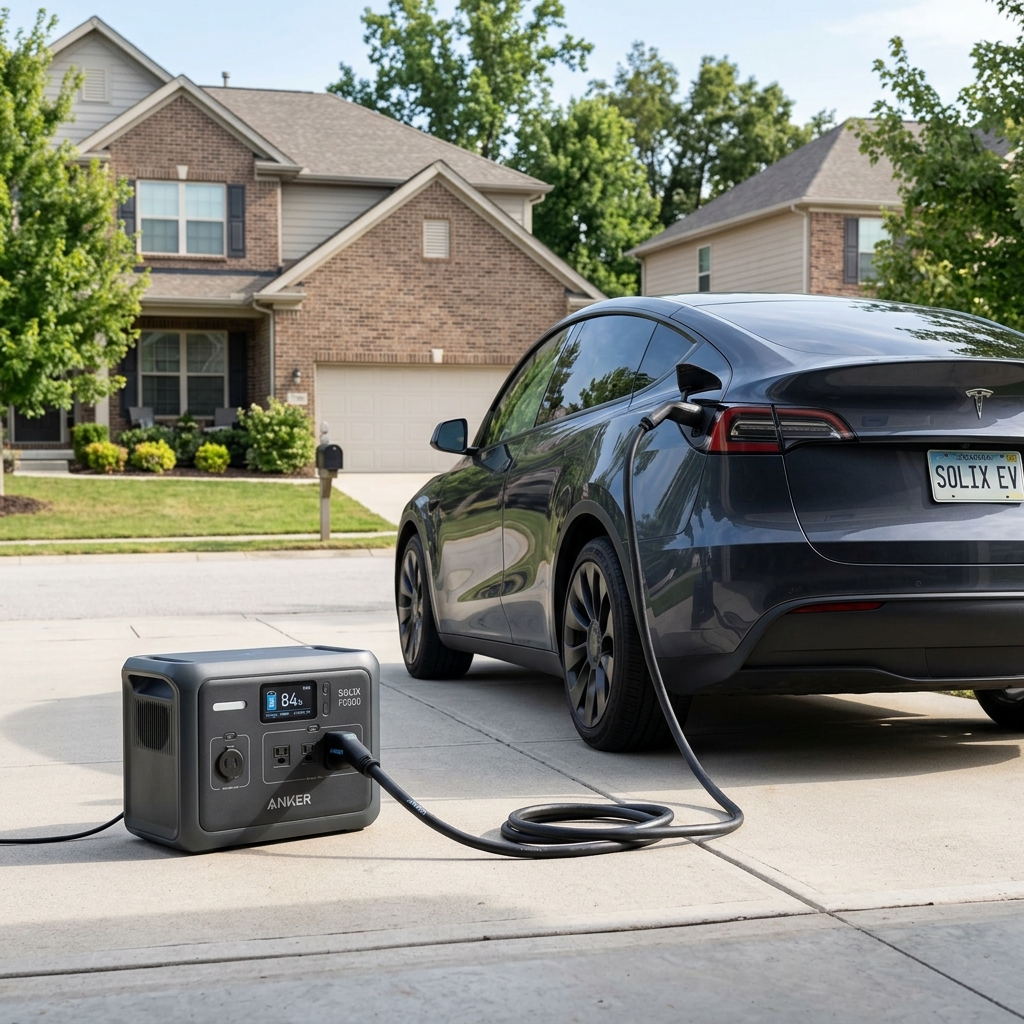
You simply plug your car’s mobile charging cable straight into the front of the F3800. On a full charge, it can inject approximately 3.2 to 3.5 kWh directly into your car’s battery pack—giving you roughly 10 to 14 miles of emergency driving range. While that won’t fuel a road trip, it is more than enough to reach a hospital, shelter, or working public supercharger during a regional blackout.
5. Portability & Everyday Usability
At 132 pounds (60 kg), the Anker F3800 is a substantial piece of hardware. You won’t be throwing it into the trunk of a compact sedan with one hand.
However, Anker made moving this unit surprisingly effortless:
- Telescoping Luggage Handle: A sturdy aluminum handle pulls out smoothly from the top, allowing an average adult to tilt and roll the unit with minimal physical strain.
- Heavy-Duty Rubber Wheels: The 4.7-inch puncture-proof wheels roll easily over door thresholds, garage concrete, and paved driveways.
- Whisper-Quiet Fans: Under typical household loads (under 500W for a fridge and lights), fan noise hovers around 35 to 40 decibels—far quieter than the engine roar and toxic fumes of a gas generator.
6. How It Stacks Up Against the Competition
How does the Anker Solix F3800 compare to other flagship backup options?
- Versus EcoFlow Delta Pro Ultra: If you have central AC, an electric clothes dryer, and want a battery system that can expand up to a massive 90kWh with rooftop solar, check out our full Anker Solix F3800 vs EcoFlow Delta Pro Ultra comparison guide. The EcoFlow offers more base capacity (6,144Wh) but comes in at a higher price tag.
- Versus Smaller 2,000Wh Batteries: If 132 pounds is too heavy and you only need to run a portable fridge and CPAP, smaller units like the EcoFlow Delta Pro 3 vs Bluetti AC200L or Anker F2000 vs Jackery 2000 Plus offer much easier grab-and-go mobility.
7. Honest Pros & Cons
- ✓Native 240V Output: Powers heavy well pumps, electric dryers, and sub-panels without extra boxes.
- ✓Direct EV & RV Plugs: Built-in NEMA 14-50 and TT-30 ports require zero costly adapters.
- ✓10+ Year LiFePO4 Lifespan: Rated for over 3,000 charge cycles before dropping to 80% capacity.
- ✓Smooth Rolling Wheels: Telescoping luggage handle makes moving 132 lbs very manageable.
- ✕Heavy Single-Chassis: At 132 lbs, you cannot carry it up stairs alone.
- ✕Solar Voltage Limit: Caps out at 60V per solar port (requires parallel panel wiring rather than high-voltage series strings).
- ✕Standby Inverter Drain: Leaving the 240V inverter on with zero load burns ~32W continuously.
8. Final Verdict: Should You Buy the Anker Solix F3800?
If you are looking for a reliable, powerful home backup battery that doesn’t lock you into a costly, permanent wall installation, the Anker Solix F3800 hits the sweet spot between power, mobility, and value.
Its ability to deliver true 240V power, recharge an electric car in a pinch, and keep a refrigerator running for more than a full day makes it an outstanding investment in family security.
3,840Wh base capacity, 6,000W output, native 120V/240V dual-voltage power, and direct EV charging in an all-in-one rolling chassis.
✓ 3,000+ LiFePO4 Cycles
✓ 5-Year Full Warranty
✓ Prime Shipping Eligible