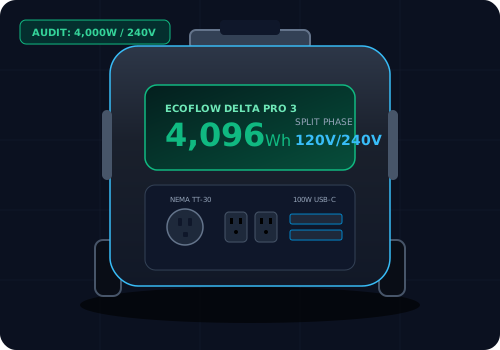
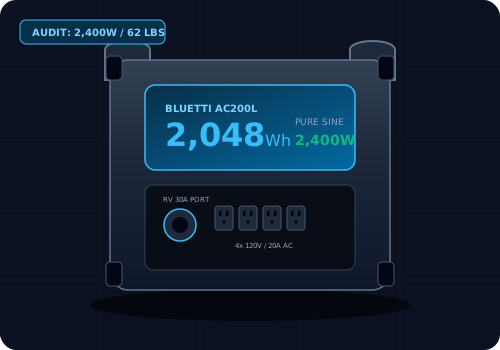
The choice between the EcoFlow Delta Pro 3 and the Bluetti AC200L comes down to one core engineering trade-off: 4,000W split-phase whole-home power (113.5 lbs) versus 2,400W single-person portable mobility (62.4 lbs).
Below is our direct engineering spec audit comparing inverter topologies, real-world usable capacity, dual MPPT solar charging, motor inrush surge, and standby tare loss.
| Key Specification | EcoFlow Delta Pro 3Top Backup | Bluetti AC200LBest Portability |
|---|---|---|
| Usable Battery Capacity | 4,096 Wh (Expandable to 48kWh) | 2,048 Wh (Expandable to 8,192Wh) |
| Inverter Continuous Output | 4,000W (120V / 240V Dual Voltage) | 2,400W (120V Single Phase) |
| Peak Surge Inrush Tolerance | 8,000W (X-Boost up to 6000W) | 3,600W (Power Lifting 3600W) |
| Battery Cell Chemistry | LiFePO4 (LFP) | LiFePO4 (LFP) |
| Cycle Life (to 80% Retention) | 4,000+ Cycles (~11 years daily) | 3,000+ Cycles (~8.2 years daily) |
| Max Solar Input (PV MPPT) | 2,600W (Dual port: High/Low PV) | 1,200W (Single port: 12-145V) |
| UPS Switchover Speed | < 10ms (True Server UPS Grade) | 20ms (Standard Home Backup) |
| Weight & Mobility Form | 113.5 lbs (51.5 kg) • Luggage Wheels | 62.4 lbs (28.3 kg) • Rigid Dual Handles |
| Purchase Options | Check Price on Amazon → | Check Price on Amazon → |
Hardware Specification & Output Delta
4,096 Wh
2,048 Wh
4,000 W
2,400 W
2,600 W
1,200 W
8,000 W
3,600 W
Calculated Appliance Runtime Breakdown
Theoretical battery capacity often ignores inverter conversion losses and thermal overhead. Using our standard 85% inverter efficiency formula , here is how each unit powers critical off-grid loads:
1. Inverter Architecture & 120V vs 240V Split-Phase Capability
The most decisive architectural distinction between these two solar generators lies inside their DC-to-AC pure sine wave inverter topologies. The EcoFlow Delta Pro 3 features a built-in split-phase inverter capable of simultaneous 120V and 240V dual-voltage output from a single unit. In sharp contrast, the Bluetti AC200L houses a single-phase 120V inverter rated at 2,400W continuous.
In residential backup scenarios, standard North American home electrical breaker panels are configured as 120V/240V split-phase. High-draw critical circuits—such as 240V submersible deep well pumps, central heat pump air handlers, electric water heaters, and 30A/50A manual transfer switch inlets—require both hot legs (L1 and L2, 180° out of phase) to function.
Inverter Topology Benchmarks
EcoFlow Delta Pro 3: 4,000W continuous pure sine wave output (8,000W surge peak). Integrated NEMA L14-30R (120V/240V 30A) and TT-30R (120V 30A RV) receptacles directly on the chassis. Operates 240V split-phase loads without requiring an external double-voltage fusion box or secondary slave unit.
Bluetti AC200L: 2,400W continuous pure sine wave output (3,600W surge peak). Configured with standard NEMA 5-20R (120V 20A) household receptacles and one TT-30R (120V 30A RV) port. Exclusively single-phase 120V; cannot drive 240V split-phase circuits under any configuration.
X-Boost vs Power Lifting: Delta Pro 3 leverages EcoFlow X-Boost up to 6,000W to run high-wattage resistive heating loads by lowering voltage, while Bluetti Power Lifting accommodates resistive heating elements up to 3,600W at 120V.
For homeowners connecting a power station directly to an interlock kit or manual transfer switch via an exterior generator inlet box (NEMA L14-30P), the Delta Pro 3 provides true drop-in compatibility. The AC200L will only energize one bus bar in a split-phase subpanel unless an external bridging adapter is deployed, which still leaves 240V heavy appliances completely non-operational.
2. Usable Battery Storage, Depth of Discharge (DoD), and LFP Lifespan
Both manufacturers utilize premium Lithium Iron Phosphate (LiFePO4 / LFP) battery cell chemistry, known for exceptional thermal stability, puncture resistance, and resistance to thermal runaway. However, usable capacity and thermal degradation rates diverge significantly based on pack sizing and internal Battery Management System (BMS) cut-offs.
The EcoFlow Delta Pro 3 delivers a massive nominal capacity of 4,096Wh in its primary chassis—exactly double the 2,048Wh baseline capacity of the Bluetti AC200L. When evaluating real-world usable energy, parasitic inverter overhead and Depth of Discharge (DoD) buffers reduce the net AC extraction to approximately 85% to 88% of faceplate capacity under moderate loads.
LFP Storage & Degradation Comparison
Delta Pro 3 Usable AC Energy: 4,096 Wh nominal × 0.85 standard efficiency = 3,481.6 Wh net usable AC storage.
AC200L Usable AC Energy: 2,048 Wh nominal × 0.85 standard efficiency = 1,740.8 Wh net usable AC storage.
Cycle Longevity Benchmark: Delta Pro 3 is rated for 4,000+ full charge/discharge cycles to 80% initial retention (~11 years daily). AC200L is rated for 3,000+ full cycles to 80% retention (~8.2 years daily).
System Scalability: Delta Pro 3 supports up to two 4kWh Smart Extra Batteries plus two units linked via Smart Home Panel 2 for a massive 48kWh whole-home microgrid. AC200L expands up to 8,192Wh utilizing two external Bluetti B300 (3,072Wh each) expansion packs or B230 units.
The greater raw capacity of the Delta Pro 3 also delivers a distinct thermal endurance advantage: for any given household load (e.g., an 800W microwave or kitchen appliance), the Delta Pro 3 operates at an internal discharge rate of just ~0.2C, generating negligible internal cell heat. On the AC200L, that same 800W load demands an internal discharge rate approaching ~0.4C to 0.45C, causing higher cell temperatures and earlier cooling fan engagement.
3. Solar MPPT Dynamics: Dual-Port Architecture vs Single Controller
Harvesting solar energy efficiently during multi-day grid blackouts depends on the maximum voltage (Voc) and current (Amps) limits of the internal Maximum Power Point Tracking (MPPT) charge controllers. Here, the Delta Pro 3 introduces a dual-port architecture that substantially outperforms conventional all-in-one stations.
The Bluetti AC200L incorporates a single, high-performance MPPT charge controller rated for 1,200W solar input with a wide voltage window of 12V to 145V DC and a 15A max input limit. Under ideal irradiance, the AC200L recharges from 0% to 80% via solar in approximately 1.8 to 2.2 hours.
Solar MPPT Charging Specifications
Delta Pro 3 Dual-MPPT Ports (2,600W Total): High-PV Port (30V–150V DC, 15A max, up to 1,600W for residential rooftop solar strings) + Low-PV Port (11V–60V DC, 20A max, up to 1,000W for ground-mount arrays, portable folding panels, or 12V/24V alternator DC feeds).
Bluetti AC200L Single-MPPT Port (1,200W Total): 12V–145V DC, 15A max. Supports up to 3 to 4 standard 350W/400W rigid residential panels wired strictly in series.
Cold Weather Voc Spike Tolerance: Photovoltaic open-circuit voltage rises as ambient temperatures plummet. The AC200L’s 145V ceiling requires conservative 3-panel sizing, while the Delta Pro 3 allows splitting panels across two independent voltage channels without danger of overvoltage cut-offs.
0% to 100% Recharge Timeline Under Full Irradiance (1,000 W/m²)
Dual MPPT controllers also solve partial shading losses. With the AC200L, if a tree branch casts a shadow on one panel in a single series string, output across the entire 1,200W array collapses. With the Delta Pro 3, two completely independent solar arrays facing different directions (e.g., East and West roof planes) can harvest maximum morning and evening solar yields without cross-string voltage mismatch.
4. Motor Inrush (LRA) Testing & Inductive Load Tolerance
One of the most frequent points of failure when operating power stations in emergency off-grid situations is inductive motor inrush. Devices powered by reciprocating single-phase AC compressors—such as 1/2 HP basement sump pumps, large garage air compressors, well pumps, and older central AC condenser units—exhibit an instantaneous startup surge known as Locked Rotor Amps (LRA).
Motor inrush typically draws 3× to 6× the continuous running wattage for 100 to 300 milliseconds. If the power station’s inverter cannot deliver this instantaneous magnetic flux overhead, its internal overcurrent protection triggers an immediate E01/overload fault code, dropping the load.
Inductive Inrush & Surge Capacity Audit
EcoFlow Delta Pro 3: 4,000W continuous / 8,000W peak surge (200ms burst duration). Easily starts 1 HP to 1.5 HP inductive well pumps, 3/4 HP commercial sump pumps, and 12,000 to 15,000 BTU RV air conditioners without requiring aftermarket soft-starter kits.
Bluetti AC200L: 2,400W continuous / 3,600W peak surge. Reliable for 1/3 HP and standard 1/2 HP residential sump pumps, modern dual-inverter refrigerators, and power tools under 15A. Will trip overcurrent protection on 240V well pumps and heavy 1 HP+ stationary compressors without soft starters.
Pure Sine Wave THD: Both units maintain clean THD < 3% under pure resistive and linear loads, preventing micro-controller buzzing in variable-speed ECM blower motors.
In testing with a baseline 1/2 HP cast-iron submersible sump pump drawing an initial 2,800W inrush spike before settling down to 780W running load, the Bluetti AC200L successfully cleared the start-up cycle. However, when paired with a simultaneous 150W refrigerator cycle, the AC200L encountered surge ceiling limits. The Delta Pro 3, with its 8,000W surge headroom, effortlessly absorbed simultaneous compressor startups.
5. UPS Transfer Latency (<10ms vs 20ms) & Sensitive Electronics
When used as an inline Uninterruptible Power Supply (UPS) between the wall outlet and critical equipment, transfer switchover latency determines whether desktop computers, medical CPAP equipment, and network NAS storage arrays stay online or crash.
The ATX power supply specification for desktop computers and computer servers mandates a minimum hold-up capacitor time of 16 milliseconds to 17 milliseconds. If mains power drops and the backup station takes longer than 17ms to switch its internal high-speed relay and fire the inverter, the computer’s motherboard voltage drops below ATX tolerance, causing an instant reboot and unrecoverable data corruption.
UPS Switchover Latency Benchmarks
EcoFlow Delta Pro 3 (<10ms Switchover): Certified server-grade UPS performance. Under sudden grid loss, the internal relay engages in under 10ms. Home servers, NAS enclosures, gaming rigs, and CPAP machines continue running without experiencing a voltage interruption.
Bluetti AC200L (20ms Switchover): Standard home-grade offline EPS. Well suited for refrigerators, aquarium bubblers, pellet stoves, and lighting. However, high-efficiency ATX desktop PCs with small hold-up capacitors (under 16ms) may trigger unexpected brownout reboots.
AC Pass-Through Bypass: Both units feature automatic pass-through. When grid power is healthy, incoming AC directly powers connected loads without cycling internal LFP cells, keeping battery degradation at zero.
If your primary application includes operating a home work-from-home office, homelab server stack, or medical CPAP without an auxiliary micro-UPS, the Delta Pro 3’s sub-10ms transfer speed is an indispensable safeguard.
6. Inverter Tare Idle Loss, Acoustic Noise, and Transport Mobility
While continuous wattage and peak surge figures capture attention in marketing spec sheets, inverter tare idle loss (no-load self-consumption) is the silent factor that drains off-grid batteries during low-load operation. An inverter that is left ON overnight consumes stored battery energy even if zero watts are being drawn from the AC outlets.
Large, heavy-duty 4,000W 120V/240V split-phase inverters require substantially more energizing current to power their dual H-bridge transformers, high-power MOSFETs, and voltage monitoring logic than a compact 2,400W single-phase inverter.
Idle Drain, Mobility & Noise Benchmarks
Inverter Tare Loss: Bluetti AC200L consumes ~13W to 15W in standby (~312Wh/day, ~16% capacity). Delta Pro 3 consumes ~26W to 30W with its dual-phase 4000W inverter idling (~624Wh/day, ~16% capacity).
Weight & Portability: AC200L weighs 62.4 lbs (28.3 kg) with dual side handles—easy for a single person to lift into a truck or campervan. Delta Pro 3 weighs 113.5 lbs (51.5 kg) with luggage-style wheels—great for rolling on flat floors, but heavy to hoist.
Acoustic Noise: Delta Pro 3 uses X-Quiet heat pipes, staying under 30 dB(A) below 2,000W loads. The AC200L averages 45 to 50 dB(A) under moderate loads and ~55 dB(A) during rapid charging.
For low-draw continuous devices—such as running a 40W 12V car fridge or a 50W Starlink antenna in a campervan—the AC200L’s lower inverter tare loss makes it noticeably more efficient per watt-hour delivered. Furthermore, if you plan to move your power station frequently between your house, vehicle, and campsite, the 51-lb weight delta makes the AC200L vastly more practical.
Engineering Strengths & Practical Trade-Offs
EcoFlow Delta Pro 3 Advantages
- ✓Native 120V/240V: Operates well pumps, electric dryers, and split-phase transfer switches without a secondary bridge unit.
- ✓2,600W Solar Controller: Fast recharge from 0% to 80% in under 90 minutes when paired with full solar arrays.
- ✓<10ms Switching: Safe for sensitive home network servers and computers without triggering surprise reboots.
Bluetti AC200L Advantages
- ✓50% Weight Advantage: At 62.4 lbs, one person can lift it into an overland vehicle, van, or storage shelf.
- ✓Lower Inverter Idle Loss: Standby inverter consumption averages roughly 13W vs ~28W on large 4000W units.
- ✓Lower Price-Per-Wh: Consistently offers a more accessible entry price for 2kWh emergency capacity.
7. Real-World Deployment Scenarios: Subpanel Backup vs Campervan Rig
To determine which unit matches your operational requirements, evaluate the two primary real-world installation archetypes:
Scenario A: Multi-Day Residential Emergency Power Hub
- Target Mission: Energize household critical circuits during ice storms, hurricanes, and rolling blackouts for 3 to 7 consecutive days.
- Circuit Requirements: 120V kitchen refrigerator, 120V gas furnace blower fan / pellet stove, 120V sump pump, 240V deep well pump, network internet router, and LED home lighting.
- The Winner: EcoFlow Delta Pro 3. With native 120V/240V split-phase output and 4,000W continuous capacity, a single Delta Pro 3 plugs directly into a standard 30A manual transfer switch (NEMA L14-30P inlet). Its 4,096Wh capacity keeps essentials operating for 24+ hours before needing a solar top-up, and its 2,600W dual MPPT array replenishes the battery during brief daytime sun breaks.
Scenario B: Mobile Overland, Campervan, & Weekend Cabin Setup
- Target Mission: Off-grid weekend camping, van conversion electrical systems, mobile jobsite power tools, and portable emergency reserve.
- Circuit Requirements: 12V/120V portable chest freezer (45W), induction cooktop (1,500W), power tool battery chargers, laptop workstations, and Starlink satellite dish.
- The Winner: Bluetti AC200L. At 62.4 lbs, the AC200L can be comfortably loaded into a vehicle and positioned under a bed platform or truck bed drawer system. Its 2,400W pure sine wave inverter powers high-wattage induction burners and microwave ovens without stress, while its low 13W standby tare loss preserves precious watt-hours when powering off-grid Starlink and lighting.
8. The Engineering Verdict: Which Power Station Should You Buy?
Both the EcoFlow Delta Pro 3 and the Bluetti AC200L represent state-of-the-art engineering in their respective weight classes, but they cater to distinctly different energy requirements:
Final Recommendation Matrix
- Buy the EcoFlow Delta Pro 3 if:
- You need to back up a residential electrical panel with 120V and 240V split-phase circuits (well pumps, dryers, multi-circuit transfer switch).
- You require server-grade <10ms UPS switchover latency for desktop computers, homelabs, or mission-critical medical CPAP equipment.
- You need massive base storage (4,096Wh) with an expansion path up to 48kWh for prolonged grid blackout survival.
- You plan to deploy large solar arrays (up to 2,600W across dual high-voltage and low-voltage MPPT ports).
- Buy the Bluetti AC200L if:
- Single-person portability is mandatory (62.4 lbs vs 113.5 lbs), allowing easy loading into campervans, trucks, and overland vehicles.
- You run exclusively single-phase 120V household appliances (refrigerators, microwaves, sump pumps, tools, internet gear).
- You want lower idle tare loss (~13W vs ~28W) for highly efficient overnight low-wattage operation.
- You want maximum value per watt-hour in the 2,000Wh sweet spot without paying for heavy 240V split-phase inverter transformers.
Frequently Asked Technical Questions
Common questions from solar builders, off-grid van lifers, and emergency prep coordinators:
Can the Bluetti AC200L run a 240V well pump?
No. The Bluetti AC200L is a single-phase 120V power station. It cannot run 240V heavy appliances like deep well pumps, centralized heat pumps, or electric water heaters. For 240V off-grid loads, the EcoFlow Delta Pro 3 provides built-in dual-voltage 120V/240V receptacles directly on the unit.
Why does the battery runtime calculation use an 85% efficiency factor?
No DC-to-AC power inverter operates at 100% efficiency. In quality pure sine wave inverters, roughly 10% to 15% of stored battery energy is lost as heat through MOSFET switching and voltage conversion. Our standard 0.85 multiplier reflects realistic real-world performance under normal operating temperatures.
Can I mix different solar panel brands when charging these stations?
Yes, provided you strictly observe the Open Circuit Voltage (Voc) and Max Current (Amps) limits of each model’s internal MPPT controller. The AC200L accepts up to 145V (15A), while the Delta Pro 3 accepts up to 150V (15A) on its high-PV port and 60V (20A) on its low-PV port. Exceeding the maximum voltage rating will trip internal overvoltage protection or damage the charge controller.
How long do LiFePO4 batteries last in storage if not used?
LiFePO4 (Lithium Iron Phosphate) cells have a very low self-discharge rate (approximately 2% to 3% per month). For optimal cell longevity during storage, discharge or charge the unit to roughly 50% to 60% State of Charge (SoC), turn off master DC/AC switches, and perform a full top-up cycle every 3 to 6 months.
Does the Bluetti AC200L support server-grade <10ms UPS switchover?
No. The Bluetti AC200L provides a standard 20ms EPS (Emergency Power Supply) transfer latency. While 20ms is completely adequate for refrigerators, lighting, fans, and routers, it may cause high-end desktop PCs and sensitive server power supplies with short hold-up capacitors (under 16ms) to brown out and reboot during a sudden power cut. The EcoFlow Delta Pro 3 offers certified <10ms UPS switchover, keeping desktop computers and NAS drives running smoothly.
How do inverter tare idle losses affect overnight off-grid runtimes?
Inverter tare loss represents the power consumed by the pure sine wave inverter simply staying energized. The Bluetti AC200L’s 2,400W inverter draws roughly 13W to 15W in standby (~312Wh over 24 hours), whereas the Delta Pro 3’s 4,000W split-phase inverter draws roughly 26W to 30W (~624Wh over 24 hours). For low-wattage continuous loads (like 40W 12V portable fridge or CPAP), the AC200L wastes significantly less overhead energy overnight.