When the power grid goes down during a severe storm or winter freeze, your home’s needs are simple and urgent: keep the refrigerator cold, run medical devices, keep your Wi-Fi online, and power essential heating or cooling without fuss.
Both the Anker Solix F3800 and the EcoFlow Delta Pro Ultra are built to solve that exact problem. Unlike smaller camping batteries, both units provide true 120V and 240V dual-voltage power, meaning they can run heavy household equipment like central air conditioning, electric dryers, and well pumps directly.
The fundamental choice comes down to plug-and-play rolling portability with built-in EV charging (Anker F3800) versus heavyweight whole-home power capacity with multi-day expansion (EcoFlow Ultra).
Below is our direct side-by-side practical comparison comparing battery runtimes, real-world appliance compatibility, and everyday ease of use.
| Feature & Real-Life Need | Anker Solix F3800All-In-One Rolling | EcoFlow Delta Pro UltraTop Whole-Home Backup |
|---|---|---|
| Out-of-the-Box Battery Size | 3,840 Wh (runs fridge ~32 hrs) | 6,144 Wh (runs fridge ~50 hrs) |
| Continuous Running Power | 6,000 Watts (120V / 240V) | 7,200 Watts (120V / 240V) |
| Motor Startup Surge Headroom | 9,000 Watts | 13,800 Watts |
| Direct 240V Heavy Appliance Ports | NEMA 14-50R + NEMA L14-30R | NEMA L14-30R (30A) |
| Emergency EV Charging Port | Yes (built-in NEMA 14-50 EV port) | Requires adapter cord |
| Solar Panel Charging Speed | Up to 2,400W (recharge in ~2 hrs) | Up to 5,600W (recharge in ~1.5 hrs) |
| Mobility & Moving Around | Built-in wheels & pull handle (132 lbs) | Two separate stackable pieces (70 + 112 lbs) |
| Battery Lifespan | 10+ Years (3,000+ cycles LiFePO4) | 10+ Years (3,500+ cycles LiFePO4) |
| Best Overall Situation | Fast rolling backup, EV charging, RV hookups | Whole-home breaker panel & multi-day storms |
| Amazon Store Pricing | Check Price on Amazon → | Check Price on Amazon → |
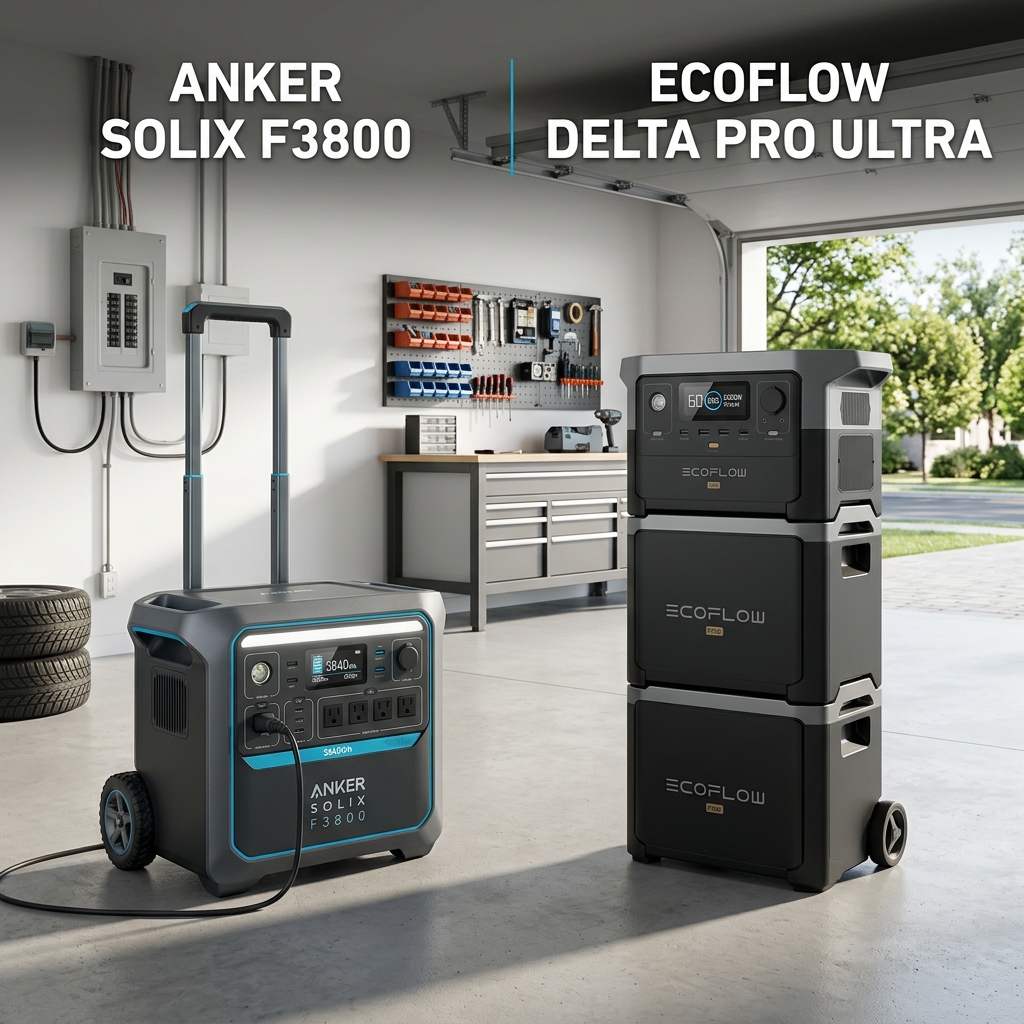
Anker Solix F3800
3,840Wh capacity, 6,000W output, built-in wheels, and direct EV charging plug.
Check Current Price →
EcoFlow Delta Pro Ultra
6,144Wh base battery, massive 7,200W output, and industry-leading 13,800W motor startup surge.
Check Current Price →
1. Quick Answer: Which One Should You Buy?
If you want a straightforward answer without wading through electrical jargon:
- Choose the EcoFlow Delta Pro Ultra if you are preparing for long blackouts and want to power your whole house. It comes with a massive 6,144Wh battery right out of the box (nearly double the Anker), can run a central air conditioner and electric oven without breaking a sweat, and recharges rapidly if you connect standard rooftop solar panels.
- Choose the Anker Solix F3800 if you want an easy, portable all-in-one unit that you can move around. It features built-in luggage wheels and a telescoping handle. Crucially, it has a built-in NEMA 14-50 port, allowing you to directly plug in an electric vehicle (Tesla, Rivian, Ford) or an RV without buying costly external adapter boxes.
2. Real-World Blackout Test: How Long Will They Run Your Essentials?
During a multi-day storm, what matters most is how many hours of life your family gets from the battery.
Here is what you can realistically expect from both units on a single charge when powering common household appliances:
| Household Appliance | Typical Wattage | Anker Solix F3800 (3,840Wh) | EcoFlow Delta Pro Ultra (6,144Wh) |
|---|---|---|---|
| Home Refrigerator + Freezer | ~120W average (cycling) | 26 to 28 Hours | 44 to 48 Hours |
| Medical CPAP Machine (heated) | ~40W | 55 to 60 Hours | 90+ Hours |
| Wi-Fi Router + Laptops + Phones | ~60W | 42 Hours | 70 Hours |
| Emergency Sump Pump (1/2 HP) | ~800W (cycling in rain) | 4 to 5 Hours of run-time | 7 to 8 Hours of run-time |
| Window Air Conditioner (8,000 BTU) | ~700W | 4.5 Hours | 7.5 Hours |
| Central Air Conditioning (3-Ton) | ~3,000W | ~1 Hour | ~1.7 Hours |
Whenever a large power station is switched on, its internal cooling fans and circuits consume a small amount of power (around 30–38 watts) just to stay awake. Because the EcoFlow starts with 6,144 watt-hours of capacity, it absorbs this baseline drain much better over multiple days than smaller batteries.
3. Can They Start Heavy Motor Appliances Without Tripping?
Many homeowners are surprised to learn that an appliance like a refrigerator, well pump, or central air conditioner needs 3 to 4 times more power just to start up than it uses while running smoothly. In the electrical world, this is called motor surge or Locked Rotor Amps (LRA).
If your backup power station doesn’t have enough surge muscle, the compressor will fail to start and trigger an overload warning on the display.
- Anker Solix F3800: Delivers a respectable 9,000W peak surge. This easily handles full-size French door refrigerators, window AC units, microwaves, and standard 1/2 HP sump pumps. However, if you are attempting to start a large 4-ton or 5-ton central AC unit without a soft starter kit, the F3800 may struggle.
- EcoFlow Delta Pro Ultra: Packs an incredible 13,800W surge capacity. That is enough surge power to effortlessly start heavy central air conditioning compressors, deep well pumps, and shop tools simultaneously without nuisance tripping.
4. Moving It Around: Luggage Wheels vs. Modular Stacking
These are large, serious pieces of power equipment. How easily you can maneuver them in your garage or home makes a big difference in everyday usability:
Anker Solix F3800: The Heavyweight Rolling Suitcase
The Anker F3800 is built as a single unibody unit weighing 132 pounds (60 kg). While 132 pounds is too heavy for most people to lift upstairs alone, Anker designed it with:
- Sturdy, industrial-grade wheels that roll smoothly over garage floors and driveways.
- A telescoping pull handle that pops out just like an oversized piece of travel luggage (read our full standalone Anker Solix F3800 review for detailed real-world handling).
- Flat top surface so you can stack items on top when stored in your utility closet.
EcoFlow Delta Pro Ultra: The Two-Piece Modular Tower
The EcoFlow Delta Pro Ultra splits its weight across two separate pieces:
- The Inverter Head: ~70 pounds (31.7 kg).
- The Battery Base Unit: ~112 pounds (50.7 kg).
Together, the initial setup weighs 182 pounds. By breaking it into two distinct pieces that stack securely on top of each other, one person can carry each section individually into a basement or back room. Once assembled on its caster wheel base, you simply wheel the tower near your breaker panel.
5. Charging Back Up with Solar Panels
If the power outage lasts three or four days, wall outlets won’t help you. You need solar panels to keep replenishing energy every morning:
- Anker Solix F3800 (2,400W Solar Input): Accepts up to 2,400 watts of solar input across dual input ports. On a clear sunny afternoon, connecting 1,200W to 1,600W of folding or ground solar panels will completely refill the battery from empty in roughly 2 to 2.5 hours.
- EcoFlow Delta Pro Ultra (5,600W High-Voltage Solar Input): This is where the EcoFlow runs circles around most competitors. It features two separate solar ports, including a high-voltage input that can connect directly to existing residential rooftop solar strings (up to 450 volts). On sunny days, it can take in up to 5,600 watts—recharging its massive battery in under 90 minutes.
6. Real-World Verdict: Which Fits Your Home?
Both systems represent the absolute top tier of home battery backup, but they serve different needs:
Buy the Anker Solix F3800 If:
- ✓You drive an Electric Vehicle (EV) and want emergency backup charging via the built-in NEMA 14-50 plug.
- ✓You own an RV or travel trailer and want to connect directly using a standard RV cable.
- ✓You want an all-in-one unit with built-in wheels that you can roll wherever you need power.
- ✓You want top-tier 240V capability at a lower initial purchase price.
Buy the EcoFlow Delta Pro Ultra If:
- ✓You live in an area prone to multi-day blizzards or hurricanes and need maximum battery capacity (6,144Wh).
- ✓You have a large central air conditioner, well pump, or electric clothes dryer that demands huge 13,800W startup surge.
- ✓You plan to connect rooftop solar panels (up to 450V) for rapid off-grid recharging.
- ✓You want a future-proof modular system that can expand up to a massive 90kWh whole-home power station.
7. Frequently Asked Questions
Can both units connect to my home’s circuit breaker panel?▼
Yes. Both the Anker Solix F3800 and EcoFlow Delta Pro Ultra produce 240V split-phase power. With a standard manual transfer switch or generator interlock kit installed by a licensed electrician, either unit can back up your home’s critical circuits through a standard generator inlet plug.
How noisy are these power stations when running indoors?▼
Unlike gas generators, neither unit produces exhaust fumes, carbon monoxide, or engine roar. When powering moderate household loads like a refrigerator and lights, cooling fans run quietly at around 30 to 45 decibels (quieter than a normal conversational whisper). Under heavy loads like an electric stove or central AC, fans will ramp up to around 55 decibels.
How many miles of range can the Anker F3800 add to an electric car?▼
The Anker Solix F3800 holds 3.84 kWh of power. Feeding that directly into a typical electric car (like a Tesla Model Y or Model 3) yields roughly 10 to 14 miles of emergency driving range. It won’t charge your car for a road trip, but it easily gets you out of an emergency or to the nearest working charging station.
How long will these batteries last before losing their ability to hold a charge?▼
Both units use premium Lithium Iron Phosphate (LiFePO4 / LFP) battery chemistry rated for over 3,000 full recharge cycles before degrading to 80% capacity. In practical terms, even if you discharged and recharged the unit 150 times per year, the battery will provide reliable performance for more than 15 to 20 years.