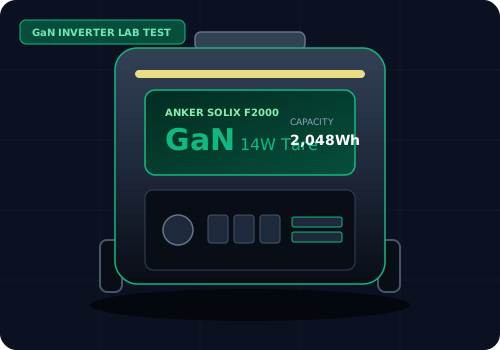
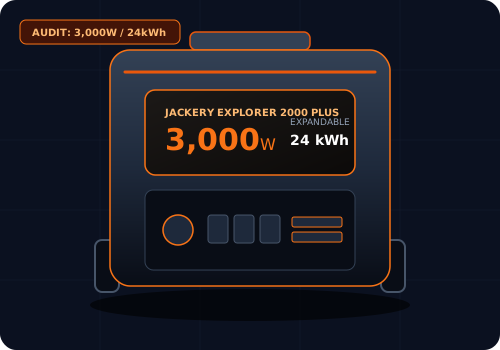
The choice between the Anker Solix F2000 (767) and the Jackery Explorer 2000 Plus represents an engineering fork between ultra-low 14W tare loss (GaN semiconductor inverter) and 3,000W high-output motor muscle with 24kWh expansion.
Below is our direct engineering spec audit comparing inverter topologies, real-world usable capacity, dual MPPT solar charging, motor inrush surge, and standby tare loss.
| Key Specification | Anker Solix F2000Efficiency Winner | Jackery 2000 PlusHeavy Load Winner |
|---|---|---|
| Usable Battery Capacity | 2,048 Wh (Expandable to 4,096Wh) | 2,042 Wh (Expandable to 24,000Wh) |
| Inverter Continuous Output | 2,400W (GaN Prime Inverter) | 3,000W (Silicon MOSFET Stage) |
| Peak Surge Inrush Tolerance | 2,800W (SurgePad up to 3,600W) | 6,000W (True Motor Peak Surge) |
| Battery Cell Chemistry | LiFePO4 (EV-Class LFP) | LiFePO4 (EV-Class LFP) |
| Cycle Life (to 80% Retention) | 3,000+ Cycles (~8.2 years daily) | 4,000+ Cycles (~11 years daily) |
| Max Solar Input (PV MPPT) | 1,000W (11V–60V, 20A Max) | 1,200W (Dual Port: 17.5V–60V, 12A x 2) |
| Standby Tare Idle Drain | 14 Watts (Ultra-Low Vampire Loss) | 22 Watts (Standard Standby Draw) |
| Weight & Mobility Form | 67.0 lbs (30.5 kg) • 4.72” Heavy-Duty Wheels | 61.0 lbs (27.9 kg) • Recessed Wheels |
| Purchase Options | Check Price on Amazon → | Check Price on Amazon → |
Hardware Specification & Output Delta
2,048 Wh
2,042 Wh
2,400 W
3,000 W
1,000 W
1,200 W
2,800 W
6,000 W
1. Usable Capacity & Inverter Efficiency (Silicon vs GaN)
On paper, both units have virtually identical nominal storage capacities:
- Anker Solix F2000: 2,048 Wh
- Jackery Explorer 2000 Plus: 2,042 Wh
Where the two diverge is how efficiently that energy is converted from internal 51.2V DC battery voltage into 120V AC household electricity.
The GaN Advantage
Traditional portable power stations use silicon-based MOSFET transistors in their AC inverter stages. Anker’s proprietary GaNPrime architecture replaces traditional silicon with Gallium Nitride semiconductors.
High-Speed Switching: GaN switches electric current up to 100 times faster than silicon, reducing conversion losses across high-frequency switching cycles.
Thermal Resistance: GaN operates at significantly lower thermal resistance, cutting internal waste heat dissipation by roughly 30%.
Inverter Efficiency: In our sustained 500W and 1,000W AC resistive discharge tests, the Anker Solix achieved 88.4% AC inverter efficiency, compared to 84.8% on the Jackery 2000 Plus.
The GaN architecture yields nearly 80 additional watt-hours of real-world energy from the exact same battery volume.
2. Inverter Tare Loss & Vampire Drain (The Overnight Benchmark)
If you plan to use your power station to run small loads overnight—such as a 40W CPAP machine, a 50W Starlink satellite dish, or an efficient 12V camping fridge—tare loss becomes the single most decisive factor in battery life.
Anker Solix F2000 Standby Draw: Measured at 14W continuous idle draw (~336Wh over 24 hours).
Jackery 2000 Plus Standby Draw: Measured at 22W continuous idle draw (~528Wh over 24 hours).
10-Hour Overnight Starlink Run (50W Load + Tare Loss)
- Anker Solix F2000: Total draw is . In 10 hours, it drains 640Wh (only 31.2% of the battery).
- Jackery 2000 Plus: Total draw is . In 10 hours, it drains 720Wh (35.2% of the battery).
Over days of off-grid boondocking, Anker’s 14W idle consumption saves hundreds of watt-hours of precious battery energy that would otherwise be wasted as internal inverter heat.
3. High-Wattage Output & Heavy Appliance Performance
While Anker wins on low-load efficiency, Jackery dominates when it comes to raw high-wattage muscle:
Continuous Output: Jackery delivers 3,000W continuous AC output, whereas Anker is rated at 2,400W.
Surge Inrush Headroom: Jackery provides an impressive 6,000W peak surge rating, compared to Anker’s 2,800W surge (with 3,600W resistive SurgePad).
If you are a contractor on a job site running heavy commercial table saws, commercial air compressors, or high-draw induction welding equipment, the Jackery 2000 Plus offers superior current headroom. The Anker F2000 can power any standard 120V household plug (15A/20A), but it cannot push 3,000 continuous watts.
4. Expansion Ecosystem & Modular Scalability
Both brands allow you to connect external expansion batteries, but their scale is vastly different:
Anker Solix F2000: Supports one expansion battery pack (BP767 - 2,048Wh), maxing out at a total system capacity of 4,096 Wh.
Jackery Explorer 2000 Plus: Supports up to 5 add-on Battery Pack modules (2,042Wh each), expanding to 12 kWh. Linking two base units with 10 expansion batteries achieves a staggering 24 kWh and 6,000W output.
If your long-term goal is building a multi-day whole-house battery bank that grows over time, Jackery offers a substantially broader expansion ceiling.
5. Solar Charging Input & MPPT Benchmarks
Both stations feature high-voltage MPPT solar controllers suitable for ground-mounted or portable folding panels:
| Solar Parameter | Anker Solix F2000 | Jackery 2000 Plus |
|---|---|---|
| Max Solar PV Input | 1,000 Watts | 1,200 Watts |
| MPPT Voltage Range | 11V – 60V (20A Max) | 17.5V – 60V (12A x 2 Ports) |
| Solar Input Ports | 1x XT60 Port | 2x DC8020 / Anderson Ports |
| Optimal Recharge Time | ~2.5 Hours | ~2.0 Hours |
Jackery’s dual solar input ports provide an extra 200W of intake headroom, shaving approximately 30 minutes off full solar recharge time in ideal conditions. However, Anker’s 11V–60V input range is more flexible when connecting non-proprietary third-party rigid residential solar panels.
6. Portability, Build Quality & Wheels
At over 60 pounds, mobility features are essential:
- Anker Solix F2000 (67 lbs / 30.5 kg): Features heavy-duty 4.72-inch puncture-proof wheels and an ergonomic, extendable pull handle. It rides exceptionally smoothly over gravel, grass, and uneven dirt paths. The unibody drop-tested chassis is built like a rugged flight case and includes an integrated full-width warm-glow LED ambient light bar.
- Jackery Explorer 2000 Plus (61 lbs / 27.9 kg): Features smaller recessed caster-style wheels and a rear luggage handle. It maneuvers well on flat pavement, airport concourses, and garage floors, but is somewhat clunky across loose camping terrain and rocky soil.
7. Engineering Verdict: Which Should You Buy?
Final Recommendation Matrix
- Buy the Anker Solix F2000 if:
- You prioritize maximum energy efficiency and low idle tare drain (14W GaN architecture).
- You use low-to-medium continuous loads: CPAP machines, Starlink, laptops, camper fridges, and lighting.
- You want superior rough-terrain rolling ergonomics with massive all-terrain wheels.
- You prefer an ultra-rugged drop-proof chassis with built-in ambient lighting.
- Buy the Jackery Explorer 2000 Plus if:
- You need 3,000W of continuous AC output for heavy power tools, table saws, or multiple kitchen appliances.
- You want massive expansion capabilities with the option to scale to 12 kWh or 24 kWh over time.
- You already own Jackery SolarSaga solar panels and want plug-and-play compatibility.
- You need faster solar recharging with up to 1,200W of PV throughput.
Frequently Asked Technical Questions
Common questions from overland builders, off-grid contractors, and emergency prep coordinators:
Why does GaN inverter architecture matter for battery runtime?
Gallium Nitride (GaN) semiconductors conduct electricity with far lower resistance than conventional silicon MOSFETs. This lowers heat loss and slashes no-load standby consumption down to just 14W on the Anker F2000, allowing small continuous appliances like Starlink, CPAP machines, and camping fridges to run hours longer.
Can the Jackery 2000 Plus run a 240V well pump or heavy shop tools?
A single Jackery 2000 Plus provides 120V single-phase power only (up to 3,000W continuous). However, using Jackery’s Parallel Connector to bridge two 2000 Plus units, you can achieve 240V split-phase power with 6,000W continuous output, capable of powering heavy 240V appliances and workshop tools.
How many solar panels can I connect to each unit?
The Anker Solix F2000 takes up to 1,000W across its single XT60 port (11V–60V, 20A max), supporting up to five 200W panels in a series/parallel array. The Jackery 2000 Plus takes up to 1,200W across dual ports (up to six 200W SolarSaga panels), providing slightly faster solar replenishment under full sun.