During a severe storm blackout, keeping your basement dry or your household water running is job number one. But thousands of homeowners discover an unpleasant surprise when connecting their emergency backup generator:
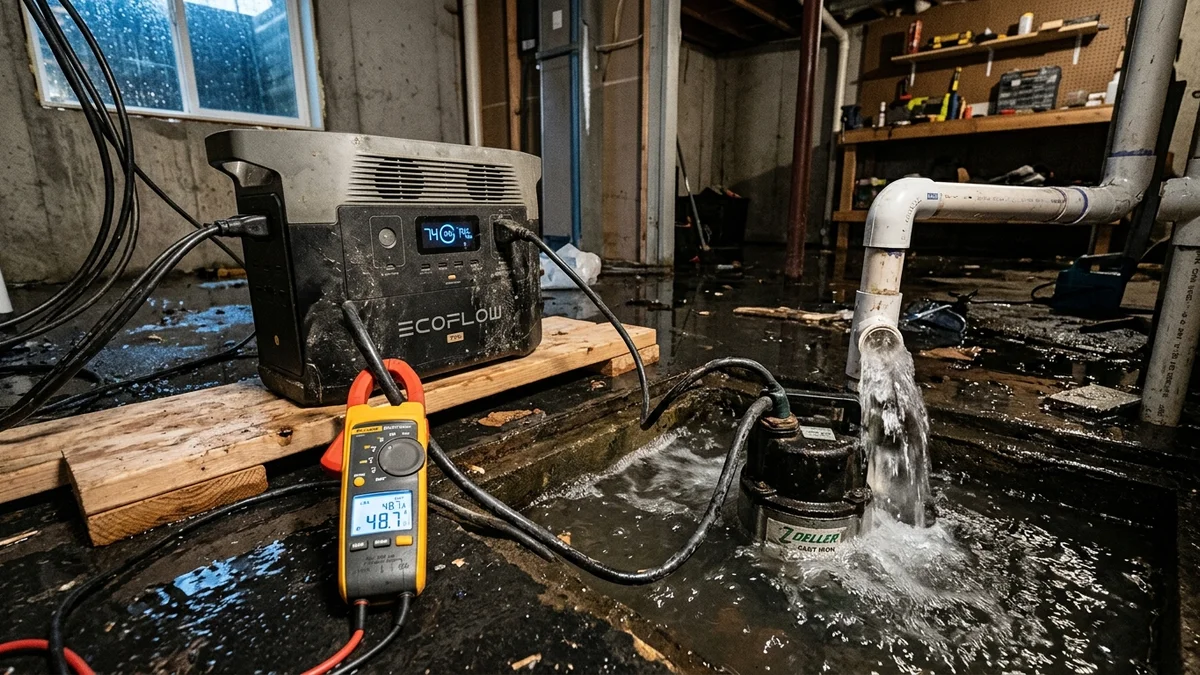
A sump pump rated at only 650 Watts immediately trips a 2,000 Watt portable power station into overload protection.
The power station isn’t defective, and the pump isn’t broken. The failure is caused by an electrical phenomenon known as motor inrush current, quantified on equipment nameplates as Locked Rotor Amps (LRA).
Below, we explain the physics of motor startup in plain English, show you how to decode your pump’s nameplate, and give you the exact sizing rules to prevent catastrophic basement flooding.
When an AC induction motor starts from a dead stop, it creates a momentary near-short-circuit until the rotor begins turning and generates counter-electromotive force (back-EMF). This inrush surge lasts 100 to 300 milliseconds and demands 5x to 7x the motor’s continuous running wattage. To run a standard 1/2 HP sump pump (800W running), your generator must supply an instantaneous surge rating of at least 3,800W to 4,500W, or you must install a mechanical soft-starter.
1. What Happens at Sub-Second Zero: The Physics of Inrush
To understand why electric motors demand massive instantaneous power, compare an induction motor to an automobile:
- Resistive Load (Space Heater / Toaster): Current simply flows through an element wire. Turn it on, and it immediately draws its steady-state wattage.
- Inductive Load (Sump Pump / Refrigerator Compressor / Well Pump): The motor consists of stationary copper coils (the stator) surrounding a steel rotor with embedded aluminum bars.
When stationary at time zero:
- Zero Back-EMF: Because the rotor is motionless, it generates zero counter-electromotive force to oppose incoming electrical current.
- Pure Winding Resistance: For the first 2 to 6 electrical cycles (30 to 100 milliseconds), the only opposition to current flow is the minuscule physical resistance of the copper wire windings.
- Current Spike: Current skyrockets to Locked Rotor Amps (LRA) until the rotor reaches approximately 80% of its rated operating speed (RPM).
Rotor locked at standstill. Inrush current peaks at 600%–800% of Running Load Amps (RLA). Inverter capacitors must deliver maximum instantaneous Joules.
Rotor spins up. Expanding magnetic field creates back-EMF, choking off excess current. Amperage drops rapidly toward steady-state levels.
Motor locks into normal slip speed (e.g., 3,450 RPM). Current stabilizes at normal continuous Running Load Amps (RLA).
2. Decoding the Motor Nameplate: RLA, FLA, and LRA
Before sizing a generator or portable power station, look at the metal specification badge on your pump motor. You will encounter three critical acronyms:
- FLA (Full Load Amps) / RLA (Running Load Amps): The continuous current the motor draws when operating under maximum rated mechanical water load.
- LRA (Locked Rotor Amps): The maximum current drawn when the motor is energized with the rotor mechanically restrained from turning. This is your generator surge benchmark.
For example, if a 1/3 HP basement pump indicates and :
Even though the pump only uses 550W when running, any power station with an instantaneous peak surge below 3,360W will trip its electronic over-current protection within milliseconds.
3. Real-World Sump Pump & Well Pump Surge Sizing Matrix
| Motor Horsepower (HP) | Nominal Operating Voltage | Running Watts (Typical) | Nameplate LRA Range | Instantaneous Surge Demand | Minimum Recommended Inverter Surge |
|---|---|---|---|---|---|
| 1/3 HP Sump Pump | 120V AC | 550W – 700W | 24A – 30A | 2,880W – 3,600W | 4,000W Surge |
| 1/2 HP Sump Pump | 120V AC | 750W – 950W | 32A – 40A | 3,840W – 4,800W | 5,000W Surge |
| 3/4 HP Heavy Sump Pump | 120V AC | 1,000W – 1,300W | 42A – 55A | 5,040W – 6,600W | 6,500W+ Surge |
| 1/2 HP Submersible Well Pump | 240V Split-Phase | 800W – 1,050W | 18A – 22A | 4,320W – 5,280W | 6,000W Surge (240V) |
| 1.0 HP Deep-Well Pump | 240V Split-Phase | 1,400W – 1,800W | 28A – 36A | 6,720W – 8,640W | 9,000W+ Surge or Soft-Start |
(Note: Never use modified sine wave power on pump motors. Check our pure sine wave vs modified sine wave analysis to understand why distorted waveforms overheat motor windings).
Calculate Your Exact Pump Surge
Input your pump horsepower, voltage, and head height to calculate exact LRA surge and required battery Wh.
Open Sump Pump Calculator →
4. Why Inverter Surge Ratings Can Be Misleading
Gasoline generators handle motor inrush with physical rotating momentum: when a pump kicks on, the heavy steel flywheel and alternator rotor physically slow down slightly, absorbing the mechanical shock without instantly dying.
In contrast, solid-state solar generators rely on MOSFET semiconductor junctions. If current exceeds the silicon’s thermal breakdown threshold for even 20 milliseconds, the internal software triggers an instant protective shutdown.
Look at Surge Duration Specifications
When evaluating portable power stations, pay attention to the surge duration window:
- True Motor Surge Rating: The continuous output the inverter can sustain for 0.5 to 3 full seconds (sufficient for motor acceleration).
- Peak Marketing Surge: The millisecond capacity of output capacitors (often rated for only 20 to 50 milliseconds). If your pump takes 200ms to clear inrush, a 50ms surge window will trip.
For whole-home backup capable of easily clearing high-surge pump starts, explore split-phase units like the Anker Solix F3800 hardware audit (featuring 6,000W continuous and 9,000W surge) or read our comparison with the EcoFlow Delta Pro Ultra.
5. Practical Solutions to Mitigate High Inrush Surges
If your existing generator or battery bank cannot handle your pump’s startup surge, you have three proven engineering options:
- Install an Electronic Soft-Starter: A soft-starter uses solid-state electronics (SCRs or triacs) to ramp up starting voltage smoothly over 100–300 milliseconds. This reduces LRA by 50% to 65%, allowing a 1/2 HP pump to start cleanly on a 2,400W inverter.
- Switch to a DC-Brushless Sump Pump System: Modern backup sump pump systems utilize high-efficiency 12V or 24V brushless DC (BLDC) motors. BLDC motors feature integrated variable-frequency electronic drives that eliminate high inrush surges entirely.
- Account for Running Duty Cycles When Estimating Battery Runtime: A sump pump does not run 100% of the time. In heavy rain, it might cycle on for 15 seconds every 2 minutes (a 12.5% duty cycle). Use our solar generator runtime calculator to factor duty cycles into your total Watt-hour storage requirements.
Anker Solix F3800 Home Backup
Equipped with a massive 6,000W continuous / 9,000W surge split-phase pure sine wave inverter, effortlessly clearing the high Locked Rotor Amps of 1/2 HP and 3/4 HP sump pumps and 240V deep-well water pumps.
6. Frequently Asked Questions
What happens if my generator is undersized for my sump pump?
The inverter will instantly trip on overcurrent protection, cutting power to your pump. If this happens while you are asleep or away during a storm, the sump pit will overflow, resulting in basement flooding. Repeatedly triggering inverter overload protection also places thermal stress on the inverter’s power MOSFETs.
Why do well pumps require 240V split-phase power while sump pumps use 120V?
Most deep-well submersible pumps are positioned 100 to 400 feet underground. Running at 240V cuts electrical current in half for the same wattage (), preventing massive voltage drop along long underground wiring. A standard 120V solar generator cannot power a 240V 3-wire or 2-wire well pump without an external step-up transformer or a split-phase generator configuration.
Can a dual-battery setup increase motor surge capacity?
On modular solar generators (such as Bluetti AC300 or EcoFlow Delta Pro Ultra), adding expansion battery packs increases total Watt-hour capacity and allows higher DC discharge rates to the inverter stage. However, the maximum AC surge is ultimately constrained by the physical rating of the inverter’s power switching transistors.