When shopping for an emergency backup power supply, off-grid inverter, or portable power station, the specification label will emphasize one critical line: Pure Sine Wave (PSW) vs. Modified Sine Wave (MSW).
While modified sine wave units can be significantly cheaper, plugging modern household appliances into them can lead to high-pitched buzzing, severe overheating in motors, digital display flickering, or complete electronic failure.
Below, we break down the electrical mechanics of both waveforms in plain English, why Total Harmonic Distortion (THD) damages specific circuits, and what happens when you plug everyday appliances into each type.
A pure sine wave delivers smooth, continuously oscillating AC power identical to the electrical utility grid with <3% Total Harmonic Distortion (THD). A modified sine wave produces harsh, stepped square pulses with up to 45% THD. Inductive loads (refrigerators, sump pumps, fans) run 20%–35% hotter and buzz loudly on modified sine waves, while sensitive electronics (CPAPs, audio gear, laptop adapters) risk component degradation or power supply shutdown.
1. Visualizing the Waveforms: Smooth Curves vs. Choppy Steps
Alternating current (AC) is designed to oscillate back and forth between positive and negative voltage 60 times per second ( in North America) or 50 times per second ( in Europe).
Smooth, continuous mathematical sine curve. The voltage changes gradually and smoothly passes through zero, producing quiet, efficient operation across all motors and silicon microcontrollers.
A stepped, modified square wave. The voltage instantly snaps from zero to roughly , rests at flat peak, snaps down to zero, and flips to . This abrupt switching generates high-frequency harmonic noise.
2. Total Harmonic Distortion (THD) and Why It Matters
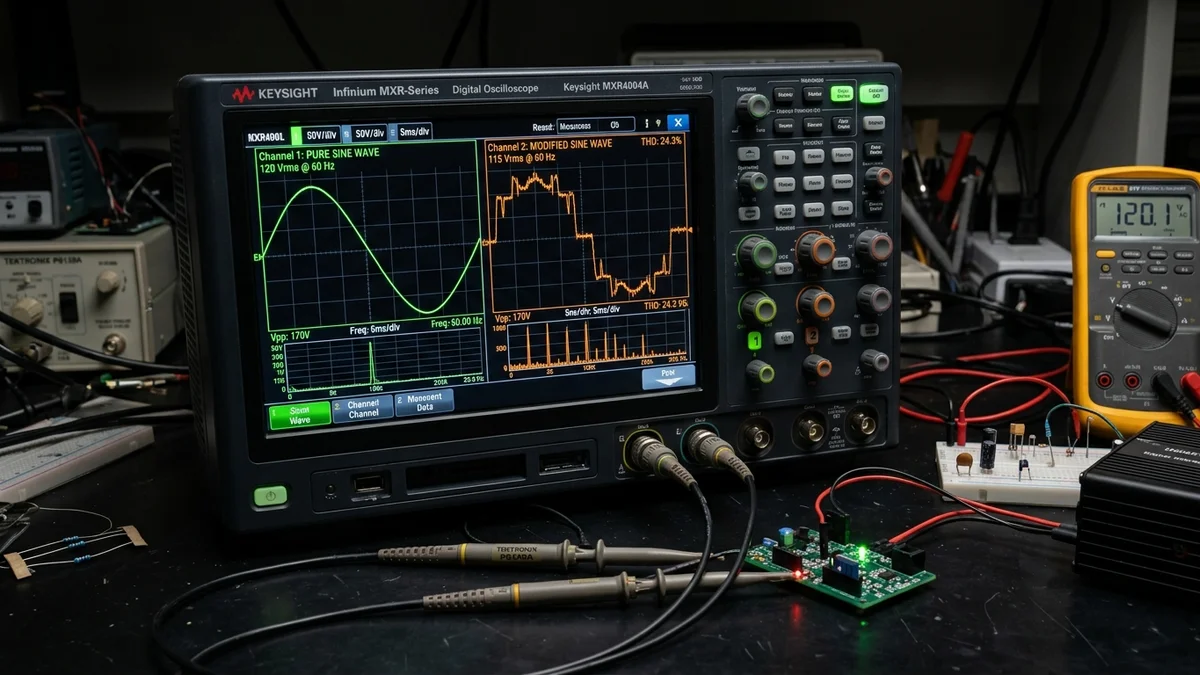
Total Harmonic Distortion (THD) measures how closely an electrical waveform resembles an ideal sine wave. It represents the proportion of unwanted electrical harmonic frequencies relative to the fundamental 60Hz frequency.
- Grid Power & Quality Pure Sine Wave: .
- Budget Standalone MSW Inverters: .
Why High THD Causes Problems
In a modified sine wave, the instantaneous jump in voltage creates high-frequency harmonics (odd multiples: 180Hz, 300Hz, 420Hz, and higher). When these harmonics hit household appliances:
- Inductive Motors (Fans, Compressors, Pumps): Induction motors depend on a smooth rotating magnetic field. When subjected to square edges, the motor cannot convert the high-frequency harmonics into rotational torque. Instead, that energy is converted entirely into waste heat (eddy currents) and mechanical vibration, producing an audible 60Hz/120Hz acoustic drone.
- Capacitive Power Supplies & Chargers: Low-cost battery chargers (cordless drills, electric toothbrushes) often use simple capacitive droppers. High (rate of voltage change) spikes cause excessive current flow through input capacitors, leading to premature component failure.
- Audio and Video Gear: The steep switching edges induce EMI (electromagnetic interference) into preamp and signal stages, causing persistent background hum on monitors and speakers.
3. Appliance Compatibility Matrix: What Can Run on What?
| Appliance Type | Load Category | Modified Sine Wave (MSW) | Pure Sine Wave (PSW) | Operational Consequences on MSW |
|---|---|---|---|---|
| Laptops & Phones (USB-C) | Switched-Mode (SMPS) | Compatible | Optimal | Runs slightly warmer; power brick may hum faintly. |
| Incandescent & Simple Heating | Pure Resistive | Fully Compatible | Fully Compatible | Space heaters and toasters operate normally. |
| Refrigerator / Freezer | Inductive Motor | Not Recommended | Optimal | Compressor runs 25% hotter; shortened operational lifespan. |
| Sump Pump & Well Pump | Inductive (High Surge) | Hazardous | Optimal | Reduced startup torque; severe motor overheating; risk of stall. |
| CPAP / BiPAP Medical Units | Sensitive Microcontroller | Do Not Use | Mandatory | Error codes, pressure sensor inaccuracies, motor heating. |
| Microwave Oven | Magnetron / Transformer | Inefficient | Optimal | Loss of heating efficiency (takes 30% longer); loud buzzing. |
| Laser Printers & Copiers | Microcontroller / Heaters | Failure Risk | Mandatory | Optical sensors and fuser control circuits fail to trigger. |
| Variable Speed Power Tools | Electronic Speed Control | Incompatible | Optimal | Triac speed controllers fail to regulate RPM smoothly. |
4. Why Modern Solar Generators Exclusively Use Pure Sine Waves
In early off-grid solar setups, pure sine wave inverters were bulky, complex, and commanded a steep price premium due to heavy low-frequency copper transformers.
However, modern portable power stations—such as the EcoFlow Delta, Bluetti AC series, and Anker Solix—use modern high-frequency Pulse Width Modulation (PWM) circuits. They chop internal 48V DC battery power into hundreds of thousands of micro-pulses per second through fast MOSFET/IGBT transistors, passing them through compact low-pass filter inductors to reconstruct a clean sine wave with THD under 3%.
While modern pure sine wave inverters safeguard your appliances, they do carry a baseline standby electrical draw. To understand how that internal circuitry draws power continuously, see our complete guide on solar generator idle power consumption (tare loss).
Check Your Device Runtime
Factor in true inverter efficiency, conversion losses, and appliance wattage before heading off-grid.
Launch Runtime Calculator →
5. Practical Buying Advice: When Is Modified Sine Wave Ever Acceptable?
Today, the price gap between modified sine wave and pure sine wave inverters has compressed significantly.
- The only remaining niche for MSW: Cheap 50 12V cigarette lighter plug-in adapters used solely to charge cheap phones, power 12V halogen work lights, or run basic resistive soldering irons.
- For emergency home backup or RV electrical panels: Always choose Pure Sine Wave. If you are running an induction motor like a basement water pump, you also must account for Locked Rotor Amps (LRA) alongside waveform quality. Check our dedicated motor inrush current and LRA guide or use our sump pump surge calculator to ensure your generator handles startup surge without tripping breaker protection.
If you are evaluating complete home-backup systems with split-phase 120V/240V pure sine wave inverters, explore our hands-on Anker Solix F3800 hardware audit or read our direct showdown in the Anker Solix F3800 vs. EcoFlow Delta Pro Ultra comparison.
Anker Solix F3800 Home Backup
Delivers laboratory-grade pure sine wave output (<3% THD) at 6,000W continuous output, supporting 120V/240V split-phase loads including central heat pumps, well pumps, and sensitive electronic gear.
6. Frequently Asked Questions
Will a modified sine wave inverter ruin my laptop charger?
Most modern laptop power supplies use Switched-Mode Power Supplies (SMPS) that rectify input AC into DC immediately. While a laptop charger will function on modified sine wave power, the input filter capacitors and bridge rectifiers will absorb extra harmonic stress and run noticeably warmer. Over extended periods, this can shorten the power brick’s lifespan.
Why do ceiling fans and desk fans make a buzzing sound on portable inverters?
If a fan buzzes, it is running on a modified sine wave. The steep voltage transitions induce rapid magnetic flux changes within the iron stator core, physically vibrating the laminations at harmonic frequencies. This vibration generates the audible buzzing and wastes energy as heat.
Can I run a refrigerator on a modified sine wave inverter during a blackout?
In an emergency, many single-speed mechanical refrigerator compressors will start and run on a modified sine wave, but they will operate with 20% to 30% higher winding temperatures. Modern variable-capacity (inverter-driven) refrigerators contain electronic digital inverter boards that may fail to operate or sustain damage on modified sine wave input.
Do all modern solar generators output pure sine waves?
Yes. Every reputable brand in the modern portable power station market (including EcoFlow, Bluetti, Anker, Jackery, and Goal Zero) incorporates a pure sine wave inverter as standard equipment. Modified sine waves are generally only found in budget standalone vehicle inverters.