When consumers purchase a 2,000Wh portable power station advertised with a “90% high-efficiency pure sine wave inverter,” they expect a simple math formula to predict runtime:
Plug in an 800W microwave, and the formula matches reality almost perfectly. But plug in a 25W bedside CPAP, a 15W Wi-Fi router, or a 45W 12V camping fridge through the AC outlet, and the battery dies in less than half the expected time.
Here is the engineering reality behind the inverter efficiency bell curve, why light loads devastate battery life, and how to configure your off-grid system for maximum operational runtime.
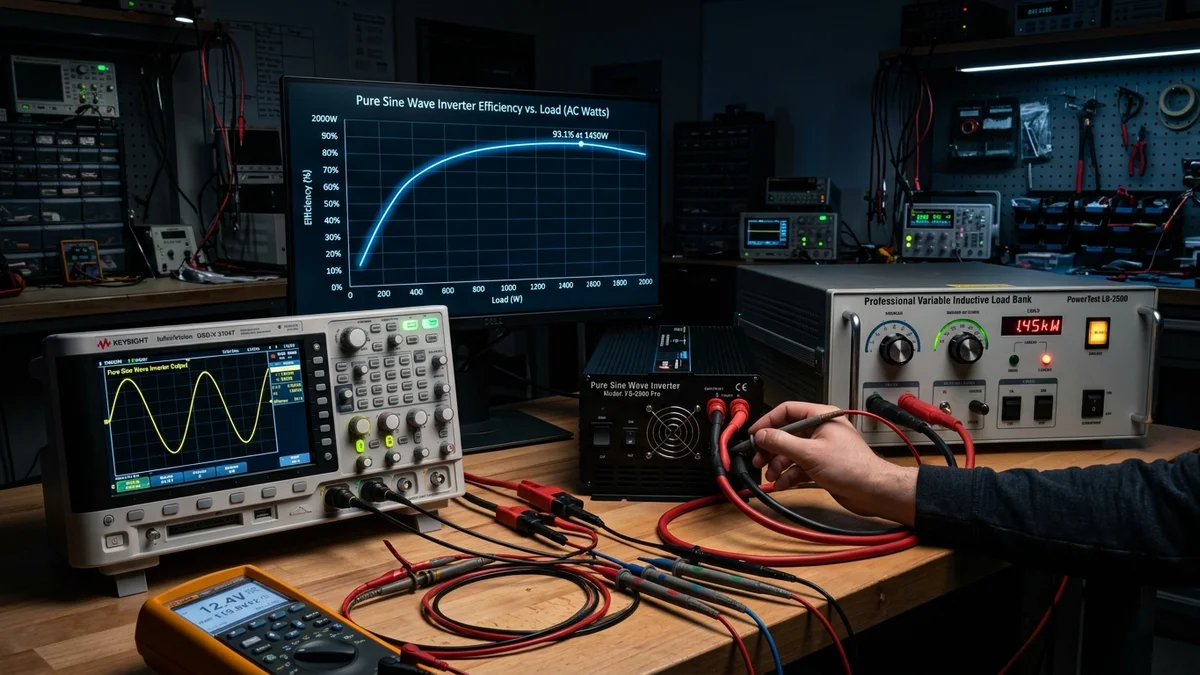
Inverter efficiency is not static—it follows a non-linear bell curve. Efficiency peaks (88%–93%) only between 30% and 70% of the inverter’s rated capacity. Below 10% load, the inverter’s constant internal tare loss (15W–35W) dominates total consumption, driving effective conversion efficiency down to 50%–65%. To eliminate this penalty on low-wattage devices, bypass the AC inverter entirely by using native 12V DC or USB-C PD ports.
1. The Anatomy of an Efficiency Bell Curve
Every DC-to-AC power inverter experiences two competing forms of power loss:
- Fixed No-Load Losses (Tare Loss): Energy required to power control microprocessors, gate drive transformers, cooling fans, and high-frequency MOSFET oscillation. This power draw is constant regardless of load ().
- Variable Conduction Losses ( Losses): As output wattage climbs toward maximum capacity, massive electrical current () flows through copper transformer windings and semiconductor junctions. Because heat dissipation scales with the square of current (), efficiency drops off sharply near maximum continuous output.
Typical 2,000W Inverter Efficiency by Load Tier
2. The Low-Load Math Penalty in Plain English
To illustrate why small loads cause runtime to plummet, consider a typical 2,048Wh solar generator with a continuous 2,400W pure sine wave inverter and an idle tare loss of 25W:
Scenario A: High-Power Appliance (1,200W Coffee Maker)
- Load:
- Tare Loss:
- Total System Draw:
- Proportion of energy doing useful work:
- Conversion Efficiency:
Scenario B: Low-Power Appliance (25W CPAP or Starlink Sleep Mode)
- Load:
- Tare Loss:
- Total System Draw:
- Proportion of energy doing useful work:
- Even if the semiconductor switches were 100% efficient, half of your battery energy is burned as heat keeping the inverter energized.
For an in-depth breakdown of standby parasitic draw across different models, read our dedicated investigation into solar generator idle power consumption.
3. Real Benchmark Data: Calculated vs. Actual Low-Load Runtime
| Connected Load | Nominal Watts | Theoretical 2,048Wh Runtime (90% Spec) | Real Inverter Runtime (with 25W Tare) | Runtime Loss |
|---|---|---|---|---|
| Wi-Fi Router / Modem | 15W | 122.8 Hours | 43.5 Hours | -64.6% |
| Medical CPAP (No Heat) | 30W | 61.4 Hours | 31.6 Hours | -48.5% |
| 12V Camp Fridge (Cycle) | 45W | 40.9 Hours | 24.8 Hours | -39.3% |
| 55-inch OLED TV | 110W | 16.7 Hours | 12.9 Hours | -22.7% |
| Full-Size Refrigerator | 180W | 10.2 Hours | 8.5 Hours | -16.6% |
| Sump Pump (Running) | 600W | 3.07 Hours | 2.80 Hours | -8.8% |
| Microwave Oven | 1,200W | 1.53 Hours | 1.48 Hours | -3.2% |
Notice the trend: As appliance wattage crosses above 300W, the tare loss penalty shrinks into single-digit percentages. Below 50W, the inverter wastes more energy than the appliance consumes.
Calculate Your Inverter Tare Losses
Input your generator capacity and appliance wattage to see real effective efficiency.
Open Tare Loss Calculator →
4. How to Overcome the Low-Load Penalty
If you rely on battery backup for overnight essentials, you can bypass the inverter efficiency curve using these practical engineering steps:
- Use Native 12V DC Outlets for Low-Wattage Loads: Modern power stations include 12V/10A or 12V/30A Anderson DC ports. Converting 48V battery voltage down to 12V DC operates through high-efficiency buck regulators (93%–96% efficiency) with near-zero standby tare draw (under 2W). Running a CPAP machine or camping fridge on DC power can more than double your runtime.
- Utilize 100W/140W USB-C PD Ports for Laptops: Plugging your laptop’s 120V AC charging brick into the wall outlet forces two conversions: DC battery to AC, then AC back to DC inside the power brick. Using a direct USB-C to USB-C cable avoids the AC inverter entirely.
- Match Inverter Size to Load Profile: Don’t power a 40W load using a 6,000W split-phase home backup unit. Heavy split-phase units (such as the Anker Solix F3800 or EcoFlow Delta Pro Ultra) are designed for whole-house transfer switches and major 240V appliances. For small campsite or medical loads, a compact 1,000Wh–2,000Wh unit is far more efficient.
- Select Inverters with Pure Sine Wave PWM: Ensure your inverter generates a clean waveform with low harmonic distortion. Check our detailed guide on pure sine wave vs modified sine wave inverters to understand why clean wave synthesis matters for motor efficiency.
5. Frequently Asked Questions
Why don’t manufacturers state low-load efficiency on product boxes?
Consumer marketing standards rely on maximum rated efficiency numbers (typically measured at 50% resistive load in controlled 25°C ambient conditions). Disclosing that efficiency drops below 65% under 30W loads would confuse non-technical consumers who don’t understand fixed tare loss.
Can I leave my AC inverter button on 24/7 if nothing is plugged in?
No. Leaving the AC inverter switched on with zero appliances connected will drain 360Wh to 840Wh every 24 hours solely as standby heat dissipation. If left unattended, a 2,000Wh power station will completely discharge within 3 to 4 days.
Does an Eco Mode or Smart Timeout feature fix this problem?
Partially. Many modern power stations feature an app-configurable “Auto-Timeout” that shuts off the AC inverter if no load is detected for 30 minutes to 2 hours. However, if you have a continuous 15W device plugged in (like a router or CPAP), the inverter detects active draw, stays awake, and continues consuming tare power.