If you read the user manual or engineering specifications of an off-grid solar battery bank or portable power station, you will encounter the 80% Depth of Discharge (DoD) Rule.
Manufacturers boast that their LiFePO4 (LFP) cells last over 3,000 to 4,000 cycles, but the fine print often mentions that this longevity is evaluated at a controlled 80% DoD.
What does Depth of Discharge mean in practice? If you buy a 2,048Wh battery, are you only supposed to use 80% of it? Below, we break down the electrochemistry of battery strain, how DoD directly governs cell degradation, and how to set up your system for maximum lifespan without sacrificing emergency reserve.
Depth of Discharge (DoD) is the percentage of total battery capacity consumed before recharging (e.g., running from 100% down to 20% is an 80% DoD). Discharging to absolute zero (100% DoD) exerts maximum mechanical expansion stress on cell electrode lattices. By keeping your operational discharge floor at 10%–20% (an 80%–90% DoD), you can increase your LiFePO4 battery’s operational lifespan from 3,000 cycles to over 5,000+ cycles.
1. DoD vs. SoC: Understanding the Terminology
- State of Charge (SoC): The fuel gauge percentage remaining inside the battery (, ).
- Depth of Discharge (DoD): The exact inverse—how much energy has been taken out.
For example, if your power station display indicates 20% battery remaining, your cycle operated at an 80% Depth of Discharge.
2. Why Deep Discharges Degrade Lithium Cells
Batteries don’t just store electricity as a liquid; they store energy via the physical movement of lithium ions between two solid crystal structures (intercalation and de-intercalation):
- Cathode Delithiation Stress: When an LFP cell is discharged down toward 0% SoC, virtually all lithium ions are stripped from the iron phosphate cathode into the graphite anode. This extreme extraction forces the crystal lattice of the cathode to contract and expand repeatedly. Over thousands of deep cycles, this mechanical breathing causes microscopic fractures in the cathode particles.
- SEI Layer Growth: The Solid Electrolyte Interphase (SEI) layer on the graphite anode thickens during high-stress deep-cycling, trapping active lithium ions permanently and increasing internal electrical resistance.
- Low-Voltage Inversion Hazard: If a cell discharges below its critical cutoff voltage (V_{\text{cell}} < 2.5\text{V} for LFP), the copper current collector can dissolve into the liquid electrolyte. Upon subsequent recharge, dissolved copper precipitates as conductive metallic dendrites, creating dangerous internal micro-shorts.
To learn more about the intrinsic chemical safety of phosphate lattices compared to ternary cells, see our comprehensive guide on LiFePO4 vs NMC battery chemistry.
3. The Cycle Longevity Curve: 100% vs. 80% vs. 50% DoD
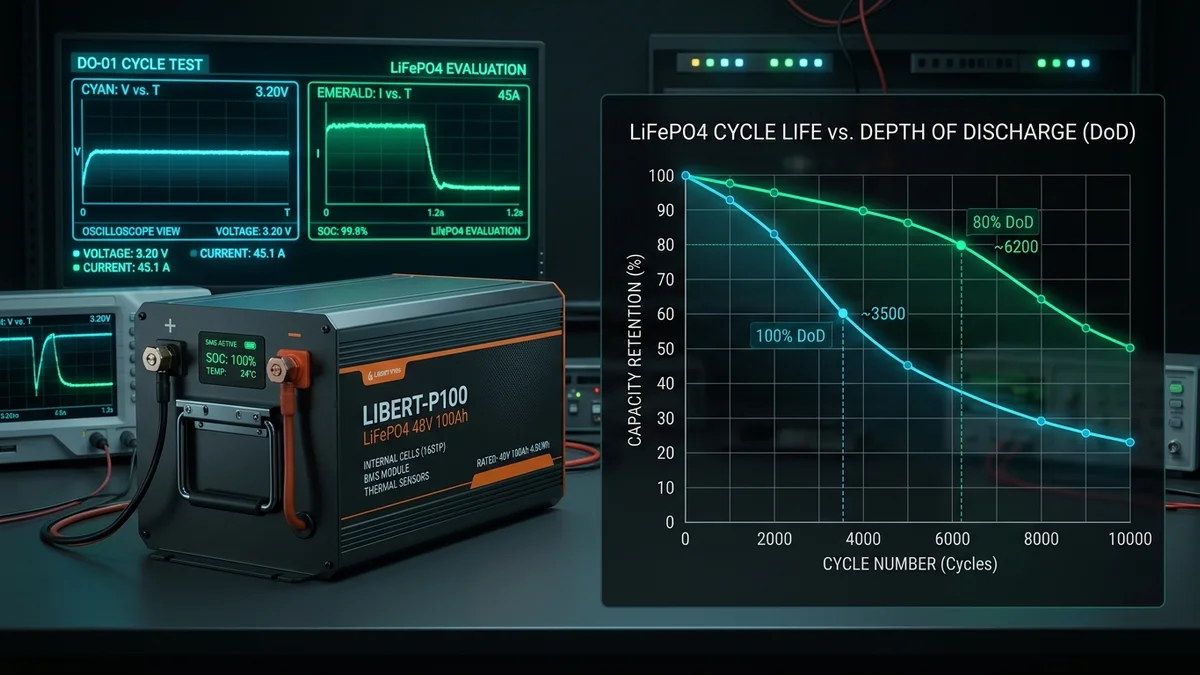
The relationship between Depth of Discharge and cycle longevity is exponential, not linear. Discharging half as deep yields more than double the cycle count.
Estimated LiFePO4 Cycle Life vs. Depth of Discharge (to 80% SOH)
Total Lifetime Energy Throughput Math
Does restricting DoD actually yield more total kilowatt-hours over the battery’s lifespan?
- At 100% DoD (2,000Wh pack): of total lifetime energy delivered.
- At 80% DoD (2,000Wh pack): of total lifetime energy delivered.
By simply setting a modest 10%–20% bottom buffer, the battery delivers over 45% more total lifetime energy before reaching its retirement threshold.
4. How to Apply the 80% Rule in Real Life
You don’t need to babysit your battery with a manual voltmeter. Here is the practical strategy:
- During Normal Daily Cycling (Off-Grid / Solar Daily Use): Use your manufacturer’s companion smartphone app (EcoFlow, Anker, or Bluetti) to configure the Discharge Limit to 10% or 15% and the Charge Limit to 90% or 95%. This automated limit keeps the battery within its electrochemical sweet spot.
- During Emergency Blackouts or Severe Weather: Use 100% of your battery! The 80% rule is an optimization for long-term daily cycle longevity—not a rigid constraint that should leave your home in the dark. Modern LiFePO4 power stations already incorporate built-in BMS voltage buffers that prevent true physical zero over-discharge.
- Calibrate Once Every 2–3 Months: Because LiFePO4 cells have an exceptionally flat voltage curve, BMS coulomb-counters can drift over time. Discharge the unit fully until it shuts off, then charge it uninterrupted to 100% once every few months to recalibrate the state-of-charge tracking.
If you are sizing a whole-home backup system to run on partial daily cycling, review the high-capacity expandable architecture in our Anker Solix F3800 hardware audit or our detailed Anker Solix F3800 vs. EcoFlow Delta Pro Ultra comparison.
Calculate Your Usable Battery Runtime
Factor in Depth of Discharge limits and inverter conversion efficiency with our interactive tool.
Open Runtime Calculator →
5. Frequently Asked Questions
Does discharging to 0% void my power station warranty?
No. When a modern solar generator reads “0%” on the screen, its internal Battery Management System (BMS) cuts output while each individual LFP cell remains at a safe resting voltage of approximately 2.8V–3.0V. The manufacturer’s BMS software protects the cells from destructive true zero inversion.
Can I leave my power station plugged into AC wall power 24/7 as an EPS?
Yes, provided the unit supports true EPS/UPS bypass circuitry. In bypass mode, incoming AC grid power routes directly to your appliances through internal relays, bypassing the battery cells completely until grid power is lost. Check our inverter tare loss and standby guide to ensure your model has low parasitic draw.
Is the 80% DoD rule different for lead-acid AGM batteries?
Yes—dramatically so. Traditional AGM or gel lead-acid batteries suffer catastrophic sulfation and plate degradation if discharged past 50% DoD. Discharging a lead-acid battery to 0% can destroy it within 50 cycles. LiFePO4 is vastly more forgiving, routinely handling 80%–100% DoD for thousands of cycles.