If you bought a portable power station prior to 2022, it almost certainly used NMC (Nickel Manganese Cobalt) lithium cells—the same high-density chemistry found in smartphones and early electric vehicles.
Today, virtually every top-tier manufacturer—including EcoFlow, Bluetti, Anker, and Jackery—has switched their flagship home backup lines to LiFePO4 (Lithium Iron Phosphate or LFP).
What drove this industry-wide revolution? Is LFP truly safer for home backup, and what trade-offs did consumers accept in exchange for 10-year longevity? Below, we examine the electrochemistry, real-world cycle data, and cold-weather behaviors of both battery chemistries.
LiFePO4 (LFP) is the superior chemistry for home backup and solar storage. It lasts 3,000 to 4,000+ cycles (roughly 10 years of daily use) before dropping to 80% capacity, compared to only 500 to 800 cycles for NMC. Furthermore, LFP’s chemical structure does not release oxygen during cell puncture or overcharge, drastically reducing the risk of catastrophic thermal runaway fires. The trade-off: LFP is 20%–30% heavier and bulkier than NMC.
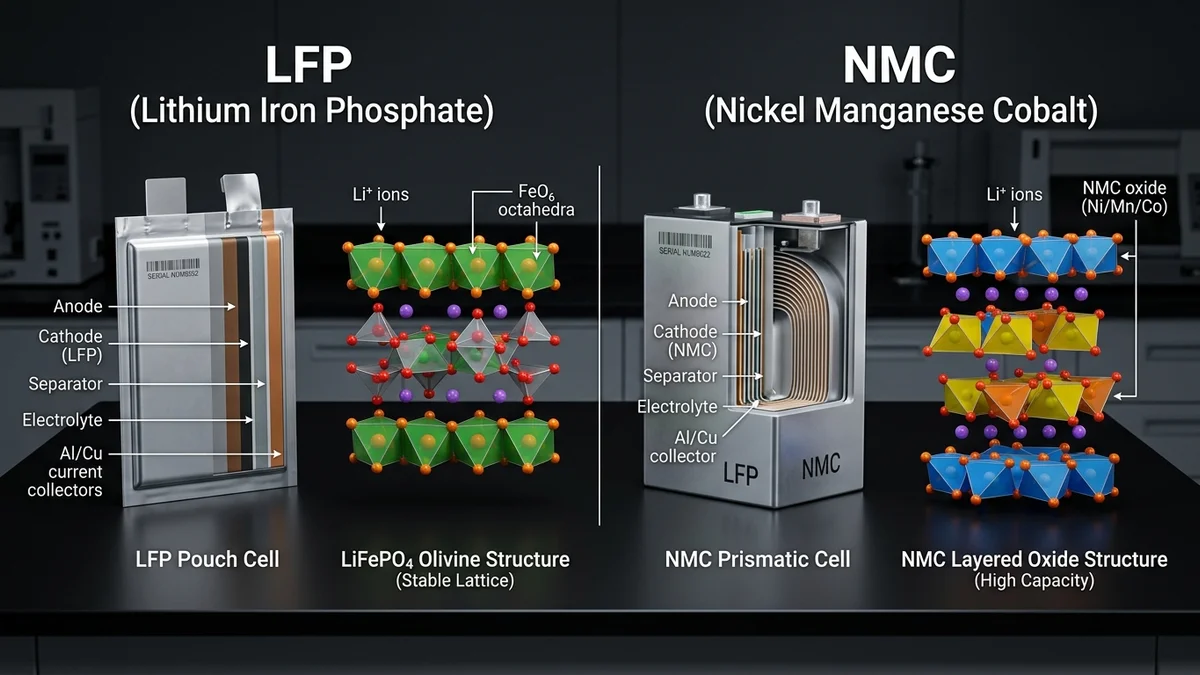
1. Chemical Structure: Olivine vs. Layered Oxide
The performance and safety differences between LFP and NMC stem directly from their crystal structures at the atomic level:
- •Covalent P-O Bonds: The phosphorus-oxygen bond is exceptionally strong. Even under severe short circuits, it resists oxygen release.
- •Flat Discharge Voltage: Delivers virtually steady 3.2V per cell across 10% to 90% State of Charge (SOC).
- •Structural Stability: Minimal volumetric expansion/contraction during lithium ion intercalation prevents micro-cracks over thousands of cycles.
- •Higher Specific Energy: Stores significantly more electrons per gram of mass (~200–250 Wh/kg).
- •Sloped Discharge Curve: Voltage slopes linearly from 4.2V down to 3.0V, making battery percentage estimation easier for simple meters.
- •Oxide Decomposition: Above 210°C, the layered metal oxide lattice decomposes and releases free oxygen, fueling rapid internal combustion if punctured.
2. Thermal Runaway & Fire Safety Thresholds
Thermal runaway occurs when an internal short circuit, physical puncture, or excessive overcharge generates heat faster than the cell can dissipate it to ambient air. Once the critical threshold temperature is crossed, a self-sustaining exothermic chain reaction begins.
- NMC Runaway Temperature: When an NMC cathode decomposes, it releases oxygen gas into an environment filled with volatile liquid electrolyte. This creates a self-feeding fire that cannot be easily extinguished with water or ABC chemical extinguishers.
- LiFePO4 Runaway Temperature: Because the phosphate group bonds tightly to oxygen, LFP cells do not readily release oxygen during electrical overcharge or nail penetration tests. Instead of erupting into jet-like flames, punctured LFP cells typically vent smoke and steam without sustained open combustion.
For permanent indoor installations—especially home battery backup connected to a main breaker panel—LFP’s thermal stability is the definitive standard.
3. Specification Benchmark: LFP vs. NMC
| Engineering Parameter | LiFePO4 (LFP) | NMC / Ternary Lithium | Real-World Impact |
|---|---|---|---|
| Cycle Life to 80% Capacity | 3,000 – 4,000+ Cycles | 500 – 800 Cycles | LFP lasts ~10 years of daily use vs 2 years for NMC. |
| Gravimetric Energy Density | 120 – 160 Wh/kg | 180 – 250 Wh/kg | NMC packs are 25%–35% lighter for the same capacity. |
| Nominal Cell Voltage | 3.2V per cell | 3.6V – 3.7V per cell | LFP packs require 16 cells in series (16S) for 48V vs 14S in NMC. |
| Thermal Runaway Initiation | 270°C (518°F) | 210°C (410°F) | LFP resists combustion; safer for living spaces and garages. |
| Cold Temperature Charging | Cutoff at 0°C (32°F) | Cutoff at 0°C (32°F) | Both chemistries suffer lithium plating if charged below freezing. |
| Discharge Temperature Range | -20°C to 60°C | -20°C to 60°C | Both can power loads in winter if already charged. |
| Raw Material Toxicity | Iron, Phosphate (Non-toxic) | Cobalt, Nickel (Toxic/Rare) | LFP is more environmentally sustainable and ethically sourced. |
4. The Weight Trade-off: Portability vs. Longevity
The single drawback of LiFePO4 chemistry is its physical mass. Because iron is heavier than cobalt and the phosphate crystal lattice is less compact:
- A 2,048Wh NMC power station typically weighs 35 to 42 lbs (16–19 kg).
- A 2,048Wh LiFePO4 power station weighs 48 to 60 lbs (22–27 kg).
If you are a backpacker, airline traveler, or drone operator needing ultra-compact power, lightweight NMC remains practical. But for RV electrical systems, off-grid cabins, and home emergency backup, portability is secondary to 10-year cycle longevity and safety.
To see how modern heavy-duty LFP power stations integrate with home backup panels, see our detailed Anker Solix F3800 hardware audit or compare specs directly in our Anker Solix F3800 vs. EcoFlow Delta Pro Ultra showdown.
Calculate Your Power Station Runtime
Input your battery capacity and connected loads to calculate realistic operating hours.
Open Runtime Calculator →
5. Frequently Asked Questions
Can I charge a LiFePO4 battery below freezing?
No. Never charge any standard lithium battery (LFP or NMC) when cell temperatures are below 32°F (0°C). Charging below freezing forces lithium ions to deposit as metallic lithium needles on the anode (lithium plating), causing permanent capacity loss and internal short circuits. Premium power stations include automatic low-temperature charge cutoffs and internal PTC heating pads.
Why does my LFP battery percentage meter jump suddenly from 20% to 5%?
LiFePO4 has an extremely flat discharge voltage curve. Between 20% and 80% charge, cell voltage barely shifts by 0.1V. Simple voltmeter battery meters cannot accurately track this. Modern units use sophisticated BMS coulomb-counting shunts, but if the unit hasn’t undergone a complete 100% to 0% calibration cycle recently, the percentage indicator can drift.
Should I store an LFP battery at 100% state of charge?
For long-term storage (more than 1 month), store LiFePO4 batteries between 50% and 70% State of Charge (SOC) in a climate-controlled room. Storing at 100% SOC while exposed to ambient summer heat accelerates chemical degradation over time.