When the power cuts out during a severe storm, the clock starts ticking on several hundred dollars of perishable groceries inside your kitchen refrigerator and freezer.
Homeowners looking at a 2,000Wh (or 2,048Wh) portable power station often perform simple division:
- Refrigerator label says: 150 Watts
- Calculation:
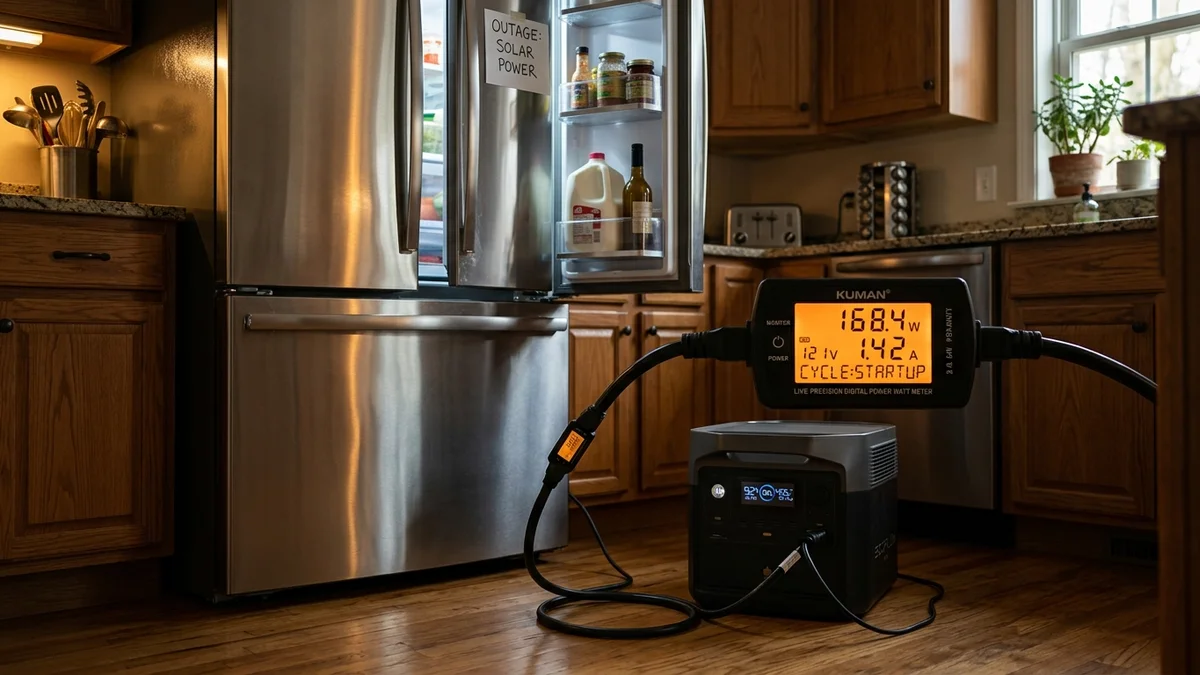
In reality, plug that refrigerator into a 2,048Wh power station, and it will typically run for 24 to 36 hours—nearly double the theoretical math!
Why does the simple formula fail? Because a refrigerator is a thermodynamic cycling system, not a continuous toaster.
Below, we break down compressor duty cycles, automatic defrost heater spikes, inverter tare loss, and show you exactly how long your food will stay safely chilled.
A standard 2,048Wh LiFePO4 solar generator will run a modern residential refrigerator (20–25 cu ft) for 24 to 32 hours under normal ambient room conditions. Because the compressor only runs 35% to 45% of the time (duty cycle), the refrigerator consumes roughly 55W to 75W of average continuous power (including inverter tare loss), consuming approximately 1.3 to 1.7 kWh per 24-hour day.
1. The Anatomy of Refrigerator Power Consumption
A household refrigerator does not draw a flat electrical line. Over a 24-hour cycle, it operates across four distinct electrical stages:
Lasts 150 to 300 milliseconds. Overcomes mechanical compressor head pressure. Pure sine wave inverter capacitors must absorb this without tripping.
Lasts 15 to 25 minutes per cycle. Circulates refrigerant through expansion valves and pulls evaporator air over cold coils.
Lasts 30 to 45 minutes between cooling cycles. Only control boards, display LEDs, and sensors remain active.
Fires once or twice every 24 hours for ~20 minutes. An electric calrod heating element melts frost buildup off the evaporator coils.
2. The Duty Cycle Formula Explained
To calculate accurate battery runtime, you must determine Average Effective Watts ():
Where:
- : Active running power (~140W).
- : Duty Cycle (the percentage of time the compressor runs, typically ).
- : Refrigerator electronics standby (~3W).
- : Inverter parasitic standby draw (~20W).
Real Calculation:
Now divide the 2,048Wh usable battery capacity (at 90% inverter efficiency):
If you keep the refrigerator door firmly closed and ambient room temperatures are cool (68°F), the duty cycle drops to 28%–32%, expanding total runtime to over 30+ hours.
To see how internal inverter tare losses alter runtime on small loads, check our dedicated inverter efficiency curve analysis.
3. Real Benchmark Matrix: Refrigerator Classes on 2,048Wh
| Refrigerator Type | Size (cu ft) | Daily Energy (kWh/day) | Average Draw (w/ Tare) | 2,048Wh Battery Runtime |
|---|---|---|---|---|
| Compact Dorm / Mini Fridge | 3.5 – 4.5 cu ft | 0.55 – 0.75 kWh | ~45W | 40 to 48 Hours |
| Single-Door Inverter Fridge | 10 – 14 cu ft | 0.85 – 1.10 kWh | ~58W | 31 to 36 Hours |
| Standard French Door / Side-by-Side | 22 – 26 cu ft | 1.30 – 1.70 kWh | ~80W | 23 to 28 Hours |
| Commercial Glass-Door Cooler | 20+ cu ft | 2.50 – 3.20 kWh | ~145W | 12 to 15 Hours |
Calculate Your Refrigerator Runtime
Input your refrigerator wattage, duty cycle, and battery capacity to view real hourly projections.
Open Refrigerator Calculator →
4. How to Maximize Battery Runtime During an Outage
- Keep the Doors Closed: Opening the door for 20 seconds dumps dense chilled air and replaces it with warm, humid room air. This forces the compressor to run for an additional 25 minutes to re-chill the cabinet.
- Pre-Freeze Water Bottles: Keep gallon jugs of water in your freezer. During an outage, frozen ice jugs act as thermal ballast, reducing compressor cycle frequency by up to 30%.
- Connect a 400W Solar Panel: Adding a single 400W solar panel can generate 1.4 to 1.8 kWh of daily recharge in good sun, allowing a 2,048Wh battery to run your refrigerator indefinitely without grid power. Review our bifacial ground-mount guide or solar sizing calculator.
For whole-home backup systems that keep refrigerators, water pumps, and lights running simultaneously, read our Anker Solix F3800 hardware audit or our Anker F3800 vs. EcoFlow Delta Pro Ultra comparison.
5. Frequently Asked Questions
Can a modified sine wave power a refrigerator?
It is not recommended. An AC induction compressor motor will run 20% to 30% hotter on a modified sine wave and emit a loud electrical hum. Modern refrigerators with digital variable-speed inverter boards can suffer permanent electronic failure on modified sine waves. Read our pure sine wave vs modified sine wave guide for full technical details.
Why does my power station show 0W when the fridge is plugged in?
Because the refrigerator compressor has satisfied the internal thermostat and is currently resting. Between cooling cycles, the refrigerator draws only 2W to 5W of standby power, which some power station LCD screens round down to zero.
Will the defrost heater drain my battery unexpectedly?
Yes, it can. The automatic defrost cycle draws 400W to 600W for approximately 15 to 25 minutes (consuming ~150Wh to 200Wh). If your battery is already down to 10% reserve, a defrost cycle can trigger low-voltage shutdown sooner than expected.