When storm season ends, many homeowners tuck their emergency portable power station into a closet, garage, or basement, expecting it to sit safely until the next major blackout a year later.
Then, when a hurricane knocks out power twelve months later, they pull the unit out:
The screen won’t turn on. The power station won’t charge from the wall, and the unit is completely dead.
The battery didn’t fail due to poor manufacturing. It failed because improper long-term storage is the fastest way to permanently destroy lithium cells.
Below, we explain the electrochemistry of battery self-discharge, why storing at 100% or 0% ruins cells, and provide the exact 3-step maintenance protocol to keep your power station ready for action.
Store your portable power station between 50% and 65% State of Charge (SOC) in a cool, climate-controlled space (55°F–75°F / 13°C–24°C). Storing at 100% accelerates chemical degradation and gas generation, while storing at 0% allows tiny background BMS parasitic drain to drop cell voltages below the critical 2.0V floor, causing permanent copper dendrite shorts. Check and top-off the battery to 60% every 3 to 6 months.
1. The Two Deadly Storage Extremes: 100% vs. 0%
Lithium-ion and LiFePO4 cells are chemically stressed at the extremes of their charge spectrum:
- Cathode Oxidation: When sitting at 100% SOC, cathode materials operate at maximum thermodynamic potential (> 3.60\text{V} per cell).
- Electrolyte Oxidation: High voltage catalyzes side reactions with the organic solvent electrolyte, creating microscopic gas pockets.
- Accelerated Capacity Fade: Storing at 100% in a warm garage (90°F) degrades usable capacity twice as fast as storing at 50%.
- BMS Parasitic Drain: Even when powered down, internal sensors, RTC clocks, and Bluetooth beacons draw continuously.
- Voltage Inversion: Over 4 to 8 months, parasitic draw pulls cell voltage below .
- Permanent Bricking: Copper current collector foils dissolve into the electrolyte; upon recharging, they form short-circuiting metallic needles. The BMS permanently locks out to prevent fires.
2. The Ideal Storage Sweet Spot: 50% to 65% SOC
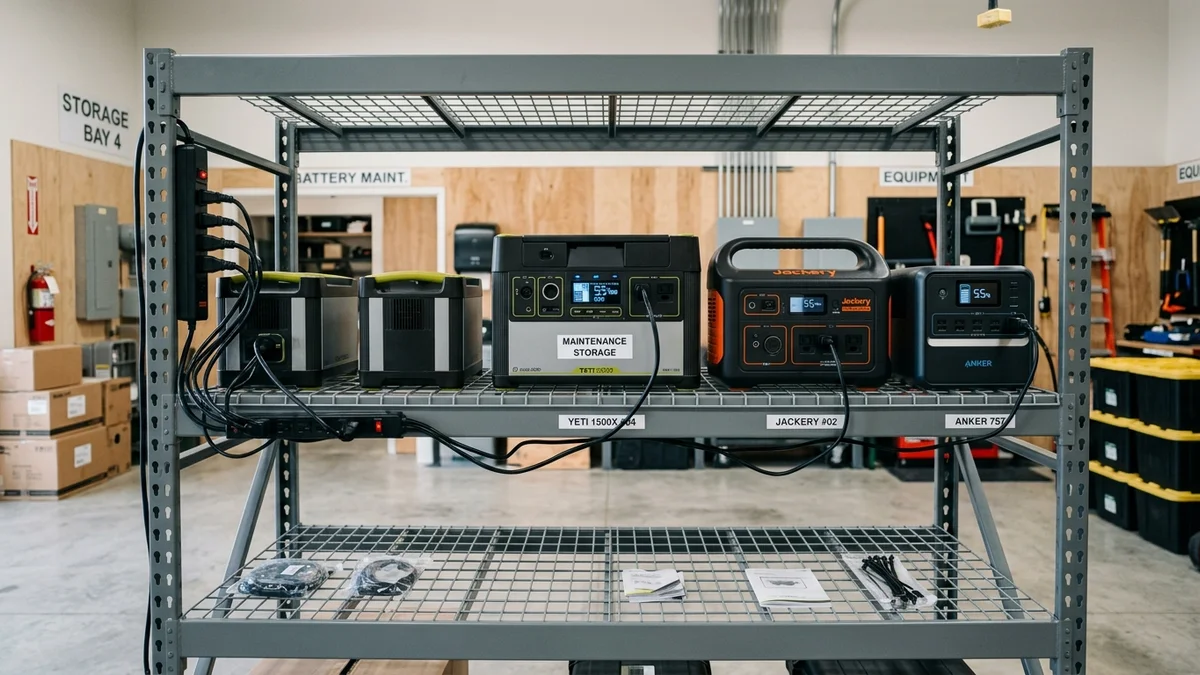
Electrochemists and battery manufacturers agree that 50% to 60% State of Charge is the optimal storage window:
- Balanced Mechanical Lattice: Roughly half of the lithium ions reside in the iron phosphate cathode, and half in the graphite anode. Neither electrode is under mechanical expansion or delithiation stress.
- Low Chemical Activity: Cell resting voltage sits at its natural electrochemical resting baseline ( per cell for LiFePO4).
- Safe Buffer Against Self-Discharge: 50% SOC provides enough energy reserve to absorb 9 to 12 months of natural background BMS self-discharge without ever approaching the dangerous 0% low-voltage floor.
To understand why chemical stability varies between battery types, read our detailed comparison of LiFePO4 vs NMC battery chemistry and the 80% DoD cycle longevity rule.
3. The 3-Step Seasonal Maintenance Checklist
To guarantee your power station will fire up instantly when severe weather strikes, follow this simple protocol:
- Step 1: Set Storage Level to 60%: If the battery is currently at 100%, plug in a space heater or hair dryer for 15 minutes to draw it down to roughly 60%. If it is empty, charge it up to 60%.
- Step 2: Store in a Climate-Controlled Room: Store the unit indoors in a closet, utility room, or basement where ambient temperatures stay between 50°F and 75°F (10°C to 24°C). Never store a power station in a hot attic (exceeding 105°F) or an uninsulated garage subject to freezing winter chills. Review our guide on cold weather lithium charging.
- Step 3: The 3-Month Check & Annual Recalibration:
- Every 3 to 6 months, turn the unit on and verify the battery level. If it has drifted down toward 40%, top it back up to 60%.
- Once per year, perform a Gauge Recalibration Cycle: discharge the unit fully until it shuts off, then charge it uninterrupted to 100%. This re-aligns the internal BMS coulomb-counting shunt so your percentage readout remains accurate.
4. Storage Comparison: LiFePO4 vs. NMC vs. Lead-Acid
| Battery Chemistry | Optimal Storage SOC | Monthly Self-Discharge Rate | Safe Storage Shelf Life | Danger Threshold |
|---|---|---|---|---|
| LiFePO4 (LFP) | 50% – 60% | 1.5% – 3.0% / month | 6 to 9 Months | Cell drops below 2.0V |
| NMC Lithium | 45% – 55% | 2.0% – 4.0% / month | 4 to 6 Months | Cell drops below 2.5V |
| Lead-Acid (AGM/Gel) | 100% (Mandatory) | 5.0% – 10.0% / month | 2 to 3 Months | Any storage below 80% causes sulfation |
(Note the stark difference with Lead-Acid: lead-acid batteries must be kept at 100% with a continuous float trickle charger. In contrast, storing a modern lithium solar generator on a continuous 100% float accelerates degradation).
For heavy whole-home power stations featuring advanced smart-app storage modes, explore our Anker Solix F3800 hardware audit or our Anker F3800 vs. EcoFlow Delta Pro Ultra comparison.
Calculate Emergency Outage Runtime
Input your battery capacity and critical home loads to plan your emergency backup strategy.
Open Runtime Calculator →
5. Frequently Asked Questions
Can I leave my power station plugged into the AC wall outlet all year round?
You can only do this safely if the power station features an EPS bypass mode and allows you to set a custom Charge Limit in its smartphone app. If you can configure the app to stop charging at 80%, leaving it plugged in as an emergency power supply is safe. Leaving it floating at 100% in a warm room 365 days a year will accelerate cell capacity fade.
What should I do if my stored power station won’t turn on at all?
If the battery has completely discharged into a low-voltage BMS lockout, the standard high-wattage AC fast-charger may refuse to initiate. Try connecting a 50W–100W DC solar panel or a 12V car cigarette lighter charger into the DC input port. Many units allow a slow DC “trickle wake-up” current to revive sleeping cells back above the 2.5V BMS wake-up threshold.
Do I need to disconnect external cables during storage?
Yes. Always disconnect all solar MC4 cables, transfer switch cords, and USB accessories from the unit before putting it into storage. Leaving solar cables or adapters plugged in can keep internal input sensing circuits awake, significantly accelerating parasitic battery drain.