Winter blizzards and sub-freezing cold snaps are prime times for extended grid blackouts. Naturally, homeowners and RV campers position their solar generators to keep space heaters, Wi-Fi, and refrigerators running.
Then, when the sun comes out and solar panels begin pumping current into the battery, the screen flashes a warning icon: Low Temp Charging Protected — Charge Current 0A.
Is the battery malfunctioning? Absolutely not. That automatic cutoff is the single most critical safety feature inside your battery management system.
Here is what happens electrochemically when lithium cells freeze, why discharging in the cold is safe while charging is hazardous, and how modern systems handle winter operations.
You can safely discharge a LiFePO4 battery in sub-zero temperatures (down to -4°F / -20°C), but you must never charge it below 32°F (0°C). Below freezing, the chemical diffusion rate of lithium ions drops drastically; forcing current into cold cells causes ions to accumulate on the anode as metallic lithium (lithium plating). This causes irreversible capacity loss and grows conductive dendrites that can pierce internal separators and trigger catastrophic short circuits.
1. Discharging vs. Charging Below Freezing: Why the Difference?
Many users confuse discharging with charging:
- Discharging Below Freezing (Safe with Capacity Drop): When drawing power from the battery, lithium ions flow naturally from the graphite anode back to the cathode. In cold temperatures, the liquid electrolyte thickens, increasing internal electrical resistance. This causes a temporary voltage sag and reduces usable Watt-hours by 15%–25%, but it causes zero permanent physical damage to the cell structure.
- Charging Below Freezing (Extremely Hazardous): When charging, an external power source (solar array or AC grid) forces lithium ions to migrate through the sluggish electrolyte and squeeze into the graphite anode lattice (intercalation). Because the diffusion rate is severely throttled by cold temperatures, the ions cannot penetrate the graphite quickly enough.
Electrolyte viscosity is low. Lithium ions migrate freely and nest safely inside the molecular graphite honeycomb layers. Zero metallic buildup occurs.
Electrolyte thickens. Ions bottleneck at the anode surface and convert into solid, metallic lithium metal. Dendrite spikes grow and permanently strip active lithium.
2. The Danger of Dendrite Growth and Internal Shorts
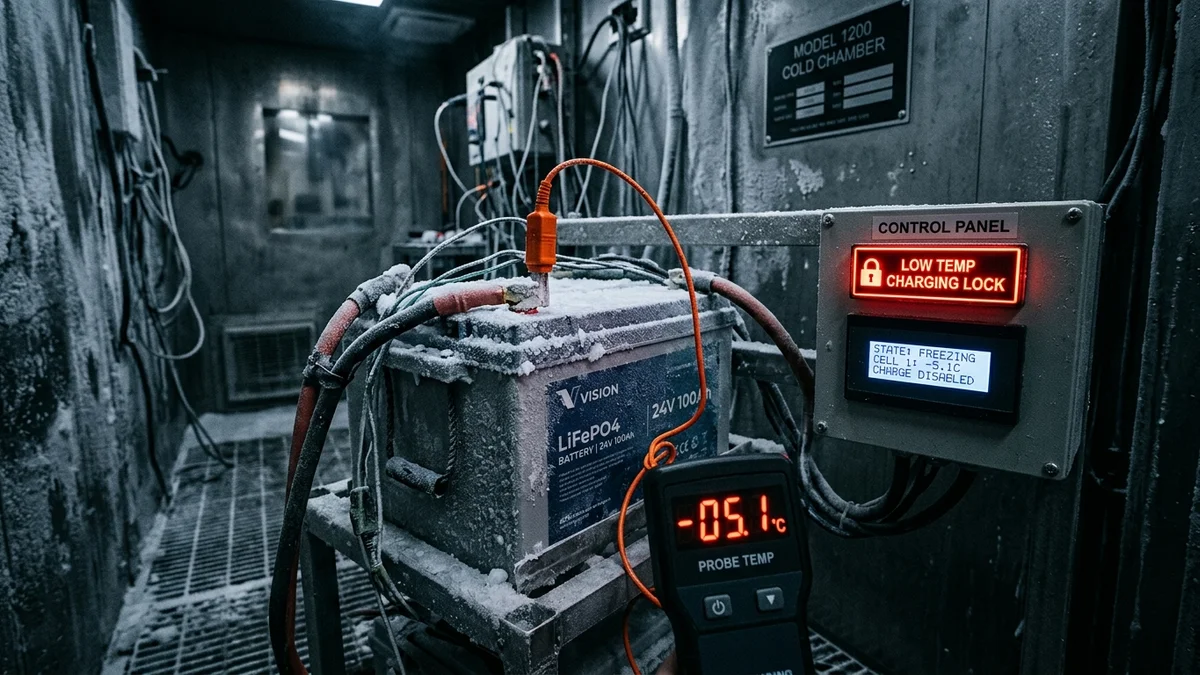
When metallic lithium forms on the anode surface, two destructive consequences follow:
- Permanent Capacity Fade: Every lithium ion that plates out as solid metal is chemically removed from the usable energy pool. After just 3 to 5 sub-freezing charge cycles, a battery can permanently lose 20% to 40% of its total storage capacity.
- Separator Puncture (Dendrite Short Circuits): Metallic lithium does not deposit in smooth sheets; it forms sharp microscopic needles called dendrites. As dendrites elongate with repeated cold charging, they physically pierce the microscopic polyolefin separator membrane separating the positive and negative electrodes, triggering an internal short circuit.
To understand how battery chemistry impacts thermal runaway thresholds if a puncture occurs, read our detailed comparison of LiFePO4 vs NMC battery chemistry.
3. Operational Temperature Ranges for LiFePO4 Systems
| Operating Mode | Safe Temperature Window | Inverter / Battery Behavior | Action Required |
|---|---|---|---|
| Normal Charging | 32°F to 113°F (0°C to 45°C) | Full C-rate charging accepted. | Standard operation. |
| Cold Charging Zone | 20°F to 32°F (-6°C to 0°C) | BMS drops charge current to <0.1C or cuts input completely. | Engage battery pre-heating pads. |
| Severe Cold Charging | Below 20°F (< -6°C) | Complete charge disconnect enforced. | Move unit inside heated space. |
| Normal Discharging | -4°F to 140°F (-20°C to 60°C) | Inverter powers loads normally; expect ~15% capacity sag at -4°F. | Keep loads within rated limits. |
| Extended Inactive Storage | 14°F to 95°F (-10°C to 35°C) | Store at 50%–60% State of Charge (SoC). | Disconnect external solar cables. |
4. How Modern Cold-Weather Power Stations Solve This
Off-grid manufacturers handle sub-freezing conditions using three primary engineering strategies:
- Hardware Low-Temperature Cutoff (Standard): Quality units place thermistor probes directly against internal cell walls. If cell temperatures register , the BMS opens solid-state charge MOSFETs, blocking solar and AC input while allowing discharge power to flow unimpeded.
- Internal Self-Heating Elements (PTC Heaters): High-end units (such as the Anker Solix F3800 and EcoFlow Delta Pro Ultra) feature internal silicone heating pads. When connected to solar or AC power in sub-freezing weather, incoming electrical energy is automatically redirected to the heating pads first. Once cell cores warm up to 41°F (5°C), charging current is routed to the battery cells.
- Discharge-Generated Self-Warming: Because internal resistance generates slight heat during discharge (), drawing power for a moderate load (like a 300W appliance) naturally elevates internal core temperatures above freezing over several hours.
Calculate Your Winter Runtime
Account for cold-temperature battery capacity sag and appliance duty cycles with our interactive tool.
Open Runtime Calculator →
5. Frequently Asked Questions
If my solar generator is in an unheated garage, will it charge during winter?
Only if the ambient garage temperature stays above 32°F (0°C) or your power station is equipped with integrated self-heating pads. If the battery is below freezing without heaters, the BMS will block incoming solar wattage completely until the unit is moved into a heated room.
Can cold weather permanently harm a battery that is turned off and unplugged?
No. Simply storing an unpowered lithium battery in sub-freezing temperatures (down to -4°F / -20°C) does not cause chemical damage. Just ensure you allow the battery to warm up to room temperature for 4 to 6 hours before plugging in a charger.
Why do solar panels produce higher voltages in freezing weather?
Cold weather increases solar cell efficiency, which causes Open-Circuit Voltage () to spike significantly above factory ratings. To prevent frying your solar generator’s MPPT controller in winter, read our guide on cold temperature Voc voltage spikes and use our cold temperature Voc safety calculator.