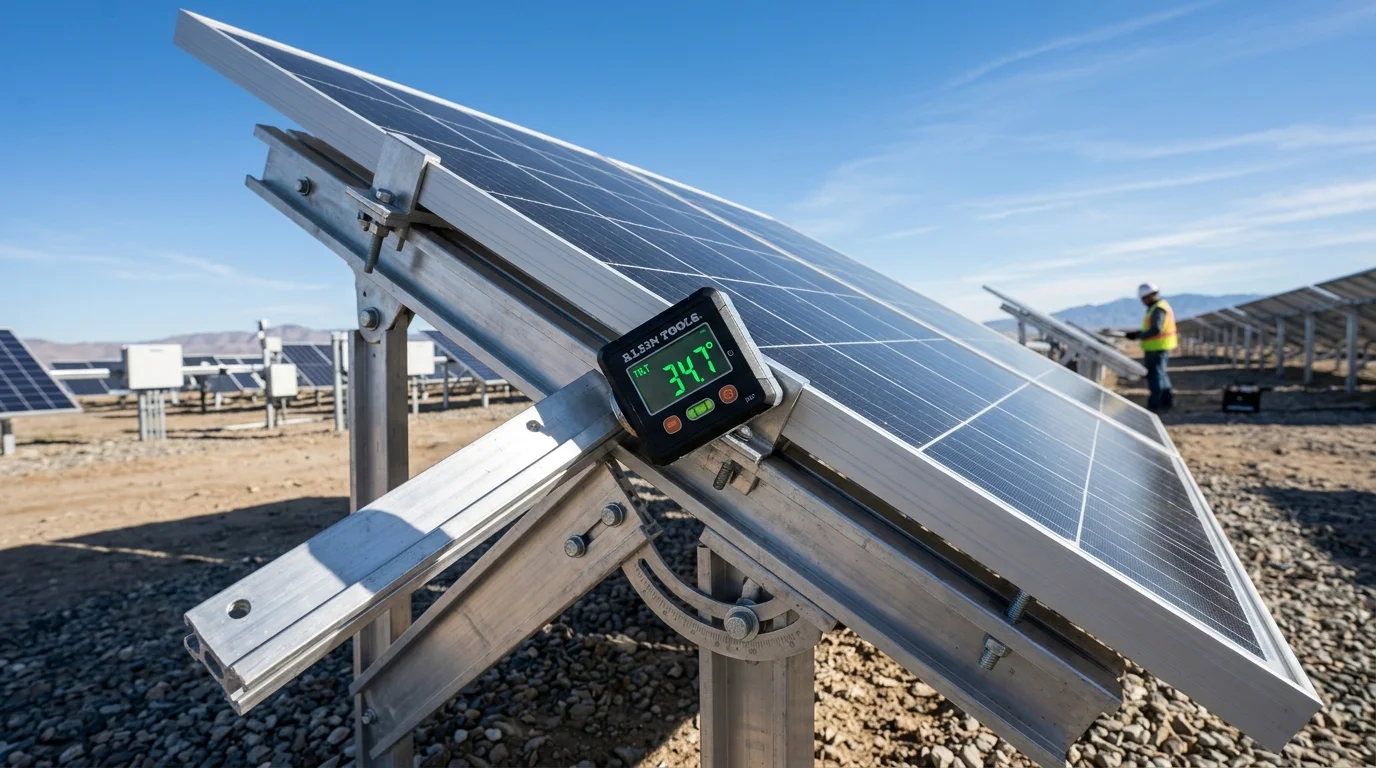
When installing solar panels—whether mounting an array on an off-grid cabin roof, configuring an adjustable ground rack, or deploying portable folding solar panels at a campsite—the angle at which the silicon face points toward the sun directly governs your total daily energy yield.
Setting your panels at the wrong tilt angle does not simply shave off 2% or 3% of peak power. In mid-to-high latitudes, laying a solar array flat during winter months can destroy more than 50% of your daily watt-hour harvest, plunging battery banks into chronic deficit.
For a fixed year-round solar array, set your tilt angle equal to your geographic latitude × 0.87 (or roughly equal to your latitude between 30° and 45°). For off-grid battery systems, adjust twice per year: Summer Tilt = Latitude - 15° (flatter for high overhead sun) and Winter Tilt = Latitude + 15° (steeper for low horizon sun and snow shedding). Mounting flat (0°) at a 40° latitude destroys over 50% of winter harvest due to Lambert’s cosine projection loss.
The Physics of Solar Incidence: Lambert’s Cosine Law For physical hardware engineered specifically for seasonal tilt adjustments, check out our Maple Leaf Goose Mount Review.
To understand why solar tilt matters, we must examine the geometric interaction between photon streams and a flat silicon wafer. Solar panels do not produce power simply from the presence of light in the sky; their output depends on the Direct Normal Irradiance (DNI) striking the glass surface perpendicular (normal) to the panel face.
When incoming solar rays strike a panel at an oblique angle rather than perpendicular (), the light spreads over a larger surface area. The effective intensity follows Lambert’s Cosine Law:
Where:
- is the direct beam solar irradiance available in the atmosphere (typically up to under clear skies).
- is the Angle of Incidence (AOI)—the angle between incoming solar rays and the normal line perpendicular to the panel surface.
When the sun is directly perpendicular to the panel, the angle of incidence is . Because , the panel receives of direct beam irradiance.
However, as the sun deviates from perpendicular, cosine losses accelerate non-linearly:
| Angle of Incidence () | Cosine Factor | Effective Irradiance ( Base) | Geometrical Cosine Loss |
|---|---|---|---|
| 0° (Perpendicular) | 1.000 | 1,000 W/m² | 0.0% |
| 15° Off-Axis | 0.966 | 966 W/m² | -3.4% |
| 30° Off-Axis | 0.866 | 866 W/m² | -13.4% |
| 45° Off-Axis | 0.707 | 707 W/m² | -29.3% |
| 60° Off-Axis | 0.500 | 500 W/m² | -50.0% |
| 75° Off-Axis | 0.259 | 259 W/m² | -74.1% |
Notice that at an incidence angle of 45°, nearly 30% of incoming energy is lost purely due to geometry, even before factoring in front-glass optical reflections or the thermal derating coefficients discussed in our real-world solar output guide.
Solar Sun Path Geometry: Summer vs. Winter Altitude
The sun’s position in the sky is governed by two astronomical coordinates:
- Solar Azimuth Angle (): The compass direction of the sun along the horizon (due East at dawn, due South at solar noon in the Northern Hemisphere, due West at sunset).
- Solar Elevation / Altitude Angle (): The angular height of the sun above the horizon.
Because the Earth is tilted on its rotational axis by , the solar altitude at solar noon changes dramatically throughout the year:
Where:
- is your local latitude.
- is the solar declination angle, which fluctuates between (Summer Solstice, ~June 21) and (Winter Solstice, ~December 21).

Figure 1: Incident ray geometry on an inclined module. As solar altitude α drops during winter, a steep panel tilt β minimizes the incidence angle θ, preventing severe Lambert cosine losses.
In a mid-latitude city like Denver, Colorado ():
- Summer Solstice Solar Noon Altitude: (high overhead).
- Winter Solstice Solar Noon Altitude: (low along the southern horizon).
If a solar panel is mounted flat on a horizontal surface () on December 21:
- The angle of incidence is .
- The cosine multiplier is .
- A 400W solar panel receives only 44.7% of direct beam light, yielding less than 180W at peak solar noon!
By simply tilting the panel to (facing due South), the angle of incidence drops to , restoring the cosine factor to (98.9% effective irradiance).
Engineering Formulas for Solar Panel Tilt
Solar designers and off-grid engineers calculate tilt angles using three primary frameworks depending on mounting flexibility.
1. Fixed Year-Round Tilt Angle (No Adjustments)
If panels are mounted permanently on a fixed roof rack or non-adjustable ground mount, the goal is to optimize total cumulative kilowatt-hours (kWh) across all 365 days.
-
Simple Rule: (Tilt angle equals geographic latitude).
-
Empirical NREL / Sandia Yield Optimization: For latitudes between and , setting the tilt slightly flatter than latitude captures significantly higher photon counts during the long 14-hour summer days while sacrificing minor winter production when total daylight is brief anyway: (For a latitude, optimal fixed annual tilt is ).
2. Two-Season Tilt Adjustment (Winter vs. Summer)
If you have an adjustable ground mount, pole mount, or RV tilt bracket, adjusting your angle twice per year (once in late spring around April 15, and once in early autumn around September 15) captures over 95% of theoretical dual-axis tracking energy:
3. Four-Season Seasonal Optimization
For off-grid homesteaders who want maximum monthly battery replenishment without automated motor trackers, adjusting four times per year aligns the array with quarterly solar altitude shifts:
- Summer (May to July):
- Autumn (Aug to Oct):
- Winter (Nov to Jan):
- Spring (Feb to Apr):
Worldwide Latitude Tilt Reference Table
The table below lists recommended tilt angles across common latitudes in North America and Europe, including the severe winter penalty suffered if panels are mounted flat ().
| Representative City / Region | Latitude | Fixed Annual Tilt | Summer Tilt | Winter Tilt | Flat (0°) Winter Loss |
|---|---|---|---|---|---|
| Miami, FL / Taipei | 25.8° N | 22.7° | 10.8° | 40.8° | -24% |
| Houston, TX / Cairo | 29.8° N | 25.7° | 14.8° | 44.8° | -31% |
| Los Angeles, CA / Atlanta, GA | 34.0° N | 29.0° | 19.0° | 49.0° | -39% |
| Denver, CO / Salt Lake City, UT | 39.7° N | 33.3° | 24.7° | 54.7° | -48% |
| New York, NY / Madrid, Spain | 40.7° N | 34.0° | 25.7° | 55.7° | -50% |
| Seattle, WA / Munich, Germany | 47.6° N | 39.3° | 32.6° | 62.6° | -62% |
| London, UK / Calgary, Canada | 51.5° N | 42.2° | 36.5° | 66.5° | -69% |
Why Winter Tilt Dictates Off-Grid Battery Reliability
In grid-tied residential solar, installers often prioritize summer power because net metering or time-of-use tariffs reward peak summer output.
In off-grid solar power systems and portable battery banks, the opposite design philosophy applies: your solar array must be sized and tilted for your worst-case month (December/January).
Here is why winter tilt is non-negotiable for off-grid battery health:
1. Compounding Sunlight Hour Deficits
In summer, an off-grid system enjoys 5.5 to 6.5 Peak Sun Hours (PSH). In winter, atmospheric day length shrinks to 8 hours, yielding only 1.5 to 2.5 PSH. If your array is tilted flat, you lose another 50% on top of that, effectively reducing your daily energy generation to under 1.0 PSH. Your battery storage bank never reaches 100% absorption charge, accelerating capacity degradation (see our 80% DoD battery lifespan analysis).
2. Natural Snow Shedding at High Angles
Monocrystalline glass panels collect snow quickly. If tilted at or , heavy wet snow packs against the aluminum frame and can remain frozen for weeks, blinding the array. When tilted at to , gravity works in your favor: the dark silicon absorbs ambient diffuse radiation, warms up slightly, and large sheets of snow slide off the slick tempered glass within minutes of sun emergence.
3. Synergies with Ground Albedo and Bifacial Panels
If your panels are ground-mounted, pairing a steep winter tilt (–) with bifacial solar panels over fresh snow creates a massive boost. Clean snow has an albedo reflectance coefficient of up to . While the front glass absorbs direct horizon light, the rear glass captures reflected ground light, yielding an extra to of free winter energy.
The 10-Degree Rule for Flat Roofs and RVs
Many van lifers, RV travelers, and commercial building managers mount solar panels completely horizontal () to eliminate wind drag or aerodynamic hardware complexity.
This creates a serious operational vulnerability known as the soiling dam effect:
⚠️
Engineering Rule: Never Mount Below 10° Tilt
Every commercial solar module has an extruded aluminum lip (1.5mm to 3mm) surrounding the tempered glass sheet.
When mounted below a 10° tilt angle, rainwater cannot freely flow off the glass. Instead, surface tension causes rainwater to pool along the lowest edge. When the puddle evaporates under baking sun, it leaves behind a concentrated strip of dirt, road dust, and pollen.
This thick dirt bar permanently shadows the bottom row of silicon cells. Because solar cells in a string are wired in series, shading just one bottom row forces bypass diodes to engage continuously, slashing string voltage by 33% and generating localized hot-spot stress on cell solder joints.
Even on flat RV roofs, always use adjustable bracket risers or angled mounting feet to maintain at least an 8° to 10° slope to ensure rainwater cleans the glass naturally.
Azimuth Orientation: True South vs. Magnetic South
Tilt angle is only half of the orientation equation. The compass direction your panels face (Azimuth) is equally vital:
- Northern Hemisphere: Point panels directly toward True South ( Azimuth).
- Southern Hemisphere: Point panels directly toward True North ( Azimuth).
Critical Field Warning: A standard magnetic compass points toward Magnetic North, not True North. Depending on your location, the difference between magnetic north and geographic true north—called Magnetic Declination—can be as high as to East or West.
For example, in Maine (East Coast USA), magnetic declination is roughly . In Washington State (West Coast USA), declination is roughly . If you align your panels with an unadjusted magnetic compass in Seattle, your panels will face rather than true , causing an afternoon cosine loss penalty. Always use a GPS-calibrated smartphone app or NOAA declination calculator to find True South.
Matching Array Tilt with Power Station Capacity
When engineering your solar charging setup, proper tilt angle ensures your portable power station or whole-home solar generator achieves its full rated charge rate during the limited hours of peak daylight.
- Calculate Daily Watt-Hours Needed: Use our Off-Grid Energy Budget Sizing Guide to calculate total continuous loads (e.g., running a refrigerator on a 2000Wh battery).
- Account for MPPT Voltage Limits: When angling panels steep for winter, cold temperatures raise open-circuit voltage (). Always verify cold-weather string voltage safety with our Voc Temperature Coefficient Calculator.
- Overpanel for Shoulder Hours: Because sun angles change throughout the morning and late afternoon, overpaneling your MPPT charge controller by 20% to 30% ensures full-throttle charging even when the sun is 30° away from your panel’s perpendicular axis (see our guide on solar panel overpaneling and MPPT current clipping).
Frequently Asked Questions
Does solar panel tilt angle matter as much in the summer?
No. In the summer, the sun sits high in the sky and traverses an enormous arc from northeast to northwest. Because diffuse atmospheric light is plentiful and peak daylight lasts 14 to 15 hours, small tilt angle errors (e.g., 10° off from optimal) only reduce total summer energy by 2% to 4%. Tilt angle errors become catastrophic in the winter, where a 20° error can wipe out 30% to 50% of your already scarce power.
What is the best angle for portable folding solar panels?
For portable panels with built-in kickstands, adjust the kickstand legs every 2 to 3 hours if you are actively at camp. At solar noon (12:00 PM to 1:00 PM), angle the panel roughly equal to your Latitude - 15° in summer and Latitude + 15° in winter. You can quickly test perpendicular alignment by placing a pencil or small stick perpendicular to the panel glass: when the stick casts zero shadow, your panel is in perfect 100% perpendicular alignment ().
Should my panels face southwest to catch afternoon sun?
For grid-tied homeowners with Time-of-Use (TOU) utility billing, facing panels toward Southwest (210°–225°) is often more profitable. While total annual kilowatt-hours will drop by roughly 4% compared to true south, peak power generation shifts into the late afternoon (4:00 PM to 8:00 PM) when utility electric rates are at their absolute highest. For off-grid battery systems, stick with True South to maximize total recharge energy.
Can dual-axis tracking pay for itself over fixed tilt?
For residential and off-grid scale systems, motorized dual-axis tracking mounts are rarely cost-effective. Motorized mounts add mechanical failure points, wind vulnerability, and high costs ($1,500 to $3,000+). Because monocrystalline solar panels are inexpensive per watt, you can achieve identical or greater total daily watt-hours by simply buying 25% to 30% more solar panels and installing them on sturdy fixed or seasonally adjustable racks.
How does roof pitch relate to tilt angle?
In the United States, roof pitch is expressed as rise over run (e.g., 4/12 or 8/12 pitch):
- 4/12 Pitch: Equals an tilt angle (ideal for summer sun in southern US latitudes).
- 6/12 Pitch: Equals a tilt angle (good all-around compromise for central US latitudes).
- 8/12 Pitch: Equals a tilt angle (near-perfect year-round angle for latitudes 35° to 40°).
- 12/12 Pitch: Equals a tilt angle (excellent for winter harvest and shedding heavy snow in northern climates).