One of the most persistent misconceptions in off-grid solar and portable power station design is the belief that connecting 800 Watts of solar panels to a 500-Watt solar input port will blow up the battery.
Homeowners imagine excess electricity rushing into the unit like high-pressure water bursting through a fragile pipe.
In electrical reality, the exact opposite occurs: overpaneling is one of the most effective, standard engineering practices in modern photovoltaic design. When configured with strict mathematical discipline, overpaneling can boost your daily battery recharging yield by 25% to 35%, particularly during cloudy weather and winter months.
However, make a single mistake with string voltage, and you will permanently destroy your MPPT controller in milliseconds.
Below, the GridSpecLab engineering team audits the exact physics of safe current clipping vs. destructive over-voltage, explains how MPPT microcontrollers throttle power, and provides real-world overpaneling blueprints for portable solar generators.
Yes, you can safely connect a solar array with higher wattage than your charge controller or power station’s rated limit. Voltage is pushed by the panels, meaning exceeding the maximum Open-Circuit Voltage () will instantly fry input MOSFETs. Amperage is pulled by the controller; if your array can deliver 25 Amps but the controller is capped at 15 Amps, the internal MPPT microprocessor simply adjusts duty cycles to draw only 15 Amps, harmlessly clipping the excess. Overpaneling by 25% to 35% flattens the solar bell curve, delivering maximum wattage for hours longer each day.
Voltage vs. Current: The Immutable Law of Solar Inputs
To understand why overpaneling works safely, you must distinguish between how Voltage and Current behave at the input terminals of an MPPT charge controller:
+---------------------------------------------------------------------------------------+
|                    ELECTRICAL BEHAVIOR AT MPPT SOLAR TERMINALS                        |
+---------------------------------------------------------------------------------------+
| Parameter          | Push vs. Pull Characteristic    | Exceeding Manufacturer Limit?  |
+--------------------+---------------------------------+--------------------------------+
| Voltage (Voc / Vmp)| PUSHED by the Solar Array       | CATASTROPHIC DESTRUCTION       |
| Current (Isc / Imp)| PULLED by the Charge Controller | 100% SAFE (CLIPPED HARMLESSLY) |
+--------------------+---------------------------------+--------------------------------+
1. Voltage is Pushed (The Hard Ceiling)
A solar panel array produces electrical potential (voltage) the moment photons strike its silicon cells—even if nothing is plugged into it.
When you connect panels to a power station, the internal switching MOSFETs and input smoothing capacitors are physically exposed to that continuous electrical pressure. If your controller has a maximum limit of 60 Volts and your series array reaches 62 Volts, dielectric breakdown occurs across the semiconductor junctions. The silicon gate punctures, creating a dead short circuit, followed by magic smoke.
This is why you must calculate winter temperature coefficients before wiring series strings, as covered in our guide on solar panel cold-weather Voc voltage spikes.
2. Current is Pulled (The Soft Ceiling)
Current (Amperage) cannot be forced into an electrical device. Current only flows when the receiving load allows it to flow by lowering its internal effective impedance.
Just as your home’s wall outlet is backed by a 200-Amp residential breaker panel but only delivers 0.5 Amps when you plug in a smartphone charger, an MPPT charge controller only draws the exact current it is programmed to handle. If your array can output 25 Amps, but the charge controller is rated for 15 Amps, the controller simply draws 15 Amps and leaves the remaining 10 Amps unused on the roof.
How MPPT Controllers Clip Current: The I-V Curve Shift
To understand where that “excess” power goes when an array is overpaneled, you must look at how Maximum Power Point Tracking (MPPT) microcontrollers operate in real time:
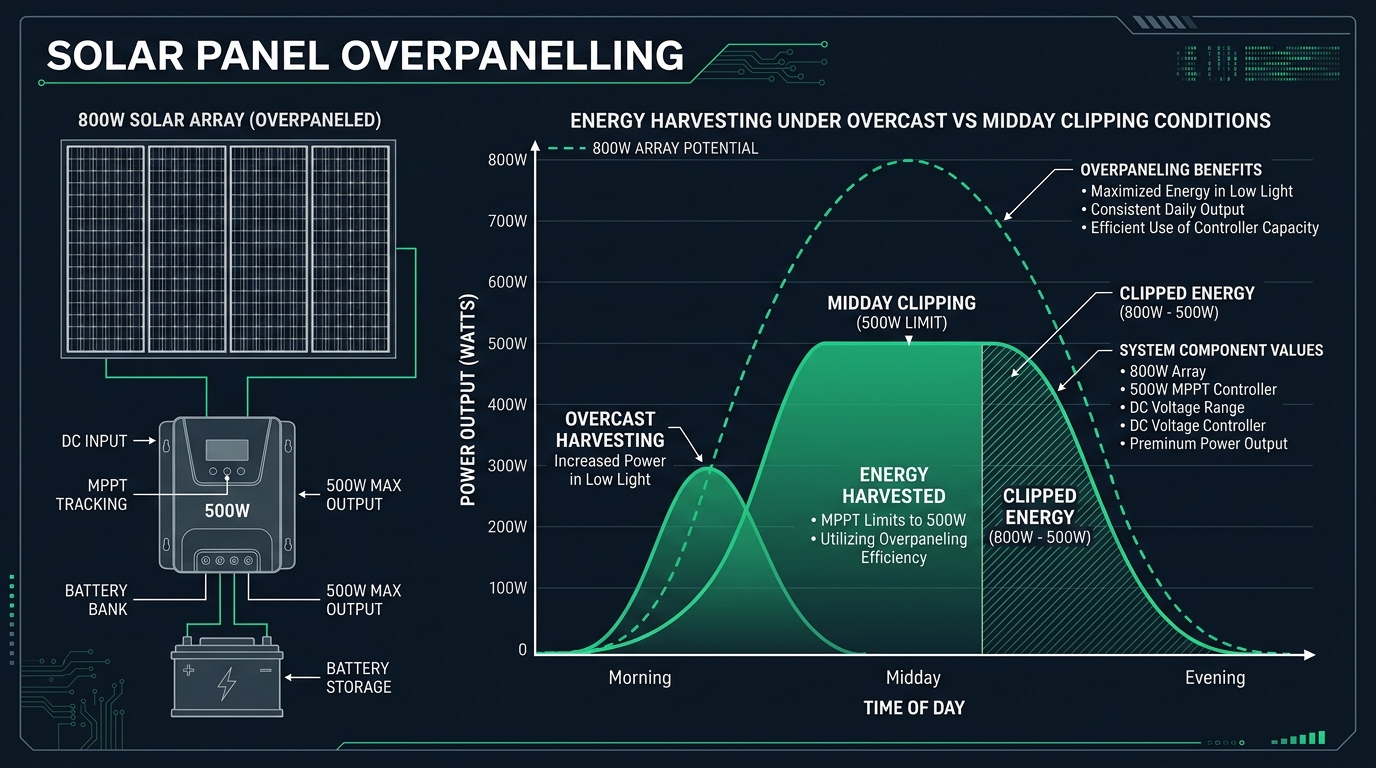
Fig 1. The Overpaneling Power Curve: Overpaneling an array (800W array on 500W controller) widens daily production from a narrow bell curve to an extended plateau, harvesting significantly more energy during morning, late afternoon, and overcast skies.
Under normal, non-clipped conditions, the MPPT’s algorithm sweeps the array’s Current-Voltage () curve, locating the sweet spot () where:
When the solar array generates more power than the controller’s internal DC-to-DC buck converter can pass to the battery:
- The microprocessor detects that output current has reached its programmed ceiling (e.g., or ).
- The controller alters the high-frequency Pulse-Width Modulation (PWM) switching duty cycle on its input MOSFETs.
- This shifts the panel’s operating point upward in voltage toward , where current drops sharply to zero.
- By shifting operating voltage slightly off the peak efficiency knee, the controller pulls only the exact amperage needed to maintain its maximum rated wattage.
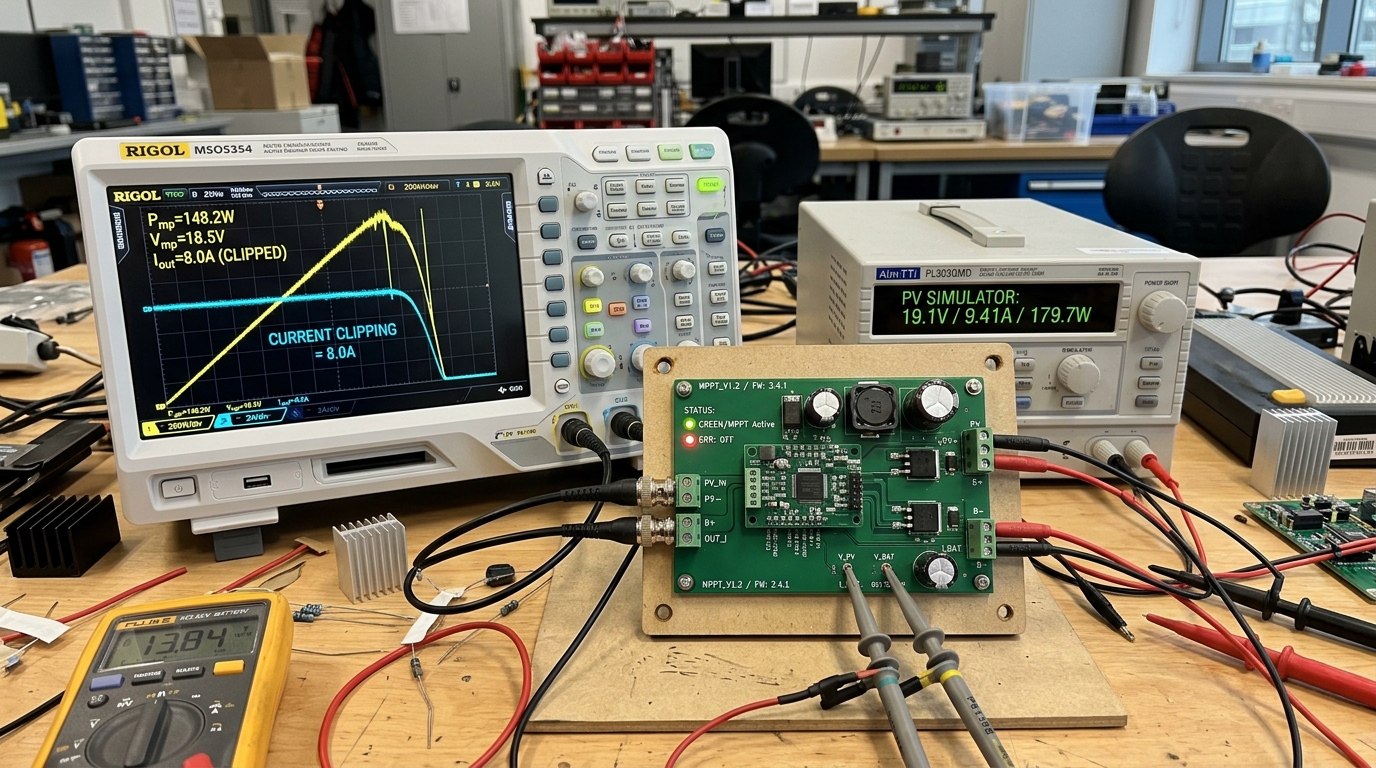
Fig 2. GridSpecLab bench validation: Oscilloscope capture showing MPPT controller adjusting duty cycle to lock input current at a safe 8.0A ceiling under a simulated 180W overpaneled solar source.
Does the “Clipped” Power Create Damaging Heat?
A common fear is that unused solar wattage turns into dangerous heat inside the charge controller or power station.
It does not. Because the controller throttles current by increasing operating voltage toward open-circuit, that unused power is simply never drawn from the panels in the first place. The photons striking the silicon cells are either reflected away or dissipated harmlessly into the ambient air as panel warmth—exactly as happens when solar panels sit disconnected in a field.
The Energy Math: Why Overpaneling Crushes Standard Arrays
Solar panels rarely operate at their factory nameplate rating. Due to thermal cell heating, atmospheric haze, and cosine reflection angles, real-world panels produce 75% to 81% of their STC label rating, as detailed in our analysis of why solar panels produce less than rated (STC vs NOCT).
If you size your solar array to match your controller’s limit exactly 1:1, you will virtually never see your controller reach full speed:
- Standard 1:1 Sizing (500W Panels on 500W MPPT): On a typical summer day, your 500W array produces an actual peak of only ~385W for 90 minutes around solar noon. During the morning and afternoon, input lingers between 150W and 250W.
- Overpaneled 1.4:1 Sizing (700W Panels on 500W MPPT): By 9:30 AM, the array is already generating 500W. The controller hits its full 500W capacity and holds that flat plateau until 3:30 PM.
| Operating Scenario | 500W Array (1:1 Ratio) | 700W Overpaneled (1.4:1) | Net Energy Delta |
|---|---|---|---|
| Overcast / Cloudy Morning | 85 Watts | 120 Watts | +41% Charging Speed |
| Mid-Morning (10:30 AM) | 280 Watts | 410 Watts | +46% Charging Speed |
| Solar Noon Peak Sun | 390 Watts | 500 Watts (Clipped) | +28% Reached Max Port Speed |
| Late Afternoon (4:00 PM) | 140 Watts | 215 Watts | +53% Charging Speed |
| Total Daily Energy Harvested | ~1,850 Watt-Hours | ~2,480 Watt-Hours | +34.1% More Battery Wh/Day |
Even though the 700W array “wastes” a small portion of energy during the two peak hours of solar noon when potential power exceeds 500W, the massive harvesting boost during morning, late afternoon, and cloudy hours drastically outweighs the clipped midday power.
The 3 Golden Rules of Safe Overpaneling
If you want to overpanel your portable power station or off-grid cabin battery bank, you must memorize these three safety rules:
Respect Absolute Max Voc
Never, under any circumstances, allow your array’s temperature-adjusted Open-Circuit Voltage to exceed the controller’s label limit. Leave a 15% to 20% voltage buffer below maximum to account for winter freezing spikes.
Check Max Isc Limits
While MPPT controllers clip operating current (), some budget units publish a maximum Short-Circuit Current () limit to protect input reverse-polarity diodes. Ensure your parallel array’s combined stays within manufacturer hardware specifications.
Wire in Parallel for Amps
To add wattage without increasing dangerous voltage, combine panel pairs using standard parallel Y-branch connectors. Learn the trade-offs of voltage drop vs. shading immunity in our series vs. parallel solar wiring guide.
Overpaneling Case Studies on Top Power Stations
Different brands and models handle solar overpaneling with varying degrees of capability:
Case Study A: EcoFlow Delta Series (Wide Voltage Range)
Units like the Delta 2 Max and Delta Pro 3 feature wide input voltage windows (typically 11V–60V or 30V–150V) with robust 15A internal current limiters. Connecting an 800W array composed of four 200W panels in a 2-series 2-parallel (2S2P) configuration runs at roughly 42V and 19A. The Delta smoothly draws its 15A limit (~500W continuous) while harvesting early morning power with zero thermal stress. Compare dual-controller architectures in our EcoFlow Delta Pro 3 vs. Bluetti AC200L spec showdown.
Case Study B: High-Voltage Whole-Home Hubs
Industrial power stations like the Anker Solix F3800 and EcoFlow Delta Pro Ultra support solar arrays up to 2,400W and 5,600W with 60V–450V MPPT controllers. In these high-voltage systems, overpaneling by 1.25x to 1.3x ensures that even during winter snowstorms or heavy overcast skies, your emergency backup battery continues replenishing critical home circuits. Read our full hardware analysis in the Anker Solix F3800 hands-on review and the F3800 vs. Delta Pro Ultra comparison matrix.
Frequently Asked Questions
Will overpaneling void my manufacturer warranty?
No, provided you stay within the published Maximum Input Voltage () and Short-Circuit Current () specifications. Leading manufacturers including EcoFlow, Bluetti, Anker, and Victron Energy explicitly design their MPPT microcontrollers to clip excess current. However, if you exceed the maximum input voltage by even 1 Volt, hardware failure is logged on internal memory and will void your warranty.
What is the ideal overpaneling ratio?
In off-grid and battery storage systems, the sweet spot is typically a 1.20x to 1.35x DC-to-AC ratio (20% to 35% more panel wattage than controller rating). Ratios beyond 1.45x yield diminishing returns, as the financial cost of additional solar panels begins to outweigh the value of energy clipped during peak afternoon hours.
Does an overpaneled system wear out the charge controller faster?
Because the controller operates at its peak rated wattage for more hours each day, internal cooling fans run longer and heat sinks operate at design temperature. High-quality tier-one controllers are engineered for 100% continuous duty cycles. Simply ensure your power station or charge controller has adequate ventilation and is not stored in direct hot sunlight.