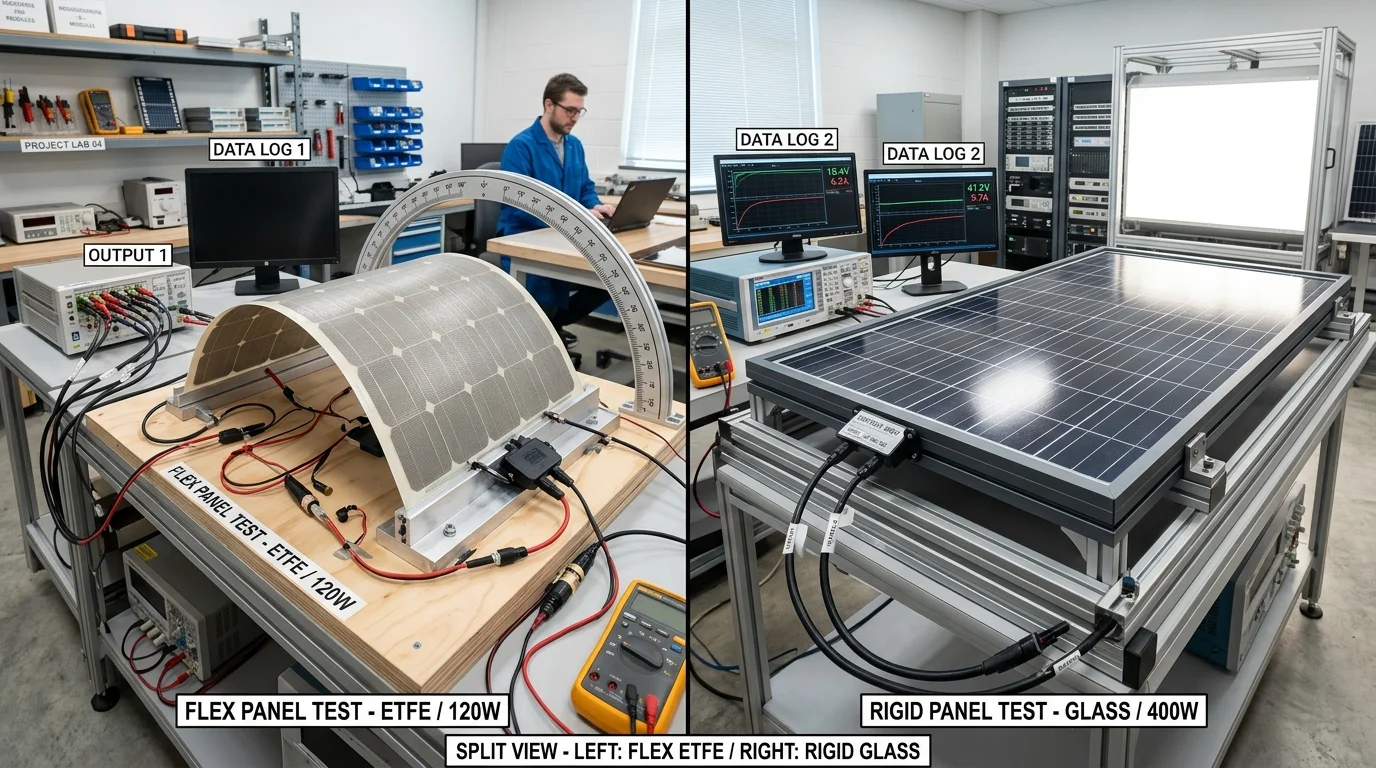
When designing a solar setup for a camper van, boat, off-grid cabin, or RV, the choice between rigid glass solar panels and lightweight flexible solar panels is one of the most critical hardware decisions you will make.
On paper, flexible panels look irresistible: they are paper-thin (typically under 3mm), weigh up to 70% less than traditional modules, require no roof drilling, and curve seamlessly over aerodynamic surfaces.
Yet in real-world off-grid testing, flexible panels have earned a controversial reputation among seasoned electrical engineers. Many owners report that after just two or three summers of intense sun, their flexible arrays produce only a fraction of their original nameplate wattage or suffer from burnt, bubbling plastic delamination.
Rigid tempered-glass solar panels are superior for 90% of installations, delivering a 25+ year lifespan, high impact resistance, and natural convective cooling beneath the aluminum frame. Flexible ETFE panels are 70% lighter and curve over teardrop trailers or boat biminis, but suffer from internal silicon micro-cracks from wind flutter and lack convective airflow—trapping heat up to 80°C (176°F), triggering 20%+ continuous thermal power loss, and typically degrading within 3 to 5 years.
Structural Anatomy: How Flexible and Rigid Panels Are Built
The profound differences in lifespan, heat dissipation, and mechanical durability between rigid and flexible solar panels stem entirely from their internal lamination stack:
Rigid Glass Solar Panel Anatomy
- Top Layer: 3.2mm tempered, low-iron solar glass. Impervious to UV yellowing, scratch-proof, and rated to withstand 1-inch hail at 52 mph (IEC 61215).
- Encapsulant: Dual layers of high-grade EVA (Ethylene Vinyl Acetate) polymer sealing the cells airtight.
- Core: Standard 160μm to 180μm monocrystalline silicon wafers.
- Backsheet: Multi-layer fluoropolymer composite (Tedlar / TPT).
- Structural Frame: Extruded anodized aluminum alloy frame (30mm to 35mm thick) providing torsional rigidity.
Flexible Solar Panel Anatomy
- Top Layer: 0.2mm to 0.5mm ETFE (Ethylene Tetrafluoroethylene) or cheaper PET film. Flexible, but susceptible to surface abrasion and thermal expansion cycles.
- Encapsulant: Thin EVA or POE (Polyolefin) film.
- Core: Ultra-thin monocrystalline or back-contact (IBC / SunPower style) silicon cells.
- Backing Substrate: Thin fiberglass sheet (PCB substrate) or plastic sheet.
- Structural Frame: None. Panel relies entirely on adhesive bonding or eyelets for mechanical stability.
The Micro-Crack Failure Mode: Why “Flexible” Silicon Is a Misnomer For a direct head-to-head field comparison between portable foldable modules and rigid frames, see our breakdown of Folding vs. Rigid Solar Panels.
One of the greatest misconceptions in the solar industry is that flexible solar panels use “flexible silicon.”
Silicon is not rubber; it is a rigid, crystalline semiconductor.
A monocrystalline solar cell has the mechanical flexibility of an ultra-thin sheet of brittle glass. While you can bend a silicon wafer slightly across a wide radius without immediate fracture, any sharp bend, localized pressure, or mechanical vibration will shatter the wafer internally.
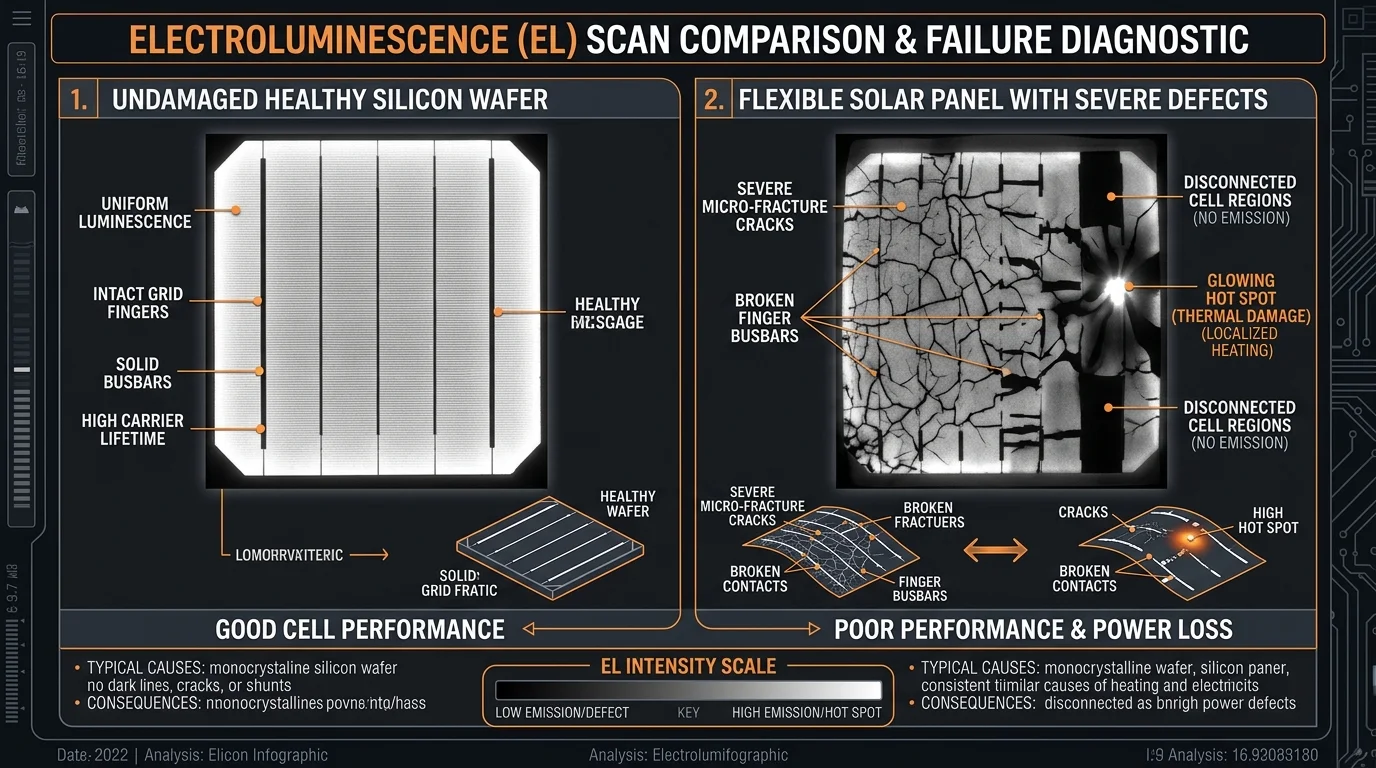
Figure 1: Electroluminescence (EL) diagnostic scan. Undamaged cells (left) show uniform photon emission. Flexible modules subjected to flexing and wind flutter (right) develop extensive spiderweb micro-fractures, severed busbars, and destructive glowing hot spots.
What Causes Micro-Cracking in the Field?
- Exceeding Minimum Bend Radius: Most flexible panel manufacturers specify a maximum bend angle of (or a minimum radius of curvature of 2 meters). In practice, installers frequently flex the panel sharply during handling, cracking the internal wafers before the panel is even glued down.
- Highway Wind Flutter: When flexible panels are secured only by corner grommets or zip ties onto roof racks, highway speeds (65–75 mph) subject the module to intense aerodynamic buffeting. The constant flapping flexes the wafer millions of times, fracturing internal silver busbars.
- Foot Traffic and Accidental Kneeling: Installers working on RV roofs sometimes step or lean a knee onto flexible modules. While the outer ETFE skin bounces back elastically, the silicon underneath crushes like a potato chip.
The Downstream Consequence: Burning Hot Spots
When a micro-crack severs a cell’s electrical grid fingers, the disconnected section can no longer pass generated current. The rest of the series string attempts to push electrical current through the restricted bottleneck.
Under reverse-bias physics, the obstructed cell stops generating power and begins acting as a high-resistance electrical heater. In our lab thermography inspections, these localized hot spots routinely spike above (), melting the polymer encapsulant, causing bubbling delamination, and occasionally scorching the roof beneath.
The Thermal Trap: Lack of Convective Backside Ventilation
Solar panels are semiconductors, and their electrical performance is strongly temperature-dependent. As explained in our STC vs. NOCT real-world solar output guide, silicon loses roughly to of its power for every degree Celsius above ().
Where is the temperature coefficient of maximum power (typically ).
This thermodynamic reality exposes the primary operational flaw of flush-mounted flexible panels:
| Mounting Architecture | Under-Panel Air Gap | Cell Temp (32°C / 90°F Ambient Sun) | Thermal Power Derating | Real Output (400W Array) |
|---|---|---|---|---|
| Rigid Panel on Z-Brackets | 1.5 – 2.0 inches | 55°C (131°F) | -11.4% | ~354 Watts |
| Rigid Panel Flush on Roof Rack | 0.5 – 1.0 inches | 65°C (149°F) | -15.2% | ~339 Watts |
| Flexible Panel Taped to Metal/Fiberglass | 0.0 inches (Zero Airflow) | 80°C (176°F) | -20.9% | ~316 Watts |
Why Flush Mounting Traps Extreme Heat
- Rigid Panels Benefit from the Chimney Effect: When rigid modules are installed using standard 1.5-inch mounting feet, solar heating creates a natural thermal pressure differential. Cool air is sucked underneath the bottom edge and exhausts out the top, maintaining convective cooling.
- Flexible Panels Absorb Vehicle Thermal Mass: When a flexible panel is adhered directly with VHB tape to an RV roof, thermal energy has nowhere to escape except conducting into the vehicle cabin. The dark sheet bakes continuously in stagnant heat, accelerating polymer degradation and reducing instantaneous electrical output by an additional 10% compared to a ventilated glass module.
Detailed Specification Comparison: Rigid vs. Flexible To explore lab-tested watt-per-dollar and efficiency rankings for off-grid travel, check out our guide to the Best Solar Panels for Portable Power Stations.
| Performance Metric | Rigid Tempered Glass Panels | Flexible ETFE Solar Panels |
|---|---|---|
| Weight per 100W Rating | 15 – 19 lbs (6.8 – 8.6 kg) | 3.5 – 5.0 lbs (1.6 – 2.3 kg) |
| Expected Service Lifespan | 25 to 30+ Years | 3 to 5 Years |
| Annual Degradation Rate | < 0.5% per year | 2.0% – 5.0% per year |
| Hail / Impact Resistance | IEC 61215 (1” hail @ 52 mph) | Vulnerable to impact gouging |
| Average Cost per Watt | 1.10 / Watt | 2.80 / Watt |
| Surface Profile / Aerodynamics | 1.5” to 2.5” height clearance | < 3mm ultra-low profile |
| Seasonal Tilt Adjustability | Easy with tilting brackets | Difficult; permanently glued flat |
ETFE vs. Cheap PET: Not All Flexible Panels Are Equal
If your project legitimately requires flexible panels, understanding the top-sheet polymer chemistry is paramount. Flexible panels sold online fall into two distinct material tiers:
Cheap PET (Polyethylene Terephthalate)
- How to Spot Them: High-gloss, smooth plastic surface, rock-bottom price ($80–$100 for 100W).
- The Engineering Flaw: PET is not UV-stable for long-term outdoor exposure. Under intense sunlight, UV radiation breaks the molecular bonds of the polymer within 12 to 18 months. The top sheet turns milky yellow, blocks light transmission to the cells, turns brittle, and cracks. Never buy PET panels for permanent outdoor mounting.
High-Grade ETFE (Ethylene Tetrafluoroethylene)
- How to Spot Them: Textured, dimpled, non-reflective matte finish resembling orange peel.
- The Advantages: ETFE is a fluoropolymer with exceptional chemical and thermal resistance. It does not degrade under UV light, offers high light transmittance (95%), and its non-stick surface allows rainwater to wash away soot and dirt. High-grade ETFE panels paired with SunPower Maxeon back-contact cells represent the most durable flexible modules on the market.
When Does It Actually Make Sense to Buy Flexible Panels?
Despite their shorter lifespan and thermal penalties, flexible solar panels solve real engineering problems that rigid glass panels cannot:
- Severely Curved Roofs: The curved nosecone of an Airstream trailer, teardrop campers, or rounded fiberglass van caps cannot accommodate flat, rectangular glass panels without massive protruding brackets that create immense wind drag.
- Marine Bimini Tops & Sailboat Canvas: Fabric biminis and boat dodgers cannot support the 40-pound static weight of a framed glass panel, let alone the dynamic loads caused by ocean swells. Flexible ETFE panels can be sewn with heavy-duty marine zippers or secured with marine-grade turn-button fasteners directly onto canvas.
- Weight-Constrained EV & Van Builds: In weight-critical builds where remaining under vehicle gross vehicle weight rating (GVWR) is tight, saving 80 to 120 pounds across a multi-panel array is a compelling engineering tradeoff.
When Rigid Glass Panels Are Mandatory
In almost all other applications, rigid panels are the only sensible economic and technical choice:
- Off-Grid Cabins and Sheds: There is no weight penalty, roofs are flat or pitched, and you want panels that will quietly generate electricity for 25 to 30 years without maintenance (see our cabin energy budget sizing guide).
- Flat Van & RV Roofs with Clear Racks: If you have roof rack crossbars or flat space, standard rigid panels mounted on 1.5-inch brackets provide superior ventilation and allow you to adjust tilt angles for winter sun (see our optimal solar tilt angle guide).
- High-Power Solar Generator Charging: Large power stations like the EcoFlow Delta Pro 3 and Bluetti AC200L or the industrial Anker Solix F3800 accept solar inputs ranging from 1,000W to 2,400W. Sizing arrays of this magnitude with flexible panels requires dozens of failure-prone adhesive joints and costs thousands of dollars more than standard residential-format rigid panels.
Engineering Recommendation: How to Mount Flexible Panels Safely
If your application demands flexible solar panels, follow these three laboratory-tested mounting rules to prevent premature failure:
- Mount with a Corrugated Twin-Wall Air Gap: Instead of gluing flexible panels directly to metal roof sheet, adhere them first to a sheet of 4mm corrugated plastic (Coroplast) or aluminum twin-wall sheeting. The internal flutes allow passive air to flow beneath the panel, dropping operating temperatures by to .
- Never Exceed a 20° Bend Angle: Even if the manufacturer claims a 30° bend radius, keep curvature under to . Never bend a panel across its short width if you can bend it across its length.
- Firmly Fasten the Leading Edge: If installed on a vehicle, apply heavy-duty 3M VHB 5952 tape along the entire leading edge with zero gaps. If highway air forces its way beneath the front lip, aerodynamic lift will peel the panel off or vibrate it into microscopic ruin.
Frequently Asked Questions
Can you walk on flexible solar panels?
No. Despite marketing claims from some sellers boasting that flexible panels are “walkable on marine boat decks,” doing so is guaranteed to ruin the panel. While the rubbery ETFE top layer may not show a visible dent, the brittle crystalline silicon wafer underneath fractures easily under localized foot pressure. These invisible micro-cracks turn into resistive hot spots within months.
How long do flexible solar panels really last?
In continuous year-round outdoor installations under direct sun, high-quality ETFE flexible panels typically last 3 to 5 years before showing notable power loss, yellowing, or cell failure. Budget PET panels often fail in under 2 years. By comparison, rigid glass panels routinely operate past 25 to 30 years with over 80% remaining capacity.
Are flexible panels more efficient than rigid panels?
No. Both types utilize monocrystalline silicon wafers, meaning cell-level efficiency is virtually identical (typically 21% to 23%). However, in real-world midday sun, flexible panels operate significantly hotter due to zero backside airflow. Because silicon loses power as it heats up, a flexible panel produces roughly 8% to 12% less real-world energy over the course of a hot summer day than an identically rated rigid panel.
Can you connect flexible panels in series with rigid panels?
You should avoid mixing flexible and rigid panels in the same series string. Because flexible panels run hotter, their operating voltage () drops further than rigid panels under midday sun. In a series string, current () is constrained by the lowest-performing panel, and voltage differences lead to MPPT tracking inefficiencies. Always keep separate chemistries or physical form factors on separate strings (review our series vs. parallel solar wiring guide).
What is the best adhesive to mount flexible panels on an RV?
The professional industry standard is 3M VHB 5952 double-sided acrylic foam tape or a structural marine polyurethane sealant like Sikaflex 252. Ensure both surfaces are thoroughly degreased with 70%+ isopropyl alcohol and primed before bonding. Avoid cheap silicone caulk, which lacks the shear strength to hold panels against 75-mph highway wind drag.