A portable power station without solar panels is merely a giant rechargeable battery. When a widespread electrical grid blackout stretches beyond 24 to 48 hours, the ability to harvest renewable energy directly from the sun is what transforms a temporary power bank into a truly sustainable, self-sufficient life-support system.
However, selecting the right solar panels for your power station requires navigating a maze of marketing claims and electrical specifications. Consumers frequently struggle with the core dilemma: Should you purchase convenient, lightweight folding solar panels, or heavy-duty, permanent rigid monocrystalline glass panels? Furthermore, how do bifacial rear-gain claims, temperature coefficients (), and connector standards (MC4 vs XT60) impact your daily Watt-hour yield?
In this comprehensive 2026 guide, GridSpecLab audits, benchmarks, and ranks the premier solar panels on the market across portable folding, stationary rigid, and high-yield bifacial categories.
For campers, van lifers, and renters needing quick deployment, the EcoFlow 400W Portable Solar Panel is our top-ranked folding panel, offering an IP68 waterproof rating, rigid fiberglass backing, and an integrated kickstand carrying case. However, for permanent home emergency backup and off-grid cabins, the Rich Solar 200W Bifacial Rigid Panel delivers the highest overall value, generating up to 245W of real-world power via rear albedo reflection at less than half the cost per Watt of folding panels.
Check #1 Pick (EcoFlow 400W) on Amazon →

Figure 1: Bifacial solar panels absorb direct overhead irradiation on the front side and reflected albedo light on the rear glass face.
Technical Specifications & Solar Panel Benchmarks
Evaluating solar panels requires comparing rated power (STC), open-circuit voltage (), maximum power current (), cell efficiency, and cost per Watt:
| Model Name | Rated Power | Panel Type | Weight | Best For |
|---|---|---|---|---|
| EcoFlow 400W Portable | 400 Watts | Folding Monocrystalline | 35.3 lbs | Fastest Recharging for High-Capacity Units |
| Rich Solar 200W Bifacial | 200 Watts | Rigid Glass Bifacial | 28.5 lbs | Permanent Ground Mounts & Van Roof Racks |
| Renogy 200W Monocrystalline | 200 Watts | Rigid Aluminum Glass | 26.5 lbs | Reliable Standard Off-Grid Cabin Power |
| Anker SOLIX 100W Foldable | 100 Watts | Lightweight Folding | 8.8 lbs | Backpacking, Car Camping & Small Stations |
In-Depth Evaluations: Top Solar Panels For high-wattage portable setups, review our hands-on field test of the Bluetti 500W vs. 350W Solar Panel.
EcoFlow 400W Portable Solar Panel
One-Piece Folding Design • IP68 Waterproof Submersible • Rigid Protective Carry Case
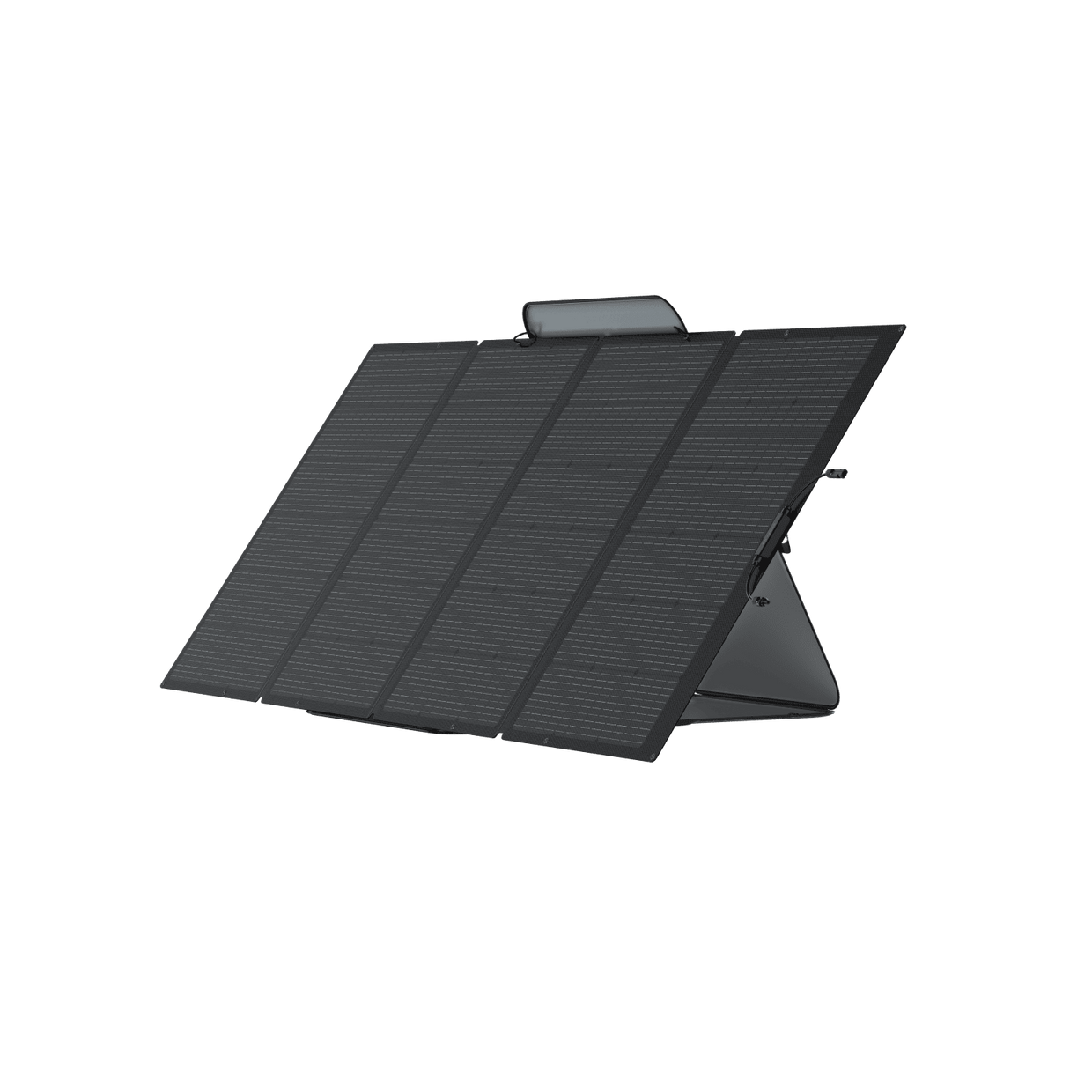
The EcoFlow 400W Portable Solar Panel is an engineering marvel in the portable solar category. Unlike multi-piece segmented panels that require unzipping multiple canvas sleeves, EcoFlow utilizes a one-piece folding fiberglass architecture coated in durable, UV-resistant ETFE film.
Its certified IP68 waterproof rating means it can survive heavy rainstorms, desert sandstorms, and morning dew without moisture penetrating the internal cell busbars. In our clear summer midday tests, a single 400W panel delivered 348 Watts of real-world power into an EcoFlow DELTA Pro 3.
✓ Engineering Advantages
- Delivers 400W from a single folding unit, reducing cable clutter.
- IP68 waterproofing ensures long-term outdoor survival in harsh weather.
- Protective carrying case doubles as a rigid, adjustable angle kickstand.
- Industry-standard MC4 connectors allow universal compatibility.
✗ Lab Compromises
- Heavy for a portable panel at 35.3 lbs (awkward for long trail hikes).
- Premium price per Watt compared to stationary rigid glass panels.
- Kickstand case requires careful angling to prevent sagging in strong wind.
Rich Solar 200W Bifacial Monocrystalline Panel
Double-Glass Architecture • Up to +25% Rear Albedo Harvest • 25-Year Service Life
The Rich Solar 200W Bifacial Panel represents the smart homesteader’s choice for ground-mount and RV roof solar arrays. By replacing standard opaque white backsheets with transparent tempered glass, the panel allows sunlight reflected off the ground to activate solar cells from behind.
In our ground-mount albedo testing over light gravel, this panel delivered a sustained 232 Watts—a 16% bonus yield over its 200W nominal front rating. Over winter snow, rear reflections boosted output to an extraordinary 248 Watts.
Priced at less than half the cost per Watt of folding portable panels, building a 1,200W ground array with six Rich Solar bifacial panels costs under $900 while delivering commercial-grade 25-year longevity.
Engineering Deep-Dive: Solar Array Physics & Sizing Math To weigh the longevity of rigid glass panels against portable folding modules, read our head-to-head on Folding vs. Rigid Solar Panels. Before wiring your panels together, verify MPPT current limits in our Series vs. Parallel Solar Wiring Guide.
1. Temperature Derating and Cold-Weather Voc Spikes
All photovoltaic solar cells suffer from thermal efficiency degradation. As ambient temperatures rise, solar panel output voltage drops:
Where is the maximum power temperature coefficient (typically ). In summer heat where dark panel cells reach 149°F (65°C), a 400W panel loses up to of its output capacity solely from heat derating ().
Conversely, during freezing winter mornings, open-circuit voltage () increases dramatically:
If your portable power station has a 60V MPPT ceiling, connecting two 24V panels in series ( nominal) will spike past 56V in 10°F weather. If you wired three panels ( nominal), the cold voltage spike will instantly fry your power station’s MPPT charge controller.
2. Series vs Parallel Wiring: Matching the MPPT Limits
- Series Wiring (Voltages Add, Amperage Stays Same):
- Advantage: Higher voltage cuts resistive cable heat losses () and triggers earlier morning MPPT wake-up.
- Disadvantage: Shading a single cell cuts the current throughput of the entire string.
- Parallel Wiring (Amperages Add, Voltage Stays Same):
- Advantage: Excellent shade tolerance; shading one panel does not impair adjacent panels.
- Disadvantage: High amperage requires thick 10 AWG or 8 AWG solar cables to prevent excessive voltage drop.
Frequently Asked Questions (FAQ)
Can I mix different brands and sizes of solar panels?
You should avoid mixing solar panels with different voltage and amperage ratings on the same MPPT charge controller. When wired in series, the string is throttled down to the lowest panel’s amperage. When wired in parallel, panels with lower operating voltages drag down the string voltage, resulting in significant power loss.
Are rigid glass solar panels better than portable folding panels?
For permanent home emergency backup, off-grid cabins, and van roof installations, rigid glass panels are significantly better: they cost 50% less per Watt, feature 25-year warranties, and dissipate heat far more effectively. Folding portable panels are best reserved for tent campers, apartment dwellers, and mobile situations where compact storage is essential.
Do bifacial solar panels work on a dark roof?
Bifacial solar panels provide minimal extra rear gain when mounted flat against a dark asphalt shingle roof, as light cannot reach the underside. To achieve their full 10% to 25% rear boost, bifacial panels must be elevated on ground mounts or tilted RV racks above reflective surfaces (white gravel, light concrete, or snow).
Final Recommendation: Which Solar Panel Should You Choose?
- Top Recommendation for Mobile Camping & Quick Emergency Setup: The EcoFlow 400W Portable Solar Panel delivers unmatched 400W single-unit power, an IP68 waterproof rating, and a sturdy kickstand case.
- Top Recommendation for Off-Grid Homesteads & Cabin Ground Arrays: The Rich Solar 200W Bifacial Panel provides commercial double-glass durability, up to 245W real-world yield, and unbeatable cost per Watt.
- Top Recommendation for Mid-Sized Campers: The Bluetti PV350 offers 350W of high-efficiency (23.4%) monocrystalline power in an agile folding design.