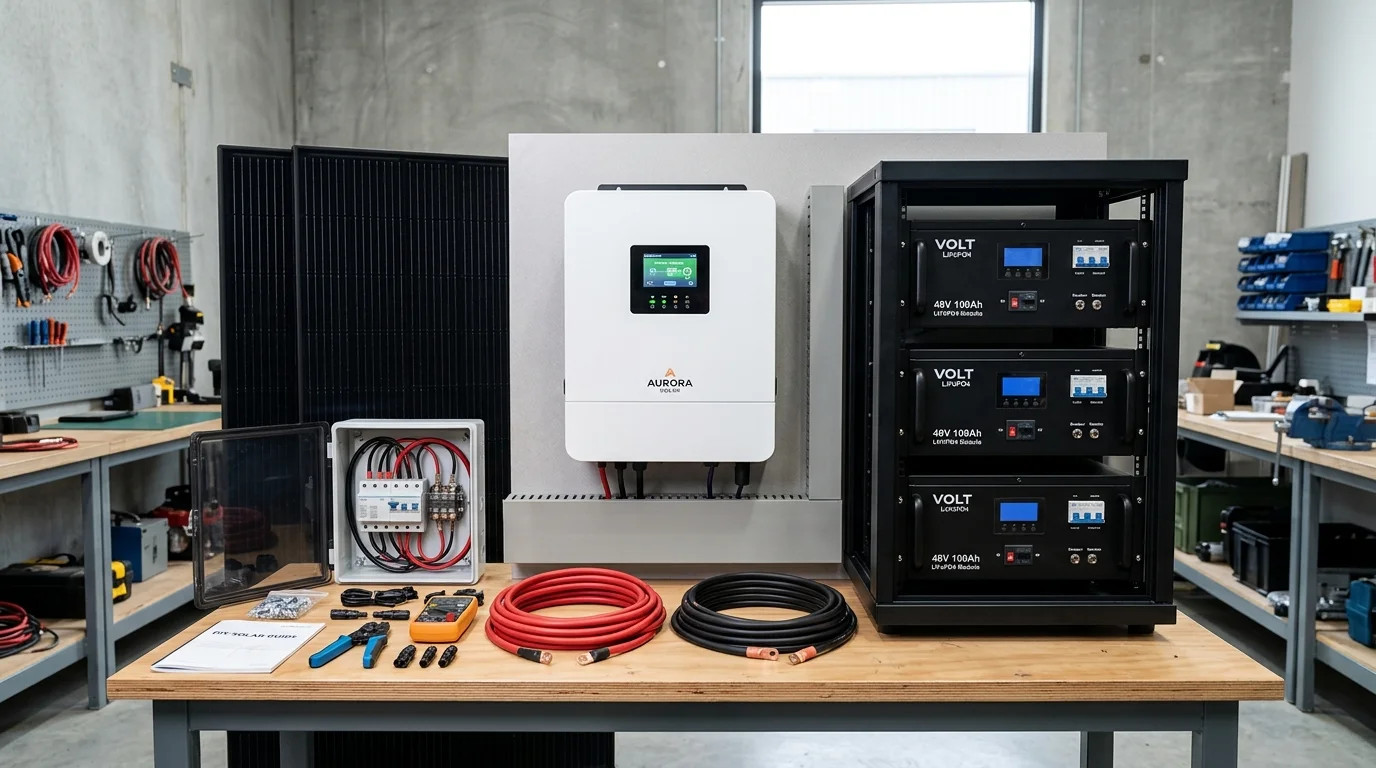
Solar energy engineering can feel overwhelming. Between confusing marketing terms, contradictory online forum advice, and complex electrical formulas involving volts, amps, watt-hours, and depth of discharge, beginners often stall before purchasing their first component.
The secret to mastering solar power is recognizing that every system—whether a compact 500Wh camping battery or a 30kWh whole-home off-grid power plant—operates on the exact same physical laws.
This master guide serves as your comprehensive learning roadmap. We structure the journey across three progressive tiers:
- Tier 1 (Beginner): Plug-and-play portable power stations, basic energy audits, and off-grid basics.
- Tier 2 (Intermediate): Custom 12V/24V mobile builds, MPPT charge controllers, DC busbars, and conductor sizing.
- Tier 3 (Advanced): High-voltage 48V split-phase (120V/240V) architectures, closed-loop lithium communication, and whole-home transfer switching.
Portable Power Stations
All-in-one enclosed units combining battery, pure sine wave inverter, and MPPT solar controller. Zero wiring required.
- Capacity: 500Wh to 3,000Wh
- Voltage: 120V AC output
- Use case: Blackouts, camping, CPAP
12V / 24V Custom Mobile Systems
Independent discrete components: LiFePO4 drop-in batteries, standalone MPPT charge controllers, DC fuses, and discrete inverters.
- Capacity: 2.5kWh to 10kWh
- Voltage: 12V or 24V DC bus
- Use case: RVs, campervans, tiny cabins
Whole-Home 48V Off-Grid Plants
Utility-grade hybrid all-in-one inverters paired with 48V server-rack lithium banks delivering 120V/240V split-phase power.
- Capacity: 14kWh to 60kWh+
- Voltage: 48V DC bus / 240V AC
- Use case: Full off-grid homes, workshops
Tier 1: Beginner Fundamentals & Portable Solar Generators
For newcomers to renewable energy, diving headfirst into high-voltage wiring and electrical conduit often leads to mistakes. Modern portable solar generators have revolutionized energy independence by packaging an entire balance-of-systems inside a safe, UL-certified chassis.
The Anatomy of an All-in-One Solar Generator
A portable power station contains four synchronized components:
- LiFePO4 Lithium Battery Cells: Modern units use Lithium Iron Phosphate cells rated for 3,000 to 4,000 cycles to 80% capacity (10+ years of daily cycling).
- Battery Management System (BMS): Microprocessor protection circuitry monitoring individual cell voltages, temperature sensors, and overcurrent limits.
- Pure Sine Wave AC Inverter: Converts internal low-voltage DC into clean 120V household electricity safe for sensitive electronics.
- MPPT Solar Charge Controller: Maximum Power Point Tracking logic that sweeps solar panel voltage 30+ times per second to squeeze maximum wattage out of the array.
First-Principles Energy Auditing
Before purchasing any solar generator, you must calculate your exact daily power requirement in Watt-Hours (Wh):
Where is continuous running wattage and is daily hours of operation.
Example Emergency Outage Load:
- 12V/AC Refrigerator: 120W running (35% compressor duty cycle) = 1,000 Wh/day
- Wi-Fi Router / Starlink: 60W continuous × 24 hrs = 1,440 Wh/day
- Smartphone & Laptop Charging: 100W × 3 hrs = 300 Wh/day
- LED Emergency Lighting: 20W × 5 hrs = 100 Wh/day
Total Daily Consumption: ~2,840 Wh
To survive 24 hours comfortably without sunshine, you need a minimum 3,000Wh battery reserve or a 2,000Wh station paired with 400W of solar harvesting.
Explore our dedicated Power Station Capacity Sizing Guide for step-by-step formulas.
Tier 2: Intermediate Systems & 12V/24V Mobile Builds
When your power needs exceed 3,000Wh—or when you want a permanently installed system inside an RV, van, or hunting camp—custom discrete components offer superior modularity and cost efficiency.
Charge Controllers: PWM vs MPPT
A solar panel rarely outputs the exact voltage your battery requires to charge. A charge controller bridges this electrical gap:
- Pulse Width Modulation (PWM): An electronic switch that forces solar panel voltage down to battery voltage. PWM controllers discard up to 30% of potential solar harvesting power. They are only appropriate for small arrays under 150W on tight budgets.
- Maximum Power Point Tracking (MPPT): A high-efficiency DC-to-DC buck converter. An MPPT takes higher voltage, low-amperage power from the panels and down-converts it to optimal battery charging voltage while boosting charging current. MPPT controllers achieve 97% to 99% conversion efficiency.
DC Conductor Sizing and Ampacity Rules
In low-voltage DC systems, voltage drop is your primary enemy. As current () travels through a conductor with resistance (), voltage drops according to Ohm’s law (), generating waste heat.
To prevent inverter low-voltage cutoffs and cable overheating:
- Keep DC voltage drop under 2% to 3% on critical battery-to-inverter runs.
- Always install an overcurrent protection device (Class T fuse or MRBF terminal fuse) within 7 inches of the battery’s positive post.
- Review our detailed guide on DC Breakers and Fuses for Solar Battery Systems.
Tier 3: Advanced Off-Grid Engineering & 48V Split-Phase Systems
When sizing a whole-home off-grid system capable of running central air conditioning, well pumps, electric water heaters, and EV chargers, you must transition to 48V DC bus architectures and 120V/240V split-phase power.
Why 48 Volts is the Standard for Whole-Home Solar
Ohm’s Law dictates that Power equals Voltage times Current (). To deliver 6,000 Watts of continuous AC power:
- At 12 Volts: Requires 500 Amps of continuous current. Conductor size must be massive 4/0 AWG dual-runs, and heavy copper busbars are required.
- At 24 Volts: Requires 250 Amps of current. Requires thick 4/0 AWG cable and heavy-duty 300A fuses.
- At 48 Volts: Requires only 125 Amps of current. Easily handled by manageable 2/0 AWG welding cable and standard 150A breakers.
By quadrupling system voltage from 12V to 48V, internal resistive thermal line losses are reduced by sixteen times ().
Calculating Winter Cold-Temperature Voc ()
The most destructive mistake advanced DIYers make is exceeding an inverter’s Maximum Solar Input Voltage (). Solar panels produce higher voltage as ambient temperature drops:
Where:
- = Open-circuit voltage at Standard Test Conditions (25°C / 77°F).
- = Temperature coefficient of (typically to , expressed as a negative decimal).
- = Historical record low temperature at your installation site in Celsius.
If your inverter has a 500V max PV limit, a solar string designed for 460V at 25°C can spike to 540V on a 0°F winter morning, instantly frying the inverter’s input capacitors.
Read our full analysis on Bifacial Solar Panels and Ground Mount Albedo and 120V vs 240V Split-Phase Home Backup.
Comprehensive Solar Architecture Comparison
| Metric / Feature | Tier 1: Portable Power Station | Tier 2: 12V/24V Custom Mobile | Tier 3: 48V Split-Phase Plant |
|---|---|---|---|
| Typical Usable Storage | 1,000 Wh – 3,800 Wh | 2,500 Wh – 10,000 Wh | 14,000 Wh – 60,000 Wh+ |
| Continuous Inverter Output | 1,800W – 3,600W (120V) | 2,000W – 3,000W (120V) | 6,000W – 18,000W (120V/240V) |
| Solar PV Input Capacity | 400W – 1,600W (60V–150V) | 600W – 1,800W (100V–150V) | 3,000W – 16,000W (500V MPPT) |
| Heavy Appliance Capability | Sump pump, mini-fridge, tools | RV A/C, 12V compressor fridge | 240V Well pumps, HVAC, dryers |
| Installation Difficulty | Zero (Plug-and-play) | Intermediate (Crimps, fuses) | Advanced (NEC compliance, conduit) |
| Estimated Cost Range | $800 – $2,500 | $2,000 – $5,500 | $6,500 – $18,000+ |
Top-Tier Recommended Solar Hardware
Depending on which tier matches your power requirements and electrical confidence, here are three proven hardware benchmarks evaluated on the GridSpecLab engineering bench:
1. EcoFlow DELTA Pro 3 Portable Power Station (Beginner Sweet Spot)
The EcoFlow DELTA Pro 3 represents the pinnacle of Tier 1 plug-and-play engineering. It delivers 120V/240V dual-voltage capability out of the box, making it capable of running heavy home appliances without requiring an electrician to wire custom busbars.

EcoFlow DELTA Pro 3
Features a massive 4,000W continuous pure sine wave inverter with dual 120V/240V output, 2,600W multi-charge solar input, and ultra-quiet operation under heavy loads.
Check Current Price & Promotions →
2. EG4 6000XP All-in-One Off-Grid Inverter (Intermediate to Advanced)
For builders constructing a cabin, workshop, or full off-grid residence, the EG4 6000XP eliminates discrete charge controllers and external transfer switches by integrating everything into a high-performance wall-mount chassis.
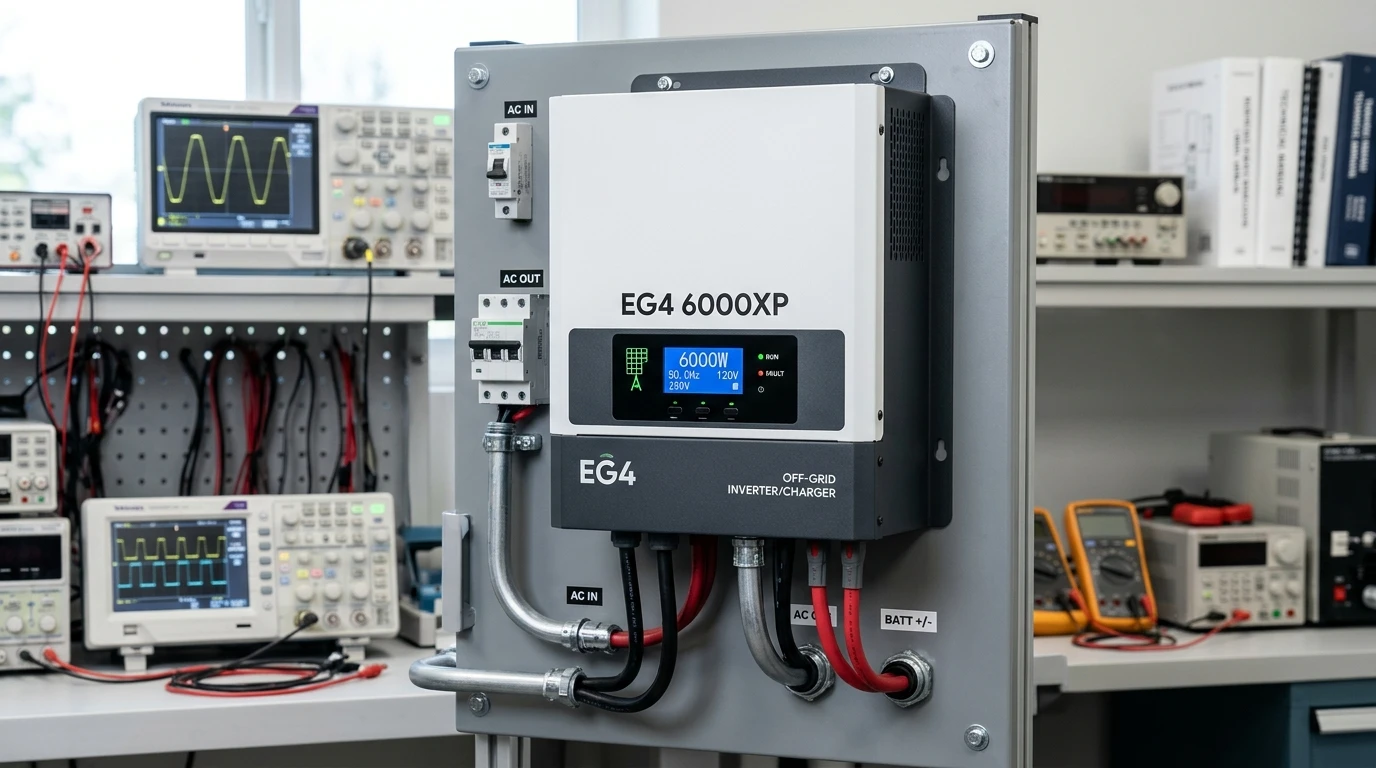
EG4 6000XP Split-Phase Hybrid Inverter
Provides native 120V/240V split-phase power without external autotransformers. Boasts dual MPPT solar trackers supporting up to 8,000W of solar PV input at up to 480VDC.
View EG4 6000XP Specs on Signature Solar →
3. Signature Solar Complete 48V Off-Grid Solar Kit (Full System Turnkey)
If you want the power of a commercial off-grid system without the headache of sourcing mismatched panels, cables, fuses, and racking independently, pre-engineered kits offer maximum peace of mind.
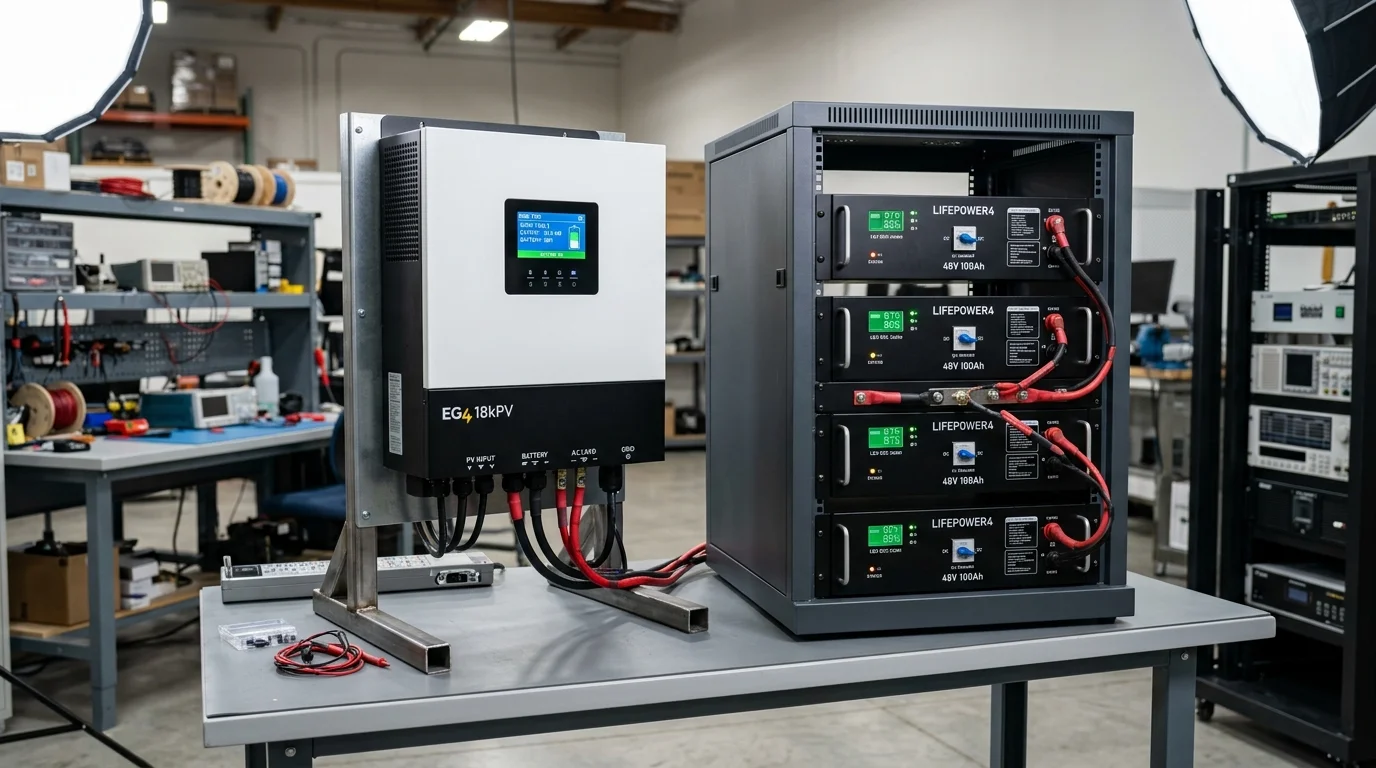
Signature Solar EG4 Complete Solar Kit
A fully matched system combining Tier-1 bifacial solar panels, an EG4 hybrid inverter, modular 48V LiFePO4 server rack batteries, pre-wired breakers, and complete balance-of-system wiring.
Explore Complete Turnkey Solar Kits →
Critical Solar Installation Mistakes to Avoid
Connecting Solar Before Battery
Always connect your battery bank to the charge controller before connecting your solar panel array. If high-voltage solar DC enters the controller without an active battery reference voltage, the controller’s internal voltage regulator can lock up or permanently burn out.
Charging Lithium Below 32°F
Discharging LiFePO4 in cold weather is safe down to -4°F (-20°C), but charging below freezing (32°F / 0°C) plates metallic lithium onto the anode, permanently destroying cell capacity. Always verify your BMS has low-temperature charging cutoff protection enabled.
Undersizing Neutral Conductors
In 120V/240V split-phase systems with unequal line-to-neutral loads, the neutral conductor carries unbalanced return current. Running an undersized neutral wire creates high-resistance heating and can cause dangerous neutral-floating voltage spikes across sensitive home electronics.
Ignoring Inverter Standby Tare Loss
Large 6kW to 12kW off-grid inverters consume 35W to 70W just remaining powered on in standby mode. Over a single cloudy day, an idling inverter burns 840Wh to 1,680Wh of stored battery power before running a single household lightbulb.
Curated Learning Hub: Essential Guides & Calculators
Continue mastering solar engineering with our in-depth technical guides:
- Sizing Battery Capacity for Your Solar Power System
- 120V vs 240V Split-Phase Home Backup: Engineering Comparison
- DC Breakers and Fuses for Solar Battery Systems
- Cold Weather Lithium Charging: Protecting Cells Below Freezing
- Bifacial Solar Panels on Ground Mounts: Maximizing Albedo Gains
- Peak Shaving Explained: How to Cut Utility Electric Bills
Frequently Asked Questions (FAQ)
Should a beginner start with a DIY system or a portable power station?
If your primary goal is emergency home backup during storms, van camping, or running a CPAP machine, start with a portable power station (such as an EcoFlow DELTA or Anker SOLIX). They require zero wiring, carry UL certifications, and cannot be miswired. If you need whole-house split-phase backup or want to expand your system over time beyond 10kWh, invest the time to build a 48V modular system.
How much solar power do I need for an off-grid home?
Most off-grid homes consuming an average of 15kWh to 20kWh per day require a solar array sized between 5kW and 8kW (twelve to twenty 400W panels) paired with a 15kWh to 30kWh battery bank. This provides enough generation to replenish battery storage during typical winter days with 3.5 peak sun hours.
Can I mix different brands or sizes of solar panels in one string?
No. Panels wired in series must share identical current ratings (Imp); the lowest-amperage panel in the string will throttle all other panels. Panels wired in parallel must share identical voltage ratings (Vmp); mismatched parallel voltages cause current to circulate between strings, generating heat and losing power. Always use identical panel models within the same MPPT tracker string.
What is the lifespan of modern LiFePO4 solar batteries?
High-grade Lithium Iron Phosphate cells are rated for 4,000 to 6,000 cycles to 80% State of Health (SoH). When cycled once per day under proper temperature conditions, a quality LiFePO4 battery bank will last between 10 and 15 years before experiencing noticeable capacity degradation.