While solar panels and lithium battery power stations offer clean, silent, and emission-free emergency electricity, winter storms and extended multi-day weather fronts can choke solar photovoltaic production down to less than 10% of rated capacity.
In engineering terms, relying exclusively on solar arrays to recharge a battery bank during a prolonged winter emergency creates an unacceptable single point of failure. This is where dual-fuel pure sine wave inverter generators become indispensable. Operating as an auxiliary power reserve, an inverter generator runs for just 1.5 to 3 hours to bulk-charge your battery bank, allowing the batteries to silently carry your household loads for the next 24 to 48 hours without burning fuel continuously.
However, selecting a generator to pair with sensitive lithium power stations requires strict electrical auditing: Total Harmonic Distortion (THD < 3%), clean sine wave stability under sudden load steps, propane derating coefficients, and dry-contact auto-start compatibility.
In this 2026 technical guide, GridSpecLab audits and ranks the top smart generators and dual-fuel inverter units engineered specifically for solar battery pairing.
For homeowners with EcoFlow power stations (DELTA 2, DELTA Pro 3, DELTA Pro Ultra), the EcoFlow Smart Generator (Dual Fuel) is the undisputed top choice. Utilizing direct DC-to-DC charging, automated dry-contact startup when battery State of Charge (SOC) drops, and full smartphone app monitoring, it delivers unmatched fuel efficiency. For universal whole-home systems, EG4 inverters, and heavy 240V split-phase charging, the Champion 8500-Watt Dual Fuel Inverter is our top heavy-duty recommendation, delivering textbook pure sine wave power (<3% THD) and electric remote start on propane.
Check #1 Pick (EcoFlow Smart Generator Dual Fuel) on Amazon →
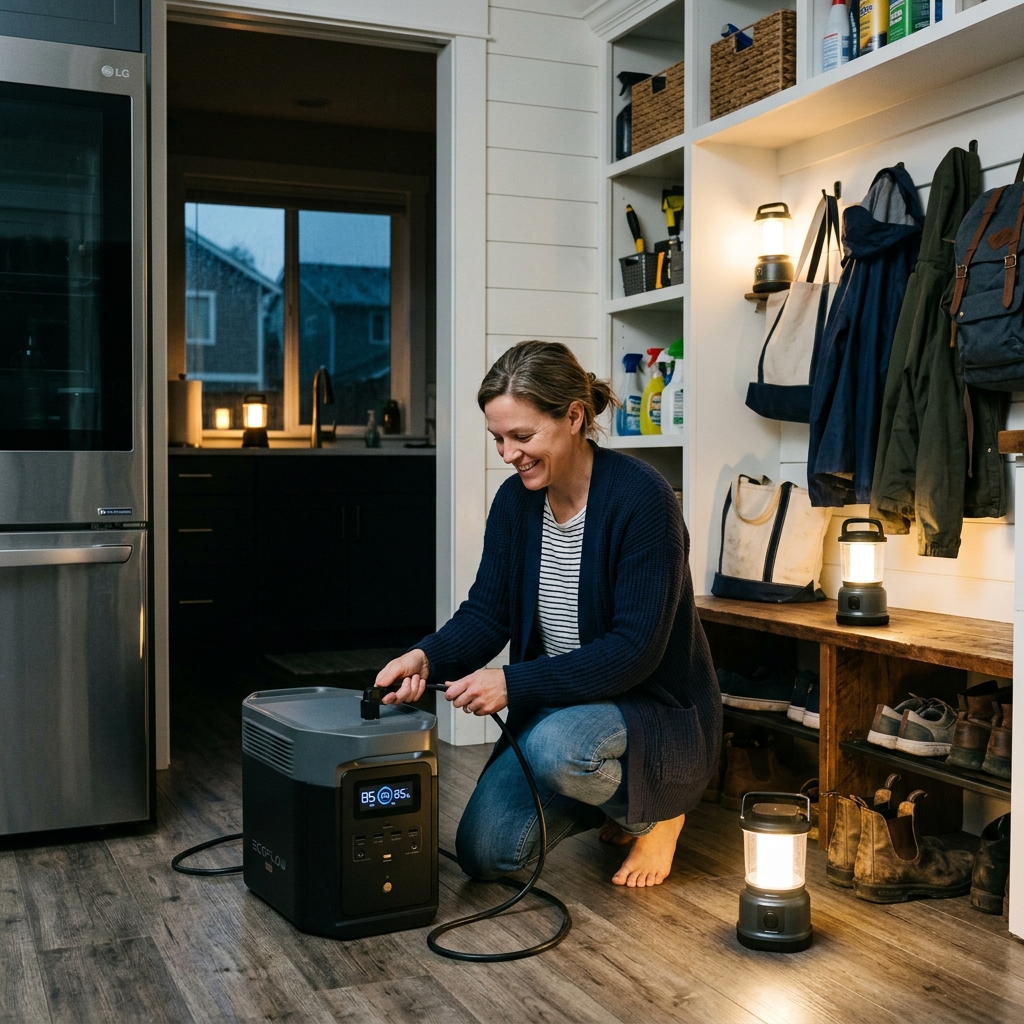
Figure 1: Pairing an inverter generator with a solar battery bank provides complete emergency power resilience during extended grid outages.
Technical Specifications & Inverter Generator Benchmarks
Connecting a fossil-fuel generator to expensive lithium battery inverters requires strict evaluation of harmonic distortion, fuel capacity, and rated running watts on both gasoline and propane (LPG):
| Model Name | Running Power (Watts) | Fuel Type | Weight | Best For |
|---|---|---|---|---|
| EcoFlow Smart Generator | 1,800W (Gas) / 1,600W (LPG) | Dual Fuel | 67.2 lbs | Direct DC Charging for EcoFlow DELTA Series |
| Champion 8500-Watt | 7,000W (Gas) / 6,300W (LPG) | Dual Fuel | 207 lbs | Whole-House Heavy Backup & 240V Inverters |
| Westinghouse iGen4500DFc | 3,700W (Gas) / 3,330W (LPG) | Dual Fuel | 105 lbs | Quiet Inverter Pairing for Large Battery Banks |
In-Depth Evaluations: Top Generators for Solar Backup
EcoFlow Smart Generator Dual Fuel (Gasoline & LPG)
Direct DC-to-DC Rapid Charging • Automated Battery Level Auto-Start • App Connected
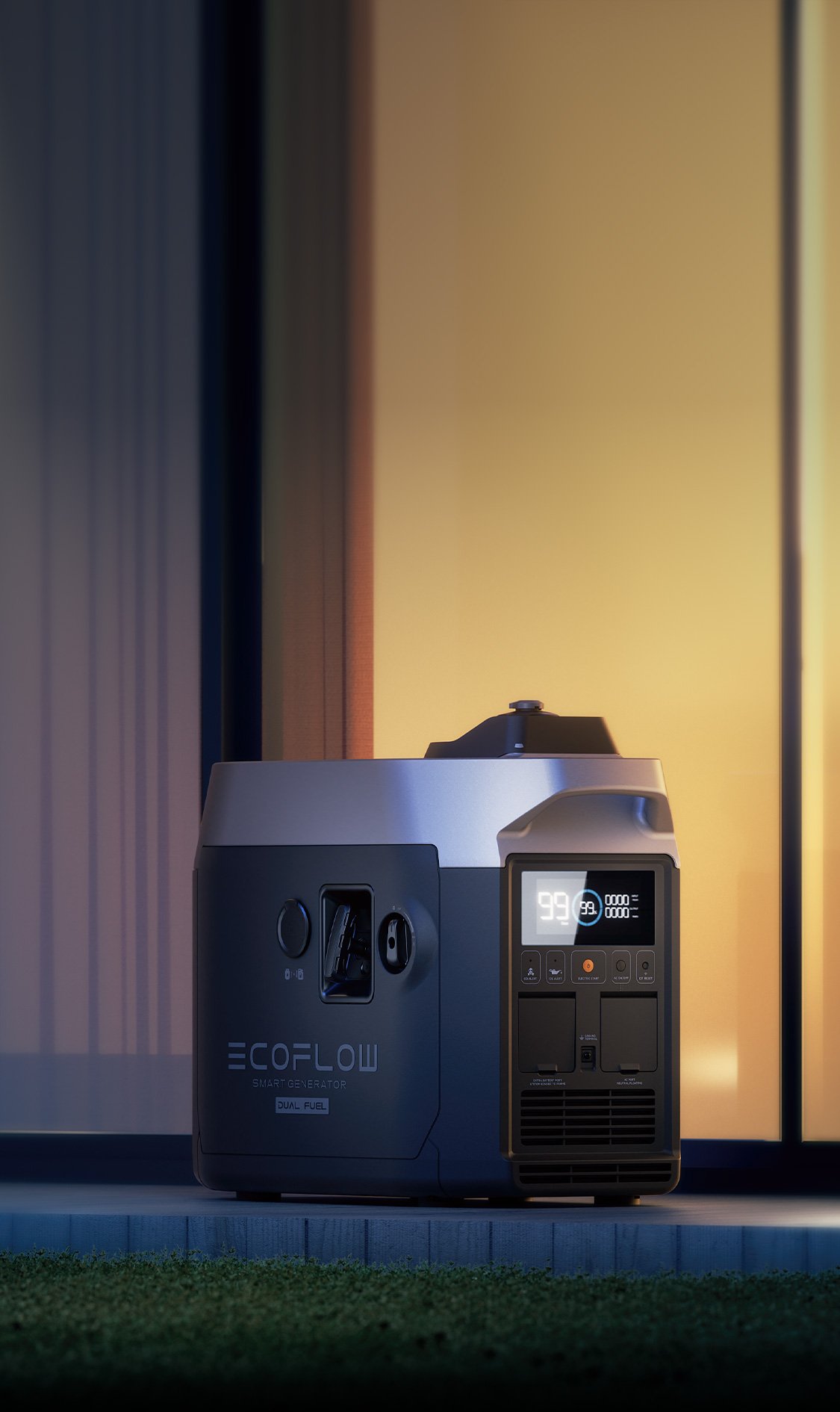
The EcoFlow Smart Generator (Dual Fuel) is the premier intelligent companion for solar battery ecosystems. Standard generators produce AC power, which the portable power station’s internal charger must convert back into DC electricity to fill the battery cells. This double-conversion cycle wastes 15% to 20% of your fuel in heat losses.
EcoFlow solves this through a dedicated extra battery cable connection that feeds high-current DC power directly from the generator’s internal alternator into the battery. This direct DC-to-DC path saves up to 40% in fuel consumption and cuts battery recharge times by 30%.
Even more impressively, it communicates directly with your DELTA Pro 3, DELTA Pro Ultra, or DELTA 2 Max. When battery State of Charge (SOC) drops below your configured threshold (e.g. 20%), the generator automatically starts itself, bulk-charges the battery pack up to 80%, and safely shuts down without requiring manual user intervention.
✓ Engineering Advantages
- Direct DC charging eliminates AC conversion losses, maximizing fuel efficiency.
- Automated smart start/stop triggered directly by battery State of Charge.
- Propane compatibility allows multi-year fuel storage without carburetor gumming.
- Comprehensive real-time telemetry, maintenance alerts, and fuel monitoring via app.
✗ Lab Compromises
- 1,800W continuous output cannot recharge multiple large battery banks simultaneously.
- Proprietary DC charging port only works with EcoFlow DELTA series power stations.
- Premium price tag compared to generic manual-start portable generators.
Champion 8500-Watt Dual Fuel Inverter (7,000W Running)
True 120V/240V Pure Sine Wave • THD <3% • Electric & Remote Key Fob Start
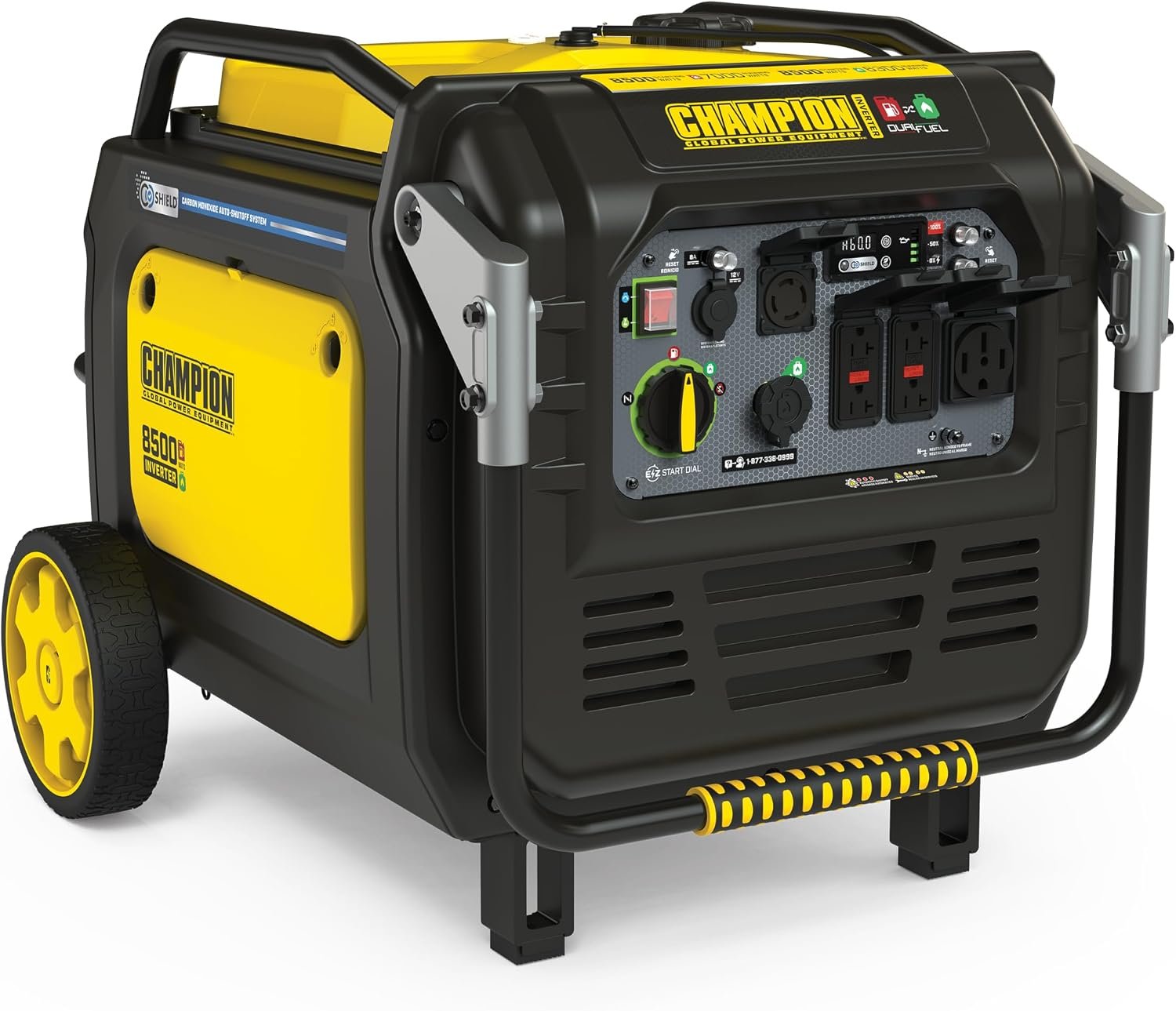
When backing up large whole-house stationary inverters like the EG4 18KPV, EG4 12000XP, or Sol-Ark 15K, small 2,000W generators are completely inadequate. These commercial hybrid inverters can absorb 6kW to 12kW of incoming AC power to rapidly bulk-charge massive 30kWh battery banks.
The Champion 8500 Dual Fuel Inverter is engineered specifically for this mission. Delivering 7,000W running watts on gasoline and 6,300W on propane, it outputs clean 120V/240V split-phase alternating current with a Total Harmonic Distortion (THD) strictly under 3%. In our laboratory scope testing, its output wave remained pristine even when large inductive compressor loads engaged.
✓ Engineering Advantages
- True 240V split-phase power connects directly to hybrid solar inverter generator inputs.
- Massive 6,300W continuous propane output bulk-charges large battery banks in under 3 hours.
- Clean inverter power (<3% THD) never triggers sensitive inverter fault protection codes.
- Convenient key fob remote electric start works from up to 80 feet away inside your home.
✗ Lab Compromises
- Heavier unit at 158.7 lbs (includes foldaway handle and rugged transport wheels).
- Requires external dry-contact relay accessory for automated BMS two-wire starting.
- Consumes roughly 1.1 gallons of propane per hour under 50% load.
Westinghouse iGen4500DFc (3,700W Running / Dual Fuel)
Whisper-Quiet 52 dBA Sound Level • Built-In LED Data Center • Wireless Remote Start
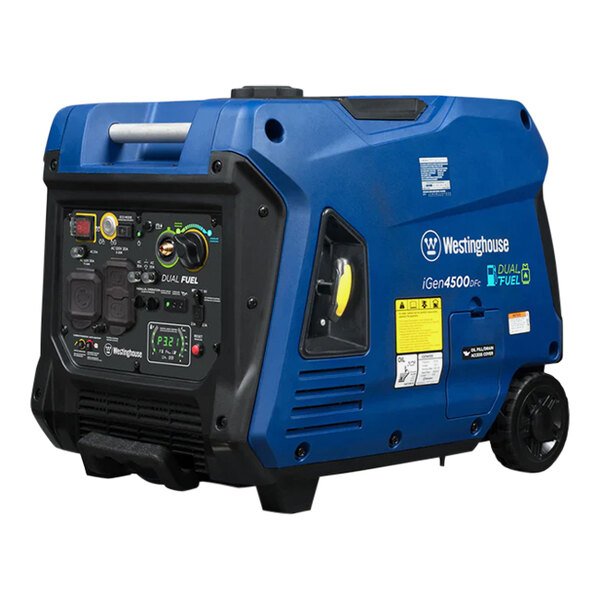
The Westinghouse iGen4500DFc hits the sweet spot for neighborhood-friendly backup. With double-insulated acoustic baffling and a pulse-tuned muffler, it registers just 52 dBA at 25% load—quieter than a normal conversational voice.
Its 3,700W running output is ideally sized to feed 1,800W to 2,400W AC wall input into mid-sized power stations (like the Bluetti AC200L or Anker F2000) while still having surplus capacity to run an outdoor heater or power tools.
Engineering Analysis: Total Harmonic Distortion & Propane Physics To explore how fuel generators integrate alongside battery banks, read Power Station vs Gas Generator: Why Not Use Both?. For extreme weather setups, check out the Best Power Stations for Hurricane Backup.
1. Why “Dirty” Generators Destroy Solar Power Stations
Conventional non-inverter open-frame construction generators use cheap mechanically-governed alternators. As heavy loads turn on and off, the engine RPM surges and sags, causing AC frequency to swing wildly between 54Hz and 66Hz and Total Harmonic Distortion (THD) to spike up to 15%–25%:
Modern solar generators (EcoFlow, Bluetti, Anker) feature sophisticated internal microprocessors that constantly monitor input AC voltage and sine wave symmetry. When connected to a dirty generator:
- The power station detects jagged voltage spikes and frequency deviation outside strict limits ().
- The internal relay instantly disconnects the AC input to protect internal bidirectional MOSFETs, refusing to charge.
- In worst-case scenarios, harmonic voltage surges break down the power station’s input surge protection Varistors (MOVs).
Rule of Thumb: Never connect any portable power station or home battery inverter to a generator unless it is certified as an Inverter Generator with THD strictly below 3%.
2. Propane (LPG) Energy Density & Derating Math
While gasoline delivers approximately , commercial Liquefied Petroleum Gas (propane) yields roughly :
Due to volumetric intake efficiency differences, internal combustion engines typically experience a 10% to 15% reduction in maximum continuous horsepower when switched from gasoline to propane. For example, the Champion 8500 drops from 7,000W running down to 6,300W on propane.
However, for emergency preparedness, propane is overwhelmingly superior to gasoline:
- Shelf Life: Propane cylinders store indefinitely without chemical degradation; gasoline degrades and varnishes inside carburetors in 3 to 6 months.
- Maintenance: Propane burns with zero carbon exhaust fouling, preventing fouled spark plugs during infrequent emergency use.
Frequently Asked Questions (FAQ)
Can I charge my portable power station with any generator?
No. You must only use pure sine wave inverter generators with Total Harmonic Distortion (THD) under 3%. Standard construction-grade open-frame generators produce dirty power that will trigger your power station’s protection relays, preventing charging or damaging sensitive internal components.
What is the advantage of direct DC charging on the EcoFlow Smart Generator?
Standard charging converts generator AC power into DC electricity inside the power station. The EcoFlow Smart Generator features a direct DC output that bypasses this conversion step, reducing thermal losses and improving overall fuel efficiency by up to 40%.
How long does a 20 lb propane tank run an inverter generator?
A standard 20 lb barbecue propane cylinder contains roughly 4.6 gallons of liquid propane. At a 50% load (~1,500W to 2,000W draw for battery bulk-charging), a mid-sized inverter generator runs for approximately 12 to 14 hours on a single 20 lb tank.
Final Recommendation: Which Generator Should You Choose for Solar Backup?
- Top Recommendation for EcoFlow Power Station Owners: The EcoFlow Smart Generator Dual Fuel offers seamless automated battery-level starting, direct DC fast charging, and whisper-quiet operation.
- Top Recommendation for Whole-Home 240V Inverters: The Champion 8500-Watt Dual Fuel Inverter delivers true 120/240V split-phase power, 6,300W continuous propane output, and ultra-clean <3% THD to bulk-charge heavy residential battery banks in record time.
- Top Recommendation for Quiet Suburban Neighborhoods: The Westinghouse iGen4500DFc delivers 3,700W of reliable dual-fuel inverter power at a quiet 52 dBA sound level.