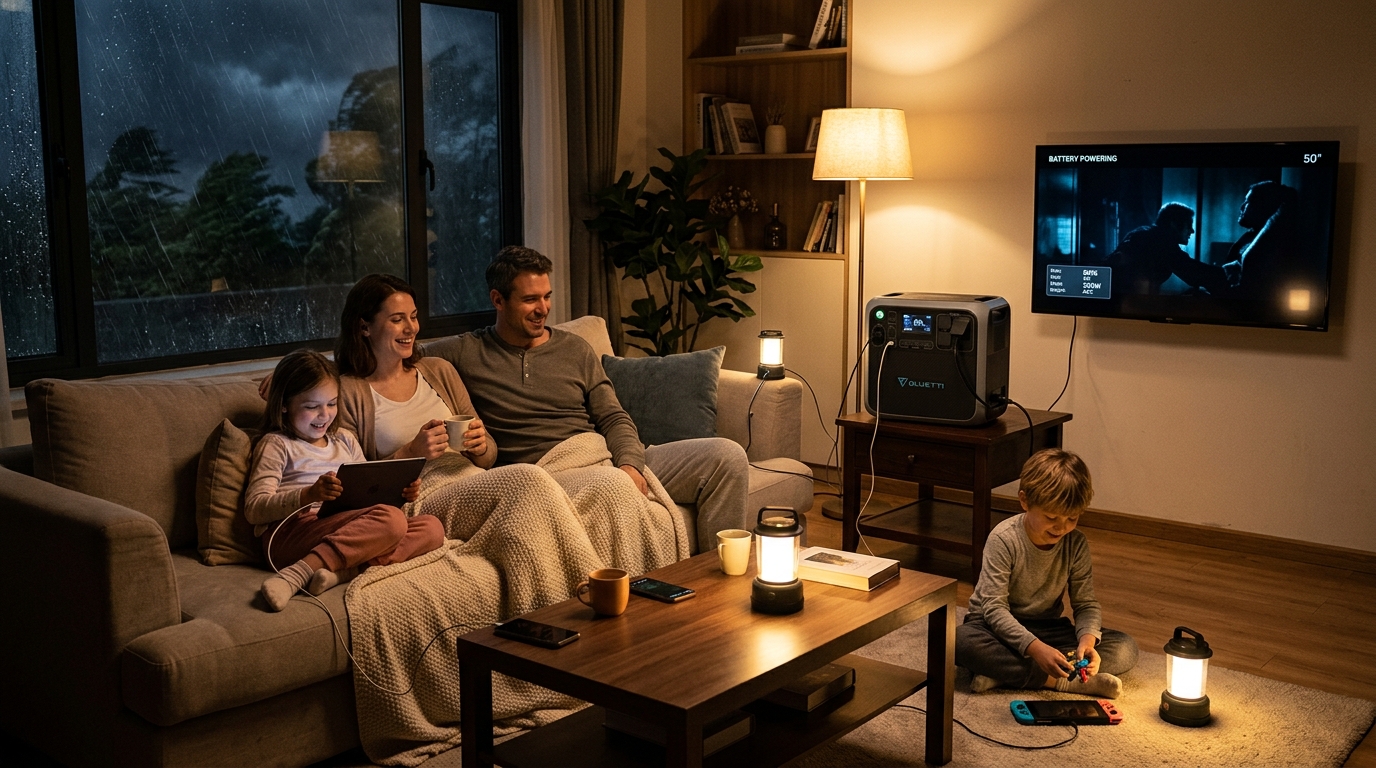
When a severe hurricane knocks out your neighborhood’s electrical grid, darkness and anxiety settle in fast. Will the food in your freezer spoil? Can you run a medical CPAP machine overnight? How will you keep your phones charged to receive local emergency alerts?
For decades, the standard answer was a loud, gas-guzzling generator. But in a hurricane, gas generators come with serious risks:
- You cannot run a gas generator indoors or in an attached garage due to deadly carbon monoxide fumes.
- Running one outdoors during 80-mph winds and torrential rain risks water short-circuits and flying storm debris.
- Local gas stations frequently lose power or run completely dry, leaving you with empty fuel cans.
Modern portable power stations (often called solar generators) change everything. They are effectively giant, rechargeable batteries packed into durable rolling cases. They produce zero exhaust fumes, operate in complete whisper silence, and are 100% safe to run right next to your kitchen refrigerator or bedside table.
In this guide—based on in-depth engineering research and manufacturer spec audits—we break down the best power stations for hurricane preparedness in everyday language, so anyone can choose the right setup for their home.
• Best Overall for Most Homes: EcoFlow DELTA Pro 3 — Enormous 4,000Wh capacity, runs full-size fridges for 50+ hours, and rolls smoothly on built-in luggage wheels.
• Best Heavy-Duty Whole-Home Backup: Anker SOLIX F3800 — Plugs directly into your home circuit panel (240V) to run well pumps, central lights, and even emergency EV charging.
• Best Budget-Friendly Pick for Kitchen Essentials: Bluetti AC200L — Compact, portable, and keeps food safely cold for over 26 hours on a single charge.
• Best Expandable Backup: Bluetti AC300 + B300 — Modular system that lets you stack extra battery packs as your storm needs grow.
What to Look for Before Buying
You don’t need an engineering degree to understand a power station. Focus on just three simple factors:
1. Battery Capacity (Measured in Watt-hours or Wh)
Think of Watt-hours (Wh) as the size of your emergency gas tank. The higher the number, the longer your devices will run.
- 1,000Wh – 2,000Wh: Great for keeping a refrigerator running for 18–28 hours, charging phones 100+ times, and running lamps and Wi-Fi routers.
- 3,000Wh – 4,000Wh+: Heavy-duty capacity that can keep your refrigerator running for 2 to 3 days, power window air conditioners, or run medical CPAP machines for over a week.
2. Continuous Power Output (Measured in Watts or W)
Think of Watts (W) as engine horsepower. It determines what kinds of appliances you can plug in at the exact same moment.
- Phones, laptops, Wi-Fi: 15W – 60W (any power station can run these).
- Full-size refrigerator: 150W running (needs ~1,200W burst to start the cooling motor).
- Microwave or electric skillet: 1,200W – 1,800W.
- Window AC unit or space heater: 1,000W – 1,500W.
3. Battery Chemistry (Always Choose LiFePO4)
Older batteries lost their charge quickly in storage and only lasted 2–3 years. All models recommended below use LiFePO4 (Lithium Iron Phosphate). They can be stored in your closet for up to a year with virtually zero charge loss, and they last for over 10 years of regular use without degrading.
The Best Power Stations for Hurricane Backup
1. EcoFlow DELTA Pro 3 — Best Overall for Most Homes
EcoFlow DELTA Pro 3

If you want one powerhouse battery that solves nearly every blackout headache, the EcoFlow DELTA Pro 3 is our top choice. With over 4,000 Watt-hours of storage right out of the box, it holds enough juice to run a full-size kitchen refrigerator for more than 50 hours straight.
Because refrigerators cycle their cooling compressors on and off rather than running non-stop, the DELTA Pro 3 easily bridges a multi-day power outage without breaking a sweat. It can also run a 1,200-watt window air conditioner or space heater for about 3.5 hours during extreme post-storm heat or winter chill.
Despite weighing 113 pounds, it is remarkably easy to manage: it features heavy-duty luggage-style wheels and an extendable pull handle, allowing you to roll it effortlessly from your garage into the kitchen or living room.
- ✓ Huge 4,000Wh battery runs fridges for 2+ full days
- ✓ Powerful 4,000W output runs high-draw kitchen appliances
- ✓ Smooth rolling wheels make moving it around easy
- ✓ Quiet operation with virtually zero idle battery drain
- • Heavy to lift upstairs (requires two people to lift)
- • Premium price point compared to smaller batteries
Ideal for: Multi-day family outages, full-size refrigerators & medical devices
Check Price on Amazon →
2. Anker SOLIX F3800 — Best for Heavy Duty & Whole-Home Circuit Backup
Anker SOLIX F3800
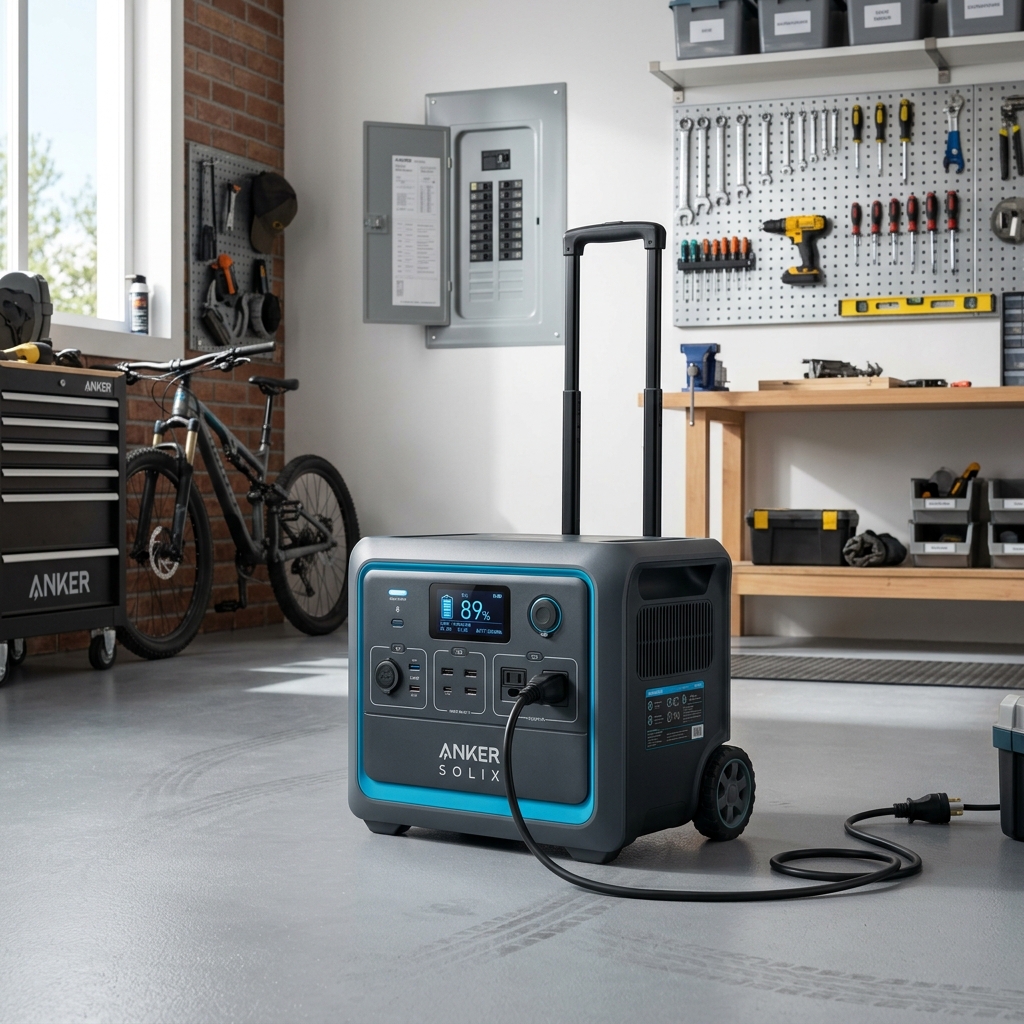
The Anker SOLIX F3800 is an industrial-strength backup battery built specifically for homeowners who want serious storm protection. What sets it apart from almost every other portable unit is its native 240V split-phase power output.
Most portable batteries only offer standard 120V household wall outlets. The F3800 includes a heavy-duty NEMA 14-50 outlet built right into the front panel. If you have an electrician install a generator inlet box and manual transfer switch on your house, you can plug the F3800 directly into your home to power central lights, ceiling fans, and well pumps throughout your whole house without running messy extension cords across the floor.
Even better: if you own an electric car, the F3800 can plug directly into your EV charger to give you emergency driving miles if local gas and charging stations are knocked out during evacuation orders.
- ✓ Massive 6,000W output handles high-draw well pumps and dryers
- ✓ Native 240V plug connects directly to home breaker panels
- ✓ Charges electric vehicles for emergency storm evacuation
- ✓ Upright luggage form factor with four sturdy wheels
- • Heavy at 132 lbs (best kept on ground floor)
- • Requires an inlet box to use whole-home 240V features
Ideal for: Homes with well pumps, 240V generator hookups & electric vehicles
Check Price on Amazon →
3. Bluetti AC200L — Best Value for Essential Kitchen & Bedroom Power
Bluetti AC200L
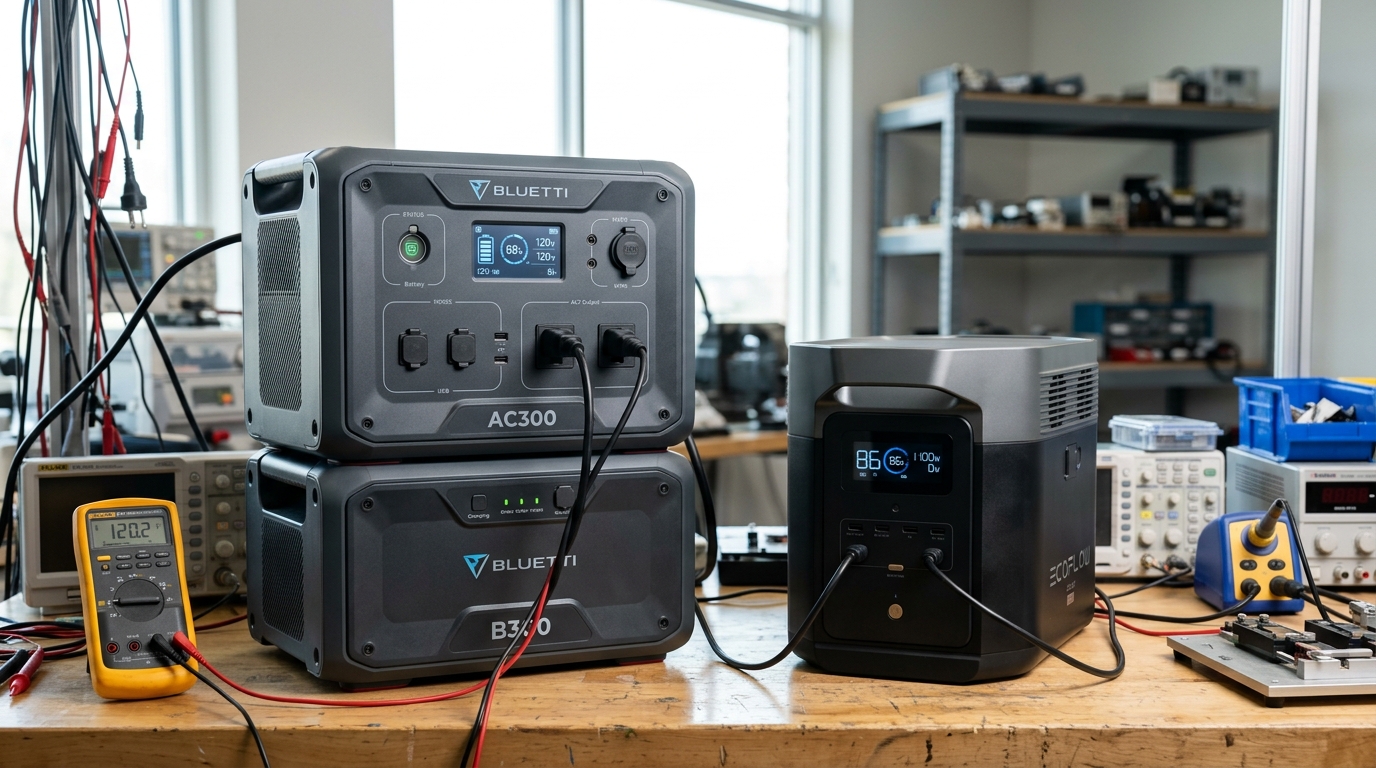
If you don’t need to power a giant house and simply want to ensure your food doesn’t spoil and your medical gear stays on, the Bluetti AC200L offers the best value in portable backup power.
Weighing in at 62 pounds, it is significantly lighter and more compact than the 100+ pound giants. One person can easily lift it into a car trunk or carry it from the kitchen to the bedroom. Despite its manageable size, it packs a full 2,048 Watt-hours of LiFePO4 battery power and a potent 2,400-watt inverter.
Based on standard residential energy math (factoring compressor duty cycles), the AC200L can sustain a standard 22-cubic-foot family refrigerator for 26 to 30 hours before needing a recharge. It also charges astonishingly fast: plugged into a standard wall outlet, it rockets from 0% to 80% in just 45 minutes, meaning you can top it off right before hurricane landfall.
- ✓ Outstanding price-to-performance ratio
- ✓ Blazing fast 45-minute recharge to 80% before storm arrival
- ✓ Light enough (62 lbs) for one or two people to carry easily
- ✓ Easily handles refrigerator startup surges without tripping
- • Does not include wheels (has two molded side handles)
- • Shorter runtime for window air conditioners than 4,000Wh units
Ideal for: Apartments, keeping food cold, CPAP machines & emergency lighting
Check Price on Amazon →
4. EcoFlow DELTA 2 Max — Best Portable Pick Under 55 Pounds
EcoFlow DELTA 2 Max
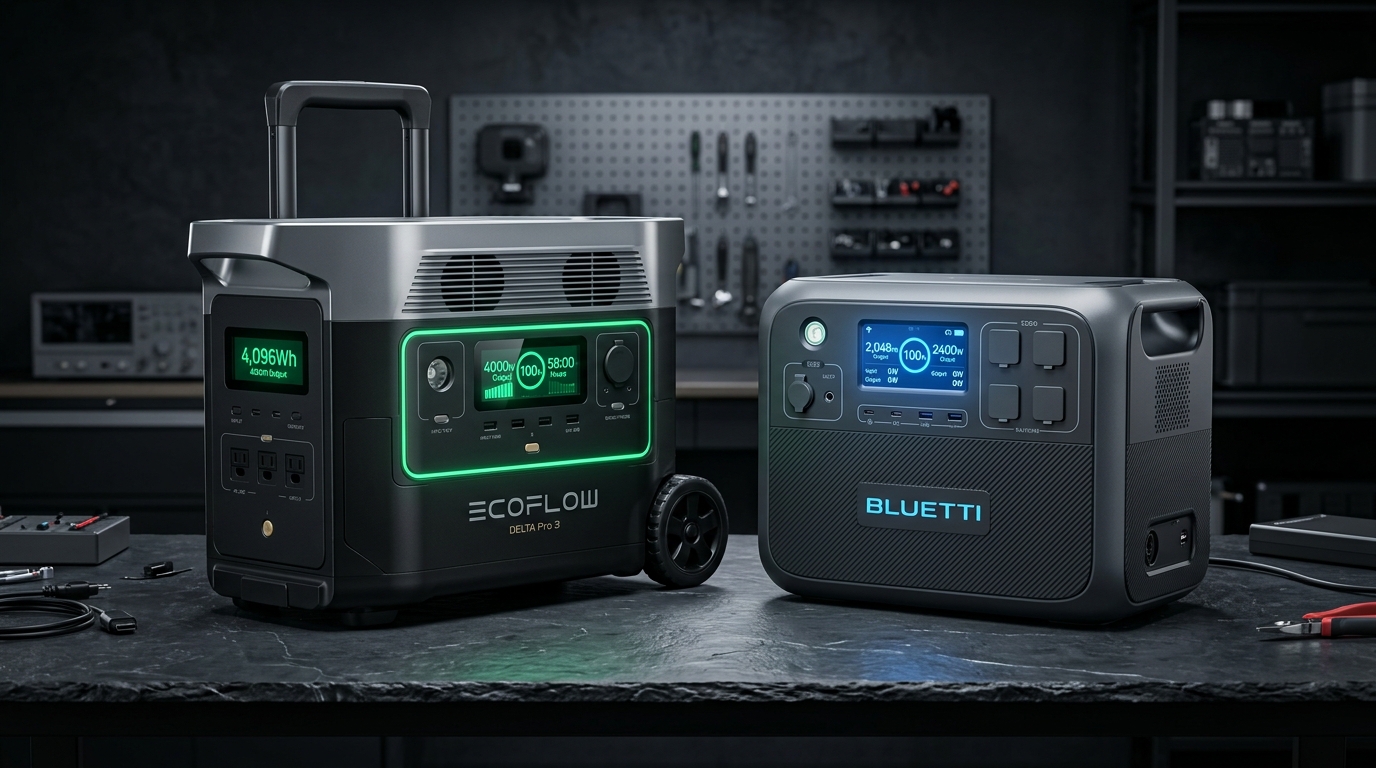
If you want the maximum amount of power in a package that weighs around 50 pounds, look no further than the EcoFlow DELTA 2 Max. At just 50.7 lbs, it is one of the lightest 2,048Wh batteries in the industry.
It is whisper-quiet—even when charging at full speed—making it an exceptional bedroom companion for running CPAP machines, portable fans, and bedside lamps during hot summer hurricane blackouts. You can also plug in up to two stackable expansion batteries later to grow your emergency storage to over 6,000Wh without buying a new main unit.
Ideal for: Bedrooms, quiet nighttime CPAP power & effortless portability
Check Price on Amazon →
Real-World Appliance Runtime Comparison For general outage emergency preparedness, browse the Best Power Stations for Blackouts and Emergency Outages. If you need split-phase 240V for whole-home storms, compare EcoFlow Delta Pro Ultra vs Jackery 5000 Plus.
Here is how our top picks compare when powering common blackout essentials:
| Essential Appliance | Bluetti AC200L (2,048Wh) | EcoFlow DELTA Pro 3 (4,096Wh) | Anker SOLIX F3800 (3,840Wh) |
|---|---|---|---|
| Kitchen Refrigerator | 26 – 30 Hours | 50 – 58 Hours (2+ Days) | 48 – 55 Hours (2+ Days) |
| Medical CPAP Machine | 4 – 5 Nights | 8 – 10 Nights | 8 – 9 Nights |
| Home Wi-Fi Router | 90+ Hours (3+ Days) | 180+ Hours (7+ Days) | 170+ Hours (7 Days) |
| Window Air Conditioner (8,000 BTU) | ~1.8 Hours | ~3.6 Hours | ~3.3 Hours |
| Basement Sump Pump (1/2 HP) | ~2.5 Hours continuous pump | ~5.0 Hours continuous pump | ~4.8 Hours continuous pump |
| Full Smartphone Recharges | 130+ Charges | 260+ Charges | 240+ Charges |
5 Practical Hurricane Prep Tips
- Top off your battery 24 hours prior: Plug it into the wall as soon as your area enters a tropical storm watch.
- Freeze water bottles in advance: 24 hours before landfall, fill plastic water bottles and freeze them solid. During the outage, they keep your fridge colder longer, meaning the cooling motor runs less often and saves battery life.
- Store heavy extension cords on top of the battery: Keep two or three 14-gauge extension cords with the battery so you never have to stumble around with a flashlight looking for cables.
- Keep solar panels stored indoors during winds: Never leave portable solar panels outside in hurricane-force winds. Store them safely in a closet and bring them out the next morning when the storm has cleared.
- Turn off screen backlights: Most modern power stations let you turn off screen lights and Wi-Fi to eliminate unnecessary idle battery drain.
Frequently Asked Questions
Can I leave my power station plugged into the wall all year round?
Yes! All the units reviewed above feature built-in pass-through EPS/UPS mode. You can keep your refrigerator plugged into the battery, and the battery plugged into the wall. As long as the grid is healthy, wall electricity flows directly to your fridge. If a hurricane knocks out the grid, the battery switches on instantly in under 20 milliseconds without your fridge ever blinking.
How do I recharge the battery if the power stays out for a week?
Once hurricane winds pass, you can recharge using portable solar panels (200W to 800W arrays recharge in 4–8 hours of sunlight). You can also charge from your car’s 12V port or borrow a neighbor’s gas generator for just 60 minutes to rapidly recharge your battery back to 80%.
How long do these batteries hold their charge in storage?
Thanks to modern LiFePO4 chemistry, these units lose only 2% to 3% of their charge per month. If you top it off at the start of hurricane season in June, it will still have over 90% charge remaining in September without needing attention.
The Bottom Line
- For the best overall balance of massive capacity and easy rolling mobility: Choose the EcoFlow DELTA Pro 3.
- For whole-home 240V circuits, well pumps, and emergency EV charging: Choose the Anker SOLIX F3800.
- For unbeatable value to keep your refrigerator, phones, and CPAP running: Choose the Bluetti AC200L.