During an emergency blackout or off-grid camping trip, your portable power station is rarely parked directly adjacent to the appliances it needs to run. A 2,000Wh power station might sit inside a ventilated garage, van rear cargo deck, or sheltered porch while powering a kitchen refrigerator 40 feet away, a CPAP machine in the bedroom, or work lights on a patio.
Bridging that physical gap requires AC extension cords. However, plugging heavy electrical loads into an improperly sized extension cord is one of the most common causes of inverter faults, damaged appliance motors, and residential electrical fires.
Unlike standard wall utility power—which is backed by a low-impedance 200A street transformer—a portable power station inverter produces a finite, chemically constrained pure sine wave. Running high current through long, undersized copper conductors triggers severe line voltage drop, dissipates valuable battery energy as wasteful heat, and can damage sensitive compressor electronics.
Where is the running current in Amperes, is conductor resistance in Ohms per foot (from NEC Chapter 9 Table 8), is the one-way cable length in feet, and the multiplier 2 accounts for both hot and neutral return paths.
The Physics of Extension Cord Resistance & Voltage Drop
All electrical conductors possess internal resistance. According to Ohm’s Law and Joule’s Law of heating:
When current () flows through the copper strands of an extension cord, resistance converts a fraction of your battery’s stored electricity into heat. If your power station outputs a clean 120.0 Volts at its faceplate AC receptacle, but your cord drops 8.4 Volts over a 75-foot run, your appliance only receives 111.6 Volts.
Why Under-Voltage Destroys Motor Loads
Resistive loads (like electric space heaters, toasters, and incandescent bulbs) simply produce less heat and light when voltage drops.
However, inductive motor loads (refrigerators, deep freezers, sump pumps, and air conditioner compressors) behave dangerously under low voltage:
- To deliver the mechanical work required by the compressor pump, an electric induction motor must maintain constant shaft horsepower ().
- If input voltage drops by 10%, the motor draws 10% more amperage to compensate.
- Because thermal dissipation increases with the square of current (), that extra current causes the motor windings to overheat rapidly, tripping the internal thermal overload switch or burning out the motor insulation permanently.
Wire Gauge (AWG) Ratings & Distance Limits Understand how overcurrent protection guards against cable overheating in our guide on What is a Circuit Breaker & How Breakers Protect You. Learn how inverter voltage reduction alters current draw in EcoFlow X-Boost Explained.
In the American Wire Gauge (AWG) system, smaller numbers signify thicker copper conductors capable of carrying more current with lower electrical resistance.
| Conductor Gauge (AWG) | Max Continuous Amps | Resistance per 100 ft () | Max Recommended Length (15A Load) | Intended Application |
|---|---|---|---|---|
| 16 AWG (Light Duty) | 10 A (1,200W max) | 0.836 Ω | DO NOT USE for 15A loads | LED lamps, Wi-Fi routers, phone chargers (<300W) |
| 14 AWG (Medium Duty) | 15 A (1,800W max) | 0.526 Ω | Up to 25 Feet | Refrigerators, TV consoles, power tool battery chargers |
| 12 AWG (Heavy Duty) | 15 A - 20 A (2,400W max) | 0.330 Ω | Up to 75 Feet | Microwaves, 1,500W space heaters, portable AC units, air fryers |
| 10 AWG (Extra Heavy Duty) | 20 A - 30 A (3,600W max) | 0.208 Ω | Up to 150 Feet | RV 30A shore power connections, table saws, whole-room backup runs |
Worked Sizing Calculation: Running a 1,500W Space Heater
Let us test a common real-world winter outage scenario: powering a 1,500W portable ceramic heater from a Bluetti AC200L power station located 50 feet away in an unheated utility room:
- Heater Load Power:
- Inverter Output Voltage:
- Operating Current:
Scenario A: Using a Cheap 50-Foot 16 AWG Extension Cord
- Total loop resistance for 50 ft of 16 AWG ():
- Voltage Drop:
- Percentage Drop:
- Power Dissipated as Heat Inside the Cord:
Result: A staggering 65.3 Watts of your battery’s energy is constantly wasted as pure heat inside the extension cord jacket. If the cord is left coiled, it will quickly soften and catch fire.
Scenario B: Using a Professional 50-Foot 12 AWG Extension Cord
- Total loop resistance for 50 ft of 12 AWG:
- Voltage Drop:
- Percentage Drop:
- Power Dissipated as Heat: P_{\text{heat}} = (12.5\text{ A})^2 \times 0.165\text{ }\Omega = \mathbf{25.8\text{ Watts}}\text{ (A 60% reduction in heat)}
The 12 AWG cord remains completely cool to the touch and preserves your power station’s runtime.
The Deadly Coiled Cord Trap: Thermal Melt & Inductive Heating
One of the most dangerous habits among portable power station owners is uncoiling only 10 feet of a 50-foot extension cord and leaving the remaining 40 feet neatly wrapped around a plastic reel or coiled in a bundle on the floor.
Why this causes catastrophic fires:
- Elimination of Surface Cooling: Under normal operation, heat generated by electrical resistance dissipates into ambient air along the entire length of the cable jacket. When coiled, the outer jacket insulation traps thermal energy inside the concentric layers.
- Thermal Runaway: Copper resistance increases as temperature rises. As the core of the coil reaches 140°F (60°C), electrical resistance climbs, causing even higher heat generation.
- Insulation Breakdown: Standard PVC jacket insulation melts at approximately 167°F to 194°F (75°C to 90°C). Once the plastic turns molten, the hot and neutral conductors make direct physical contact, resulting in a violent dead short circuit.
Whenever you draw more than 6 Amps (approx. 700W) through an extension cord, you must fully uncoil and spread out the entire cord across the floor. Never leave excess cable tightly bundled, coiled, or wrapped on a spool during high-load operation.
Recommended Portable Power Stations with Robust AC Inverters
When powering appliances over extension cord runs, choose power stations with high surge overhead and intelligent overcurrent protection:
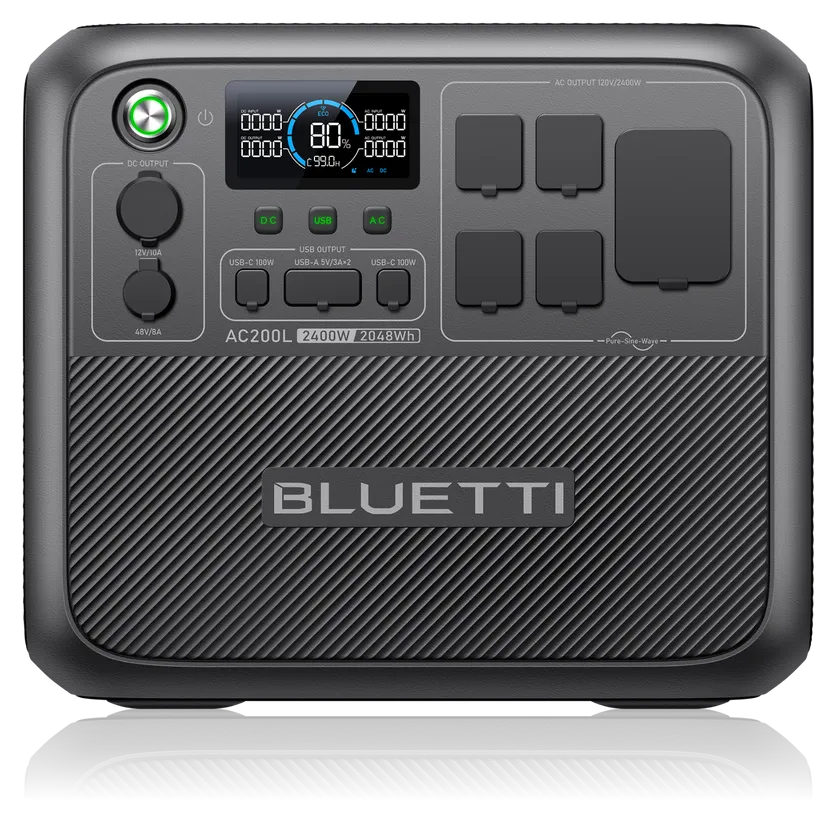
Bluetti AC200L (2,048Wh LiFePO4)
Delivers 2,400W pure sine wave continuous output with a massive 3,600W Power Lifting mode. Features an integrated NEMA TT-30R 30A RV port, enabling direct connection to thick 10 AWG shore power cords without multiple flimsy adapters.
- • Continuous Inverter: 2,400W (4,800W peak surge)
- • Outlets: NEMA TT-30R 30A + 4x 20A AC ports
- • Chemistry: LiFePO4 (3,000+ cycles to 80%)
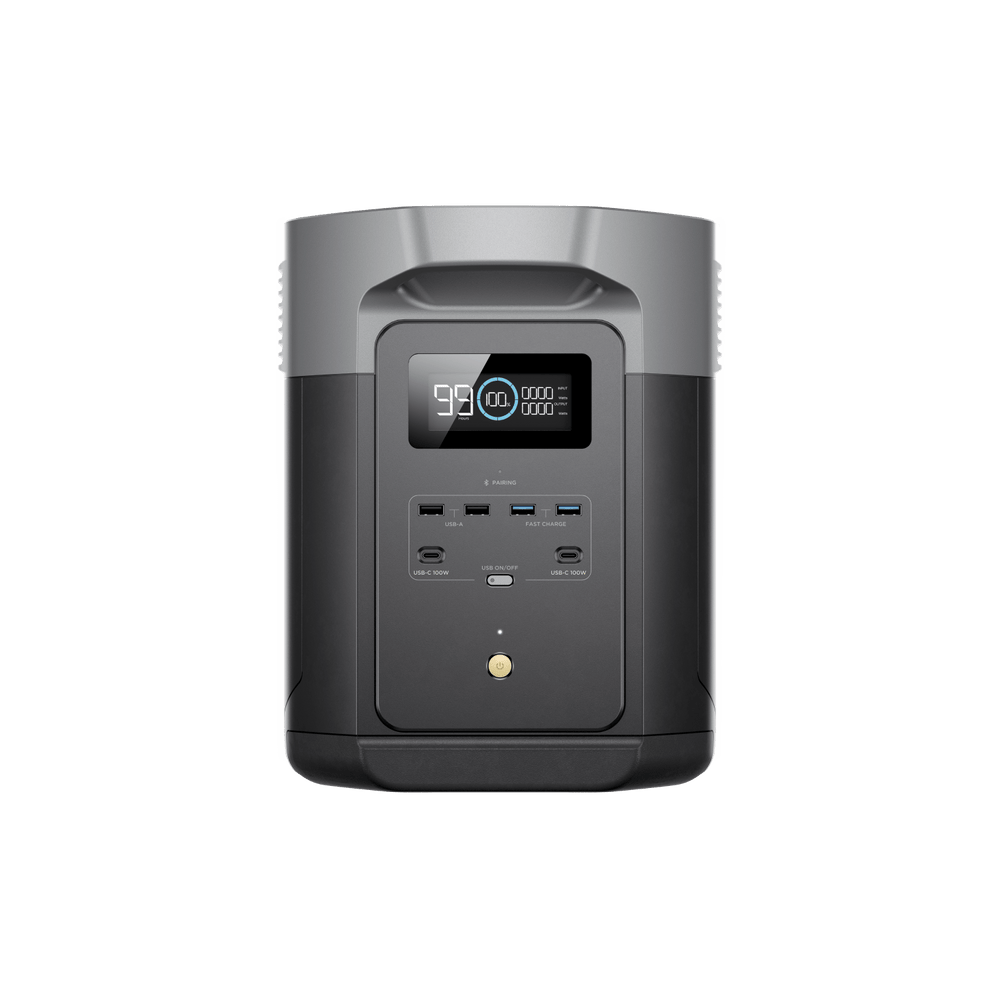
EcoFlow DELTA 2 Max (2,048Wh)
Offers 2,400W AC output (X-Boost up to 3,400W) with whisper-quiet operation under 30 dB. Built-in ultra-fast overload detection trips electronically before cord overheating can occur, protecting equipment during short circuits.
- • Inverter Output: 2,400W (Surge 4,800W)
- • Expandable: Up to 6,144Wh with Smart Extra Batteries
- • Overload Protection: Fast sub-cycle digital cutoff
How to Read Extension Cord Jacket Letter Codes
When shopping for an extension cord to pair with a portable power station, look at the stamped letter codes on the outer rubber jacket:
- S (Service Grade): Heavy-duty commercial cord rated for 600 Volts. The best quality cord available.
- SJ (Junior Service): Standard consumer duty cord rated for 300 Volts (completely adequate for 120V power stations).
- T (Thermoplastic): Vinyl/PVC jacket material (flexible in warm weather, stiff in freezing cold).
- E (Elastomer): Synthetic rubber blend (remains pliable down to -40°F).
- O (Oil Resistant): Outer jacket resists oil and automotive grease degradation.
- W (Weather & Water Resistant): Rated for outdoor sunlight (UV) and rain exposure. Mandatory for outdoor solar setups.
The Ideal Standard: For all-weather emergency backup or van life, choose an SJTOW or SOOW 12/3 extension cord (12 AWG, 3-conductor with ground, oil-resistant, weather-rated).
Crucial Extension Cord Safety Rules for Power Stations
- Never “Daisy Chain” Extension Cords: Connecting two 25-foot cords together doubles the contact resistance at the plug interface. Every plug connection adds between 0.05 Ω and 0.15 Ω of contact resistance, creating localized hot spots and voltage drops. Always use a single continuous cord of the correct length.
- Never Cut Off the Ground Pin: Floating-neutral portable power stations must maintain grounding integrity for attached equipment chassis. Removing the third round prong destroys ground fault safety and increases electrocution hazard around damp camping grounds.
- Protect Plug Interfaces from Moisture: When running cords outside from a tent or van to a solar generator, keep plug junctions elevated off the ground in waterproof silicone gasket boxes. Water intrusion trips the inverter’s sensitive ground-fault protection.
Frequently Asked Questions
Can I run a refrigerator with an extension cord connected to a portable power station?
Yes, but you should use a heavy-duty 14 AWG cord (for runs under 25 feet) or a 12 AWG cord (for runs up to 50 feet). Never use a thin 16 AWG cord. When the refrigerator compressor cycles on, it draws an initial surge current of 1,200W to 1,500W. An undersized cord will cause excessive voltage drop, potentially stalling the compressor or tripping the power station inverter.
What happens if I use a 16 AWG extension cord on a 1,500W space heater?
A 16 AWG cord is rated for a maximum continuous current of 10 to 13 Amps. A 1,500W space heater draws 12.5 Amps at 120V. Running this maximum current through thin copper generates significant heat, resulting in a 4% to 6% voltage drop. Over prolonged use, the cable jacket will soften, degrade, and can melt or ignite surrounding carpet or bedding.
Why does my portable power station trip its overload when I plug in an appliance through a long cord?
Long extension cords with thin wire gauges introduce high loop resistance. When an appliance with a high motor inrush current (like a power tool or air compressor) attempts to start, the heavy starting amperage combined with line resistance causes voltage at the appliance to collapse. The motor draws even higher current to compensate, triggering the power station’s instant overcurrent shutdown.
Is a 12 AWG extension cord better than a 14 AWG cord?
Yes. 12 AWG wire contains thicker copper strands with approximately 37% lower electrical resistance than 14 AWG wire. This reduces voltage drop, minimizes energy wasted as heat, and ensures full operating voltage reaches your appliances—especially over distances between 25 and 100 feet.