When shopping for portable power stations, one specification frequently causes confusion among consumers: marketing claims that an 800W or 1,800W inverter can “power devices up to 1,600W or 3,400W.”
In EcoFlow power stations, this proprietary feature is called X-Boost. In Bluetti units, a similar technology is marketed as Power Lifting. In Jackery power stations, it is called Emergency Super-Power.
Marketing brochures often imply that the power station magically produces twice as much continuous electricity through secret inverter circuitry.
In reality, X-Boost cannot violate the laws of thermodynamics or electrical physics. A 1,000W inverter cannot deliver 2,000W of electrical energy.
Instead, X-Boost uses an intelligent solid-state technique called voltage stepping (phase-angle clipping): when an overload is detected, the inverter drops output voltage from 120 Volts down to 85–95 Volts.
This comprehensive technical guide explains the exact electrical formulas behind X-Boost, benchmarks what appliances will (and will not) operate safely, and highlights the severe risks of using voltage-reduction features on motor and compressor loads.
Where is electrical power in Watts, is alternating current root-mean-square (RMS) voltage, and is the fixed physical electrical resistance of the heating element in Ohms. Because power is proportional to the square of voltage (), reducing voltage causes power draw to drop precipitously.
How X-Boost Actually Works (The Math)
Inside an ordinary portable power station, if you plug an 1,800W hair dryer into an inverter rated for 1,000W continuous output, the inverter’s overcurrent protection circuit triggers within 200 milliseconds, cutting power to prevent the MOSFET transistors from overheating.
When X-Boost is toggled ON inside the companion smartphone app:
- The digital microprocessor senses that the connected device demands 1,800W at 120V.
- Instead of cutting the circuit, the pulse-width modulation (PWM) controller alters the inverter’s gate drive signals, clipping the sine wave and reducing effective RMS voltage to approximately 89.4 Volts.
- Because the hair dryer’s internal nichrome wire heating coil has a fixed electrical resistance (), lowering the voltage forces the appliance to consume significantly less current ().
The Worked Calculation:
Consider a standard 1,800W countertop electric tea kettle:
At standard wall utility voltage ():
Now, connect this 8.0 Ω kettle to an EcoFlow Delta 2 Max with X-Boost active, reducing operating voltage down to :
The Technical Reality: The kettle does not run at 1,800W. It runs at 1,000W.
Because 1,000W is within the continuous capacity of the inverter, the power station runs continuously without tripping. The kettle simply takes 5 minutes to boil a liter of water instead of 2.8 minutes.
What Appliances Work Flawlessly With X-Boost
X-Boost is designed strictly for purely resistive heating loads that lack digital control boards or motors. A pure resistive load is simply a loop of high-resistance metal alloy that converts electrical friction into radiant thermal heat:
| Appliance Category | Typical Rated Watts | X-Boost Compatibility | Real-World Operational Behavior |
|---|---|---|---|
| Manual Electric Kettles | 1,500W - 1,800W | 100% Compatible | Boils water at reduced speed; perfectly safe |
| Ceramic Space Heaters (Manual Switch) | 1,500W | 100% Compatible | Blows warm air instead of hot air; fan speed slightly lower |
| Curling Irons & Hair Straighteners | 800W - 1,200W | 100% Compatible | Heats to target temperature; takes 30 seconds longer to warm up |
| Manual Toasters & Waffle Makers | 1,200W - 1,400W | 100% Compatible | Nichrome coils glow orange-red; toasts bread normally |
| Soldering Irons & Heat Shrink Guns | 600W - 1,500W | 100% Compatible | Maintains operating temperature for field electronics repairs |
What Appliances Will Be Damaged by X-Boost (DO NOT USE) For extension cord safety and resistance calculations when running heavy heating loads, see Using Extension Cords with Portable Power Stations. Browse compatible units in our Best EcoFlow Power Stations Guide.
While resistive heaters tolerate lower voltages without complaint, two major categories of electrical loads will malfunction or permanently burn out if operated under X-Boost:
1. Inductive Electric Motor Loads (Refrigerators, ACs, Air Compressors)
Electric induction motors do not behave like fixed resistors. As voltage collapses from 120V down to 90V:
- The motor’s magnetic field weakens.
- The motor rotor loses rotational torque and slows down.
- To maintain mechanical output against the physical compression load, the motor draws exponentially higher amperage.
- This excessive current causes rapid internal winding overheating, melting copper enamel insulation and causing motor seizure.
2. Voltage-Sensitive Digital Electronics (Microwaves, CPAP Machines, Audio Gear)
Appliances with integrated microprocessors, switch-mode power supplies (SMPS), digital LED clock displays, or touchpads require precise 120V (±5%) input.
- When exposed to 85V, the internal low-voltage DC transformers fail to maintain regulated 5V/12V rails.
- Digital control boards reboot repeatedly, timers freeze, display screens flicker, and the internal relays fail to engage the microwave magnetron tube.
- • Kitchen Refrigerators & Deep Freezers: Compressor will stall and burn out thermal start relays.
- • Microwave Ovens with Digital Displays: Magnetron will fail to produce microwave radiation; displays glitch.
- • CPAP & BiPAP Medical Machines: Air pressure sensors and blowers will fluctuate dangerously.
- • Desktop Gaming PCs & Audio Amplifiers: Power supplies will trip undervoltage protection lockouts.
- • Variable-Speed Power Tools: Electronic speed controllers (SCR triggers) will overheat and short.
Comparing EcoFlow X-Boost vs. Bluetti Power Lifting
Both market-leading brands utilize voltage-reduction algorithms, but their software implementations differ slightly:
| Feature | EcoFlow X-Boost | Bluetti Power Lifting |
|---|---|---|
| Primary Mechanism | Dynamic voltage stepping with phase-angle modulation | Constant current voltage throttling |
| Default State Out of Box | ON by default on AC ports | OFF by default (Must toggle via app) |
| Recommended Setting for Home Backup | Disable in app when powering refrigerators | Leave disabled unless heating water |
| Minimum Operating Voltage | Drops to ~80V – 90V under heavy load | Drops to ~85V – 95V under heavy load |
| Inverter Efficiency Under Boost | Decreases by 5% to 8% (higher thermal losses) | Decreases by 4% to 7% |
Recommended Power Stations with High-Wattage Inverters
If you frequently run heavy loads like induction cooktops, high-output space heaters, or air compressors, the best strategy is to purchase a power station whose native pure sine wave inverter can handle the load at full 120V without requiring voltage reduction:
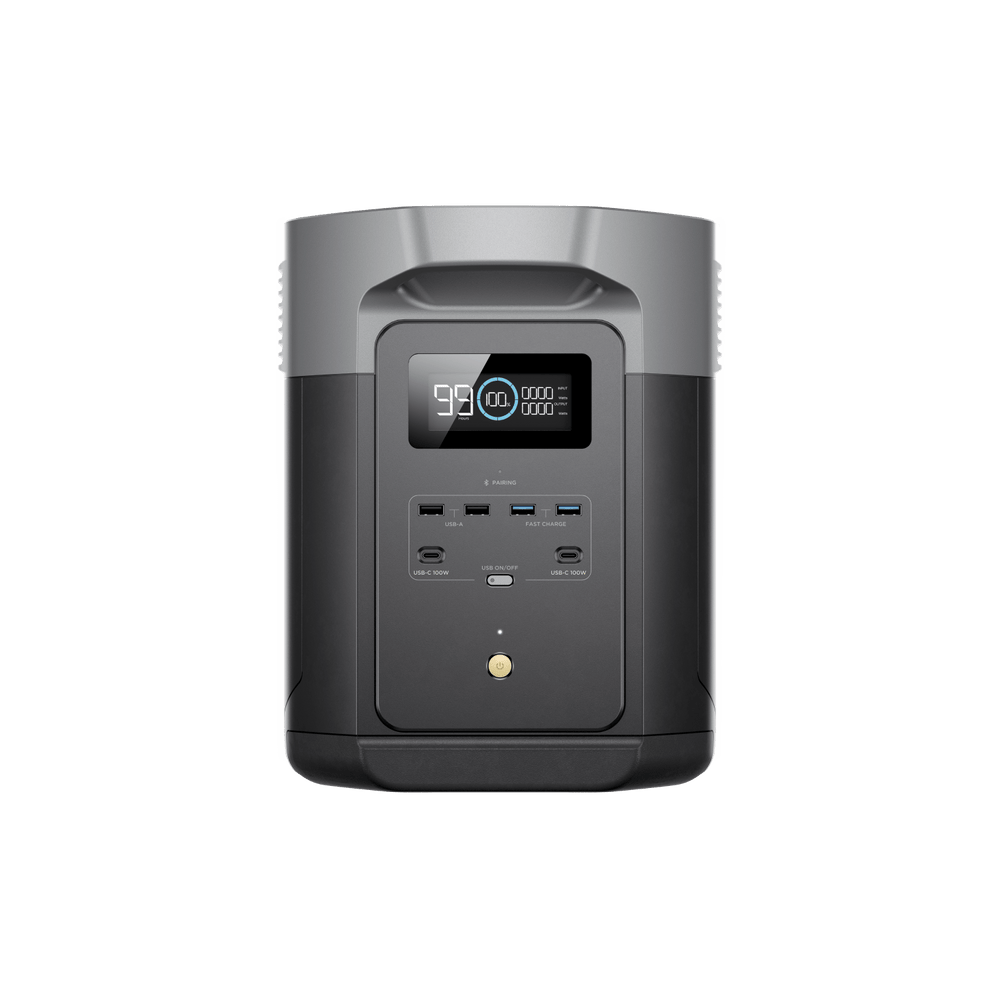
EcoFlow DELTA 2 Max (2,048Wh)
Features a robust 2,400W pure sine wave inverter that easily powers 99% of kitchen and workshop appliances natively. X-Boost enables support for heating loads up to 3,400W, making it the most versatile camping and emergency hub in its weight class.
- • Native Inverter: 2,400W pure sine wave (4,800W surge)
- • X-Boost Ceiling: Up to 3,400W for heating elements
- • LFP Battery: 3,000+ cycles to 80% capacity
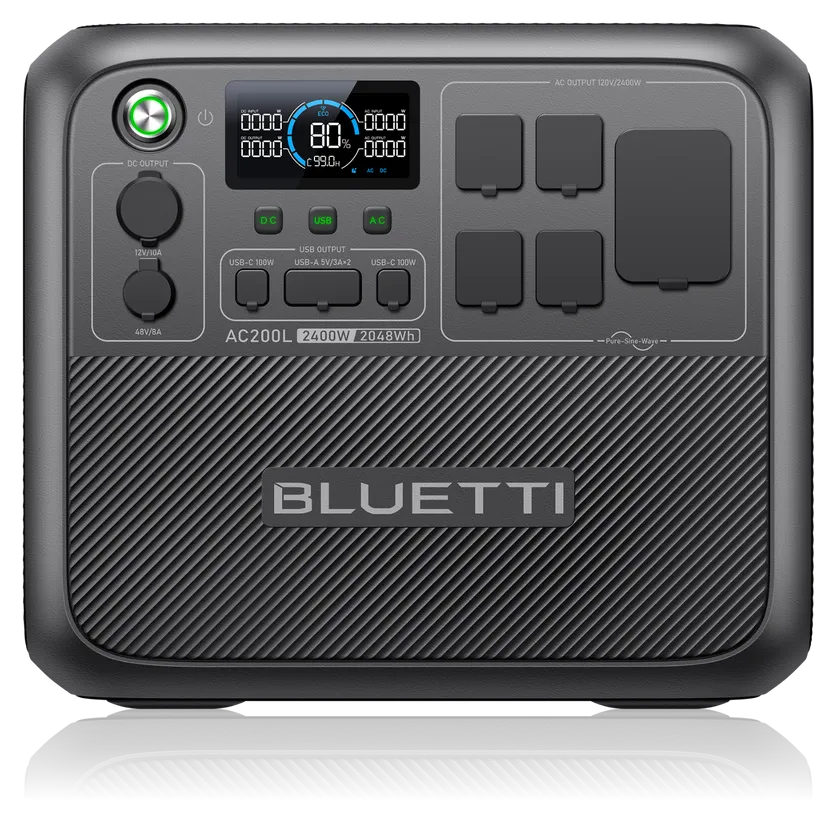
Bluetti AC200L (2,048Wh LiFePO4)
Equipped with 2,400W continuous pure sine wave output and a 3,600W Power Lifting mode. Features an ultra-heavy-duty 30A RV port, allowing direct, un-throttled connection to high-draw heating elements and off-grid van infrastructure.
- • Continuous Power: 2,400W (Surge 4,800W)
- • Power Lifting Mode: Up to 3,600W resistive loads
- • Rapid Solar Input: 1,200W MPPT charge controller
Best Practices: When to Turn X-Boost ON vs. OFF
- Turn X-Boost ON When: You are camping or in an emergency outage and need to boil water in a 1,500W electric kettle, dry your hair on low heat with a hair dryer, or run a basic manual electric skillet from a compact power station.
- Turn X-Boost OFF When: You are using your power station for home emergency backup to power refrigerators, freezers, medical CPAP devices, pellet stove digital controllers, or televisions. Disabling X-Boost ensures the inverter trips cleanly rather than feeding destructive low voltage into complex appliances.
Frequently Asked Questions
Is EcoFlow X-Boost safe for all appliances?
No. X-Boost is only safe for purely resistive heating elements like electric kettles, space heaters, toasters, and hair curling irons. It is not safe for inductive motor loads (refrigerators, air conditioners, water pumps) or delicate electronics with digital microprocessors, as dropping voltage to 85V can overheat motor windings and corrupt sensitive circuits.
Does X-Boost drain my battery faster?
No. Because X-Boost lowers voltage, the heating appliance actually consumes fewer Watt-hours per minute than it would under full utility voltage. However, because power output is reduced, heating tasks take proportionally longer to complete. Total energy consumed from the battery to boil a given volume of water remains nearly identical.
Can I run a refrigerator with X-Boost enabled?
You should disable X-Boost when powering a refrigerator. Refrigerator compressors require full 120V pure sine wave power to start and cycle cleanly. If the starting inrush current triggers X-Boost to drop voltage, the compressor motor will stall, draw excessive amperage, overheat, and potentially burn out its internal thermal overload switch.
Why does my microwave turn on but not heat food when X-Boost is on?
Microwave ovens use high-voltage transformers and magnetron tubes that require precise input voltage to generate electromagnetic heating waves. Under X-Boost, the turntable motor and light bulb may run at reduced voltage, but the magnetron cannot strike an arc at 90V, resulting in zero food heating. Always run microwaves on native inverter power without X-Boost.