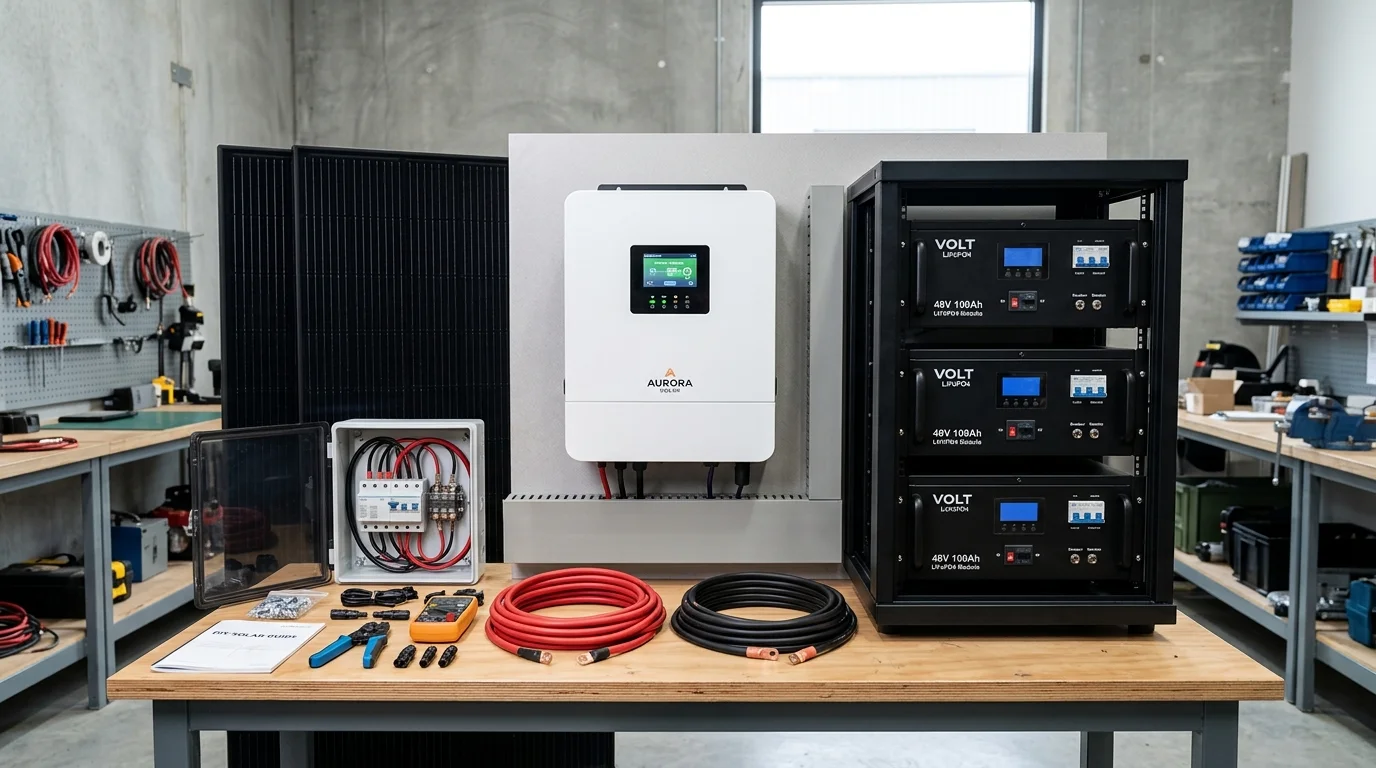
Designing a solar energy system for a tiny home is a unique engineering puzzle. Unlike sprawling suburban rooftops or expansive off-grid homesteads, a tiny house presents two non-negotiable physical constraints: limited roof footprint (typically 150 to 250 square feet) and restricted interior storage space for heavy battery enclosures.
At the same time, modern tiny living demands modern comfort: induction cooking, reliable high-speed Starlink internet, energy-efficient 12V/24V compressor refrigerators, and mini-split heating and cooling.
If you choose the wrong system voltage or under-gauge your DC wiring, you risk dangerous thermal bottlenecks inside narrow timber-framed walls.
Below is your complete step-by-step engineering blueprint to design an affordable, reliable, code-compliant solar power system for tiny homes on wheels (THOW) and foundation builds.
If your tiny home power inverter exceeds 1,500 continuous watts or you plan to run an induction cooktop, microwave, or mini-split AC, bypass 12V and build a 24V or 48V system (or deploy an all-in-one 48V portable power station). Operating high-wattage inverters on 12V demands massive 4/0 AWG welding cables and creates excessive heat inside confined living spaces.
System Voltage Showdown: 12V vs. 24V vs. 48V For conductor sizing and conversion efficiency between different system voltages, see Solar Battery Voltage: 12V vs 24V vs 48V Explained. To evaluate mobile all-in-one stations, explore the Best Power Stations for RV and Van Life.
Ohm’s Law () dictates that for any given power requirement, increasing your system voltage proportionally reduces current (amperage).
Let’s observe what happens when a tiny home inhabitant boils water on a 1,800W induction cooktop:
- At 12 Volts: of DC current!
- At 24 Volts: of DC current.
- At 48 Volts: of DC current.
| Architecture | Max Practical Inverter Size | Battery Cable Gauge (at 2,000W) | Component Availability | Best Tiny Home Application |
|---|---|---|---|---|
| 12V DC Native | 1,200W – 1,500W | 2/0 to 4/0 AWG (Heavy) | Ubiquitous (RV gear, 12V fans) | Minimalist builds, camper vans, lighting & laptops only |
| 24V DC Intermediate | 2,000W – 3,000W | 1/0 to 2 AWG | Moderate (requires 24V-to-12V step-down) | Medium builds with microwave, Starlink & water pump |
| 48V DC Standard | 3,000W – 6,000W+ | 4 AWG to 6 AWG (Compact) | High (Server rack batteries & hybrid inverters) | Modern builds with mini-split AC, induction cooktops & laundry |
For a deeper look at battery chemistries suited for tiny homes, see our breakdown on LiFePO4 vs. NMC Lithium Battery Chemistry.
Tiny Home Daily Energy Budget Worksheet
To size your solar panels and battery bank, you must calculate your Daily Watt-Hour Consumption (). Below is a realistic electrical consumption audit for a modern 200 sq ft tiny home:
| Appliance / Circuit | Operating Watts | Daily Run Time | Daily Energy Consumption |
|---|---|---|---|
| 12V/120V Efficient Refrigerator (10 cu ft) | 50W (Duty cycle avg) | 24 Hours | 1,200 Wh |
| Starlink Mini / Standard Internet | 35W – 50W | 14 Hours | 600 Wh |
| LED Lighting (5 fixtures) | 30W total | 5 Hours | 150 Wh |
| Laptops, Phones & Tablet Charging | 80W | 4 Hours | 320 Wh |
| 12V On-Demand Water Pressure Pump | 60W | 0.5 Hours (30 mins) | 30 Wh |
| Single-Burner Induction Cooktop | 1,400W | 0.6 Hours (35 mins) | 840 Wh |
| 9,000 BTU Mini-Split AC (Summer mode) | 450W (inverter ramped) | 6 Hours | 2,700 Wh |
| Total Daily Energy Consumption (Without Mini-Split): | 3,140 Wh / Day | ||
| Total Daily Energy Consumption (With Mini-Split): | 5,840 Wh / Day | ||
To calculate runtime for individual appliances, consult our engineering guide on How Long Can a 2,000Wh Battery Run a Refrigerator?.
Sizing the Battery Bank & Solar Array
Sizing the LiFePO4 Battery Bank
To prevent discharging beyond safe thresholds and maintain power during one full cloudy day (1.5 days of autonomy):
For our baseline non-AC tiny home drawing :
At 48V, this is roughly one 48V 100Ah or 150Ah LiFePO4 Server Rack Battery (such as the EG4-LL-S evaluated in our Best Server Rack Batteries Review).
Sizing the Rooftop Solar Array
Assuming an average of per day:
A typical 24-foot tiny house roof can comfortably mount three 400W residential rigid panels () wired in series.
DIY Component Build vs. All-In-One Power Station
Tiny home builders face a major build choice: assemble a custom system from discrete components or deploy an all-in-one portable power station.
Units like the Anker SOLIX F3800 or Pecron E3600LFP package the LiFePO4 battery, 3.6kW–6kW pure sine wave inverter, dual MPPT charge controllers, and 30A RV plug into a single wheeled enclosure.
- ✓ Zero complex electrical wiring, crimping, or fuse box fabrication
- ✓ Plugs directly into your tiny home’s exterior 30A shore power inlet
- ✓ Fully portable: roll it into your truck or tow vehicle if you relocate
A discrete system pairs a 48V all-in-one hybrid inverter/charger with wall-mounted 5kWh server rack batteries, Lynx busbars, Class-T fuses, and dedicated DC distribution panels.
- ✓ Unlimited scalability: add 5kWh battery modules easily over time
- ✓ Lowest cost per kilowatt-hour of storage for large installations
- ✓ Integrates directly with hardwired 120V/240V breaker panels
For high-capacity mobile units suited for tiny home shore inlets, read our roundup on Best Big Power Stations for Home Backup.
Frequently Asked Questions (FAQ)
Can a tiny home run a mini-split heat pump completely on solar?
Yes, but you must size your system carefully. A high-efficiency 9,000 to 12,000 BTU inverter mini-split (such as a 20+ SEER2 model) draws approximately 350W to 650W when maintaining temperature. Running it for 6 hours daily requires at least 2,500Wh of dedicated battery capacity and an extra 700W of solar generation.
How do I wire solar panels on a tiny home roof to avoid shading losses?
Because tiny home roofs often have chimney flues, skylights, and vent pipes that cast shadows throughout the day, wiring your panels in parallel or using dual independent MPPT charge controllers is far superior to a single long series string. To understand why a single shaded cell can disable a series array, see our guide on Solar Panel Shading & Bypass Diodes.
What size generator should I keep as a tiny home backup?
A compact 2,000W to 2,500W dual-fuel inverter generator (running on clean propane or gasoline) is the perfect companion for a tiny home solar setup. It can recharge a depleted 3kWh to 5kWh battery bank in under 2.5 hours during consecutive days of winter storms.