
Boondocking and off-grid van life have experienced a technological revolution. For decades, RVers were trapped between two frustrating extremes: noisy, vibrating gasoline generators that disturbed peaceful public campgrounds, or complicated, expensive custom lead-acid battery banks with separate inverters, shunts, and complex wiring harnesses.
Today, all-in-one portable power stations have emerged as the premier plug-and-play solution for campers, travel trailers, and camper van conversions. By simply plugging your RV’s 30-amp shore power cord directly into a high-capacity power station, you immediately energize every 120V AC wall outlet, your microwave, television, and even your rooftop air conditioner.
However, selecting an RV power station requires strict adherence to mobile electrical standards: native NEMA TT-30R receptacles, regulated 12V DC outputs for 12V fridges, alternator DC charging compatibility, and robust vibration-resistant LiFePO4 construction.
In this 2026 technical guide, GridSpecLab tests and ranks the premier power stations engineered specifically for life on the road.
For the vast majority of travel trailers, truck campers, and class-B camper vans, the Bluetti AC200L earns our #1 overall recommendation for 2026. Featuring an integrated NEMA TT-30R 30-amp RV outlet, 2,048Wh of long-life LiFePO4 storage, a 2,400W pure sine wave inverter, and a 145V high-voltage solar MPPT input, it powers RV air conditioners and charges at RV parks in under 45 minutes. If rolling maneuverability over rough campsites is your top priority, the Anker SOLIX F2000 (767) with its oversized wheels is a close second.
Check #1 Pick (Bluetti AC200L) on Amazon →
Figure 1: High-capacity power stations deliver seamless off-grid power to camper vans and travel trailers via standard 30A shore power connections.
Technical Specifications & RV Power Benchmarks
Powering an RV requires analyzing continuous AC output, native 30A RV connections, 12V DC fridge stability, and rooftop solar voltage ceilings:
| Model Name | Battery Capacity | Power Output | Weight | Best For |
|---|---|---|---|---|
| Bluetti AC200L | 2,048 Wh | 2,400 Watts | 62.4 lbs | Direct 30A RV Hookup & Heavy Solar Arrays |
| Anker SOLIX F2000 (767) | 2,048 Wh | 2,400 Watts | 67.2 lbs | Built-in Wheels & Retractable RV Handle |
| EcoFlow DELTA 2 Max | 2,048 Wh | 2,400 Watts | 50.7 lbs | Compact Van Storage Under Bed Platforms |
| Pecron E3600LFP | 3,072 Wh | 3,600 Watts | 83.8 lbs | Off-Grid Van Air Conditioning & Long Trips |
In-Depth Evaluations: Top RV & Van Life Power Stations
Bluetti AC200L (2,048Wh / 2,400W)
Native 30A NEMA TT-30R RV Port • 145V High-Voltage MPPT • 48V DC Expansion
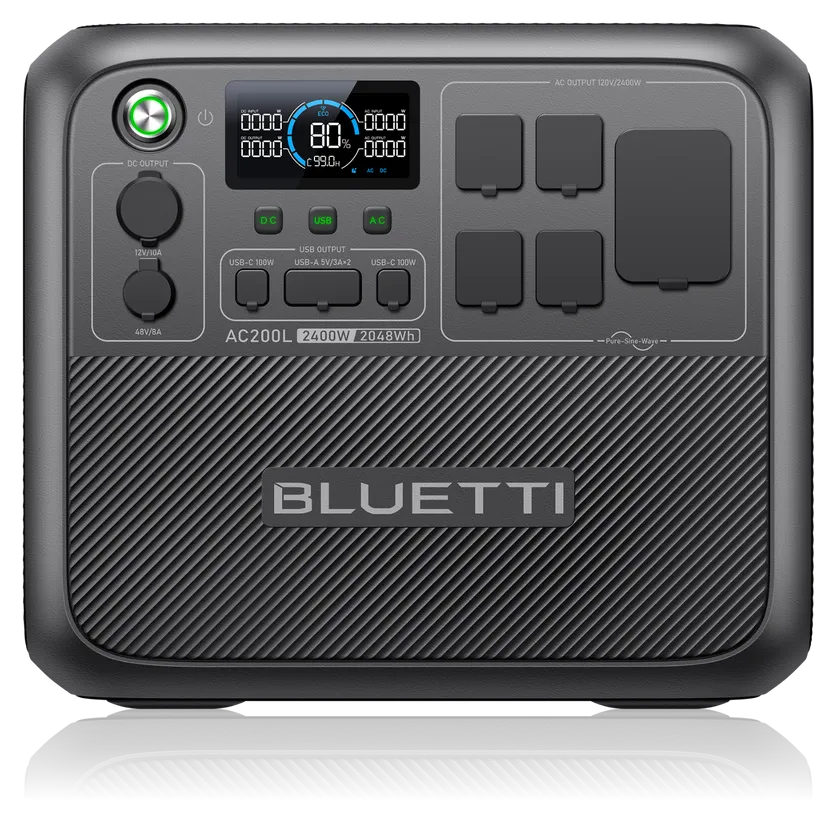
The Bluetti AC200L is the most purpose-built portable power station on the market for travel trailers and camper vans. The standout feature is its native NEMA TT-30R 120V/30A receptacle, which allows you to plug your RV’s 30-amp shore power cable directly into the unit without using dangerous 15A-to-30A dogbone adapters.
Equally crucial for van lifers is its 145V maximum solar input voltage. While competing units are capped at 60V (limiting you to low-voltage parallel solar arrays), the AC200L allows you to wire three large 400W commercial residential solar panels in series on your RV roof or ground array without exceeding the MPPT ceiling.
✓ Engineering Advantages
- Native 30A RV receptacle powers travel trailers without external adapters.
- 145V solar input allows series wiring of commercial high-wattage panels.
- LiFePO4 chemistry delivers 3,000+ cycles to 80% capacity for full-time living.
- High-speed 2,400W AC charging fully charges at RV parks in under 1.2 hours.
✗ Lab Compromises
- Weighs 62.4 lbs without wheels; awkward to move across campsites.
- Standard 12V DC port is limited to 10A (requires 48V port for heavy DC loads).
- App connectivity switches to Bluetooth when parked outside Wi-Fi coverage.
Anker SOLIX F2000 / 767 (2,048Wh / 2,400W)
Integrated Heavy-Duty Wheels • GaNPrime Inverter • 30A TT-30 RV Port
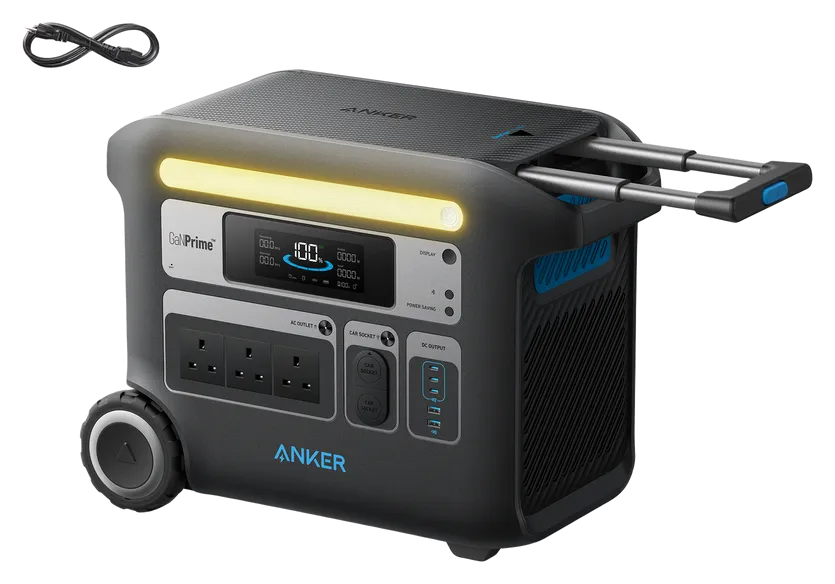
The Anker SOLIX F2000 was designed from the ground up for mobile transit. Packaging oversized 4.72-inch rugged wheels and an extendable telescoping suitcase handle, you can roll the unit effortlessly across rough dirt paths and gravel campsites directly to your travel trailer’s hitch box.
Its GaNPrime inverter runs remarkably cool and quiet, ensuring restful sleep even when running a rooftop vent fan or 12V camping fridge inside the vehicle.
Engineering Deep-Dive: RV Electrical Integration & Soft Starters For dedicated 30A RV plug solutions, read our reviews of the Allpowers S2000 Pro and Allpowers R1500. Building a mobile solar setup? Consult our Tiny Home Solar Power Setup Guide.
1. Locked Rotor Amps (LRA) on RV Rooftop Air Conditioners
The single most difficult appliance to power in an RV is the rooftop air conditioner (typically a Dometic, Coleman-Mach, or Furrion 13,500 BTU or 15,000 BTU unit). While these air conditioners consume only 1,200W to 1,600W while running continuously, the compressor motor requires an enormous surge of electrical current to overcome mechanical inertia at startup. This instantaneous surge is known as Locked Rotor Amps (LRA):
A standard 13,500 BTU RV air conditioner has an LRA rating of 45 to 60 Amperes:
This 6,600W instantaneous inductive surge will instantly trip the overload protection on standard 2,400W inverters.
The Engineering Solution: Installing an aftermarket Soft Starter (such as a Micro-Air EasyStart 364). A soft starter electronically ramps up compressor motor winding current over a 100-millisecond window, reducing LRA surge by 65% to 70% (down to ~16–18 Amps). With a soft starter installed, a 2,400W power station like the Bluetti AC200L or Anker F2000 starts and runs an RV air conditioner with ease.
2. Regulated 12V DC Bus vs Compressor Fridge Cutoffs
Modern overland refrigerators (Dometic CFX3, ICECO VL Pro) use efficient 12V DC Danfoss/Secop variable-speed compressors. These compressors feature internal low-voltage cutoff circuits designed to prevent draining a vehicle’s starter battery below 10.8V to 11.2V.
On poorly engineered power stations with unregulated 12V cigarette ports, output voltage drops as battery State of Charge depletes:
When battery capacity drops below 50%, unregulated DC voltage falls below 11.0V, causing the 12V fridge compressor to trigger an error cutoff and shut down. All power stations recommended in this guide feature tightly regulated 12V/13.6V DC buck-boost converters, ensuring consistent 12.8V–13.6V power all the way down to 0% battery capacity.
Frequently Asked Questions (FAQ)
Can I plug my 30-amp RV cord directly into a portable power station?
Yes, provided the power station features a native NEMA TT-30R receptacle (such as the Bluetti AC200L or Anker SOLIX F2000). If the unit only features standard 15A/20A household wall outlets, you must use a heavy-duty 15A-male to 30A-female dogbone adapter, though total power draw will be limited to 1,800W to 2,400W.
Can an RV power station charge from the vehicle’s alternator while driving?
Yes. All featured power stations support DC car charging via standard 12V/24V cigarette ports (drawing ~100W–120W). For high-speed vehicle charging, users can install a 12V-to-48V DC-DC charger (such as Victron Orion or EcoFlow Alternator Charger) to charge the power station at up to 500W to 800W directly from the vehicle’s alternator while driving.
Should I turn off my RV’s internal converter/charger when plugged into a power station?
Yes! This is critical. When you plug your RV shore cord into a portable power station, the RV’s internal onboard AC-to-DC converter will attempt to use the power station’s AC power to charge your RV’s 12V house batteries, creating an energy-wasting feedback loop. Always switch off the “Converter” circuit breaker in your RV’s distribution panel when running on portable power.
Final Recommendation: Which Power Station Should You Choose for RVing?
- Top Recommendation for Most RVers & Campers: The Bluetti AC200L offers the optimal blend of RV usability, 2,048Wh capacity, native TT-30 receptacle, and a 145V high-voltage solar MPPT controller.
- Top Recommendation for Easy Campsite Mobility: The Anker SOLIX F2000 features rugged 4.72-inch wheels and an extendable handle for seamless towing across gravel and dirt.
- Top Recommendation for Large Rigs & Full-Time Boondockers: The EcoFlow DELTA Pro provides 3,600Wh of baseline storage and 3,600W continuous output to power large dual-A/C rigs.