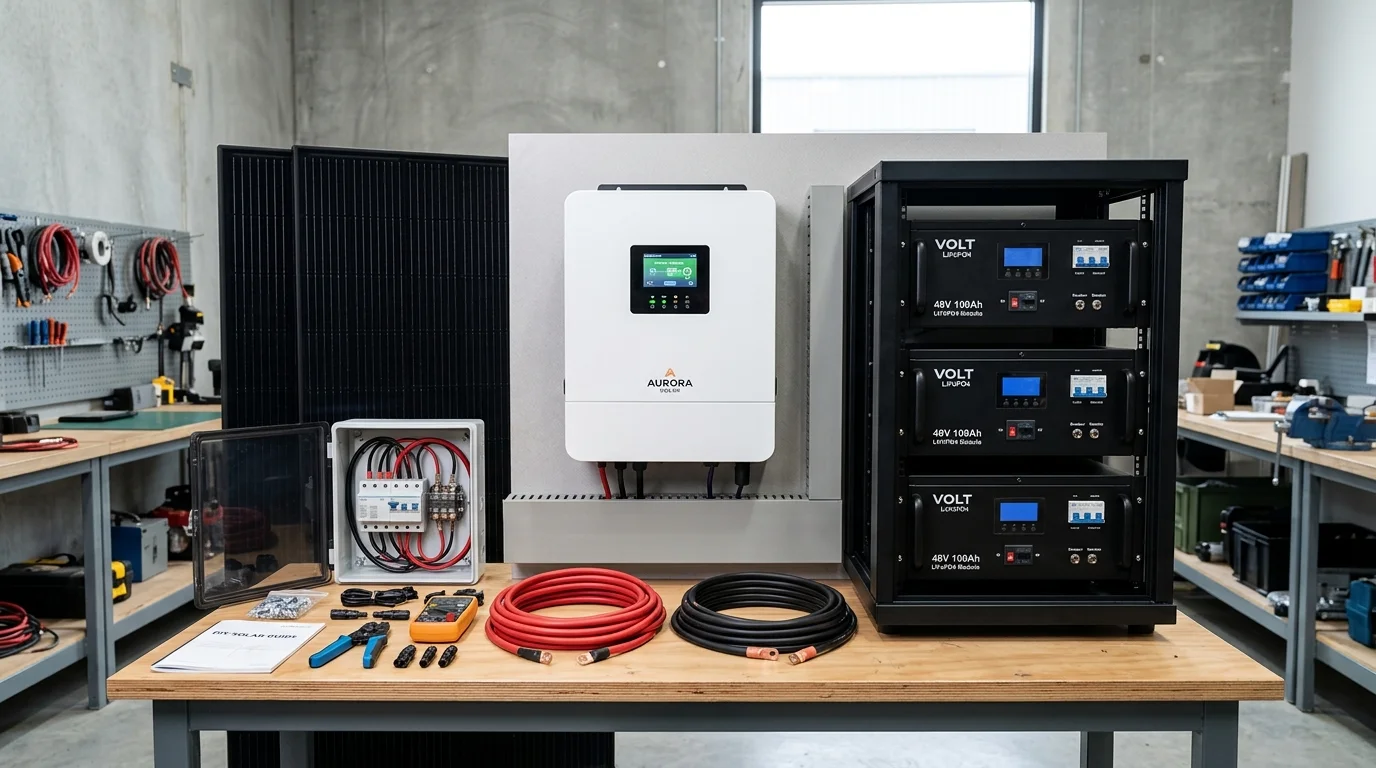
Navigating the photovoltaic landscape requires balancing raw electrical load calculations with contractor reliability, warranty terms, and local grid interconnection standards. Selecting the right engineering partner is just as critical as determining your household kilowatt-hour (kWh) consumption or battery depth of discharge (DoD). Whether you are planning an off-grid cabin or a grid-tied residential array with backup storage, matching your specific energy profile with a verified local or national installer prevents under-sizing, permitting bottlenecks, and costly inverter clipping.
This technical guide integrates our interactive solar company match quiz framework with first-principles electrical engineering formulas. By evaluating your precise device wattages, localized peak sun hours, and daily runtimes, we bridge the gap between theoretical photovoltaic design and real-world contractor execution, ensuring your system delivers decades of reliable power.
Interactive Solar Company & System Match Framework
Compare system sizing profiles, localized permitting requirements, and battery depth of discharge boundaries to determine whether a regional specialist or national provider matches your installation needs.
Evaluate your continuous load demands, required photovoltaic generation (), and storage buffer boundaries to establish target contractor qualifications.
Key Engineering Takeaways If you prefer self-procuring equipment rather than turnkey installations, consult our Buying Solar Equipment Online Guide and learn how utility credits impact your payback in our Net Metering & NEM Billing Guide.
Designing a resilient photovoltaic and storage installation goes beyond plugging numbers into a generic calculator. Electrical safety, thermal derating, and localized building codes dictate system longevity.
- Load Diversity and Inverter Surge: Continuous loads differ significantly from inductive motor start-up surges. Your inverter must handle peak surge ratings (often 2x to 3x continuous watt limits) without tripping metal-oxide varistors (MOVs) or thermal breakers.
- Temperature Coefficient Derating: Photovoltaic panels lose conversion efficiency as cell temperatures rise above Standard Test Conditions (STC at 25°C). High ambient summer temperatures require applying a -0.30% to -0.45% power derating factor per degree Celsius.
- Battery Chemistry and DoD Boundaries: Lithium Iron Phosphate (LiFePO4) chemistry safely handles 80% to 90% Depth of Discharge over 6,000 cycles, whereas traditional Lead-Acid flooded cells degrade rapidly past 50% DoD, drastically limiting usable amp-hours (Ah).
First-Principles Electrical Physics and Formulas
Accurate solar sizing relies on governing equations derived from Ohm’s Law, power laws, and photovoltaic yield algorithms.
The baseline energy consumption of any connected appliance over a 24-hour cycle is expressed as:
Where is the active power draw in watts of appliance , and is the runtime in hours. To account for direct current (DC) to alternating current (AC) conversion losses through the inverter (), the actual energy pulled from the battery bank is:
When sizing the photovoltaic array to replenish both the daily load and account for system inefficiencies (such as dust, wiring resistance, and solar module degradation), the minimum peak kilowatt () requirement is calculated as:
Where typically ranges between 0.75 and 0.82 for standard residential rooftop string and microinverter layouts.
Practical Test Bench Benchmarks
At GridSpecLab, our test bench measures actual conversion efficiencies, standby parasitic draws, and inverter response times under rigorous load profiles. The following pre-calculated cheat sheet details common household and off-grid appliances alongside their real-world energy footprints.
| Appliance / Device | Running Watts (W) | Surge Watts (W) | Daily Energy (Wh/day) | Min Inverter Bracket |
|---|---|---|---|---|
| Standard Refrigerator (Inverter Compressor) | 150W | 1,200W | 1,800 Wh | 2,000W+ |
| Medical CPAP Machine (with humidifier) | 60W | 110W | 480 Wh | 500W+ |
| Mini-Split Air Conditioner (9,000 BTU) | 900W | 2,400W | 7,200 Wh | 3,000W+ |
| Starlink Gen 2 / Gen 3 Terminal | 75W | 130W | 1,800 Wh | 500W+ |
| 55” LED Smart Television | 110W | 150W | 440 Wh | 500W+ |
Real-World Sizing and Installation Scenarios
To illustrate how these formulas apply in practice, let us examine two distinct deployment scenarios handled by our installer matching framework.
Scenario A: Remote Cabin with Essential Loads (Under 500Wh Bracket)
An off-grid user requires running a Starlink terminal, LED lighting, and charging laptop batteries totaling 350Wh daily.
- Inverter Selection: A 500W pure sine wave inverter is sufficient.
- Storage Requirement: A compact 1,000Wh LiFePO4 power station provides nearly 3 days of autonomy without solar recharge, ensuring safety during extended overcast periods.
- Installer Verdict: Typically handled via direct-to-consumer modular kits or local electricians specializing in off-grid sub-panels.
Scenario B: Residential Grid-Tied Backup (3,000W+ Bracket)
A suburban household consumes an average of 30 kWh daily, with critical loads (refrigeration, HVAC air handler, internet routing) requiring 12 kWh during grid outages.
- Array Sizing: Utilizing an average of 4.5 peak sun hours and an 80% system efficiency factor yields a minimum 8.3 kW rooftop array.
- Storage Requirement: A stacked 15 kWh modular battery bank operating at 80% DoD comfortably bridges evening peak rate periods and sudden grid failures.
- Installer Verdict: This configuration requires navigating complex utility Net Metering 3.0 (NEM) tariffs, structural engineering stamps, and local building permits—making vetted regional or national solar contractors essential for code compliance.
Tailored Product Recommendations and Power Brackets
Selecting hardware that matches your quiz results ensures optimal performance and cost-efficiency. Below are industry-validated power brackets mapped to specific deployment tiers.
Under 500Wh Bracket: Portable & Emergency Kit
- Best For: CPAP machines, communication routers, and laptop charging during short utility blackouts.
- Engineering Specs: Usually features 12V or 24V architecture with built-in MPPT solar charge controllers accepting up to 200W of photovoltaic input.
- Top Pick: EcoFlow River 2 Max / Equivalent Compact Power Station
1000W to 2000W Bracket: Mid-Tier Backup & Mobile Living
- Best For: Refrigerators, sump pumps, and extended remote work setups.
- Engineering Specs: Employs 48V nominal battery topologies to reduce resistive thermal losses across internal busbars, featuring pure sine wave outputs with robust surge handling.
- Top Pick: Bluetti AC200MAX / Mid-Tier Generator System
3000W+ Bracket: Whole-Home Resilience & Solar Arrays
- Best For: Central HVAC air handlers, well pumps, EV Level 2 charging, and full residential net-zero integration.
- Engineering Specs: High-voltage DC coupled or AC coupled hybrid inverters with split-phase 120V/240V output, integrated rapid shutdown compliance, and smart load-shedding relays.
- Top Pick: Tesla Powerwall 3 / Enphase 5P Modular System
Frequently Asked Questions
How does the Solar Company Match Quiz determine my ideal contractor?
Our matching engine cross-references your geographic zip code, utility provider tariff structure, and system capacity needs against a database of licensed, bonded, and vetted local and national installers. It ensures you are paired with contractors experienced in your specific regional building codes and interconnection rules.
Why is inverter sizing different from battery capacity sizing?
Inverter sizing dictates the maximum instantaneous power (watts) you can draw at any single moment, whereas battery capacity measures total stored energy (watt-hours or kilowatt-hours) available over time. An appliance may draw 2,000W instantly upon startup, but run for only 10 seconds, requiring high surge inverter capacity rather than massive energy storage.
What is the advantage of using a local installer over a national brand?
Local regional installers typically possess deeper familiarity with municipal permitting offices, local AHJ inspectors, and regional microclimates (such as heavy snow loads or coastal salt-fog corrosion). National brands often provide standardized warranty administration and corporate financing options, making the choice dependent on whether your priority is bespoke engineering or streamlined corporate financing.