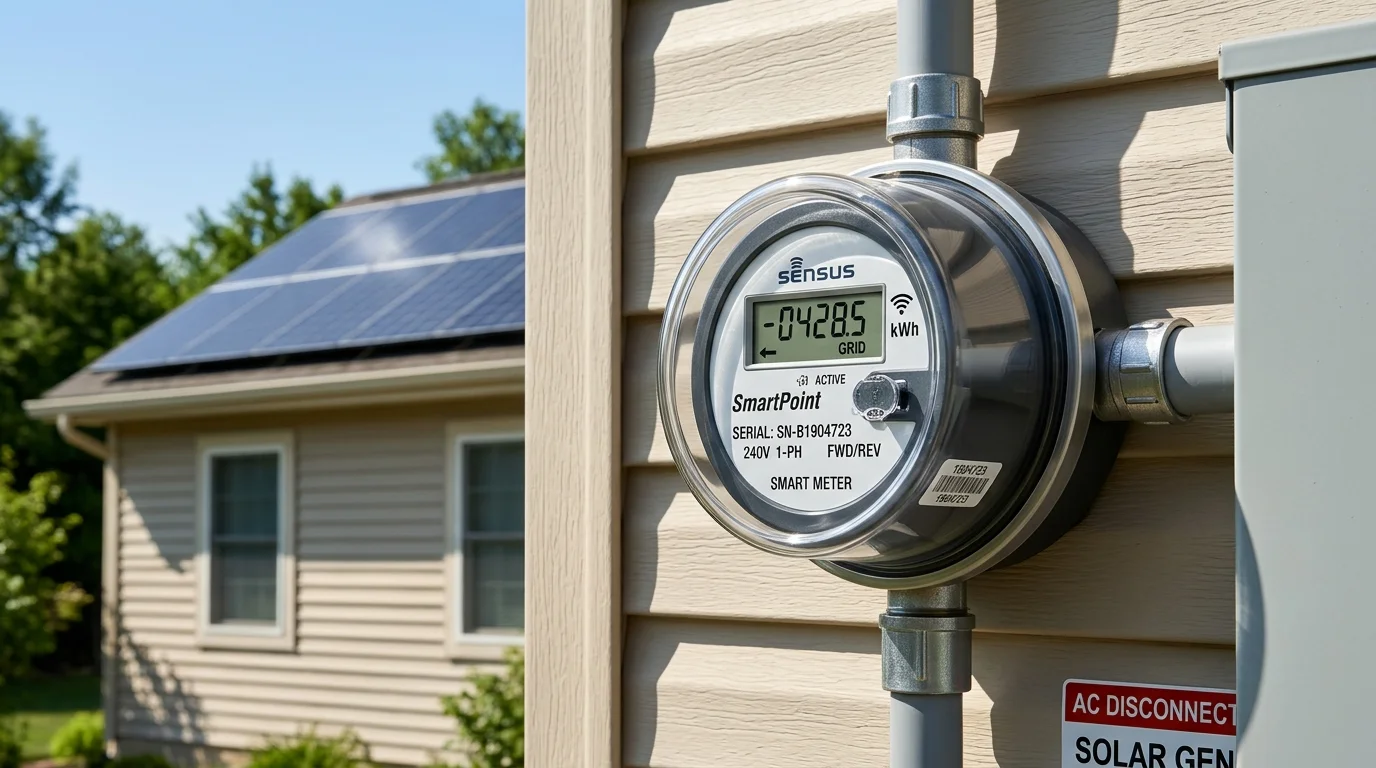
For more than two decades, the primary financial engine powering residential rooftop solar across North America was Net Energy Metering (NEM). Under traditional net metering laws, the electric utility grid acted as a free, 100% efficient virtual battery. If your solar panels generated 25 kWh while you were at work, that energy spun your electric meter backward, earning full 1-to-1 retail credits that you could use for free at night.
Today, that financial framework is rapidly disappearing.
With California’s transition to NEM 3.0 (the Solar Billing Plan) and dozens of states restructuring investor-owned utility (IOU) tariffs, exported solar energy is no longer compensated at retail prices. Instead, utilities pay fractional wholesale rates while charging homeowners steep Time-of-Use (TOU) rates when the sun goes down.
Understanding net metering math, utility billing cycles, and self-consumption architecture is the single most important factor determining whether your solar investment delivers a 5-year payback or becomes a financial liability.
Where is energy drawn from the grid during interval , is the active tariff rate, is solar power pushed into the grid, is the wholesale export credit value, and NBCs are Non-Bypassable Charges.
How Traditional Net Metering (NEM 1.0 & NEM 2.0) Worked
In standard alternating current residential wiring, electricity follows the path of least electrical resistance. When your rooftop solar array generates power:
- Instantaneous Self-Consumption: Solar electrons first feed whatever circuits are actively running inside your home (refrigerator compressor, air conditioner, router).
- Surplus Production Export: Any excess electricity not consumed internally flows out through your main electrical service panel, through a bi-directional utility smart meter, and onto the utility distribution grid.
- Meter Rollback (NEM 1.0/2.0): Under 1-to-1 net metering: If electricity costs $0.32 per kWh, exporting 1 kWh earned you a credit of exactly $0.32 against future usage.
The Annual “True-Up” Billing Cycle
Rather than forcing homeowners to cash out each monthly billing period, net metering policies operate on a 12-month Cumulative True-Up Cycle:
- Spring & Summer Months: High solar irradiance and long daylight hours create substantial credit surpluses.
- Fall & Winter Months: Short daylight hours, cloud cover, and heating loads cause homeowners to draw down accumulated credits.
- The 12-Month Settlement: At the end of month 12, the utility tallies total imports and exports. Under NEM 2.0, homeowners who were net-zero energy consumers owed only modest monthly connection fees ($10 to $15 per month).
The NEM 3.0 Revolution: From Net Metering to Net Billing To connect with vetted local and national contractors who understand regional NEM 3.0 utility tariffs, try our Solar Company Match Tool.
On April 15, 2023, California implemented the Solar Billing Plan (NEM 3.0), setting a precedent that regulatory utility commissions across the US are now adopting.
Under NEM 3.0, traditional 1-to-1 net metering was replaced with Net Billing:
| Tariff Feature | NEM 1.0 (Legacy) | NEM 2.0 (Transition) | NEM 3.0 (Net Billing) |
|---|---|---|---|
| Export Compensation | Full Retail Rate (1-to-1) | Retail minus NBCs (approx. $0.02 - $0.03/kWh) | Avoided Cost Tariff (approx. $0.05/kWh avg) |
| Export Rate Reduction | 0% | 5% to 8% | 75% to 85% Drop |
| Mandatory Rate Plan | Tiered or Flat | Time-of-Use (TOU) | Highly volatile hourly TOU (Electrification Rates) |
| Non-Bypassable Charges | N/A | $0.02 – $0.03 per imported kWh | Mandatory on gross imports ($0.03–$0.04/kWh) |
| Battery Storage Requirement | Optional / Financial luxury | Recommended for backup only | Mandatory for positive financial ROI |
| Typical Solar Payback | 4 – 6 Years | 5 – 7 Years | 12 – 16 Years (Solar-only) / 6 – 8 Years (Solar + Battery) |
The Avoided Cost Calculator: Why Exporting Solar Now Loses Money To mitigate unfavorable export tariffs by self-consuming stored battery power during evening peaks, read our guide to Peak Shaving and Time-of-Use Storage. Review the four system topologies in our Four Types of Solar Power Systems Guide.
The central mechanism of NEM 3.0 is the Avoided Cost Calculator (ACC). Instead of pegging solar export values to retail electricity prices, the California Public Utilities Commission (CPUC) sets export values based on what it would cost the utility to generate that power elsewhere.
Because hundreds of thousands of homes produce peak solar electricity simultaneously between 11:00 AM and 2:00 PM (creating the famous California Duck Curve), wholesale power prices during midday collapse to near zero—sometimes even turning negative.
The Real-World Financial Spread:
Consider a typical homeowner on an electrification TOU rate:
- Midday Solar Generation (1:00 PM):
- Utility Avoided Cost Credit for Export: $0.045 per kWh
- Evening Peak Consumption (7:00 PM):
- Utility Retail Cost for Import: $0.560 per kWh
If you do not have a battery and export 15 kWh of surplus afternoon solar:
When your family returns home in the evening and consumes that same 15 kWh to run the kitchen, lighting, and air conditioning:
Over a single year, pushing 15 kWh per day through the utility meter rather than storing it locally costs you $2,817.80 in lost savings!
The Self-Consumption Strategy: Why Batteries Are Mandatory
The death of retail net metering transformed home energy storage from an emergency blackout backup luxury into an essential daily economic tool.
Under a Zero-Export Self-Consumption Architecture, your solar system operates under automated intelligent control:
- Midday Solar Prioritization: When solar generation exceeds household consumption, the hybrid inverter directs surplus power straight into a high-capacity DC battery bank (such as an EG4 PowerPro 14.3kWh or Sol-Ark 15K). Zero power is exported to the grid at pennies.
- Evening Battery Discharge: As soon as retail grid rates enter the peak window (4:00 PM to 9:00 PM), the battery bank discharges to power the house. The home imports zero electricity at $0.56/kWh.
- True Arbitrage Capture: By avoiding the 0.50/kWh of net daily value**.
There is one major exception in the NEM 3.0 Avoided Cost table: September evenings between 6:00 PM and 8:00 PM. When summer heatwaves strain the grid, wholesale avoided-cost credits spike from $0.05/kWh up to $2.50 to $3.50 per kWh! Smart hybrid inverters can be scheduled to intentionally dump stored battery energy into the grid during these specific critical hours, capturing hundreds of dollars in utility credits in a single week.
Recommended Equipment for NEM 3.0 Self-Consumption & TOU Shifting
To maximize solar ROI under net billing, homeowners need high-efficiency hybrid inverters capable of rapid closed-loop load tracking and scalable LiFePO4 battery storage:

Sol-Ark 15K Hybrid Inverter
The gold standard for NEM 3.0 zero-export compliance. Features dual 200A pass-through busbars, three MPPT controllers (up to 19.5 kW DC PV input), and sub-5ms split-phase transfer time with fully customizable TOU charge/discharge automation.
- • Continuous Power: 15,000W AC (120V/240V split-phase)
- • Grid Interconnect: UL 1741-SB & IEEE 1547 compliant
- • Fast Response: External CT sensor zero-export tracking

EcoFlow DELTA Pro Ultra
Modular 6 kWh to 30 kWh energy storage system pairing with the Smart Home Panel 2. Automatically syncs with local utility tariff schedules via Wi-Fi to discharge during on-peak hours, minimizing reliance on high-rate grid imports.
- • Inverter Output: 7,200W continuous (up to 21.6 kW with 3 units)
- • Solar Input: High-voltage MPPT up to 5,600W
- • Smart App: Automated TOU rate arbitrage algorithm
How to Read Your Bi-Directional Utility Meter
When net metering is installed, your utility company replaces your traditional one-way electric meter with an advanced AMI Smart Bi-Directional Meter.
Smart meters cycle through automated display screens every few seconds:
- Channel 001 / Total Active kWh Delivered (Forward Flow): Indicates cumulative kilowatt-hours imported from the utility grid into your home. This number increases whenever household consumption exceeds solar generation.
- Channel 002 / Total Active kWh Received (Reverse Flow): Indicates cumulative kilowatt-hours exported into the utility grid from your solar panels.
- Instantaneous kW Display (+ / - Arrow):
- A positive (+) value or right-pointing arrow indicates net importing from the grid (you are consuming grid power).
- A negative (-) value or left-pointing arrow indicates net exporting (solar array is back-feeding clean energy into the street transformer).
Common Net Metering Pitfalls to Avoid
- Oversizing Your Solar Array Under NEM 3.0: Under NEM 2.0, oversizing by 120% was profitable because excess generation earned credits. Under NEM 3.0, any annual net surplus above 100% of consumption is cashed out at the abysmal Net Surplus Compensation (NSC) rate—often as low as 0.03 per kWh. Design arrays for 100% internal offset, not massive grid export.
- Ignoring Non-Bypassable Charges (NBCs): Even if you export 500 kWh and import 500 kWh, you still pay NBCs (approx. 0.04/kWh) on every imported kWh. Under net billing, imports and exports are accounted for separately; you cannot cancel out NBCs with export credits.
- Failing to Install Consumption Current Transformers (CTs): A hybrid inverter cannot prevent grid export or perform zero-export self-consumption unless external split-core CT sensors are properly clamped around your main 200A service entrance cables. Ensure your installer calibrates CT polarity.
Frequently Asked Questions
What happens to excess net metering credits at the end of the year?
At your 12-month True-Up anniversary, if you exported more total energy than you imported, the utility reconciles the account via Net Surplus Compensation (NSC). Instead of paying retail value, the utility reimburses excess kilowatt-hours at wholesale spot market prices (typically between 0.04 per kWh), either as a check or a credit rollover on your account.
Can I remain grandfathered on NEM 2.0 if I add a battery?
Yes! In California and most jurisdictions with grandfathering rules, adding energy storage (batteries) to an existing NEM 1.0 or NEM 2.0 solar system does not forfeit your grandfathered status, provided you do not expand the nameplate DC capacity of your solar panel array by more than 1 kW or 10%.
Is solar still worth it under NEM 3.0?
Solar is still financially viable under NEM 3.0, but only when paired with battery storage. A standalone solar system has an extended payback period of 12 to 16 years because 70% of generation is exported at wholesale rates. A solar-plus-battery system stores daytime surplus to offset expensive $0.50+/kWh peak evening electricity, yielding a healthy 6 to 8-year payback and full protection against utility rate hikes.
What are Non-Bypassable Charges (NBCs)?
Non-Bypassable Charges are mandatory utility fees (typically funding public purpose programs, low-income subsidies, and nuclear decommissioning) that are assessed on every gross kilowatt-hour imported from the grid. Even if your solar system exports enough power to wipe out energy charges, you cannot bypass or offset NBC fees.