Across the United States and global energy markets, electric utility rate structures have fundamentally shifted. Traditional flat-rate billing—where you paid a fixed $0.14 per kilowatt-hour regardless of the time of day—is rapidly disappearing in favor of mandatory Time-of-Use (TOU) rate tariffs.
Under TOU rate plans, electricity consumed between 4:00 PM and 9:00 PM (when families return home, turn on air conditioning, cook dinner, and plug in electric vehicles) is billed at extreme premium rates. In states like California, Arizona, and parts of the Northeast, on-peak rates frequently exceed 0.68 per kWh, while off-peak overnight rates sit at 0.24 per kWh.
Peak shaving with solar battery storage is the deliberate engineering process of storing cheap midday solar or off-peak grid energy and discharging it locally during expensive on-peak hours.
Below, we detail the mathematical financial models, inverter configuration modes, and the impact of Net Metering 3.0 policy changes.
Where is on-peak tariff, is off-peak/solar charging cost, is DC-to-battery-to-AC round-trip efficiency (), and is cycle wear cost per kWh (\approx \0.04$).
How Time-of-Use (TOU) Rates Work
To understand peak shaving, you must examine how utility load curves trigger variable pricing. In electric grid operations, electricity cannot easily be stored at the grid level without multi-billion dollar pumped-hydro or utility-scale battery installations.
When peak demand occurs at 6:00 PM, utilities must fire up expensive, inefficient natural gas “peaker plants” to prevent grid frequency collapse. To disincentivize consumption, they bill consumers with punitive pricing tiers:
| Rate Window | Hours of Day | Typical Rate ($/kWh) | Battery Operation Mode |
|---|---|---|---|
| Off-Peak (Midday Solar) | 9:00 AM – 4:00 PM | 0.18 | Bulk Solar Charging into Battery |
| ON-PEAK (The Danger Zone) | 4:00 PM – 9:00 PM | $0.58 / kWh | Peak Shaving: Zero Grid Draw |
| Super Off-Peak (Overnight) | 12:00 AM – 6:00 AM | $0.19 / kWh | Standby / Optional Low-Rate Top-Up |
During that 5-hour window between 4:00 PM and 9:00 PM, running a 3.5-ton central air conditioner (3,500W), an electric stove (2,000W), and household electronics costs approximately 16 every single afternoon. Over a billing month, on-peak energy alone accounts for 480 on standard residential utility bills.
The Net Metering 3.0 (NEM 3.0) Disruption
Historically under Net Metering 1.0 and 2.0, homeowners with grid-tied solar did not need batteries to avoid peak charges. If your solar panels generated excess electricity at 1:00 PM, the utility gave you a 1-to-1 retail credit (0.35), effectively turning the grid into a free 100% efficient virtual battery.
Under Net Metering 3.0 (Avoided Cost Tariff), utilities slashed export credits by 75% to 85%:
- Midday Export Credit: Utilities now credit exported solar at wholesale avoided cost: just 0.06 per kWh.
- Evening Import Cost: When the sun sets at 6:30 PM, the same utility charges you $0.58 per kWh to purchase back power!
If you export 20 kWh of excess solar during the day, you earn 11.60. You lose $10.60 per day simply by pushing power through utility meters.
The Solution: Storing that 20 kWh locally in a 48V battery bank (e.g., EG4 18kPV paired with EG4 PowerPro 14.3kWh) captures the full 3,800 annually**.
Round-Trip Efficiency & The Economic Spread Threshold
Energy is never stored for free. When converting 300V DC rooftop solar into 48V battery chemical storage and subsequent 120V/240V AC output, energy undergoes three conversion stages:
This means for every 10.0 kWh of energy you push into a battery bank, you will extract approximately 8.8 kWh of usable AC power. 1.2 kWh is dissipated as ambient warmth across the cooling heat sinks and internal cell resistance.
Furthermore, every battery has a mechanical Levelized Cost of Storage (LCOS) derived from cycle degradation:
The Financial Rule of Thumb: Peak shaving is financially profitable whenever:
In virtually all major US metro areas with TOU tariffs, the rate spread ranges between 0.40/kWh, making peak shaving overwhelmingly profitable with a typical equipment payback period of 4.2 to 5.8 years.
How to Program Your Inverter for Automated Peak Shaving Calculate your household daily kWh baseline before scheduling discharge windows using our guide on How Many Batteries to Power a House.
Modern smart hybrid inverters and whole-home power hubs automate peak shaving through internal microcontroller clocks. You do not need to flip breakers or monitor clocks manually.
EG4 18kPV / Sol-Ark 15K TOU Configuration Map
In “Time-of-Use Discharge” mode, current sensors (CT clamps) installed at your main electrical service entrance measure power entering your home from the utility meter in real time:
- If your central air conditioner starts up drawing 3,500W, the inverter instantly increases its battery output to exactly 3,500W.
- The net power registered by the utility meter remains at 0 Watts.
- You run your air conditioning, lights, and kitchen appliances entirely on stored midday solar, completely bypassing on-peak utility meters.
Recommended Hardware for Residential Peak Shaving For whole-home hybrid inverters with advanced TOU peak-shaving scheduling, read our Fortress Power Envy True 12k Review. You can also automate circuit level shedding via a Smart Transfer Switch.
EG4 18kPV Hybrid Inverter
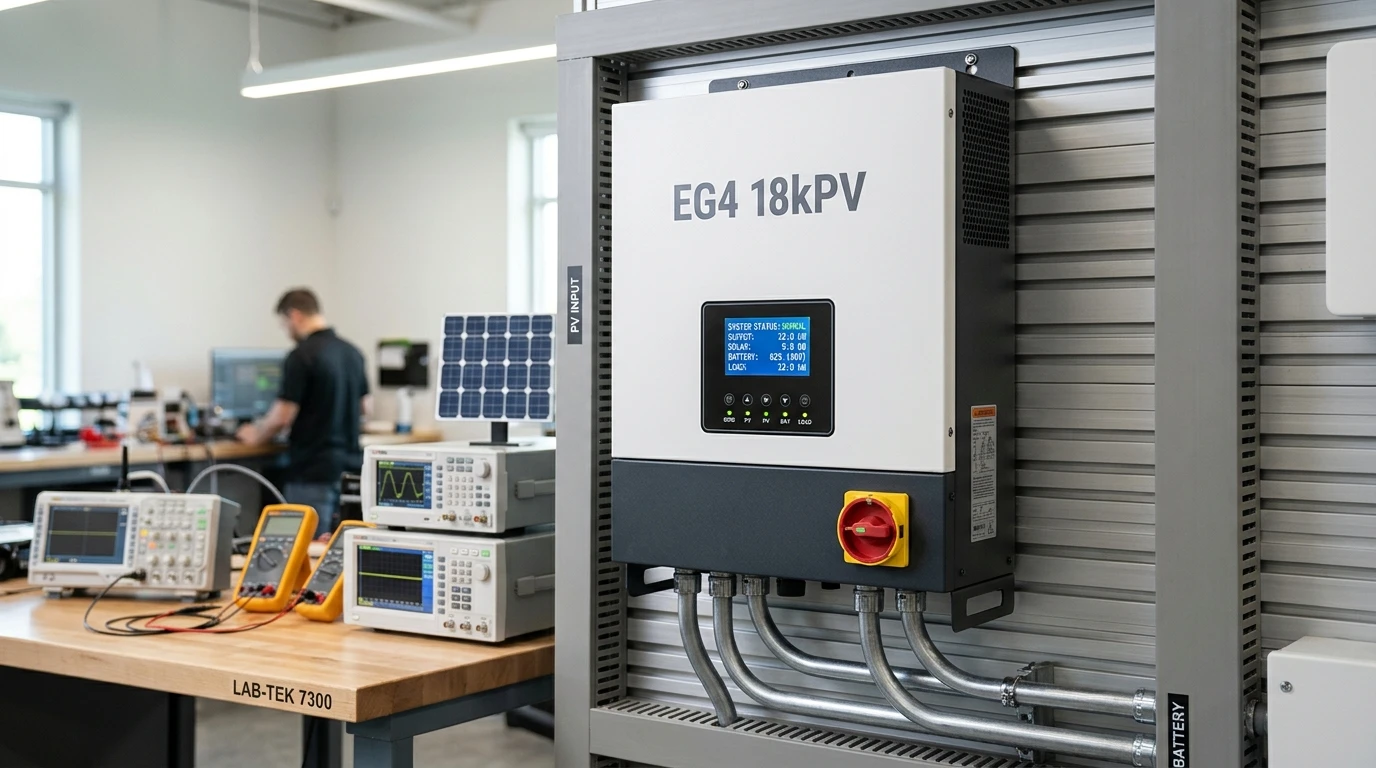
Native 200A grid pass-through and automated Time-of-Use rate scheduler. Discharges 48V battery banks to maintain zero-watt grid import during on-peak windows without critical load sub-panels.
EcoFlow DELTA Pro Ultra

Pairs with the EcoFlow Smart Home Panel 2 to automate circuit-level TOU load shifting. Monitors utility electricity rates directly through the app to maximize financial savings.
Peak Shaving Sizing Checklist
- Identify On-Peak Tariff Hours: Check your utility electric bill for exact peak windows (e.g., 4:00 PM – 9:00 PM).
- Calculate Peak Energy Consumption: Audit total kWh consumed during those 5 peak hours (typically 8 to 15 kWh).
- Size Battery Bank with 20% Emergency Reserve: A 15 kWh battery pack allows you to discharge 12 kWh for daily peak shaving while preserving 3 kWh (20%) in reserve for unexpected power outages.
- Verify Inverter Current Sensor (CT) Calibration: Ensure external CT sensors are clamped around utility service conductors in the correct direction to prevent inaccurate feedback.
- Enable Low-Rate Off-Peak Grid Assist: In winter months with insufficient solar irradiance, program the inverter to charge the battery from the grid during super-off-peak overnight hours (0.58/kWh).
Frequently Asked Questions
What is the difference between peak shaving and load shifting?
While often used interchangeably, peak shaving specifically focuses on reducing instantaneous power demand spikes () to lower utility demand charges or avoid peak tariff brackets. Load shifting (or energy arbitrage) refers to moving a volume of energy consumption () from high-cost periods to low-cost off-peak periods, either by scheduling heavy appliances or by charging a battery at night and discharging it in the evening.
Can I do battery peak shaving without having solar panels?
Yes. You can program a hybrid inverter or smart home battery to perform pure Time-of-Use (TOU) arbitrage without solar panels. The inverter charges the battery from the utility grid during low-cost off-peak overnight hours (e.g., 0.55/kWh), capturing the financial spread between rate tiers.
How much money can a home battery save on Time-of-Use rates?
Under aggressive TOU rate structures like California NEM 3.0 or Arizona APS rates, a 15 kWh battery system cycling daily can displace 10 to 12 kWh of peak power per day. At a 4.00 to 1,400 to $1,750 in direct annual utility bill savings**.
Does daily peak shaving wear out a LiFePO4 battery quickly?
Modern Lithium Iron Phosphate (LiFePO4) battery chemistry provides between 6,000 and 8,000 full discharge cycles to 80% remaining capacity. Cycling a LiFePO4 battery once per day for peak shaving represents 365 cycles per year. At this rate, the battery will operate for 16 to 20 years before reaching its 80% capacity retirement threshold.