One of the most frequent questions asked by homeowners preparing for power grid instability or designing an off-grid solar installation is deceptively simple: “How many batteries do I need to run my house?”
The answer depends on a crucial distinction that many solar sales representatives gloss over: power () versus energy ().
- Power (): The rate at which electricity is consumed at any given instant. If your central air conditioner, microwave, and well pump kick on simultaneously, your battery inverter must deliver 8 to 12 kilowatts of continuous power without tripping circuit breakers.
- Energy (): The total volume of electricity consumed over time. Running an average American home for 24 hours without utility grid power requires between 12 kWh (strict emergency conservation) and 35 kWh (unrestricted living with HVAC).
This engineering sizing guide walks through the exact calculations to determine how many 48V 100Ah server rack batteries or wall-mounted power units your specific home requires.
Where Daily AC Load is determined by an electrical load audit, DoD is usable Depth of Discharge (0.85 to 0.90 for LiFePO4), and is pure sine wave conversion efficiency (typically 0.90).
Choosing Your Backup Tier: Critical Loads vs Whole-House
Before sizing battery modules, decide whether you are backing up an Essential Critical Loads Sub-Panel or aiming for Unrestricted Whole-Home Backup:
| Backup Tier | Protected Circuits | Daily kWh Budget | Required 48V Batteries |
|---|---|---|---|
| Tier 1: Survival Essentials | Full refrigerator, freezer, LED lights, Wi-Fi, CPAP machine, phone charging | 4 – 6 kWh / day | 1 to 2 Batteries (5 – 10 kWh) |
| Tier 2: Critical Sub-Panel | All Tier 1 loads + 1/2 HP well pump, gas furnace blower, microwave, TV, security system | 10 – 14 kWh / day | 3 Batteries (15.36 kWh) |
| Tier 3: Moderate Whole-Home | All Tier 2 loads + mini-split heat pumps, kitchen outlets, garage door opener | 18 – 24 kWh / day | 4 to 6 Batteries (20 – 30 kWh) |
| Tier 4: Unrestricted Luxury | Central 3 to 5-ton heat pump AC, electric water heater, electric dryer, EV charging | 35 – 50+ kWh / day | 8 to 12+ Batteries (40 – 60+ kWh) |
Conducting an Appliance Load Audit: Calculating Daily kWh
To determine how many batteries your household needs, sum the daily energy draw of your intended appliances:
- Full-Sized Inverter Refrigerator & Freezer: 150W running at 35% duty cycle = 1,260 Wh/day (1.26 kWh).
- 240V 3/4 HP Deep Well Water Pump: 1,200W running 1.5 hours total = 1,800 Wh/day (1.80 kWh).
- Natural Gas / Propane Furnace Blower Motor: 450W running 6 hours during winter = 2,700 Wh/day (2.70 kWh).
- Starlink Internet & Wi-Fi Router: 65W continuous running 24 hours = 1,560 Wh/day (1.56 kWh).
- Kitchen Microwave & Coffee Maker: 1,400W running 30 minutes total = 700 Wh/day (0.70 kWh).
- Household LED Lighting & Laptop/Phone Charging: 1,200 Wh/day (1.20 kWh).
Adding a 15% safety buffer for inverter tare idle consumption and transformer conversion losses:
Sizing 48V Server Rack Batteries
To choose between standard 19-inch rack units and wall-mounted enclosures, consult our engineering guide to Server Rack vs Wall-Mount Batteries.
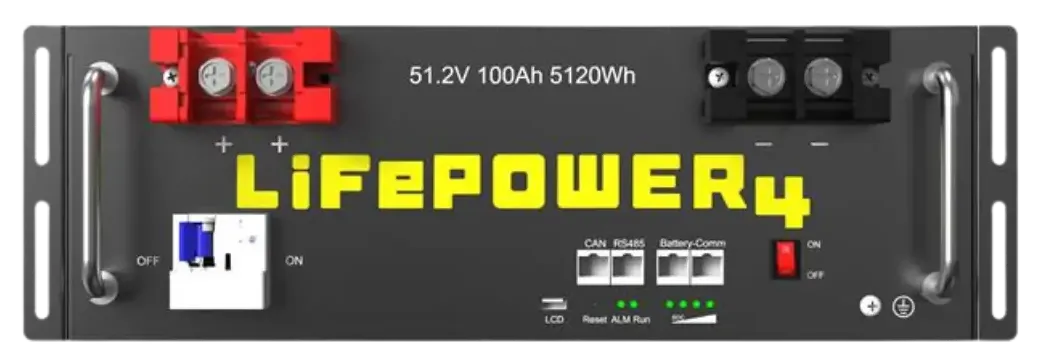
The industry standard building block for residential solar energy storage is the 48V 100Ah Lithium Iron Phosphate (LiFePO4) Server Rack Battery (such as the EG4 LL-S or Ruixu 48V Rack):
- Nominal Voltage: (16 prismatic cells in series)
- Rated Capacity:
- Nominal Stored Energy:
- Usable Energy at 85% Depth of Discharge:
Sizing for 24 Hours of Autonomy (Zero Solar Input):
To cover our 10.6 kWh daily critical load:
Three 48V 100Ah batteries provide 15.36 kWh nominal storage (13.0 kWh usable), delivering over 28 hours of continuous runtime without any solar panel input or generator assistance.
The Giant Load: Sizing for Central Air Conditioning & Heat Pumps
The single appliance that completely alters battery sizing is central air conditioning or an electric heat pump.
A modern 3-ton (36,000 BTU) central heat pump with a SEER2 rating of 16 consumes approximately 2,500 to 3,200 Watts while running. During a humid summer day, it may cycle for 10 to 12 hours:
Running this single appliance requires an extra 7 to 8 server rack batteries on its own!
The Locked Rotor Amperage (LRA) Starting Inrush Surge
Beyond raw kilowatt-hours, central AC compressors feature severe electrical starting surges:
- A 3-ton scroll compressor may have a Locked Rotor Amperage (LRA) of 75 to 90 Amps at 240V, demanding an instantaneous surge of 18,000 to 21,600 Watts to overcome mechanical pressure.
- The Solution: Installing an advanced electronic Micro-Air EasyStart or Soft Starter on the AC compressor reduces starting inrush current by 65% to 75%, allowing a standard 12 kW to 15 kW hybrid inverter (like the EG4 18kPV) to start the compressor smoothly without causing lights to dim or inverters to trip.
Recommended Home Battery Storage & Inverter Systems
To leverage your battery bank for utility bill reduction, read our strategy guide on Peak Shaving and Time-of-Use Storage. For real-world continuous load testing, see Can a Power Station Survive a 24-Hour Outage?.
To achieve reliable whole-home backup, choose modular lithium battery storage paired with UL-listed hybrid inverters:
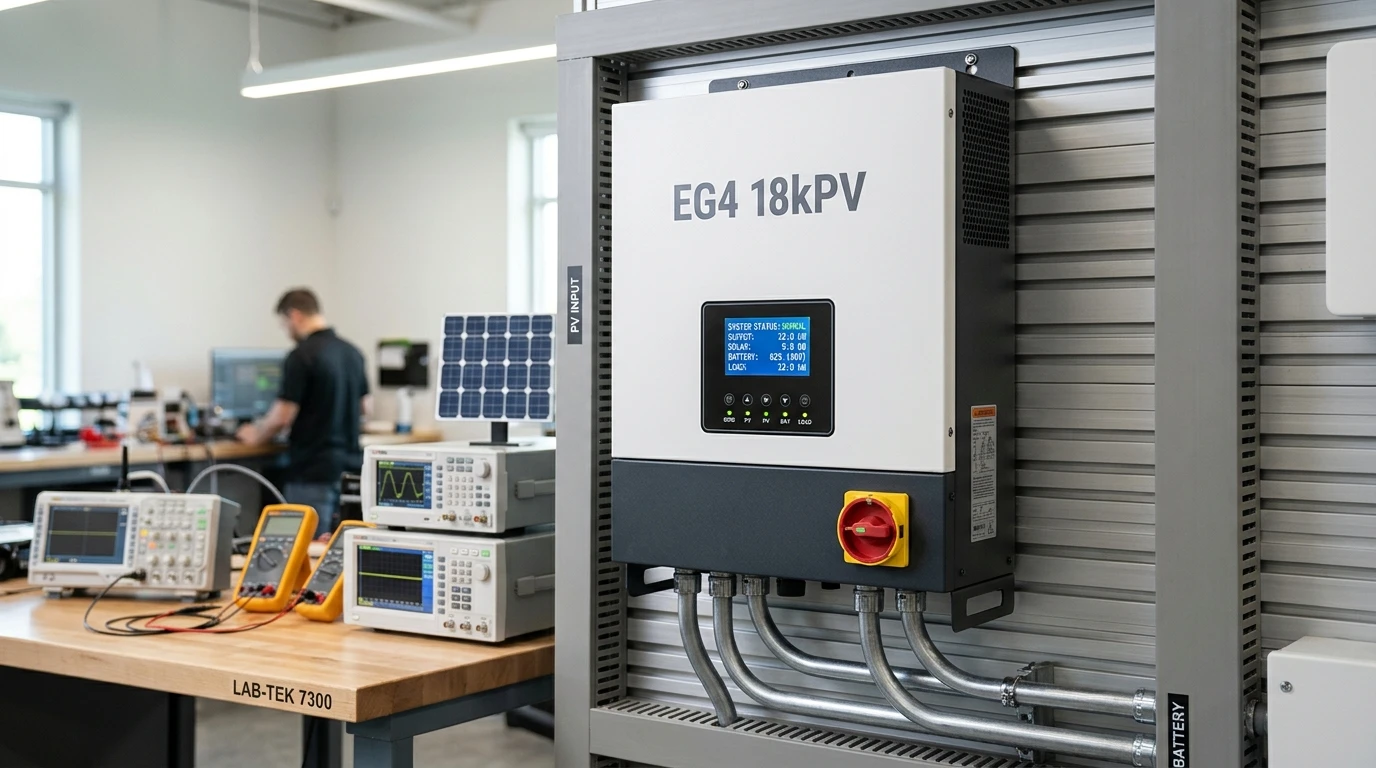
1. EG4 18kPV Hybrid Inverter
Provides 12,000W continuous pure sine wave power (120V/240V split-phase) with a 200A integrated whole-home transfer switch. Directly connects up to 16 server rack batteries (81.9 kWh) and features three MPPT solar inputs accepting up to 18,000W of rooftop solar.
- • Continuous Power: 12,000W AC (240V split-phase)
- • Surge Capability: 16,000W (for AC compressor starts)
- • Battery Compatibility: 48V closed-loop LiFePO4

2. EG4 LL-S 48V 100Ah Battery (5.12 kWh)
Tier-1 prismatic LiFePO4 cells rated for over 7,000 cycles at 80% DoD. Features closed-loop CAN/RS485 communications with all major inverters, an on-board LCD diagnostic display, and an integrated 100A DC circuit breaker for instant circuit isolation.
- • Nominal Storage: 5,120 Wh per module
- • Parallel Scalability: Connect up to 16 modules (81.9 kWh)
- • Cycle Life: 7,000+ cycles (15+ years daily use)
How Many Batteries Do You Need? (Quick Reference Table)
Use this sizing reference to match your home square footage and target electrical autonomy:
| Home Profile | Target Scope | Total Usable Storage | Recommended 5.12 kWh Batteries |
|---|---|---|---|
| 1,200 sq ft Small Home / Cabin | Critical circuits + Mini-split AC | 10 – 15 kWh | 2 to 3 Server Rack Batteries |
| 2,000 sq ft Suburban Home | Critical sub-panel + Gas furnace + Well pump | 15 – 20 kWh | 3 to 4 Server Rack Batteries |
| 2,500 sq ft All-Electric Home | Whole-home backup with 3-ton Central AC (Soft-Start) | 30 – 40 kWh | 6 to 8 Server Rack Batteries |
| 3,500+ sq ft Large Estate | Unrestricted whole-house with dual AC units & EV charger | 45 – 60+ kWh | 9 to 12+ Server Rack Batteries |
Frequently Asked Questions
Can one 5kWh battery power a house during a blackout?
One 5.12 kWh battery can power essential survival loads (refrigerator, Wi-Fi router, LED lighting, and small electronics) for approximately 12 to 18 hours. However, it cannot run large 240V appliances like central air conditioners, electric water heaters, or electric stoves, which would drain the battery in less than 90 minutes.
How many Tesla Powerwalls do I need to power a house?
A single Tesla Powerwall 3 provides 13.5 kWh of usable capacity. To back up an average 2,000 sq ft home with critical loads, one to two Powerwalls (13.5 to 27 kWh) are typically required. If you want to run central air conditioning or an electric vehicle charger without restriction, three Powerwalls (40.5 kWh) are recommended.
Is it cheaper to build a server rack battery system than buying a Powerwall?
Yes, significantly cheaper. A 15 kWh server rack battery bank (three 48V 100Ah LiFePO4 modules) costs approximately $4,000 to $4,500 in equipment. In contrast, a single 13.5 kWh Tesla Powerwall or Enphase battery installed typically costs between $10,000 and $14,000, offering less modular repairability and vendor lock-in.
What is the difference between battery continuous power and surge power?
Continuous power (measured in kilowatts, kW) is the sustained electrical output the battery inverter can deliver indefinitely without overheating. Surge power is the momentary burst of high wattage (usually lasting between 100 milliseconds and 5 seconds) the system can supply to start heavy electric motors, such as air compressor pumps and well pumps.