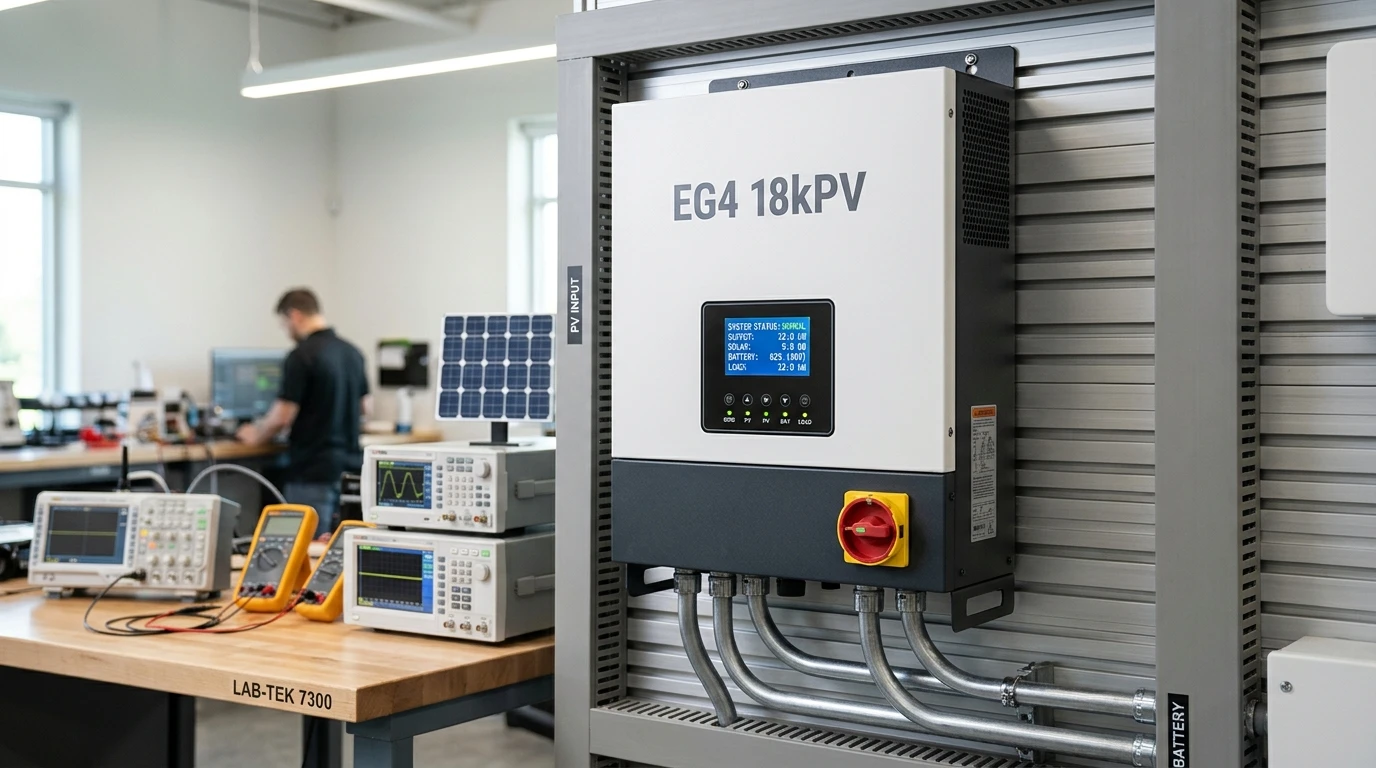
When sizing a residential hybrid solar system for complete energy independence, the 15-kilowatt continuous AC power class represents the summit of performance. At 15kW continuous split-phase power (62.5 Amps at 240V), an inverter can effortlessly sustain a fully electrified 3,500+ sq ft home—running multiple central heat pumps, an electric oven, a water heater, a well pump, and EV charging simultaneously.
At this elite tier, two machines dominate North American installations: the Sol-Ark 18K-2P and the EG4 FlexBOSS 21.
Both units feature integrated 200A service entrance transfer switches, triple-MPPT solar charge controllers, and 48V battery busbars. However, stark differences in solar array limits, surge handling, and hardware pricing create distinct buying rationales. Below is our side-by-side engineering teardown.
Quick Spec Comparison
The table below contrasts the technical fundamentals of both flagship inverters:
| Specification | EG4 FlexBOSS 21 | Sol-Ark 18K | Key Advantage |
|---|---|---|---|
| Continuous AC Output | 15,000W (62.5A @ 240V) | 15,000W (62.5A @ 240V) | Identical 15kW power output |
| Peak Motor Surge | 21,000W (10 sec) | 24,000W (10 sec) | Sol-Ark provides +3kW surge headroom |
| Max Solar PV Input | 21,000W (21kW Array) | 19,500W (19.5kW Array) | EG4 accepts 1,500W more solar |
| Grid Pass-Through | 200A Native Bypass | 200A Native Bypass | Both power entire 200A home panel |
| Standby Tare Loss | 52W Idle Draw | 65W Idle Draw | EG4 draws approx. 310Wh less daily |
| Typical Price Range | 5,800 | 8,500 | EG4 saves over $2,500 on hardware |
15kW Continuous Output and Household Load Sharing
Both the EG4 FlexBOSS 21 and the Sol-Ark 18K deliver an impressive 15,000 watts continuous of pure sine wave power at 120V/240V split-phase. In practical terms, this means:
- You can run two 3-ton central air conditioners simultaneously during a summer heatwave blackout.
- You can heat your home with a central heat pump while preparing meals on an induction stove.
- You avoid the constant fear of tripping the inverter when multiple appliances cycle on together.
Both inverters feature a 200A whole-home transfer switch, allowing whole-panel backup without requiring an electrician to split circuits into a critical loads subpanel.
Solar DC Sizing and MPPT Architecture
Where these two flagships diverge is in their solar array capabilities:
- EG4 FlexBOSS 21: Supports up to 21,000 watts of DC solar panels. It features 3 independent MPPT controllers with dual string terminals per MPPT (6 strings total). Each string can handle up to 600V Voc, allowing massive solar arrays that power the home during the day while pushing surplus energy into battery storage.
- Sol-Ark 18K: Supports up to 19,500 watts of DC solar panels across 3 MPPT controllers with 4 string inputs (configured as 2+1+1).
The extra 1.5kW DC solar input and additional string inputs on the EG4 FlexBOSS 21 provide a distinct advantage for complex residential roofs where solar panels must face multiple directions (East, South, and West).
Surge Tolerances and Latency
When it comes to motor inrush and switchover speeds:
- Sol-Ark 18K: Delivers an astonishing 24,000W peak surge (10 seconds) and an ultra-fast 5ms optical transfer speed. For medical gear, server racks, and older 5HP deep well pumps with massive inductive startup spikes, the Sol-Ark provides the highest safety margin available.
- EG4 FlexBOSS 21: Delivers a 21,000W surge (10 seconds) and an 8ms transfer speed. This transfer latency is still classified as true uninterruptible power supply (UPS) grade—home computers, TVs, and clocks will not reset during a grid outage.
Upfront Price vs System Expansion
The most compelling engineering differentiator is the financial equation:
- The Sol-Ark 18K retails between 8,500.
- The EG4 FlexBOSS 21 retails between 5,800.
With both units producing the exact same 15,000 watts of continuous AC output, the 2,700 price difference is monumental. That savings alone can purchase an entire 14.3 kWh EG4 WallMount LiFePO4 battery or 10 high-efficiency 400W solar panels.
Pros and Cons Breakdown
EG4 FlexBOSS 21 Advantages
- ✓ Huge Cost Advantage: Saves over $2,500 compared to Sol-Ark 18K for identical 15kW continuous power.
- ✓ Higher Solar PV Limit: 21,000W DC solar capacity across 6 string connections.
- ✓ Lower Standby Overhead: Low 52W idle draw saves battery reserves during prolonged dark spells.
- ✓ Lightweight Design: 118 lbs vs 145 lbs makes wall-mounting significantly easier.
Trade-offs
- • 21,000W surge vs 24,000W on Sol-Ark.
- • 8ms transfer speed vs 5ms optical transfer.
Sol-Ark 18K Advantages
- ✓ Extreme Surge Rating: 24,000W handles the most demanding commercial shop tools and well pumps.
- ✓ 5ms Optical Switching: The fastest transfer switch in the residential solar sector.
- ✓ Universal Closed-Loop Support: Compatible with virtually every high-end battery brand on the market.
- ✓ Proven Industrial Heritage: Designed for mission-critical off-grid microgrid installations.
Trade-offs
- • Substantially higher retail cost ($8,000+).
- • Higher standby tare loss (around 65W).
The Verdict: Which One Should You Buy?
For 95% of residential whole-home backup installations:
-
The EG4 FlexBOSS 21 is our Top Recommendation. Matching the Sol-Ark’s 15kW continuous output while offering higher 21kW solar array support and saving over $2,500 on hardware makes it the undisputed value and performance champion for residential homeowners. Read our full hardware benchmark in the EG4 FlexBOSS 21 Review or see how it stacks up against the previous generation in EG4 FlexBOSS 21 vs 18kPV.
-
The Sol-Ark 18K is the Premium Commercial Choice. If your installation demands the absolute fastest 5ms optical transfer speed for delicate data equipment or 24,000W surge tolerance for heavy agricultural machinery, the Sol-Ark 18K remains an industrial-grade titan. For an alternative comparison between earlier flagships, check out our EG4 18kPV vs Sol-Ark 15K Showdown or browse complete kit packages in our ShopSolar Solar Kits Review.