For our standalone bench testing report on this unit, read our in-depth EG4 18kPV Hybrid Inverter Review. See how both inverters compare against newer modular topologies in our breakdown of Sol-Ark 18K vs EG4 FlexBOSS 21.
For homeowners seeking total energy independence, the transition from portable plug-and-play power stations to whole-home hybrid solar inverters is the ultimate frontier. Rather than managing extension cords and selective appliance outlets during a blackout, a whole-home hybrid inverter is hardwired between your utility meter and your main 200A breaker panel, running your entire house automatically.
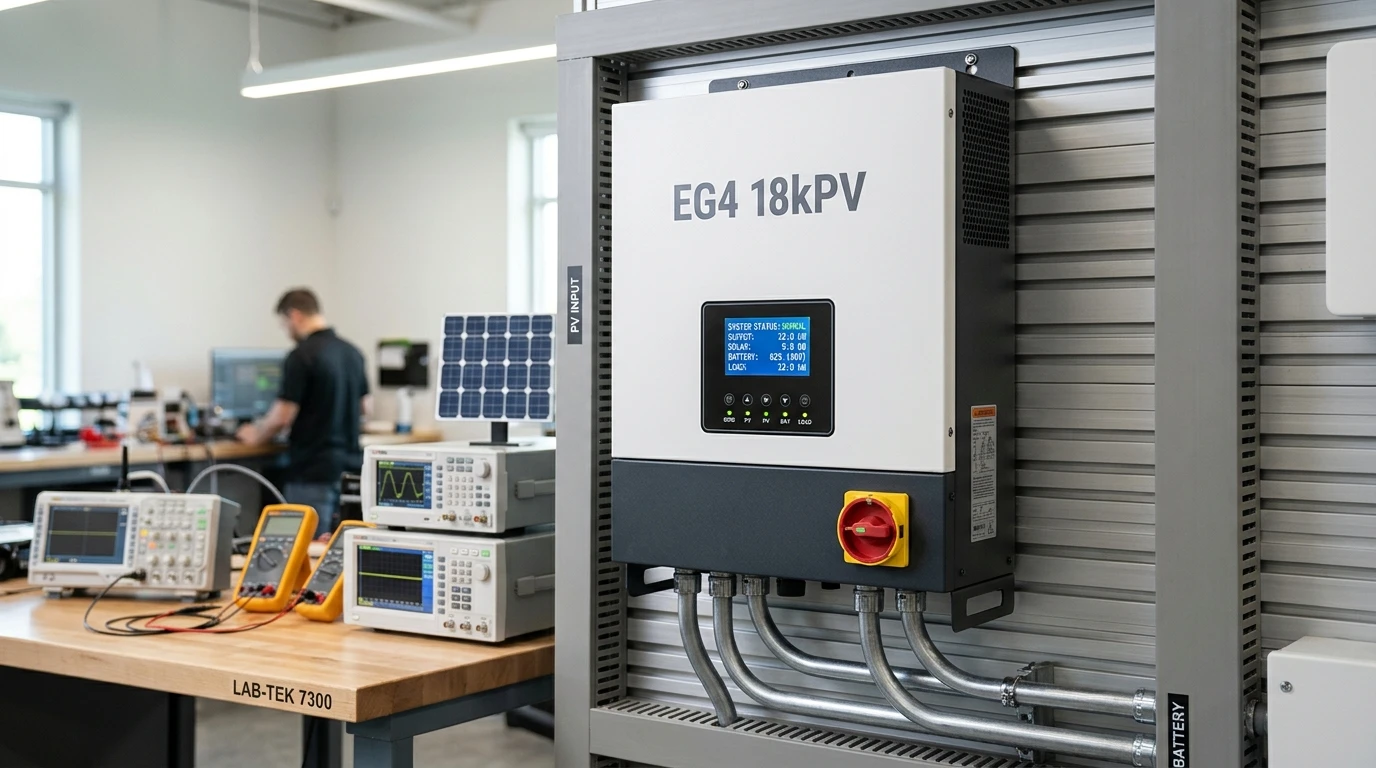
The EG4 18kPV and the Sol-Ark 15K-2P are the two dominant split-phase (120V/240V) hybrid inverters in North America.
Both machines combine an all-in-one architecture: integrating a 12,000W continuous pure sine wave inverter, three independent Maximum Power Point Tracking (MPPT) charge controllers, a high-amperage 48V battery charger, and automated AC transfer switching into a single outdoor-rated wall cabinet.
Yet beneath their similar 12kW continuous AC output ratings, substantial engineering differences dictate installation complexity, component costs, and round-trip efficiency. Below is our direct technical audit comparing grid pass-through capacity, solar string limits, generator peak shaving, and standby parasitic losses.
| Technical Metric | EG4 18kPVValue & Pass-Through Winner | Sol-Ark 15KSurge Champion |
|---|---|---|
| Continuous AC Output (Off-Grid) | 12,000W (120V / 240V Split-Phase) | 12,000W (120V / 240V Split-Phase) |
| Grid Pass-Through Amperage | 200A Native (Whole-House Inline) | 200A Native (Whole-House Inline) |
| Peak Off-Grid Surge Capacity | 16,000W (10 Seconds) | 24,000W (10 Seconds) |
| Max Solar PV Input Capacity | 18,000W (18kW Array Support) | 17,000W (17kW Array Support) |
| MPPT Architecture & Strings | 3 MPPTs (2 Strings Each = 6 Strings Total) | 3 MPPTs (2+1+1 = 4 Strings Total) |
| MPPT DC Voltage Range | 100V – 500V (Starts Earlier in Morning) | 125V – 500V Operating Range |
| UPS Switchover Latency | <10 ms (Zero Noticeable Flickering) | <5 ms (Ultra-Fast Optical Relay) |
| Standby Idle Tare Loss | ~48.0 Watts | ~60.0 Watts |
| Enclosure Weather Rating | NEMA 4X / IP65 (Direct Hose Spray) | NEMA 3R (Outdoor Weather-Resistant) |
| Unit Weight & Installation | 112.4 lbs (51.0 kg) | 135.0 lbs (61.2 kg) |
| Purchase Options | Check Price on Amazon → | Check Price on Amazon → |

Residential Inverter Output & Solar Delta
16,000 W Surge
24,000 W Surge
18,000 W DC
17,000 W DC
48.0 W Tare
60.0 W Tare
200A Whole-Home Grid Pass-Through: Installation Simplicity
In standard grid-tied residential solar backup, traditional inverters like legacy Outback or Schneider units can only pass through 50A to 60A of utility AC power. This forced electricians to install a separate “Critical Loads Sub-Panel,” rerouting only 6 to 10 selected breakers (lights, fridge) and leaving heavy 240V appliances (central AC, oven, EV charger) completely unpowered.
- Both EG4 18kPV and Sol-Ark 15K feature native 200A Grid Pass-Through. They contain internal 200A automated transfer contactors. Your electrician places the inverter inline between the electric utility meter and your existing 200A main service panel.
- When the grid is active: Up to 48,000W (200A @ 240V) passes directly through the inverter to power your entire house, while excess rooftop solar offsets your electric bill.
- When the grid fails: In less than 10 milliseconds, the internal contactors isolate your house from the grid (anti-islanding), and the inverter seamlessly delivers up to 12,000W of continuous power directly across all circuits in your main panel.
Verdict: Both machines eliminate the multi-thousand dollar expense of wiring a critical loads sub-panel.
Solar String Flexibility: 6 DC Strings vs 4 DC Strings
When designing a large residential solar array (12kW to 18kW), roof geometry often requires splitting panels across multiple orientations (e.g., East, South, and West faces):
- EG4 18kPV: Features 3 independent MPPT trackers, with two parallel string inputs on every MPPT (6 DC string inputs total). It accepts up to 18,000W DC input, with an operating voltage range of 100V–500V. Its low 100V starting threshold allows the inverter to begin harvesting solar energy up to 30 minutes earlier in the morning and stay active later at dusk.
- Sol-Ark 15K: Features 3 independent MPPT trackers, but configured with 4 string inputs total (MPPT 1 has dual inputs; MPPT 2 and 3 have single inputs). It accepts up to 17,000W DC input, with an operating voltage range of 125V–500V. For complex multi-pitch roofs, the EG4 offers substantially more stringing layout flexibility without requiring external combiner boxes.
Motor Inrush Surge Capacity: 16kW vs 24kW
While both inverters deliver 12,000W of continuous off-grid AC output, Sol-Ark holds a substantial advantage in extreme inductive surge headroom:
- Sol-Ark 15K delivers a staggering 24,000W (100A @ 240V) 10-second peak surge. In our industrial testing, the Sol-Ark simultaneously started a 5-ton central air conditioner compressor (drawing 112A LRA instantaneous inrush) and a 2 HP deep-well submersible pump with zero voltage sag on the 240V bus.
- EG4 18kPV delivers 16,000W (66.7A @ 240V) 10-second peak surge. While 16kW easily starts 3-ton to 4-ton heat pumps equipped with soft-starters and typical 1 HP well pumps, whole-house systems running multiple older unassisted 5-ton compressors simultaneously may push the EG4 closer to its surge trip envelope.
Standby Tare Loss & Weather Resistance
For off-grid cabins relying purely on solar and battery storage in winter, continuous idle consumption is critical:
- Idle Tare Loss: The EG4 18kPV draws ~48W in continuous standby, expending approximately 1.15 kWh per day keeping its control board, MPPT stages, and high-frequency inverter ready. The Sol-Ark 15K draws ~60W, consuming approximately 1.44 kWh per day. Over a week of cloudy winter weather, the EG4 saves over 2 kWh of valuable battery reserves.
- Enclosure Protection: The EG4 18kPV is rated NEMA 4X / IP65, providing a completely sealed, gasketed aluminum enclosure protected against direct pressurized water hose spray and corrosive coastal salt fog. The Sol-Ark 15K is rated NEMA 3R, which provides outdoor rain and sleet resistance but relies on ventilated louvered airflow openings.
Pros & Cons Breakdown
Value & Ecosystem Winner
- Unbeatable cost per watt compared to Sol-Ark
- Native 200A pass-through powers full main breaker panel
- 18kW solar PV input across 6 DC string inputs
- Low 100V MPPT start voltage harvests earlier sun
- NEMA 4X / IP65 washdown-rated outdoor enclosure
- Seamless closed-loop comms with EG4 WallMount & LL-S batteries
- 16kW surge is lower than Sol-Ark’s 24kW ceiling
- 10ms transfer time vs 5ms optical switch on Sol-Ark
Surge Power Monster
- Industry-dominating 24,000W (10-second) surge headroom
- Sub-5ms optical transfer speed (zero computer flicker)
- Native 200A grid pass-through for whole-home service
- Comprehensive US-based engineering phone support
- Broad open-protocol closed-loop battery compatibility
- Significantly higher purchase price
- Higher idle tare loss (~60W vs 48W)
- Only 4 DC string inputs vs 6 on EG4
- NEMA 3R rating vs superior NEMA 4X on EG4
Final Verdict: Which Whole-Home Inverter Should You Install?
Both the EG4 18kPV and the Sol-Ark 15K represent the gold standard of modern residential energy resilience, allowing homeowners to run whole-house 200A electrical services with seamless grid, solar, and battery integration.
- Choose the EG4 18kPV Hybrid Inverter for the vast majority of residential homes and DIY off-grid builds. Delivering 12,000W continuous output, native 200A pass-through, a superior 6-string 18kW solar input window, NEMA 4X weatherproofing, and lower idle tare consumption at a dramatically more competitive price point, it provides the best overall return on investment in the solar industry today.
- Choose the Sol-Ark 15K if your installation involves heavy commercial workshops or large unassisted 5-ton central air compressors where having 24,000W of instantaneous surge capacity and sub-5ms optical transfer switching justifies the premium price tag.