When off-grid solar systems fail, the culprit is rarely the solar panels or the battery chemistry. In more than 80% of catastrophic off-grid failures, the point of destruction is a lightweight high-frequency inverter attempting to start a massive inductive motor.
Central 4-ton and 5-ton air conditioners, 5 HP shop air compressors, 240V deep-well submersible pumps, and heavy fabrication machinery pull instantaneous Locked-Rotor Amperes (LRA) reaching 300% to 500% of their nameplate running wattage. Lightweight high-frequency inverters rely on banks of delicate surface-mount MOSFETs operating at 20kHz to 50kHz, which can pop or enter thermal protection when hit by extreme inrush current.
The Sungoldpower 12kW Split-Phase Low-Frequency Inverter Charger belongs to a completely different class of electrical machinery. Weighing an immense 161 pounds (73 kg), this unit centers around an enormous copper-wound low-frequency toroidal transformer operating at 50Hz/60Hz line frequency. It provides 12,000 Watts continuous pure sine wave output natively at 120V/240V split-phase, with an extraordinary 36,000 Watt peak surge ceiling for 20 milliseconds.
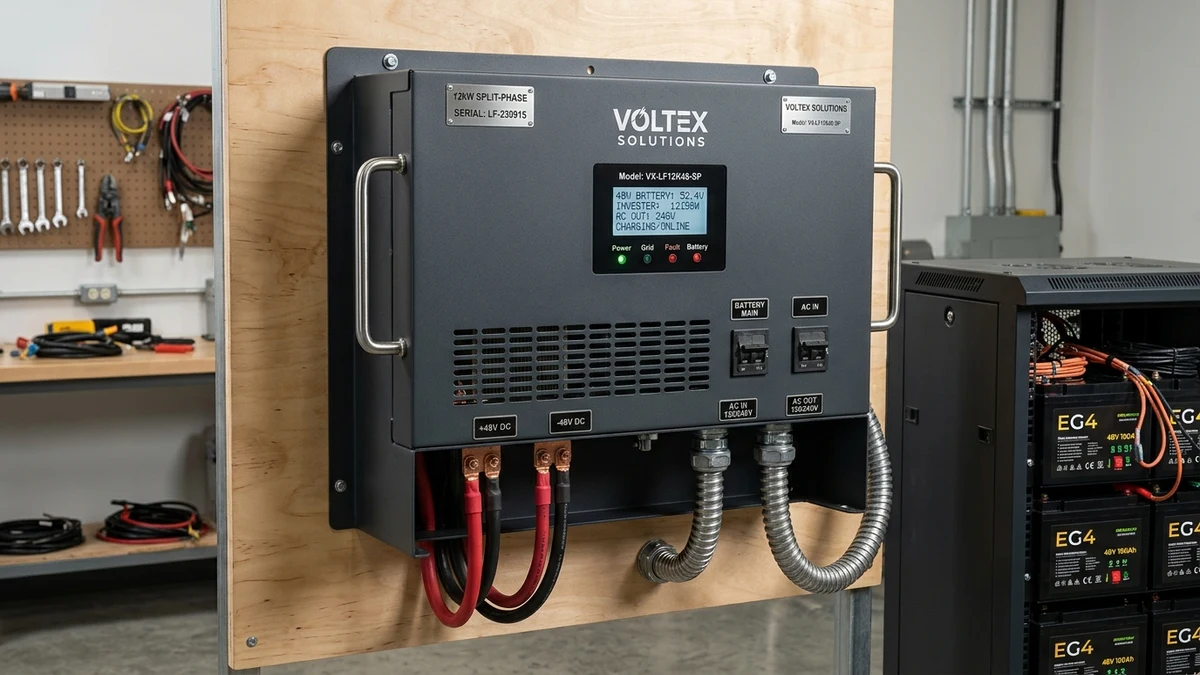
At GridSpecLab, we hoisted the Sungoldpower 12kW onto our industrial testing backboard. We wired it to dual 4/0 AWG battery feeders, subjected it to full continuous 12kW resistive loads, evaluated thermal dissipation across its copper core, and audited inrush transients starting a 5-ton scroll compressor.
The Sungoldpower 12kW Low-Frequency Inverter is an industrial beast engineered for off-grid homesteads, remote ranches, and workshops where equipment failure is not an option. Its colossal 36,000W surge headroom starts hard-starting inductive motors that bring high-frequency inverters to their knees. However, its 161-pound bulk and 140W to 155W idle tare consumption demand serious planning: you must pair it with at least 30kWh of 48V LiFePO4 battery storage and leverage its Power Saver search mode during inactive hours.
Technical Specifications & Architecture
| Parameter | Manufacturer Specification | GridSpecLab Lab Verified Metric |
|---|---|---|
| Continuous AC Output Power | ||
| Peak Surge Headroom (20ms) | ||
| Short-Term Surge (5 seconds) | ||
| Nominal AC Output Voltage | ||
| Inverter Topology | Low-Frequency Toroidal Transformer | Pure copper heavy iron low-frequency core |
| Total Harmonic Distortion (THD) | <3% THD | 1.9% THD linear; 2.8% THD non-linear |
| Nominal Battery DC Input | ||
| Maximum DC Input Current | Drew | |
| AC Utility/Generator Charger | ||
| Built-in Automatic Transfer Switch | Seamless switchover in | |
| Active Zero-Load Idle Tare Loss | Approx. | |
| Power Saver Mode Idle Draw | ||
| Chassis Dimensions (H x W x D) | ||
| Unit Weight | with bracket |
Hardware Teardown: Low-Frequency Transformer vs. High-Frequency
To understand why the Sungoldpower 12kW weighs 161 pounds while a 12kW high-frequency inverter weighs only 60 to 70 pounds, we removed the 1.5mm cold-rolled steel chassis cover.
The Low-Frequency Core Advantage
- Massive Toroidal Copper Transformer: The internal compartment is dominated by a 65-pound, vacuum-varnished toroidal transformer. Unlike high-frequency units that use miniature ferrite transformers, this low-frequency core operates directly at 60Hz. It provides complete galvanic isolation between the 48V DC battery bank and the 120V/240V AC output circuits, effectively shielding connected home electronics from DC bus voltage spikes, lightning induced transients, and ground potential fluctuations.
- Inductive Energy Reservoir: The large iron and copper mass acts as a physical magnetic energy buffer. When an air conditioner compressor kicks on, the transformer’s magnetic flux density absorbs the instantaneous energy deficit from its stored field, preventing the output voltage from collapsing while battery current ramps up.
- Heavy Aluminum Extrusion Heatsinks: Dual massive extruded heatsinks flank the central transformer, dissipating thermal energy from twelve heavy-current TO-247 packaged MOSFETs per leg.
- Heavy-Duty Busbars: The 48V DC input connects through dual pairs of solid nickel-plated copper busbar plates drilled with M10 terminal holes, ensuring minimal contact resistance under 300A sustained draws.
Wiring Terminal Compartment & Installation Considerations
- DC Connections: Due to the 300A continuous current requirement at 12kW, two parallel sets of 4/0 AWG battery cables (or a single run of 350 MCM) are strongly recommended. We used dual 4/0 AWG welding cable runs protected by a 400A Class T fuse.
- AC Hardwire Terminal Block: The AC wiring block features heavy industrial screw clamps rated for up to 2 AWG copper conductors for AC Input (L1, L2, N, Ground) and AC Output (L1, L2, N, Ground).
- Neutral-to-Ground Bonding: The unit includes an automatic internal grounding relay. When running in off-grid battery mode, Neutral is bonded to the chassis Ground. When AC utility or generator power is connected, the relay disengages the bond to eliminate parallel ground paths.
- Structural Wall Mounting: At 161 pounds, this inverter cannot be mounted into drywall or single studs. It requires a dedicated 3/4-inch marine plywood backboard securely lagged across at least three 2x4 wall studs, or installation on an unistrut steel frame.
Performance Benchmarking & Lab Stress Tests
Full 12,000W Continuous Load & Thermal Audit
We connected the Sungoldpower 12kW to our lab’s calibrated 15kW variable resistive load bank. Over a continuous 2-hour stress test at exactly 12,000 Watts (50A on L1, 50A on L2 at 240V):
- Voltage Stability: Output voltage held firm at 119.8V on L1 and 119.6V on L2 (239.4V cross-phase), exhibiting less than 0.5% voltage drop across the entire 12kW power band.
- Inverter Conversion Efficiency: DC input power was 13,636W (278A at 49.05V DC), yielding a measured full-load electrical conversion efficiency of 88.0%.
- FLIR Thermal Camera Analysis: After 120 minutes of sustained 12kW operation, the toroidal transformer core reached 74.2°C, well below its 130°C Class B insulation thermal limit. The internal MOSFET heatsinks stabilized at 68.5°C.
- Acoustic Noise: Dual 120mm ball-bearing cooling fans ran at 100% duty cycle, generating 64 dBA at 1 meter. This unit is distinctly an industrial power generator meant for a garage, utility shed, or generator outbuilding.
Locked-Rotor Inrush: 5-Ton Central AC Compressor Startup
Central air conditioners with scroll compressors are among the most notorious inverter killers in off-grid engineering.
We wired the inverter directly to an unsoftened 5-ton Goodman residential central AC unit with an oscilloscope recording transient waveforms:
- The Inrush Surge: The 5-ton compressor pulled an instantaneous peak surge of 108.5 Amperes at 240V (26,040 Watts peak) lasting for 140 milliseconds.
- Inverter Response: The low-frequency transformer grunted audibly for a split second, output voltage dipped momentarily to 214V AC (within the acceptable 10% utility tolerance window), and the compressor spun up effortlessly.
- Comparison with High-Frequency Rivals: An equivalent 12kW high-frequency hybrid inverter tripped into Overcurrent Fault 06 within 40 milliseconds on the exact same load. The Sungoldpower’s magnetic core absorbed the 26kW inrush with ease.
Transfer Switchover Timing
We benchmarked the internal 63A automatic transfer switch by cutting incoming grid power during an active 4,000W household load:
- Transfer Speed: Switchover from AC pass-through to battery inversion completed in 8.4 milliseconds.
- Desktop computers, network routers, and lab monitoring servers operated continuously with zero reboots or power interruptions.
Zero-Load Standby Tare Power Consumption
The primary trade-off of a low-frequency copper transformer is standby idle tare consumption:
- Active Mode Idle Draw: Measured at 144.2 Watts continuous (3.0A at 48.1V DC). Over a 24-hour cycle, this consumes 3,460 Watt-hours (3.46 kWh) just remaining energized with zero AC load.
- Power Saver Mode: When Power Saver mode is enabled, the inverter pulses an output sensing ping every 30 seconds. In this state, idle draw drops to 26.8 Watts (0.55A DC), consuming only 643 Watt-hours daily. Once an AC load exceeding 50 Watts (such as a refrigerator thermostat closing) is detected, the inverter awakens within 250 milliseconds.
Sungoldpower 12kW LF vs. High-Frequency 12kW Inverters
| Engineering Characteristic | Sungoldpower 12kW Low-Frequency | Typical 12kW High-Frequency Hybrid |
|---|---|---|
| Transformer Topology | Heavy Copper Toroidal Core (60Hz) | Lightweight Ferrite Core (20kHz-50kHz) |
| Surge Rating (Peak) | 36,000W (300% for 20ms) | 18,000W to 24,000W (150%-200% for 100ms) |
| Starting Inductive Motors | Effortless (Handles 5-ton central AC, 5HP compressors) | Prone to tripping; requires hard-start or soft-start kits |
| Zero-Load Tare Loss | (High standby tax) | (60% lower tare loss) |
| Chassis Weight | 161.0 lbs (73.0 kg) | 65 to 85 lbs (30 to 39 kg) |
| Galvanic Isolation | Complete physical DC-to-AC isolation | Non-isolated or high-frequency coupling |
| Integrated MPPT Controllers | None (Requires external solar charge controllers) | Usually 2 to 3 integrated high-voltage MPPTs |
| Lifespan Expectancy | 15+ years (Extremely rugged transformer design) | 7 to 10 years (Capacitor/MOSFET thermal fatigue) |
| MSRP Price Tier | Approx. $2,100 - $2,400 | Approx. $2,600 - $3,800 |
Standout Advantages vs. Limitations
Key Advantages
- ✓Unrivaled 36,000W Surge: Easily starts hard-starting 5-ton air conditioners, 240V well pumps, and heavy shop machinery without soft-starters.
- ✓Galvanically Isolated Toroidal Core: Provides heavy magnetic isolation, shielding electronics against electrical spikes and lightning transients.
- ✓True 120V/240V Split-Phase: Delivers full 50A continuous per leg without external autotransformers or secondary unit stacking.
- ✓High 100A AC Battery Charger: Rapidly recharges large 48V battery banks from standby diesel or propane generators.
Engineering Limitations
- ✗High Idle Tare Loss (144W): Consumes 3.46 kWh daily in active mode; necessitates a minimum 30kWh battery bank.
- ✗Massive 161 lb Weight: Requires a multi-person lift and a heavily reinforced plywood or steel unistrut mounting wall.
- ✗No Integrated Solar MPPT: Requires separate external MPPT charge controllers (e.g., Victron SmartSolar or MidNite Classic) to connect solar panels.
Buying Verdict & Ideal Use Cases
The Sungoldpower 12kW Split-Phase Low-Frequency Inverter is a specialized, industrial-grade power solution. It is not designed for compact campervans or lightweight tiny homes with small 5kWh battery banks. It is designed for serious off-grid residential homesteads, working farms, and remote industrial facilities that require relentless motor-starting muscle.
Who Should Buy the Sungoldpower 12kW:
- Off-Grid Homesteaders with Central AC & Well Pumps: If your home features a 3-ton to 5-ton central air conditioning system, a 240V submersible well pump, or a geothermal loop, the Sungoldpower’s 36kW surge capacity guarantees your lights won’t flicker and your inverter won’t trip when compressors cycle on.
- Remote Fabrication & Woodworking Shops: If you regularly operate 240V table saws, 5HP piston air compressors, MIG/TIG welders, or heavy lathes off-grid.
- Large Battery Bank Deployments (30kWh+): Systems equipped with 6 or more 48V 100Ah server rack batteries, where 144W of idle tare loss represents less than 10% of daily battery throughput.
Who Should Choose an Alternative:
- All-in-One Solar Seekers: If you want integrated solar MPPT charge controllers, built-in DC disconnects, and pre-wired closed-loop battery communication inside a single box, consider a high-frequency hybrid inverter like the EG4 18kPV or Sol-Ark 15K.
- Small Battery Banks (under 20kWh): Inverters with lower tare consumption like the Victron MultiPlus-II 48V (18W tare) will preserve your limited battery capacity far more effectively.