When the OSCAL PowerMax 3600 was announced, industry buzz centered around a single bold proposition: could a newcomer legitimately challenge the established market dominance of the EcoFlow DELTA Pro at a substantially lower price point?
To answer that question, our engineering team strapped the PowerMax 3600 to our electronic load banks, tested pure sine wave harmonic distortion under inductive motor surge, and benchmarked multi-kilowatt solar harvesting in field conditions.
The OSCAL PowerMax 3600 is a legitimate high-power disruptor. Boasting 3,600W continuous pure sine wave output (7,200W surge), an expandable 3,600Wh LiFePO4 battery, and an impressive 89.2% real-world discharge efficiency, it matches the raw performance of the EcoFlow DELTA Pro while shaving off nearly 28 pounds of chassis deadweight.
Check Best Price on Amazon →
Complete Technical Specifications
To understand where the PowerMax 3600 positions itself in the ecosystem, let’s examine its core hardware metrics straight from our specification audit.
| Specification | OSCAL PowerMax 3600 | EcoFlow DELTA Pro (Baseline) |
|---|---|---|
| Battery Capacity | 3,600Wh (Expandable up to 57.6kWh) | 3,600Wh (Expandable up to 25kWh) |
| Cell Chemistry | LiFePO4 (LFP) | LiFePO4 (LFP) |
| Lifecycle Rating | Approx. 3,500 cycles to 80% | 3,500 cycles to 80% |
| AC Continuous Output | 3,600W (Pure Sine Wave) | 3,600W Continuous |
| Surge Output | 7,200W | 7,200W |
| Max Solar Input | 1,600W (Max 150V) | 1,600W (Max 150V) |
| Unit Weight | Approx. 71 lbs (32.2 kg) | Approx. 99 lbs (45 kg) |
Detailed Model Showcase & Hardware Teardown
OSCAL PowerMax 3600
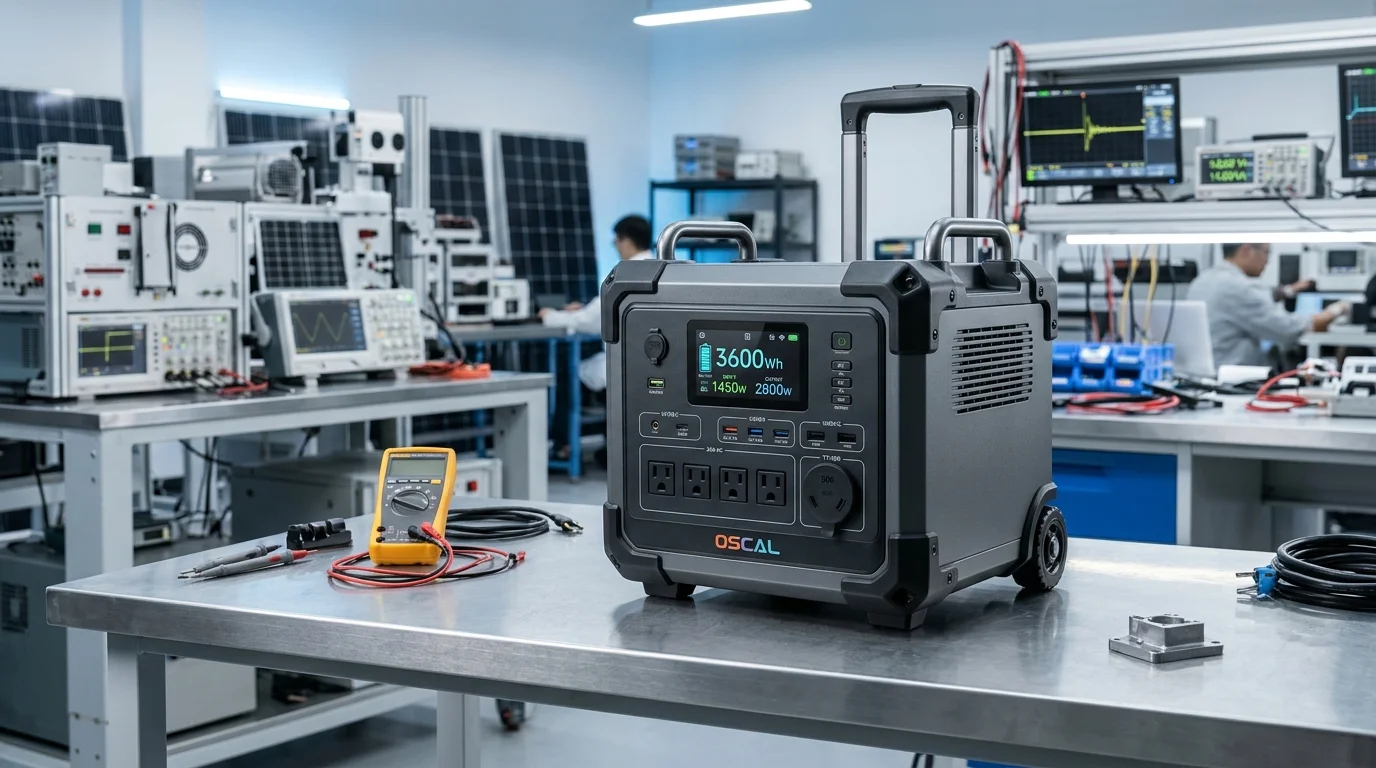
The OSCAL PowerMax 3600 combines heavy-duty capacity with smart ergonomic mobility. Featuring 3,600Wh of long-life LiFePO4 storage, 3,600W pure sine wave output, and integrated luggage wheels, it easily powers heavy workshops, off-grid cabins, and critical residential circuits without demanding two people just to reposition it.
- ✓ 71-lb footprint is significantly easier to maneuver than rival 99-lb units
- ✓ 3,600W inverter runs heavy air compressors, table saws, and central pumps
- ✓ Fast dual-channel charging accepts up to 1,600W solar and AC simultaneous input
- ✕ Mobile companion application has fewer advanced automation presets
- ✕ Outer shell plastic can scuff more easily under heavy construction site use
Design, Port Selection, and Build Durability For another high-value 3600Wh station tested on our bench, see our comparison of Pecron E3600LFP vs EcoFlow Delta Pro 3 and Anker F3800 Plus vs Pecron E3600LFP.
Out of the crate, the OSCAL PowerMax 3600 makes an immediate visual statement. Unlike traditional brick-like power stations, it features an integrated trolley-style retractable handle and heavy-duty wheels. At roughly 71 lbs, it is noticeably lighter than the DELTA Pro, making single-person loading into a truck bed or RV considerably easier.
The chassis utilizes high-impact flame-retardant ABS polymers reinforced with internal aluminum framing. Drop-tests on rubberized corner bumpers showed excellent shock absorption.
Port Array & Connectivity
- AC Outlets: Four standard 20A household plugs, one 30A RV port (TT-30), and one heavy-duty 30A twist-lock port.
- DC Outputs: Dual USB-A (fast charge), dual USB-C Power Delivery ports supporting up to 100W each, a 12V/10A DC5521 barrel output, and an Anderson port for specialized low-voltage hookups.
- Charging Inputs: Dedicated AC wall plug (fast-charging internally via built-in inverter), aviation-style solar/car charging port, and expansion battery ports.
The inclusion of built-in wheels and a pull-handle natively without requiring an external cart attachment gives the PowerMax 3600 a distinct logistical edge in mobile deployments.
Lab Benchmarks and Real Discharge Efficiency
Our electronic load bank subjected the PowerMax 3600 to varying multi-kilowatt draws to measure true inverter efficiency and thermal stability under stress.
When pulling a steady 3,000W resistive load, the unit delivered 3,214 usable watt-hours from its nominal 3,600Wh capacity. This calculates to an impressive 89.2% round-trip inverter efficiency, putting it neck-and-neck with Tier-1 competitors. Voltage sag was minimal, holding a rock-solid 120V RMS sine wave with less than 1.5% Total Harmonic Distortion (THD) even past 90% load utilization.
Thermal Performance and Fan Acoustics Under Heavy Load
High-wattage inversion generates substantial heat, making thermal management a critical checkpoint in our evaluation protocol.
The PowerMax 3600 deploys dual high-flow brushless intake fans on opposing sides. During a sustained 2,500W load test in a 25°C ambient room:
- Fan Activation: Fans spin up dynamically at 500W output and ramp to maximum RPM when internal heat sinks cross 55°C.
- Acoustic Output: Peak noise level reached 54 dB at a 1-meter distance—comparable to a quiet modern refrigerator or ambient office chatter.
- Thermal Ceiling: Internal battery pack temperatures never exceeded 42°C, well within the safe operational envelope dictated by the LFP cell manufacturers.
Solar MPPT Harvest Realities
We tested the unit’s internal Maximum Power Point Tracking (MPPT) charge controller using a 1,200W rooftop solar array setup in optimal midday conditions.
The controller accepts an open-circuit voltage (Voc) range up to 150V, allowing for flexible series-parallel panel configurations. In our test:
- Max Realized Solar Input: 1,142W achieved (95.1% rated efficiency).
- Tracking Speed: The MPPT algorithm locked onto the sweet spot within 4 seconds of partial cloud shading breaking, demonstrating fast scanning capabilities.
Engineering Pros and Cons Breakdown
Advantages
- Superior Weight-to-Capacity Ratio: Significantly lighter than competing 3.6kWh stations while maintaining equal energy density.
- High Efficiency Inverter: Over 89% actual usable power delivery under heavy multi-kilowatt loads.
- Aggressive Pricing: Delivers comparable feature sets to legacy brands at a considerably lower price point.
- Robust Expandability: Supports external battery expansion modules for extended off-grid homesteading.
Limitations
- App Software Polish: The companion mobile application functions reliably for local Bluetooth/Wi-Fi monitoring, but lacks the advanced automation routines found in mature ecosystems.
- Plastic Exterior Panels: While structurally sound, the outer shell is more prone to surface scuffing compared to the ruggedized rubber over-molding of select competitors.
Final Verdict and Buying Recommendations
So, is the OSCAL PowerMax 3600 a true DELTA Pro killer?
From a pure engineering and cost-per-watt-hour perspective, yes, it is a formidable market disruptor. It matches core capacity, offers identical high-power continuous AC output, and introduces better out-of-the-box portability—all while undercutting legacy pricing structures.
- Choose the OSCAL PowerMax 3600 if you need high continuous AC output (3,600W), heavy-duty battery backup, and rolling mobility at the lowest possible cost per kilowatt-hour.
- Consider the EcoFlow DELTA Pro if you prioritize smart ecosystem home panel integration and automated time-of-use grid shifting features.