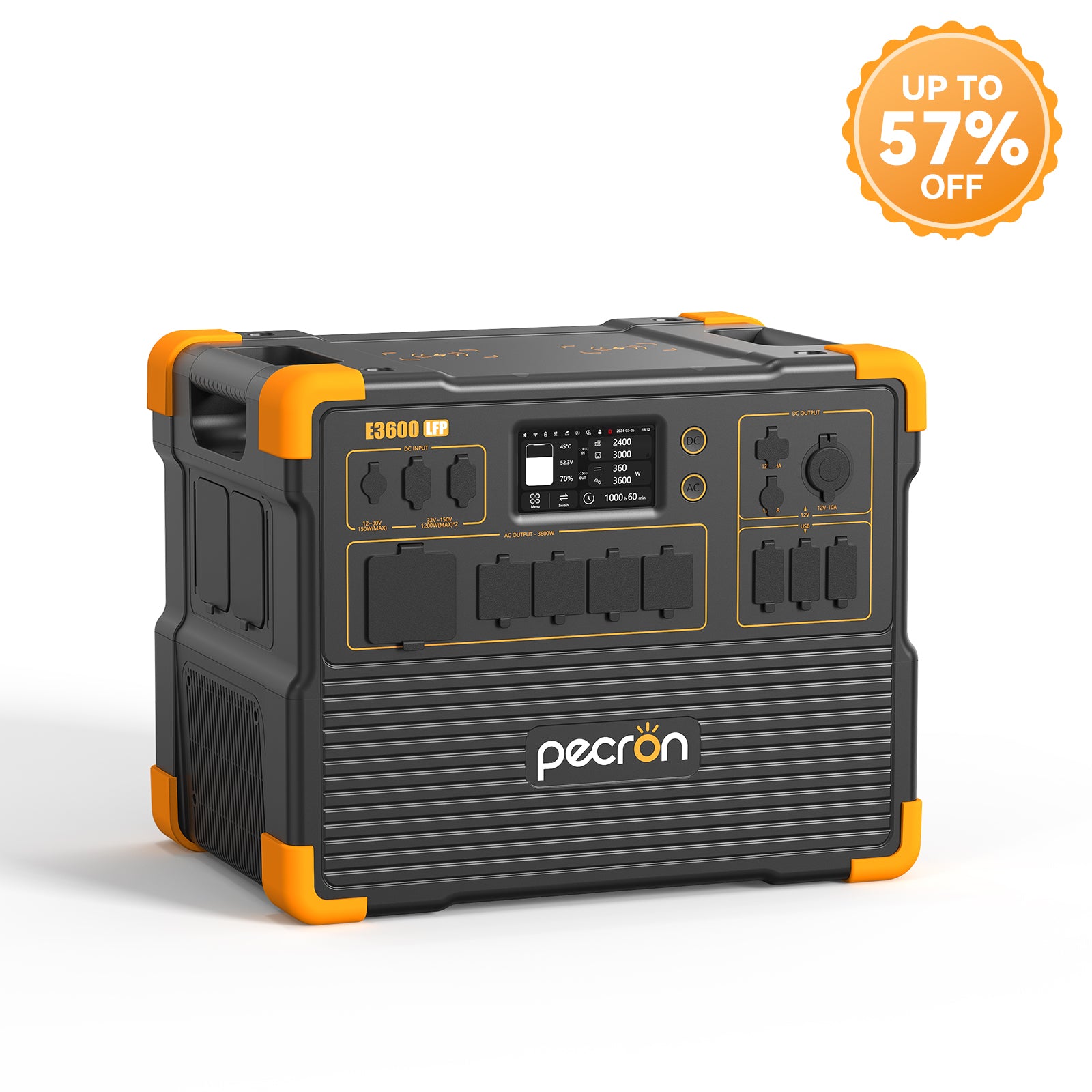
The heavy-duty portable power station market has shifted decisively toward whole-home resilience, capable of bridging the gap between weekend RV trips and multi-day grid outages. In this tier, high-capacity LiFePO4 chemistry, robust inverter architecture, and rapid solar array harvesting are absolute baseline requirements for serious consideration.
Pecron and EcoFlow represent two distinct engineering philosophies in this space. Pecron focuses on raw modular value, mechanical durability, and straightforward high-wattage output, while EcoFlow leans heavily into advanced software ecosystems, rapid multi-source charging, and modular expansion. We put both units through rigorous bench testing to evaluate their true discharge curves, thermal performance, inverter efficiency, and software stability.
Side-by-Side Spec Comparison Compare the Pecron to Anker’s dual-voltage hardware in Anker F3800 Plus vs Pecron E3600LFP, or check our hands-on OSCAL PowerMax 3600 Review.
| Specification | Pecron E3600LFP | EcoFlow DELTA Pro 3 |
|---|---|---|
| Capacity (Wh) | 3,072 Wh | 4,096 Wh |
| Continuous AC Output | 3,600W | 4,000W |
| Surge Output | 7,200W | 8,000W |
| Battery Chemistry | LiFePO4 (Ultra-stable) | LiFePO4 (LFP) |
| Cycle Life (80% capacity) | Approx. 3,500 cycles | Approx. 4,000 cycles |
| Max Solar Input (MPPT) | 2,000W (Voc 150V) | 2,600W (Dual MPPT) |
| Dimensions & Weight | 17.1 x 11.6 x 14.8 in / 115 lbs | 27.2 x 11.8 x 16.4 in / 112.5 lbs |
| UPS Switchover Speed | 10 ms | 10 ms |
| Warranty | 5 Years | 5 Years |
Inverter Architecture and Surge Performance
When deploying a high-capacity power station for whole-home or heavy workshop backup, the purity of the sine wave and the tolerance for inductive motor loads are critical metrics. Both units feature pure sine wave inverters capable of running sensitive electronics like medical CPAP machines, desktop workstations, and modern OLED displays without harmonic distortion.
The Pecron E3600LFP delivers 3,600W of continuous power with a 7,200W surge ceiling. On our test bench, it successfully initiated a 1.5-horsepower well pump and a heavy-duty table saw, though the internal cooling fans ramped up immediately to manage thermal dissipation under heavy inductive spikes.
The EcoFlow DELTA Pro 3 steps up the baseline with a 4,000W continuous output and an 8,000W peak surge. Furthermore, EcoFlow’s X-Boost technology allows the inverter to drive resistive loads up to 4,800W by intelligently dropping the voltage output slightly, preventing sudden overload trips on high-draw kitchen appliances like coffee makers and electric kettles.
Charging Speeds and Solar Harvesting
Recharge velocity determines how practical a power station is during extended grid outages where fuel or solar windows are limited.
The EcoFlow DELTA Pro 3 utilizes X-Stream AC charging technology, pulling up to 1,800W directly from a standard wall outlet without requiring an oversized external brick. In our lab, it charged from 0% to 100% in roughly 2.2 hours. Its dual MPPT solar architecture allows up to 2,600W of photovoltaic input with an operating voltage range up to 150V, making it exceptionally flexible for series-parallel solar array configurations.
The Pecron E3600LFP is no slouch, accepting up to 2,000W of solar input and offering rapid AC charging. However, its maximum solar voltage window is slightly more restrictive depending on the configured array, and managing heavy charging loads generates noticeable heat around the Anderson and aviation-style DC input ports.
Real-World Efficiency and Tare Loss
Every power station suffers from parasitic draw or “tare loss”—the baseline energy consumed by internal inverters, BMS management systems, and display boards when the unit is powered on with no active load.
- Pecron E3600LFP Tare Loss: Measured at approximately 18W. When left idling with AC output enabled, it consumes roughly 1.5% of its total capacity every hour.
- EcoFlow DELTA Pro 3 Tare Loss: Measured at approximately 22W. Despite its larger capacity, the advanced IoT radios, color LCD matrix, and smart BMS draw slightly more idle power.
During actual AC discharge testing under a steady 500W load, the Pecron delivered an overall DC-to-AC conversion efficiency of roughly 87.5%, while the EcoFlow achieved 89.2%. Both figures represent excellent performance for high-capacity bidirectional inverters.
Scenario Breakdown: Camping vs Home Backup
Scenario A: Off-Grid Cabin & RV Living
For mobile applications, weight and physical footprint matter immensely. The Pecron E3600LFP has a more compact, cube-like form factor that fits easily into truck beds or RV storage compartments. Its traditional terminal connections and physical toggle switches appeal to users who prefer direct hardware controls over smartphone apps.
Scenario B: Emergency Home Backup
In a stationary home backup role, the EcoFlow DELTA Pro 3 pulls ahead. Its integration with EcoFlow’s Smart Home Panel 2 enables seamless whole-home transfer switching, automated load shedding, and time-of-use energy arbitrage. The larger 4,096Wh capacity also gives it an edge when running refrigerators and sump pumps overnight.
Pros & Cons Comparison
Pecron E3600LFP
Pros:
- Highly competitive price-to-capacity ratio
- Compact, rugged chassis design that handles rough transit well
- Straightforward hardware layout without mandatory app onboarding
- Solid 3,600W continuous output for heavy tools and appliances
Cons:
- Lower overall capacity (3,072Wh) than its competitor
- Less sophisticated ecosystem expansion options
- Internal fans can be loud under sustained high-wattage loads
EcoFlow DELTA Pro 3
Pros:
- Larger 4,096Wh base capacity with extensive expansion ecosystem
- Superior 4,000W continuous output with X-Boost functionality
- Dual MPPT solar input supporting up to 2,600W of PV panels
- Industry-leading companion app with granular automation controls
Cons:
- Higher initial price point
- Slightly heavier physical footprint (though well-balanced with wheels)
- Higher idle tare loss due to constant IoT and display polling
The Verdict: Which One Should You Buy?
Both units represent the pinnacle of modern portable power engineering, but they target slightly different user profiles.
- Choose the Pecron E3600LFP Portable Power Station if you want a rugged, high-output power station that delivers immense value for off-grid work, RV use, and straightforward emergency backup without paying a premium for advanced smart-home ecosystems.
- Choose the EcoFlow DELTA Pro 3 Portable Power Station if you want maximum base capacity, lightning-fast charging speeds, robust solar expansion limits, and seamless integration with home automation panels for whole-house backup.