While all-in-one portable power stations excel at mobile camping and basic emergency plug-and-play duties, powering an entire residential property or remote off-grid homestead requires fixed, permanent electrical infrastructure.
In this stationary energy storage category, EG4 Electronics has fundamentally disrupted the market. Previously, installing a 12kW whole-house solar system meant paying $25,000 to $40,000 for proprietary closed ecosystems like the Tesla Powerwall or Enphase. EG4 revolutionized the industry by offering open-protocol, high-power hybrid inverters and 48V LiFePO4 battery systems at a fraction of the cost—all backed by rigorous UL certifications (UL1741SB, UL9540, UL9540A).
However, designing an EG4 power system requires precise engineering calculations: string open-circuit voltage calculations (), battery bank C-rate sizing, and neutral-ground bonding configurations.
In this comprehensive 2026 hardware audit, GridSpecLab evaluates and ranks the top EG4 solar inverters and battery storage modules on the market.
For grid-tied homeowners seeking whole-house backup and peak-shaving solar capability, the EG4 18KPV is the undisputed gold standard. Combining a 12,000W continuous split-phase inverter, 18,000W solar array capacity, and an integrated 200A whole-house service entrance disconnect, it replaces multiple separate boxes in a single clean enclosure. For dedicated off-grid properties where grid export is not desired, the EG4 12000XP delivers identical 12kW inverter muscle at a dramatically lower price point. Pair either inverter with the EG4 WallMount 14.3kWh LiFePO4 Battery for seamless closed-loop reliability.
Check #1 Pick (EG4 18kPV) on Amazon →
Read our dedicated lab evaluation in the EG4 18kPV Inverter Review: Still Worth It in 2026? and compare it against its main rival in EG4 18kPV vs Sol-Ark 15K.
Technical Specifications & EG4 Benchmarks
Stationary solar inverters and energy storage banks must be analyzed by continuous AC output, maximum DC photovoltaic input, battery voltage architecture, and UL safety certifications:
| Model Name | Hardware Type | Power / Capacity | Weight | Best For |
|---|---|---|---|---|
| EG4 18kPV All-in-One | Hybrid Inverter | 12,000W AC (Split-Phase) | 114 lbs | Whole-Home Grid-Tied Backup & Net Metering |
| EG4 12000XP Off-Grid | Off-Grid Inverter | 12,000W AC (Split-Phase) | 105 lbs | Remote Homesteads, Farms & Large Workshops |
| EG4 6000XP Split-Phase | Off-Grid Inverter | 6,000W AC (Split-Phase) | 52 lbs | Off-Grid Cabins, Tiny Homes & Outbuildings |
| EG4 WallMount 14.3kWh | Lithium Battery | 14,336 Wh (51.2V) | 282 lbs | Whole-Home Indoor/Outdoor Wall Storage |
| EG4 LifePower4 V2 | Server Rack Battery | 5,120 Wh (51.2V) | 99 lbs | Scalable Modular Cabinets for DIY Systems |
In-Depth Evaluations: Top EG4 Inverters & Batteries
EG4 18KPV Hybrid Inverter (12kW AC / 18kW PV)
200A Whole-Home Pass-Through • 3 Independent MPPTs • UL1741SB Grid Compliant
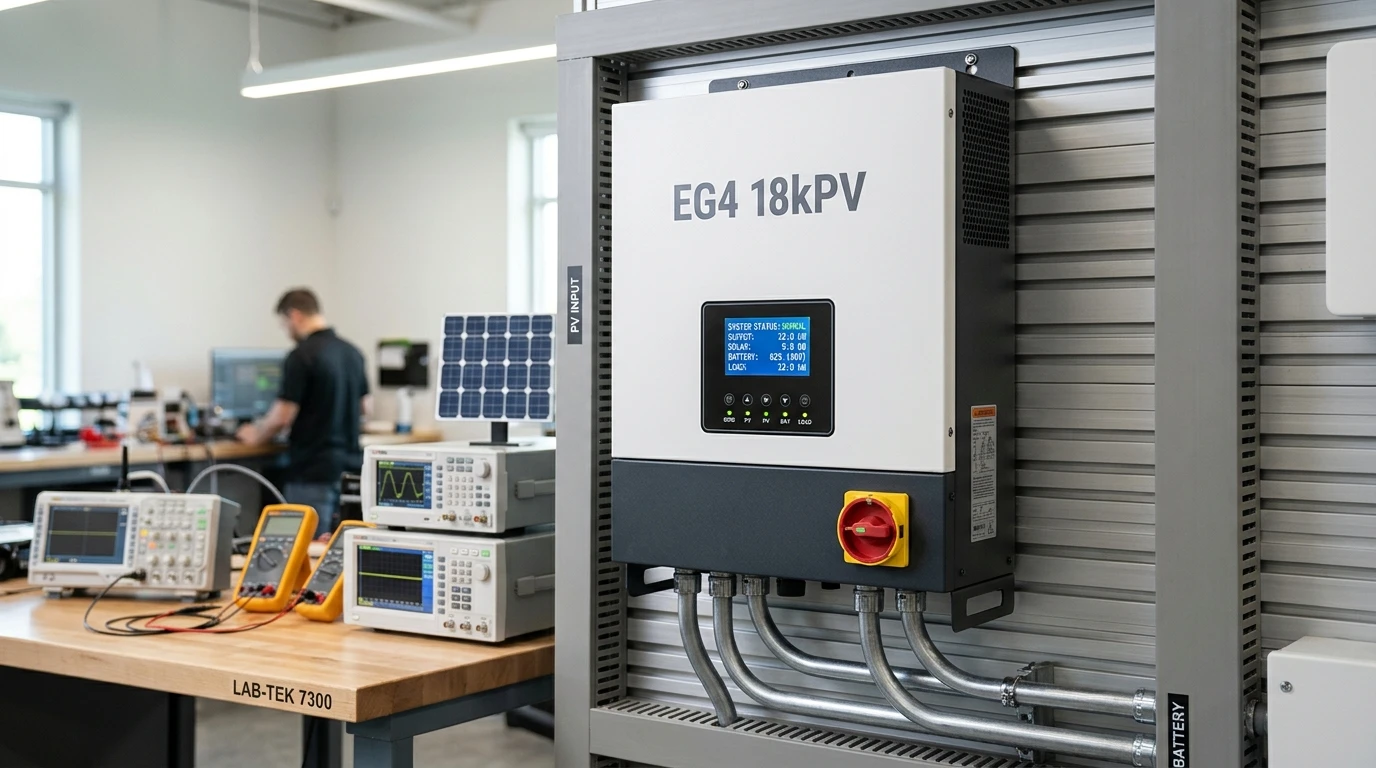
The EG4 18KPV represents the pinnacle of residential solar and energy storage engineering. Engineered as a true whole-house hybrid inverter, it eliminates the need for separate external autotransformers, AC combiner boxes, or external 200A transfer switches.
Because it contains an internal 200A grid pass-through relay, the 18KPV can be installed directly between your utility meter and your main distribution breaker panel. During a grid outage, the internal transfer switch disconnects from the grid in under 10 milliseconds, seamlessly powering your entire household without a flicker on computer monitors or clocks.
With three independent MPPT controllers accepting up to 500V DC per string, you can wire large rooftop solar strings across East, West, and South roof pitches with zero string cross-talk losses.
✓ Engineering Advantages
- 12kW continuous split-phase output easily runs central 4-ton AC units and electric heat.
- Integrated 200A pass-through eliminates expensive external critical subpanels.
- UL1741SB certification meets stringent utility net metering interconnection rules.
- Closed-loop CAN/RS485 communication with EG4, Ruixu, and Fortress batteries.
✗ Lab Compromises
- Weighs 114.6 lbs; requires two-person mounting to solid wall studs.
- Requires professional electrical permitting and utility interconnection agreements.
- Requires minimum 10kWh to 15kWh 48V battery bank for full 12kW surge delivery.
EG4 12000XP (12kW Split-Phase / 16kW PV)
Dual 8kW High-Voltage MPPTs • No Grid Export Bureaucracy • Built-In Generator Auto-Start
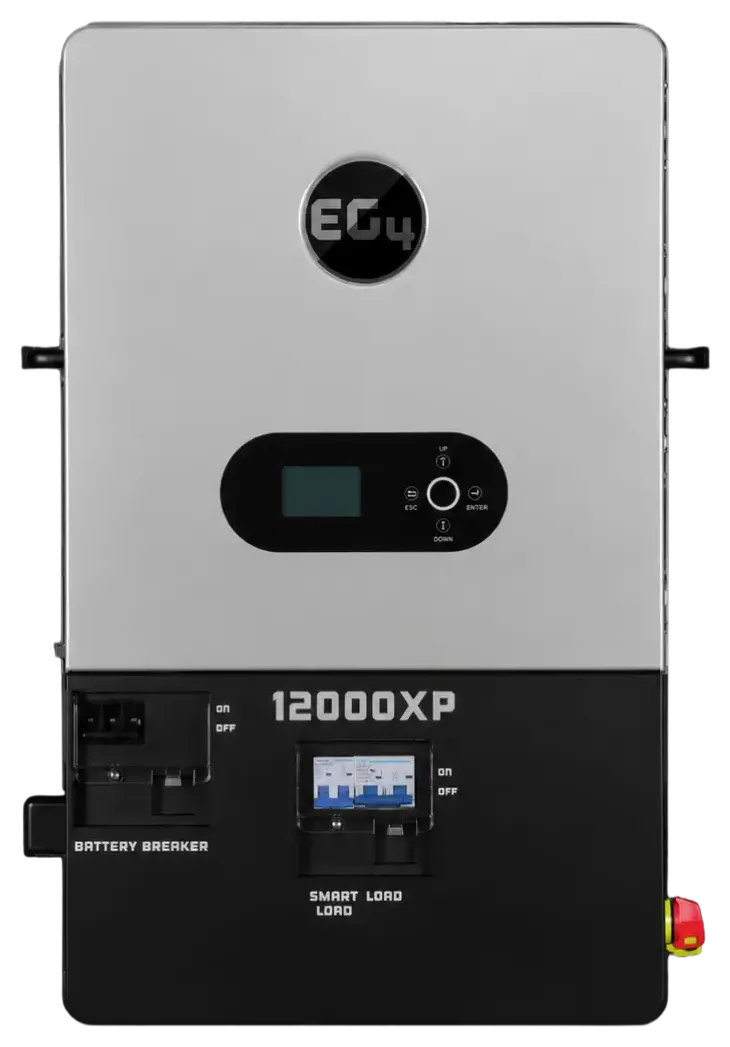
For homesteaders, ranches, and off-grid builders who do not have (or want) a utility grid connection, paying for expensive grid-export circuitry is a waste of capital. The EG4 12000XP solves this by providing the full 12,000W continuous output of the 18KPV in a pure off-grid architecture.
It features an integrated dry-contact generator auto-start relay and dedicated AC generator input. When winter storm clouds deplete your battery storage below a programmable State of Charge (SOC), the 12000XP automatically fires up your diesel or propane backup generator, charges the 48V battery bank, and powers your household loads simultaneously.
EG4 WallMount 14.3kWh LiFePO4 Battery (280Ah / 51.2V)
UL9540 / UL9540A Certified • Built-In 200A Breaker • Integrated Heating Pad

The EG4 WallMount 14.3kWh (280Ah / 51.2V) represents a massive evolutionary step over multi-unit server rack setups. Instead of wiring three separate 5kWh batteries, external busbars, and disconnect switches inside an expensive steel cabinet, the WallMount delivers 14.3kWh of Tier-1 prismatic LiFePO4 cells in a single slimline wall-mounted enclosure.
It features an integrated 200A DC thermal-magnetic breaker, internal fire arrestor protection, and an automatic heating pad that ensures safe charging in unconditioned garages down to -4°F (-20°C).
Engineering Deep-Dive: Closed-Loop Communication & C-Rate Sizing
1. Closed-Loop Communication vs Voltage-Based SOC
In generic 48V battery setups, the inverter guesses the battery’s State of Charge (SOC) by measuring overall terminal voltage. However, because LiFePO4 cells have an extremely flat discharge curve (maintaining ~3.25V per cell across 80% of their discharge cycle), voltage measurements lead to massive state-of-charge drift:
EG4 hardware utilizes closed-loop digital communication (via RJ45 CAN or RS485). The Battery Management System (BMS) transmits precise real-time data to the inverter:
- Exact cell-level voltages and weakest cell tracking
- Micro-Amp shunt coulomb counting for ±1% accurate SOC
- Dynamic charge current requests (automatically ramping down amps when individual cells reach 3.65V balancing thresholds)
2. Battery Bank C-Rate Matching
A critical mistake in whole-home solar sizing is under-sizing the battery bank for the inverter’s continuous AC wattage:
To output a full 12,000W continuous at 51.2V nominal with 94% inverter efficiency:
A single EG4 LifePower4 v2 battery is limited to 100A continuous discharge. Running a 12kW inverter on a single 100A battery causes immediate low-voltage shutdown or BMS thermal cutouts. A 12kW system requires a minimum of three LifePower4 v2 batteries (300A total) or two EG4 WallMount batteries (400A total) to safely sustain full inverter output.
Frequently Asked Questions (FAQ)
What is the difference between the EG4 18KPV and EG4 12000XP?
- EG4 18KPV: A fully certified hybrid inverter capable of backfeeding surplus solar power to the electrical utility grid for net metering credits. Features an integrated 200A whole-home service disconnect and full UL1741SB compliance.
- EG4 12000XP: A dedicated off-grid inverter that cannot export electricity to the utility grid. Ideal for remote cabins, off-grid homesteads, or systems where homeowners wish to bypass utility interconnection permitting fees.
Can I mix EG4 LifePower4 and EG4 WallMount batteries together?
While both batteries operate on a 51.2V nominal bus, mixing different Ah capacities (100Ah server racks with 280Ah WallMounts) on the same closed-loop communication string is not recommended. Different internal cell resistances cause unequal current sharing. For optimal battery health and warranty protection, keep battery banks uniform.
Is the EG4 18KPV eligible for the 30% Federal Solar Tax Credit?
Yes. Both the EG4 18KPV inverter and connected 48V LiFePO4 battery storage systems (exceeding 3kWh capacity) qualify for the 30% Federal Residential Clean Energy Credit (Section 25D) in the United States.
Final Recommendation: Which EG4 Hardware Setup Should You Build?
- Top Recommendation for Grid-Tied Homes: The EG4 18KPV Hybrid Inverter paired with two EG4 WallMount 14.3kWh Batteries delivers 12kW continuous AC power, 28.6kWh of storage, and 200A whole-home automatic backup. See our direct matchup in EG4 18kPV vs Sol-Ark 15K.
- Top Recommendation for Off-Grid Homesteads: The EG4 12000XP provides uncompromised 12kW split-phase power, dual 8kW MPPTs, and integrated generator auto-start at significant savings.
- Top Recommendation for Modular Budget Expandability: An EG4 6000XP paired with two LifePower4 V2 server rack batteries (10.2kWh) provides a complete 120/240V split-phase solar backup system for under $5,000. For cabin builders on a strict entry budget, also consider the EG4 3000W Inverter.
- Authorized Distributor Sourcing: When ordering complete pallet shipments and pre-wired balance-of-system kits, read our verified Signature Solar Review & Buying Guide.