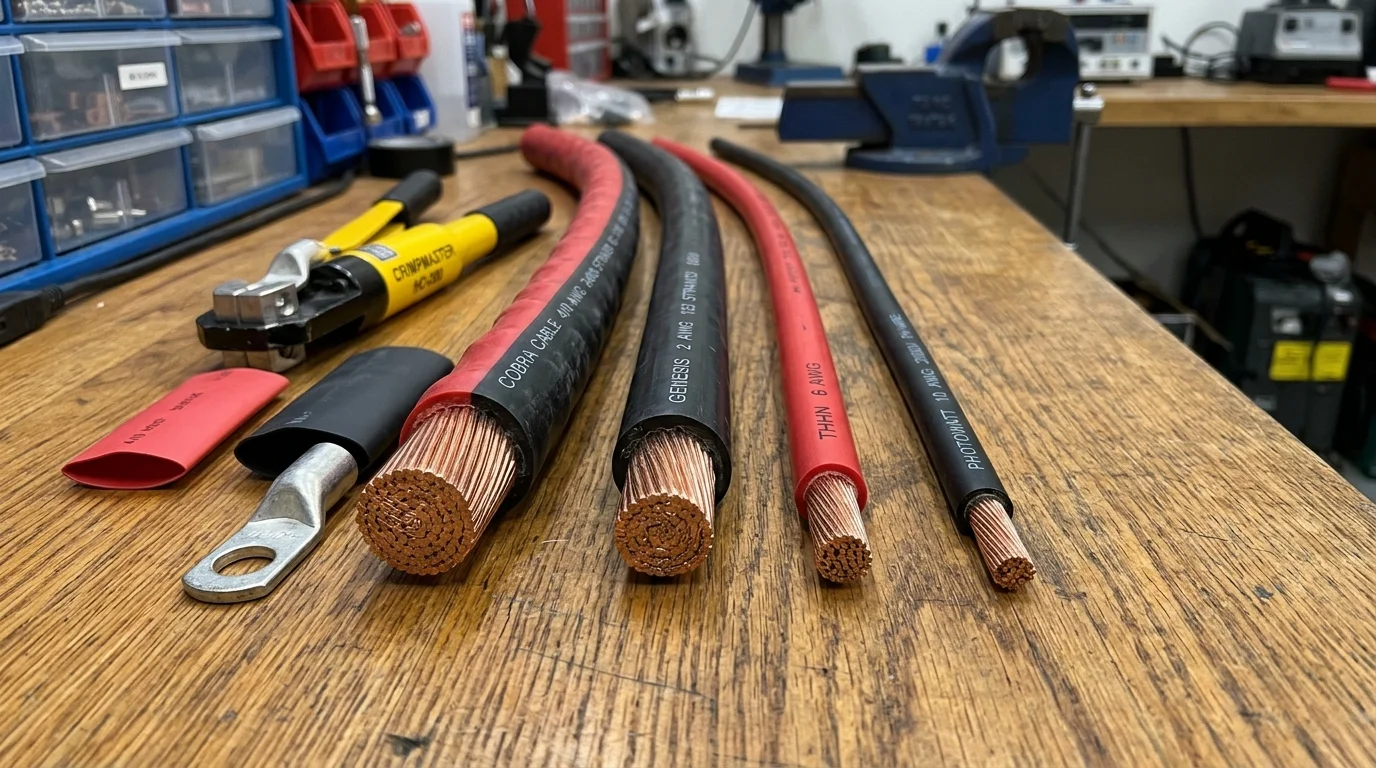
During a sudden blackout, storm, or camping trip, your portable power station is the electrical command center of your household. But because power stations are often placed outdoors, in a garage, or in a utility closet to keep heavy battery packs and solar cables isolated, getting that power to your refrigerator, CPAP machine, microwave, or workspace requires extension cords.
It is tempting to grab whatever thin, orange or green extension cord is sitting in the back of your garage, plug it into the power station’s 120V AC outlet, and run it across the floor.
In an emergency, this single mistake is one of the leading causes of tripped inverters, damaged appliance motors, melted receptacles, and electrical fires.
Unlike a municipal utility grid—which delivers low-impedance power from a massive local transformer—a portable power station relies on a compact, sensitive digital inverter with tight voltage cutoff windows, thermal overload sensors, and a floating neutral architecture.
In this guide, we break down the physics of extension cord wire gauges, calculate real-world voltage drop across 25 to 100-foot runs, explain the dangers of coiled thermal runaway, and show you how to safely manage neutral-ground bonding.
For high-wattage power station loads (1,500W to 1,800W continuous, such as space heaters, electric kettles, or refrigerators), always use a 10 AWG or 12 AWG cord under 50 feet. Never leave a cord coiled on a reel under heavy load (coiled cords can reach over 150°F / 65°C via thermal trapping). If your EV charger or furnace refuses to operate from the power station, you are experiencing a floating neutral conflict that requires an external Neutral-Ground Bonding Plug.
Launch Appliance Runtime Calculator →
Wire Gauge (AWG) vs. Distance: The Voltage Drop Math
Every electrical conductor has inherent resistance (). When current () flows through a wire, two things happen simultaneously based on fundamental physics:
- Voltage Drops (): The voltage arriving at the appliance is lower than the 120V leaving the power station.
- Power is Lost as Heat (): Electrical energy is wasted heating the rubber jacket of your cord instead of running your appliance.
In the American Wire Gauge (AWG) system, smaller numbers mean thicker wires. A thick 10 AWG wire has vastly less resistance than a skinny 16 AWG cord:
- 10 AWG Copper:
- 12 AWG Copper:
- 14 AWG Copper:
- 16 AWG Copper:
When you draw a heavy 15-Amp load (1,800 Watts) through a 100-foot, 16 AWG cord (which has 200 feet of round-trip wire):
At under 108 Volts, inductive compressor motors in refrigerators struggle to spin up, electronic control boards glitch, and the extension cord dissipates over 180 Watts of continuous waste heat (). That is the equivalent of running a 180W space heater inside the cord itself!
Extension Cord Sizing Matrix for Power Stations
The National Electrical Code (NEC) recommends keeping total voltage drop below 3% for branch circuits and below 5% for combined runs.
The following table provides the maximum recommended continuous wattage and amperage based on wire gauge and run length:
| Wire Gauge (AWG) | Max Continuous Amps | 25 Foot Run | 50 Foot Run | 100 Foot Run | Best Use Case |
|---|---|---|---|---|---|
| 10 AWG (Extra Heavy) | 15A – 20A (1,800W–2,400W) | 0.8% Drop (119.0V) | 1.6% Drop (118.1V) | 3.2% Drop (116.2V) | Space Heaters, Table Saws, Inverter Max Draw |
| 12 AWG (Heavy Duty) | 15A (1,800W) | 1.2% Drop (118.6V) | 2.4% Drop (117.1V) | 4.8% Drop (114.2V) | Refrigerators, Microwaves, Coffee Makers |
| 14 AWG (Medium Duty) | 10A – 12A (1,200W–1,440W) | 1.5% Drop (118.2V) | 3.0% Drop (116.4V) | 6.1% Drop (112.7V - Avoid) | Desktop PCs, TVs, CPAP Machines, Box Fans |
| 16 AWG (Light Duty) | < 8A (800W) | 2.7% Drop (116.8V) | 5.4% Drop (113.5V) | 10.7% Drop (107.2V - Danger) | Phone Chargers, LED Lamps, Laptops Only |
The Coiled Cord Hazard: The Physics of Thermal Runaway
One of the most dangerous, yet widespread habits during an emergency power setup is leaving an extension cord coiled up on a spool or in a tidy bundle while powering a major load.
Many users think: “I only need 15 feet to reach my fridge, so I’ll leave the remaining 35 feet neatly wrapped on the reel.”
Here is what actually happens:
Zero Airflow & Heat Trapping
When uncoiled across a cool floor, a heavy cord easily radiates its normal 20W to 40W of heat dissipation into the surrounding ambient air. But when packed into tight adjacent coils, the heat from layer 1 is trapped by layer 2, which is insulated by layer 3. Internal temperatures inside a coiled 14 AWG or 16 AWG spool carrying a 1,500W load can soar past 160°F to 200°F (70°C to 95°C) in under 45 minutes.
PVC Melt-Through & Arc Short Circuits
Standard thermoplastic (PVC) wire jacketing softens dramatically above 140°F (60°C). Under continuous heat and mechanical pressure from tight coiling, the copper conductors physically migrate through the softened vinyl until the Hot (black) and Neutral (white) conductors touch. The result is an instantaneous high-energy arc flash that welds the coil into a flaming plastic mass before your power station’s inverter overload protection can trip.
[!CAUTION] Always uncoil extension cords completely and lay them flat in serpentine “S-curves” along the floor, even if you only need a fraction of the cord’s total length.
Floating Neutral vs. Bonded Neutral: Solving Open Ground Errors
When you plug an appliance into a standard wall outlet in your home, you are connecting to a Bonded Neutral system. At your main electrical panel, the Neutral busbar and the Ground busbar are physically bonded together with a green bonding screw or strap. This provides a clear, low-impedance path back to the utility transformer to trip circuit breakers if a live wire faults to an appliance’s metal chassis.
However, almost all portable power stations (EcoFlow DELTA series, Anker SOLIX, Bluetti, Jackery) are designed with a Floating Neutral:
Why Manufacturers Use Floating Neutral
Floating neutrals make portable power stations safe for mobile, standalone use (e.g., job sites, tailgates, and camping). Because neither side of the 120V output is connected to Earth ground, touching a single hot wire will not complete a circuit through the earth, significantly reducing electrocution risks in outdoor environments.
When Floating Neutral Causes Failures
Modern sensitive electronics check for a ground-neutral connection. When plugged into an extension cord connected to a floating-neutral power station:
- EV Mobile Chargers (Tesla Mobile Connector, Emporia, Lectron) will flash red and refuse to charge due to “Missing Ground Fault.”
- Gas/Propane Furnace Control Boards cannot detect the pilot flame ionization rod and lock out immediately.
- RV Transfer Switches refuse to engage shoreline power.
How to Fix It: The Neutral-Ground Bonding Plug
If you need to power an EV charger, furnace blower, or sensitive device that demands a bonded neutral, you do not need to replace your power station. You simply insert a Neutral-Ground Bonding Plug (approx. $12 to $15) into any unused AC outlet on your power station.
A bonding plug contains an internal bridge connecting the Neutral blade to the Ground pin. This safely establishes a reference bond across the entire AC output bus, clearing the “Open Ground” error instantly.
Recommended Hardware: Tested Heavy-Duty Extension Cords
Based on our bench testing, here are the top 3 heavy-duty extension cord configurations certified for continuous high-load power station applications:
1. Iron Forge Cable 50-Foot 10/3 SJTW Lighted Outdoor Extension Cord
Iron Forge Cable 10 AWG 50-Foot Heavy Duty Cord
Engineered with ultra-pure stranded 10 AWG copper conductors, this cord handles continuous 15A to 20A loads (up to 2,400W) with less than 1.6% voltage drop across its entire 50-foot span. It features molded strain-relief boots, a water-resistant SJTW vinyl jacket, and a translucent LED lighted female end that visually confirms active inverter AC output.
Check Best Price →
2. Southwire 25-Foot 12/3 Outdoor Extension Cord (Refrigerators & Small Appliances)
Southwire 2587SW0002 12/3 Contractor Grade Cord
If your power station is situated in your kitchen or living room within 25 feet of your refrigerator, Southwire’s 12/3 cord is the gold standard. Thinner and significantly more flexible than bulky 10 AWG cables, it delivers full 15-Amp continuous power with an imperceptible 1.2% voltage drop, ensuring compressors start smoothly without hesitation.
Check Best Price →
3. Progressive Industries 30A RV to Triple 15A Splitter Adapter
30-Amp TT-30P to 3x 5-15R Multi-Outlet Distribution Cable
High-output power stations (like the EcoFlow DELTA Pro, Anker F3800, and Bluetti AC300) include a high-current 30A 120V TT-30R RV socket. Plugging standard household extension cords into this port via a heavy-duty 10 AWG splitter allows you to draw full 3,600W system capacity across three distinct circuits without overloading individual 15A wall outlets.
Check Best Price →
Common Extension Cord Mistakes That Damage Inverters
Daisy-Chaining Multiple Cords Together
Plugging three 25-foot extension cords together to make a 75-foot run creates six mechanical connection interfaces. Each plug-and-receptacle junction introduces contact resistance, especially if prongs are slightly loose or tarnished. Under a 12A continuous load, poor contact fitment generates intense localized heat, often melting the molded plastic plug ends. Always use a single continuous cord of the proper length.
Running Extension Cords Under Rugs or Through Doorways
Tucking cords under rugs traps heat and conceals physical damage. Every footstep or door pinch compresses the internal copper strands, eventually severing individual copper filaments. As strand count decreases, resistance spikes dramatically, creating an invisible hot spot that can ignite carpet fibers without tripping the power station’s circuit breaker.
Using Indoor-Only (SPT-2) “Lamp Cords” Outdoors
Thin, flat two-prong zip cords (SPT-2) lack an outer protective jacket and have zero moisture or UV resistance. Laying them across wet grass or snowy concrete allows moisture to track along the prongs, creating electrical leakage currents that trip sensitive inverter GFCI protection or create shock hazards. Always use outdoor-rated cables stamped with “W” in the designation (e.g., SJTW, STW, or SOOW).
Pulling on the Cord Instead of the Plug Head
Yanking the cord to disconnect it from the power station stresses the internal crimp connections inside the molded plug head. Over time, the ground pin separates or the hot wire pulls partially loose, creating an intermittent arc hazard that can destroy the power station’s AC inverter board. Always grip the heavy molded connector body when unplugging.
Frequently Asked Questions (FAQ)
Can I run a refrigerator on a 100-foot extension cord?
Yes, but only if you use a heavy-duty 10 AWG or 12 AWG cord. A standard refrigerator draws between 120W and 180W while running, but requires an instantaneous startup surge of 1,200W to 1,800W. If you use a thin 16 AWG cord over 100 feet, the startup inrush current causes severe voltage sag below 105V, which can stall the compressor rotor and trip the inverter on overload.
What does the “SJTW” stamp on an extension cord mean?
SJTW is an industry designation defined by UL and the National Electrical Code:
- S: Service Grade (flexible multi-conductor cable)
- J: Junior Service (rated for 300 Volts, standard for home use)
- T: Thermoplastic / Vinyl insulation and outer jacket
- W: Weather, Sunlight, and Water resistant (certified for outdoor use)
Why does my EV mobile charger say “Ground Fault” when plugged into my power station?
Because most portable power stations have a Floating Neutral (neither the Hot nor Neutral wire is bonded to Earth ground). Many EV chargers, including Tesla Mobile Connectors, perform an internal safety diagnostic that checks for ground-to-neutral continuity before permitting charging. Plugging an inexpensive Neutral-Ground Bonding Plug into an adjacent socket on the power station creates the necessary bond and resolves the fault.
Can an extension cord damage my power station?
Yes. An undersized (thin) extension cord or a loose, corroded plug introduces high electrical resistance. When running high-wattage loads through high resistance, voltage sags and amperage increases, forcing the inverter to operate at elevated temperatures. In extreme cases, loose plug connections can generate continuous micro-arcs that melt the power station’s built-in AC sockets.