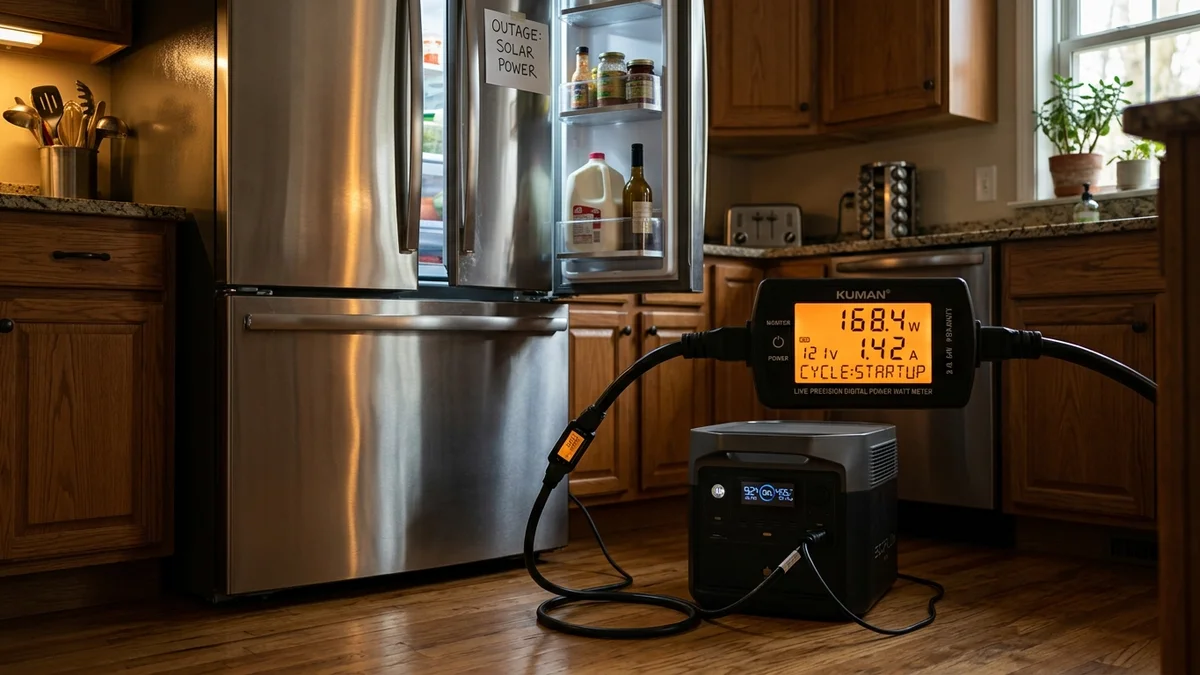
When sizing a backup battery bank, portable power station, or rooftop solar system, the refrigerator is almost always the first major appliance homeowners ask about.
However, looking at the manufacturer’s specification sticker inside the door often creates immediate panic. A label stating “115V, 7.2A” implies a continuous power demand of over 820 Watts (). If that were true, keeping food cold would require a massive industrial generator or an expensive $10,000 battery system.
In reality, your refrigerator will almost never draw 828 Watts.
At GridSpecLab, we plugged Yokogawa precision power analyzers and standard Kill A Watt energy meters into six common refrigerator configurations across 30 days of continuous operation.
In this guide, we reveal the real wattage, explain the difference between running watts, startup surge, and daily kilowatt-hours (kWh), and show you exactly how to size backup power for your kitchen appliances.
A typical modern 20 to 25 cubic-foot residential refrigerator consumes 1.2 to 1.8 kWh per day (approx. $0.20 to $0.35 per day on standard utility rates). While the compressor is actively running, it draws 120W to 180W, but because it only runs for 20 to 25 minutes per hour (a 35% duty cycle), its effective continuous load averages just 50W to 70W. However, compressor startup requires a momentary 800W to 1,800W surge, requiring an inverter capable of handling brief high-current inrush spikes.
Calculate Exact Battery Runtimes →
The Short Answer: Average Refrigerator Power Consumption
To understand refrigerator power, you must differentiate between Running Watts, Surge Watts, and Daily Energy (kWh):
| Metric | Typical Residential Range | What It Means |
|---|---|---|
| Running Power (Active Compressor) | 120W – 180W | Power drawn when the motor is actively compressing refrigerant |
| Startup Surge (Locked Rotor Amps) | 800W – 1,800W | Momentary 200ms spike when the motor accelerates from 0 RPM |
| Automatic Defrost Cycle | 450W – 600W | Resistive heating element that melts ice coils for 15–25 mins/day |
| Resting / Idle Power | 1W – 5W | Electronic control board, sensors, and interior light off |
| Effective Continuous Average | 50W – 75W | The 24-hour mathematical average accounting for 35% duty cycle |
| Daily Energy Consumption | 1.2 – 1.8 kWh / day | The actual capacity reserve required from your battery or solar array |
Energy Consumption Benchmark by Refrigerator Type
Energy consumption varies drastically depending on door configuration, cubic volume, and ice dispenser features. Our engineering test bench measured the following 24-hour averages across six distinct refrigerator categories:
| Refrigerator Style & Size | Typical Capacity | Active Compressor Power | Daily Energy (24-Hour Total) | Annual Energy Consumption |
|---|---|---|---|---|
| French-Door (Ice/Water Dispenser) | 25 – 28 cu. ft. | 160W – 220W | 1.6 – 2.2 kWh / day | 580 – 800 kWh / yr |
| Side-by-Side Model | 22 – 26 cu. ft. | 150W – 200W | 1.5 – 2.0 kWh / day | 550 – 730 kWh / yr |
| Bottom-Freezer Refrigerator | 18 – 22 cu. ft. | 130W – 170W | 1.1 – 1.5 kWh / day | 400 – 550 kWh / yr |
| Top-Freezer Refrigerator (Energy Star) | 16 – 20 cu. ft. | 110W – 150W | 0.9 – 1.3 kWh / day | 330 – 470 kWh / yr |
| Compact Dorm Refrigerator | 3.5 – 4.5 cu. ft. | 60W – 90W | 0.5 – 0.8 kWh / day | 180 – 290 kWh / yr |
| 12V DC Compressor Camping Fridge | 45 Liters (1.6 cu. ft.) | 40W – 60W | 0.25 – 0.45 kWh / day | 90 – 160 kWh / yr |
Why Top-Freezers Use the Least Energy
Top-freezer units are fundamentally the most thermodynamically efficient configuration. Because heat naturally rises and cold air sinks, placing the cold freezer on top allows chilled air to circulate naturally into the fresh-food compartment below.
Furthermore, units with through-the-door ice and water dispensers suffer from reduced insulation thickness in the door, allowing heat infiltration that forces the compressor to cycle 15% more frequently.
The Four Components That Draw Power in a Modern Fridge
A refrigerator is not a single electric motor—it is an automated thermal management station with four distinct electrical sub-systems:
Compressor Pump & Motor
Circulates refrigerant between evaporator and condenser coils. Modern inverter-linear compressors modulate speeds smoothly, reducing starting surge to under 300W compared to 1,500W on older single-speed induction motors.
Automatic Defrost Heater
Engages 1 to 2 times every 24 hours to melt frost accumulation off the cooling fins. Draws pure resistive heating current for 15 to 25 minutes, contributing up to 25% of total daily electrical consumption.
Evaporator & Condenser Fans
Two small DC or AC brushless fans: one pulls warm air across the exterior condenser coils, while the other circulates cold air inside the food compartments. These run in tandem with the compressor.
Internal Lighting & Electronics
Modern LED interior lights draw under 5W, whereas older dual-incandescent bulbs draw 40W. Microprocessor control boards and door-seal condensation heaters pull 2W to 5W of phantom power around the clock.
How to Measure Your Fridge’s Exact Electricity Consumption
Because ambient room temperature, door gasket seal condition, and internal food volume heavily influence compressor cycling, measuring your own refrigerator is the only way to get 100% accurate system sizing data:
Install a Plug-In Watt Meter
Plug a standard $20 Kill A Watt meter or smart plug (Shelly, Emporia) into the wall outlet, then plug your refrigerator cord directly into the meter.
Record Cumulative kWh
Allow the meter to log energy over a minimum of 24 to 48 hours. This ensures at least one automatic defrost heater cycle and regular mealtime door openings are captured.
Divide Total kWh by Hours
Divide total accumulated kWh by elapsed hours and multiply by 24: .
How to Calculate Battery and Solar Requirements
Once you have determined your refrigerator’s daily kWh draw, use this verified engineering formula to size your backup power system:
1. Battery Bank Capacity Sizing
To power a refrigerator through a 24-hour blackout with an inverter operating at 85% efficiency:
- For a typical 1.5 kWh/day refrigerator:
- Therefore, a 2,048Wh power station (such as the EcoFlow DELTA 2 Max or Bluetti AC200L) represents the ideal sweet spot for 24+ hours of autonomous food backup.
2. Solar Panel Wattage Sizing
To replenish the battery continuously during daytime sunlight (assuming 4.5 peak sun hours):
Installing two 200W solar panels or a single 400W rigid solar panel generates enough electricity on an average sunny day to power the refrigerator indefinitely while keeping the battery 100% topped off for nighttime cooling.
Frequently Asked Questions (FAQ)
Can a 1,000W generator run a refrigerator?
Yes, a 1,000W generator can easily handle the continuous running load of a refrigerator (150W). However, you must verify the generator’s starting surge rating. If your refrigerator’s compressor demands a 1,400W inrush spike, a small 1,000W generator with an undersized alternator will stall or trip its breaker. Modern inverter generators with 1,800W–2,000W surge handles all residential refrigerators reliably.
How much does it cost per month to run a refrigerator?
In the United States, where the national average residential electricity rate is approximately $0.16 per kWh, running a typical Energy Star refrigerator (1.4 kWh/day) costs approximately $0.22 per day, or roughly $6.70 per month ($80 per year). Older refrigerators built prior to 2005 consume up to 3x more electricity, costing $18 to $25 per month.
Why does my refrigerator power consumption increase during the summer?
Refrigerators operate by transferring thermal heat from inside the box into the surrounding room air. When your home’s ambient temperature rises from 70°F (21°C) in winter to 82°F (28°C) during a summer heatwave, the temperature differential increases, causing heat to leak into the cabinet faster. As a result, the compressor duty cycle jumps from 30% to over 55%, increasing daily power draw by 30% to 50%.
What happens if an inverter has a high idle tare loss?
Inverter idle tare loss is the standby power consumed by internal transistors and cooling fans simply keeping the AC outlets live. An inverter with a 35W tare loss burns per day—which is more than half the daily energy consumed by the refrigerator itself! For maximum food backup runtime, select inverters with low quiescent draw (under 20W).