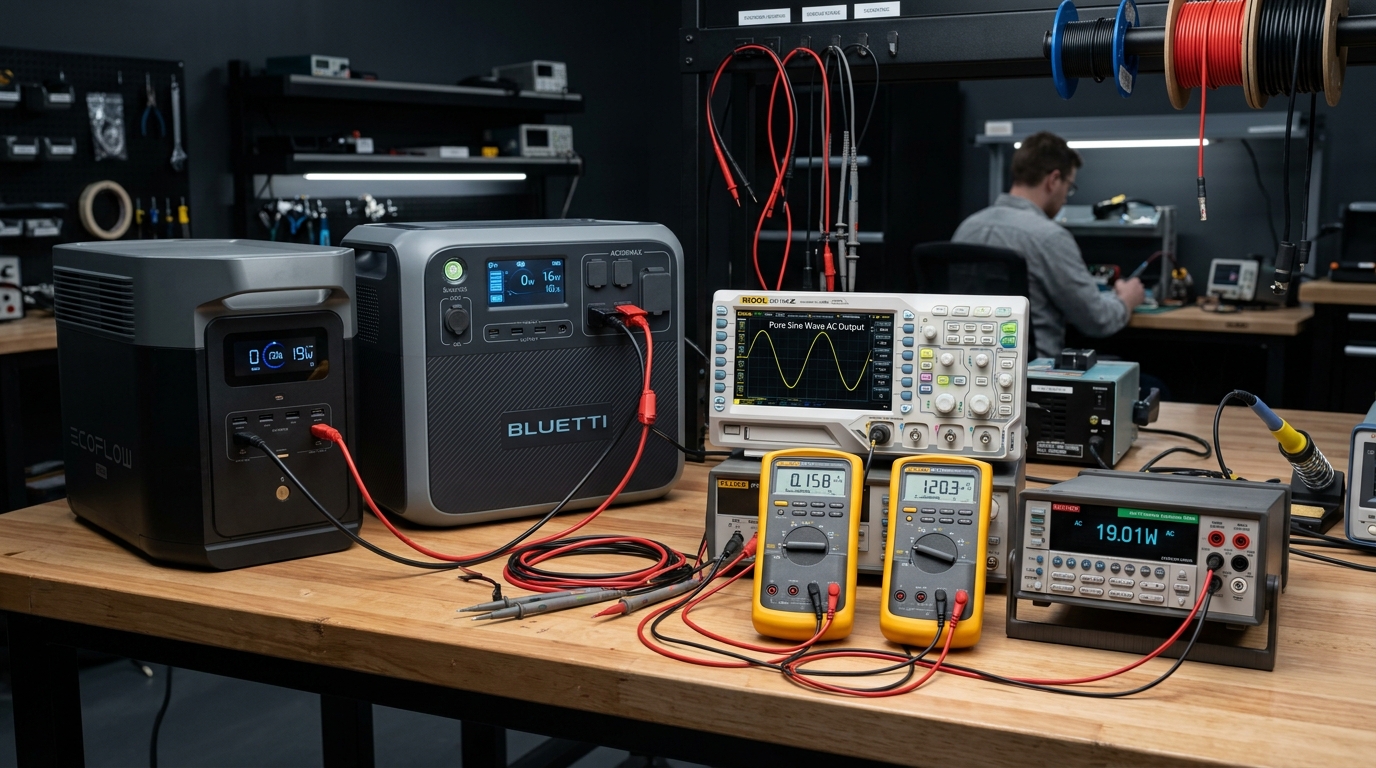
Accurately calculating electrical consumption and battery run time is the single most critical engineering step when designing resilient off-grid solar power systems or selecting portable power stations. Underestimating your kilowatt-hour (kWh) requirements leads to unexpected blackouts, premature battery degradation, and overloaded inverter architecture. Conversely, over-dimensioning inflates capital expenditure without yielding proportional operational benefits.
This comprehensive technical guide provides electrical engineers, off-grid system designers, and advanced DIYers with the exact mathematical models, first-principles physics, and interactive calculation frameworks required to size autonomous solar arrays and energy storage banks precisely. By accounting for conversion losses, inverter quiescent draw, ambient temperature coefficients, and battery chemistry limits, you can engineer reliable power architectures tailored to any operational load profile.
Key Engineering Takeaways For comprehensive battery storage sizing formulas, consult our guide on How Many Batteries to Power a House and test your emergency watt-hour requirements in our Power Station Capacity Sizing Calculator.
- Systemic Inefficiency: Total system efficiency () rarely exceeds 80–85% due to DC-to-AC inverter conversion losses, maximum power point tracking (MPPT) inefficiencies, and cabling resistive heat dissipation.
- Chemistry Constraints: Lithium Iron Phosphate (LiFePO4 / LFP) chemistries safely allow 80% to 100% Depth of Discharge (DoD), whereas traditional sealed lead-acid (AGM/GEL) chemistries must be restricted to 50% DoD to prevent terminal sulfation and capacity collapse.
- Solar Geometry & Derating: Panel wattage ratings are measured under Standard Test Conditions (STC: , cell temp). Real-world yields require applying a system derating factor () to account for dust, tilt angle variance, and thermal losses.
Interactive Solar Power Consumption Calculator
Use our interactive engineering calculator below to model your specific device loads, runtimes, and solar replenishment requirements. Adjust the values to evaluate your exact energy balance.
Model your appliance load profile, usable battery storage (), and solar replenishment cycles to verify off-grid autonomy under real-world operating conditions.
First-Principles Electrical Physics & Formulas
To engineer robust power systems, sizing must rely on exact electrical equations rather than general rules of thumb.
Battery Run Time Calculation
The fundamental equation determining how long a stored energy reserve will power a dynamic electrical load is:
Where:
- = Estimated operating time in hours
- = Total nominal battery capacity in Watt-hours (Wh)
- = Recommended maximum Depth of Discharge (expressed as a decimal, e.g., for 80%)
- = Inverter efficiency factor (typically to for modern pure sine wave units)
- = Total continuous power consumption of connected appliances in Watts (W)
Daily Solar Array Energy Generation
To replenish your battery bank via photovoltaic panels, the daily generation potential must match or exceed your cumulative daily consumption ():
Where:
- = Daily energy harvested in Watt-hours ()
- = Total rated peak photovoltaic panel capacity in Watts ()
- = Peak sun hours per day (average global horizontal or tilt-optimized irradiance equivalent)
- = Total end-to-end system efficiency factor (accounting for temperature derating, wiring resistance, and charge controller loss; typically )
Practical Test Bench Benchmarks
In real-world testing environments, appliances rarely draw their nameplate maximum continuously. For instance, compressor-based systems feature high surge (starting) currents followed by low steady-state thermal maintenance cycles.
| Appliance / Device | Running Wattage | Surge Wattage | Run Time on 2,000Wh LFP Battery |
|---|---|---|---|
| CPAP Machine (with humidifier off) | 30W - 45W | 60W | Approx. 35 - 45 Hours |
| Full-Size Residential Fridge (Inverter Compressor) | 120W - 160W (Average) | 1,200W | Approx. 10 - 13 Hours |
| Starlink Gen 2 / Gen 3 Terminal | 50W - 75W | 120W | Approx. 20 - 28 Hours |
| Portable 5000 BTU Inverter AC Unit | 550W - 650W | 1,500W | Approx. 2.2 - 2.6 Hours |
| 55-Inch 4K LED Smart TV | 90W - 130W | 150W | Approx. 12 - 17 Hours |
Real-World Sizing & Installation Scenarios
Scenario A: Remote Telecommunications / Starlink Outpost
- Objective: Power a continuous 60W telemetry load and Starlink router () 24 hours a day.
- Daily Energy Demand: .
- Storage Sizing: Factoring an 80% DoD and 90% inverter efficiency:
- Solar Array Sizing: Assuming 4 peak sun hours and a 75% system derating factor ():
Scenario B: Emergency Home Backup (Refrigerator & Medical Devices)
- Objective: Keep a refrigerator and CPAP operational during a 48-hour grid outage.
- Load Profile: Refrigerator () + CPAP () = . Total for 48 hours = .
- System Architecture: Requires a modular 4kWh to 5kWh LiFePO4 battery storage bank paired with a minimum 2,000W pure sine wave inverter to handle refrigerator compressor surge spikes safely.
Tailored Hardware Recommendations by Power Bracket
Selecting the correct ecosystem depends entirely on your calculated peak wattage and daily kilowatt-hour requirements. Here are our benchmarked hardware recommendations across primary power brackets:
Under 500Wh (Ultralight Portable / Medical Travel)
- Ideal Use Cases: CPAP travel usage, laptop charging, drone battery arrays, camera gear expeditions.
- Engineering Standard: Look for lightweight LiFePO4 cells with pass-through charging capabilities and regulated 12V DC outputs.
- Top Pick: EcoFlow River 2 Max – Features a 512Wh capacity, 500W pure sine output, and rapid AC recharging in under 60 minutes.
1000Wh to 2000Wh (Weekend Camping / Essential Emergency Backup)
- Ideal Use Cases: Refrigerator backup during short blackouts, mobile workstations, Starlink off-grid deployment.
- Engineering Standard: Expandable battery architecture, robust BMS (Battery Management System) with short-circuit and thermal protection.
- Top Pick: Bluetti AC200MAX – Boasts a 2,048Wh LFP capacity, 2,200W AC inverter, and heavy-duty surge tolerance up to 4,800W.
3000Wh+ (Whole-Home Essential Subpanel Integration)
- Ideal Use Cases: Multi-day home backup, large RV living, permanent off-grid cabin setups.
- Engineering Standard: 48V architecture, split-phase 120V/240V output capabilities, seamless UPS switchover times under 15 milliseconds.
- Top Pick: Anker Solix F3800 – Delivers 3,840Wh base capacity (expandable), 6,000W output, and direct EV charging integration without requiring dedicated adapters.
Frequently Asked Questions (FAQ)
What is the difference between Watt-hours (Wh) and Amp-hours (Ah)?
Watt-hours (Wh) measure total energy capacity, accounting for both voltage and current (). Amp-hours (Ah) measure electrical charge capacity at a specific reference voltage. When comparing batteries of differing voltages (e.g., 12V vs. 48V systems), always convert specs to Watt-hours to ensure an apples-to-apples comparison.
Why does my inverter consume power even when appliances are turned off?
All inverters feature a “quiescent load” or idle consumption draw—typically between 10W and 30W—required to power internal control boards and maintain ready-state AC voltage waveforms. If left on 24/7, an idle inverter can drain up to 720Wh of energy per day simply by being powered on.
How do sub-zero temperatures impact solar battery performance?
Lithium Iron Phosphate (LiFePO4) batteries cannot accept a charge when internal cell temperatures drop below () without suffering permanent lithium plating and structural anode damage. High-grade portable power stations and off-grid battery banks incorporate automated internal heating pads that draw grid or solar power to warm cells prior to charging.