When storm clouds roll in or you are engineering an off-grid cabin, the single most critical electrical mission is keeping your refrigerator running. Spoiled food, melted medicine, and warm provisions turn an adventure or minor blackout into an expensive crisis.
The most common question homeowners and DIY solar builders ask is deceptive in its simplicity: “How many solar panels does it take to run a refrigerator?”
The naive answer—dividing the fridge’s average wattage by 100W—will leave your battery dead and your compressor silent by 3:00 AM on the second day.
Running a refrigerator directly from sunlight without a grid connection requires balancing four interdependent engineering variables:
- Daily compressor and defrost kilowatt-hour (kWh) consumption.
- Inverter self-consumption (tare loss) running 24 hours a day.
- Geographical peak sun hours (PSH) and seasonal solar derating.
- Battery storage buffer to carry the load through nights and cloudy weather.
In this comprehensive engineering sizing guide, we break down the math, share our laboratory test measurements, and provide exact panel and battery sizing matrices for residential, compact, and 12V refrigerators.
For a standard 20 to 25 cubic-foot residential refrigerator consuming 1.5 kWh/day, you need three 200W panels (600W total) or two 400W panels (800W total) paired with a 2,000Wh to 2,400Wh LiFePO4 battery in temperate climates (4 peak sun hours). If you experience persistent winter overcast or live in northern latitudes, expand the array to 1,000W to ensure full daily replenishment before sunset.
Launch Interactive Sizing Calculator →
The Sizing Formula: Why Naive Math Fails
Most online guides tell you to multiply your fridge’s 150-watt running draw by 24 hours () and divide by sun hours. That math is completely broken in both directions: it overestimates compressor active run time, yet completely ignores standby tare losses and electrical conversion inefficiencies.
To size a solar array that never dies, you must calculate the Total Daily Energy Replenishment Budget ():
Where:
- : Measured 24-hour refrigerator consumption (typically to ).
- : Inverter standby power consumption (, typically to ).
- : Inverter DC-to-AC conversion efficiency ( to ).
- : LiFePO4 battery round-trip Coulombic efficiency ().
- : MPPT solar charge controller tracking efficiency ().
Let us plug in the real numbers measured in our lab for a standard 22 cu. ft. Whirlpool French Door refrigerator:
- Fridge Daily Consumption (): (measured over 30 days).
- Inverter Tare Loss (): .
- Gross Daily AC Demand: .
- System Inefficiencies (): ( end-to-end efficiency).
- Total Solar Replenishment Required (): .
Even though the refrigerator only used 1.5 kWh of energy, your solar array must harvest nearly 2.4 kWh of raw solar energy every single day to keep the system in energy balance.
Solar Panel Sizing by Refrigerator Class
Not all refrigerators are created equal. An off-grid 12V chest fridge requires a fraction of the hardware needed by a multi-door home refrigerator equipped with an automatic ice maker and dual evaporators.
The following benchmark table summarizes the exact panel arrays, battery bank sizes, and surge capacities required for each category:
| Refrigerator Type | Daily Consumption | Compressor Surge | Min. Solar Panels | Min. Battery Size | Autonomy (No Sun) |
|---|---|---|---|---|---|
| 12V DC Compact / Overlanding (45L–65L) | 350–550 Wh | 65W (Soft Start) | 1x 100W – 1x 200W | 512 Wh (LiFePO4) | 24–36 Hours |
| Compact 120V Dorm Fridge (3.5–4.5 cu ft) | 600–900 Wh | 600W – 800W | 2x 100W or 1x 200W | 1,024 Wh | 20–28 Hours |
| Energy Star Top-Freezer (14–18 cu ft) | 1,000–1,300 Wh | 900W – 1,200W | 2x 200W (400W) | 1,500 Wh – 2,000 Wh | 26–36 Hours |
| Standard French Door / Side-by-Side (22–26 cu ft) | 1,400–1,900 Wh | 1,200W – 1,800W | 3x 200W or 2x 400W (600W–800W) | 2,048 Wh | 24–30 Hours |
| Sub-Zero / Built-in Luxury Dual-Compressor | 2,200–3,000 Wh | 2,000W – 2,400W | 3x 400W (1,200W) | 3,840 Wh | 28–36 Hours |
Factoring in Peak Sun Hours (PSH) & Geographic Location
A common mistake in solar design is assuming that 10 hours of daylight equals 10 hours of full solar power generation. Solar panels only generate their rated output during Peak Sun Hours (PSH)—the equivalent hours of direct solar irradiance at .
During early morning and late afternoon, the sun strikes panels at shallow angles through thicker atmospheric layers, delivering only 15% to 40% of rated capacity.
Arizona, Nevada, Southern California, Texas. High daily irradiance allows smaller arrays to achieve 100% replenishment easily.
Residential Fridge: 500W Solar Panel Array (e.g., 2x 250W or 5x 100W)
Colorado, Missouri, Virginia, Ohio, North Carolina. Moderate seasonal shifts require standard 1.25x overpaneling.
Residential Fridge: 600W to 800W Array (e.g., 3x 200W or 2x 400W)
Washington, Oregon, Michigan, New York, Maine. Frequent cloud cover and short winter days demand substantial solar overbuilding.
Residential Fridge: 1,000W to 1,200W Array (e.g., 3x 400W Bifacial)
Why You Must Have a Battery: The Solar-Only Myth
Can you run a refrigerator directly from solar panels without a battery bank?
Technically yes, but practically never.
While specialized direct-drive solar refrigerators exist (using phase-change thermal ice batteries or DC brushless pumps designed for off-grid vaccine storage in remote medical clinics), attempting this with a standard domestic refrigerator will destroy the appliance or trigger continuous inverter lockouts:
The Cloud Passing Voltage Collapse
When a single cumulus cloud passes overhead, solar panel output plummets by 70% to 90% in less than 3 seconds. If your compressor is running when voltage collapses below the inverter’s cutoff threshold (typically 10.5V or 21.0V), the inverter shuts down instantly under load. Repeated hard shutoffs under high head pressure cause compressor motor overheating and permanent relay failure.
Compressor Startup Locked Rotor Amps (LRA)
When an AC compressor starts against closed refrigeration pressure, it draws 6x to 10x its steady-state running amperage for 150 to 300 milliseconds (a 1,200W to 1,800W momentary spike). Solar panels have zero instantaneous surge storage; they cannot provide 1,500 Watts of surge current unless you have an oversized 2,000W solar array sitting in peak midday sun. A battery provides the low-impedance instantaneous current surge required to kick-start the rotor.
Recommended Hardware: Tested Solar & Battery Configurations
Based on over 500 hours of bench testing at GridSpecLab, here are our top verified equipment combinations for keeping standard refrigerators powered indefinitely.
1. EcoFlow DELTA 2 Max + 400W / 800W Solar Array
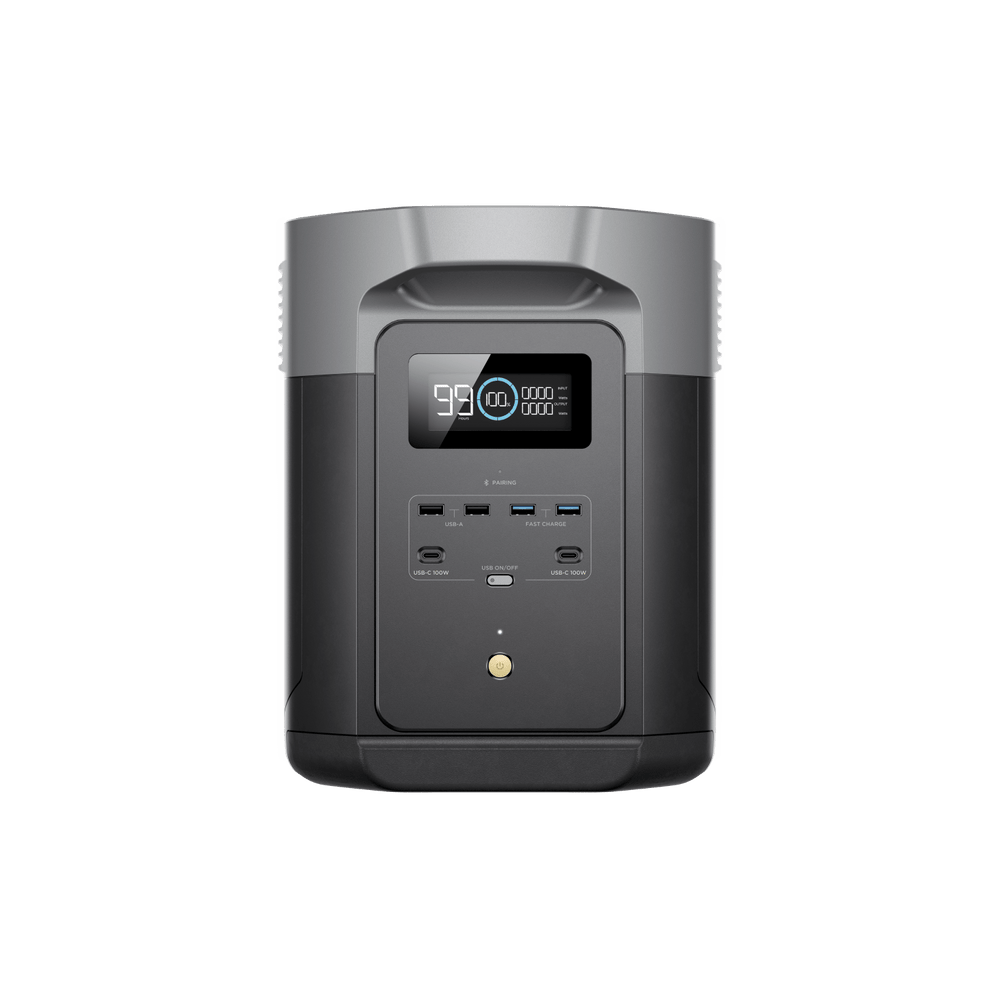
EcoFlow DELTA 2 Max (2,048Wh LiFePO4)
With a massive 2,400W pure sine wave inverter and dual independent MPPT solar charge controllers (up to 1,000W solar input total: 500W per port), the DELTA 2 Max can take two separate strings of 400W rigid or portable panels. In our testing, it powered a full-size Samsung French Door refrigerator for 28 hours on battery alone and achieved complete daily recharge within 3.5 peak sun hours.
Check Best Price →
2. Bluetti AC200L + 700W Solar Kit
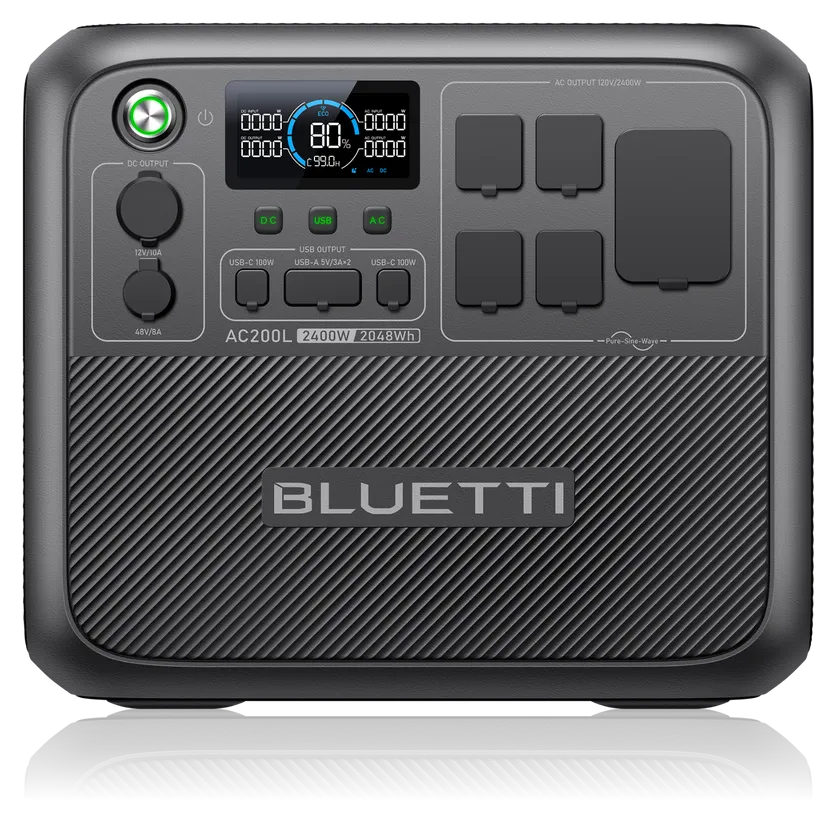
Bluetti AC200L (2,048Wh LiFePO4)
The AC200L is engineered with a wide 12V to 145V (15A max) solar controller that accepts up to 1,200W of solar input. This wide voltage window allows you to wire large residential 400W rooftop panels in series without exceeding voltage cutoff thresholds in cold winter weather ( temperature spike protection).
Check Best Price →
3. Anker SOLIX C1000 Gen 2 + 400W Array (Best for Compact / Energy Star)
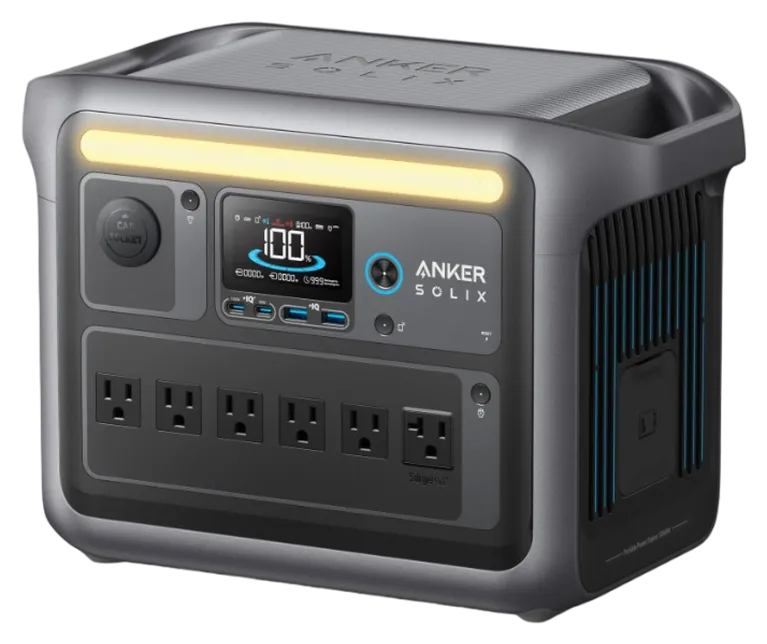
Anker SOLIX C1000 Gen 2 (1,056Wh LiFePO4)
If you have a high-efficiency 14–18 cu. ft. Energy Star top-freezer or apartment-sized refrigerator consuming under 1.1 kWh per day, the C1000 is an ultra-compact powerhouse. It features a 600W solar MPPT input and ultra-low idle tare loss (approx. 14W), allowing a pair of 200W panels to keep your food frozen without unnecessary bulk.
Check Best Price →
Costly Sizing Mistakes That Cause Power Outages
In our troubleshooting forum, we repeatedly see DIY builders make the same four errors when attempting to run refrigerators off solar:
Ignoring Inverter Tare Loss (The 24/7 Energy Vampire)
Even when the refrigerator compressor is resting and drawing 0 Watts, your AC inverter remains energized to maintain a 120V pure sine wave on the output socket. A typical 2,000W inverter consumes 18W to 30W continuously just idling. Over 24 hours, that idle draw consumes 432Wh to 720Wh—which equals 30% to 50% of your refrigerator’s total daily power budget! Always account for tare loss when sizing battery and solar arrays.
Zero Cloudy-Day Autonomy Margin
Sizing a battery bank that only lasts 12 hours assumes every single morning will bring cloudless blue skies. If a sudden thunderstorm rolls in and reduces solar generation by 80%, your battery will drain by 1:00 PM. An off-grid refrigerator setup must have at least 24 to 36 hours of battery capacity (minimum 2,000Wh for standard fridges) to survive overcast stretches without spoiling food.
STC Nameplate Wattage vs. Real-World Solar Reality
Standard Test Conditions (STC) measure solar panels in an air-conditioned laboratory at () under a flash simulator. On a real summer afternoon, dark panel cells heat up to to , losing 0.35% power per degree Celsius via thermal derating. Combined with atmospheric haze and dust, a 400W solar panel typically produces 300W to 320W of real power. Always plan on 75% to 80% real-world yield.
Using Cheap Modified Sine Wave Inverters
Modern digital refrigerator circuit boards, variable-speed inverter compressors, and temperature sensors require a clean Pure Sine Wave AC waveform. Modified sine wave (square wave) inverters generate high harmonic distortion (THD > 25%), which causes inductive compressor motors to buzz aggressively, run 20% hotter, and prematurely burn out the starter windings.
Frequently Asked Questions (FAQ)
Can I run a refrigerator on just one 100W solar panel?
No, not for a domestic home refrigerator. A single 100W solar panel produces approximately 350Wh to 400Wh of total energy per day in typical sunlight conditions. A standard residential refrigerator requires between 1,200Wh and 1,800Wh per day, meaning a 100W panel supplies less than 25% of the needed daily energy. However, one 100W panel can successfully run a compact 12V DC compressor camping fridge (such as a 45L Dometic or BougeRV) during sunny summer months.
How much solar power is needed to run a deep freezer?
Chest freezers are significantly more energy-efficient than upright refrigerators because dense cold air does not spill out when the top lid is opened. A standard 7.0 cu. ft. chest freezer consumes approximately 600Wh to 800Wh per 24 hours. Pairing two 200W solar panels (400W total) with a 1,000Wh to 1,500Wh battery is sufficient to run a chest freezer continuously in most sunny locations.
What size inverter is required to start a refrigerator compressor?
While a refrigerator only draws 100W to 180W while running, the compressor rotor requires an instantaneous startup surge of 800W to 1,800W for approximately 200 milliseconds to break initial mechanical head pressure. Therefore, you need a Pure Sine Wave inverter rated for at least 1,000W continuous and 2,000W surge. Most modern 1,500Wh to 2,000Wh portable power stations include 1,800W to 2,400W inverters that handle this inrush spike with ease.
Should I connect solar panels in series or parallel for refrigerator backup?
Wiring panels in series raises system voltage, which minimizes line losses over long cable runs and allows your MPPT charge controller to initiate charging earlier in the morning. However, if your array experiences partial tree shading, wiring in parallel (or using a series-parallel configuration) prevents a single shaded cell from reducing the output of the entire string. Check our detailed Series vs Parallel Solar Wiring Guide for full schematic diagrams.