Designing a solar energy system from bare components can be overwhelming for beginners. You must calculate panel open-circuit voltages (), match Maximum Power Point Tracker (MPPT) voltage windows, select correct DC fuse ratings, ensure battery BMS closed-loop communication, and size heavy-gauge copper conductors. One mathematical error can result in an inverter shutdown or blown equipment.
This complexity is why pre-engineered DIY solar kits have become the most popular route for off-grid homesteaders, cabin owners, and emergency preppers. Retailers like ShopSolar, Signature Solar, and Renogy bundle solar panels, inverters, and lithium battery banks into a single package, advertising them as “turnkey” or “complete.”
However, not all solar kits are created equal. Some kits are genuinely plug-and-play, while others are missing hundreds of dollars worth of critical Balance-of-System (BOS) safety components—like Class-T fuses, DC disconnects, grounding rods, and mounting brackets.
In this comprehensive guide, we demystify solar kits from first principles. We explain the four main categories of solar kits, provide a step-by-step engineering sizing framework, highlight what retailers often leave out, and rank the top verified kits for 2026.
Zero-Permit Plug & Play
EcoFlow / Anker. Best for renters, camping, and basic fridge backup. No wiring required.
Vans & Overlanding
Renogy / Victron kits. Compact, lightweight, runs 12V DC fridges and lights directly.
3kW to 6kW All-in-One
EG4 6000XP + Server Rack batteries. Runs 120V/240V off-grid tiny homes and workshops.
12kW to 18kW Split-Phase
Sol-Ark 15K / EG4 18kPV. Seamless grid-tie net metering with 240V well pump and central AC.
Why Buying a Pre-Packaged Solar Kit Makes Sense (And When It Doesn’t)
Before spending $2,000 to $15,000 on a kit, consider whether a bundled package aligns with your technical comfort level and project requirements.
Advantages of a Pre-Packaged Kit
- Engineered Electrical Compatibility: The primary failure point in DIY solar builds is component mismatch. In a proper kit, the distributor has pre-verified that the solar array’s maximum power voltage () and open-circuit voltage () fall safely inside the inverter’s MPPT window, and that the battery’s maximum discharge rate matches inverter demand.
- Pre-Commissioned Closed-Loop Communications: Modern lithium batteries require CAN-bus or RS485 communication protocols with the hybrid inverter. High-end kits arrive with pre-configured communication cables and matched firmware, eliminating “Error 61” battery communication lockouts.
- Single-Source Warranty & Support: If your system fails to power on, you call one technical support line rather than having the inverter manufacturer blame the battery company, who in turn blames the solar panel manufacturer.
When to Avoid Pre-Bundled Kits
- You Have Irregular Roof Geometry: Kits generally ship with identical 400W–450W rigid panels intended for rectangular strings. If your roof has multiple hips, valleys, or shading dormers, you may need microinverters or mixed panel sizes that standard kits do not accommodate.
- You Already Own Quality Hardware: If you already have an off-grid inverter or a battery bank, buying an all-in-one kit forces you to repurchase components you do not need.
The Four Categories of Solar Kits Explained
To choose the right kit, you must match your physical power requirements to one of four equipment classes:
| Category | Inverter Output | Battery Capacity | Typical Solar Array | Target Application |
|---|---|---|---|---|
| Plug & Play Generator | 1,800W – 3,600W (120V) | 1kWh – 4kWh LiFePO4 | 200W – 800W Folding | Apartments, tailgating, CPAP & fridge backup during outages. |
| 12V / 24V Mobile Kit | 1,000W – 2,000W (120V) | 1.2kWh – 2.5kWh (100–200Ah) | 200W – 600W Rigid | Camper vans, overland trailers, sailing boats, small hunting cabins. |
| 48V Off-Grid All-In-One | 3,000W – 6,000W (120V/240V) | 5kWh – 15kWh Server Rack | 1,600W – 4,000W (4–10 Panels) | Off-grid tiny homes, remote cabins, homestead workshops, barns. |
| Whole-Home Hybrid Split-Phase | 12,000W – 18,000W (240V) | 14kWh – 30kWh+ PowerWall | 6,000W – 15,000W (14–35 Panels) | Full residential grid-tied homes, net metering, 3-ton central AC, well pumps. |
Sizing Your Solar Kit in Four Technical Steps
Never select a solar kit by guessing. An undersized kit will leave you running a gas generator in the dark, while an oversized kit wastes thousands of dollars. Use this first-principles calculation framework:
Calculating Total Daily Energy Consumption
Calculate your continuous energy requirement in Watt-hours () per day by multiplying each appliance’s rated power by its daily runtime hours:
For example, a modern off-grid cabin running basic essential circuits typically consumes:
- Full-size Refrigerator (150W running @ 35% duty cycle): 1,260 Wh/day
- Starlink Internet / Wi-Fi Router (50W continuous @ 24 hrs): 1,200 Wh/day
- LED Lighting & Electronics (100W @ 5 hrs): 500 Wh/day
- Water Pressure Pump (600W @ 0.5 hrs intermittent): 300 Wh/day
- Total Daily Demand:
Sizing the Battery Bank (Factoring Autonomy & Efficiency)
Batteries must supply power during cloudy days without sun (Days of Autonomy). To prevent accelerated cell degradation, size the battery using the standard 80% Depth-of-Discharge (DoD) threshold and account for inverter tare loss:
For our 3,260 Wh daily cabin load with 1.5 Days of Autonomy:
A single 5.12kWh 48V server rack battery would be slightly undersized; two 5.12kWh batteries (10.24kWh total) provide comfortable 2-to-3-day off-grid security.
Sizing the Solar Array (Factoring Peak Sun Hours & Derating)
Your solar array must harvest enough energy during peak daylight hours to replenish yesterday’s battery drain while powering active daytime loads. Solar engineers quantify daily sunlight as Peak Sun Hours (PSH):
Assuming an average winter baseline of 3.5 Peak Sun Hours in the continental United States:
To ensure reliable winter recovery, choose a kit with at least 1,600W of solar panel capacity (e.g., four 400W monocrystalline panels).
Sizing Inverter Continuous & Surge Amps
Examine the starting surge of all inductive motor loads. An air compressor, well pump, or refrigerator draws 5 to 7 times its running wattage in Locked Rotor Amps (LRA) for 100 to 300 milliseconds.
Ensure your kit’s inverter features:
- Continuous Wattage: Greater than the sum of all appliances running simultaneously.
- Surge Rating: Minimum 1.5x continuous rating for high-frequency inverters, or choose a low-frequency inverter for heavy deep-well pumps.
The Missing Balance-of-System (BOS) Checklist
The most common complaint from first-time solar kit buyers is: “I opened the boxes, but I can’t hook anything up because half the wires and fuses are missing!”
Before purchasing any kit, review this checklist of items that distributors frequently omit from “complete” packages:
⚡ Electrical Safety & Protection
- Class-T Battery Fuse: Crucial fast-acting fuse rated for lithium short-circuit currents (20,000A AIC). Standard automotive ANL fuses can arc-weld shut.
- 2-Pole DC Disconnect Switch: Isolates the high-voltage solar array before entering the inverter for maintenance.
- AC Input/Output Breakers: Subpanel breakers protecting house circuits.
🔧 Hardware, Conduit & Racking
- Solar Racking / Ground Mounts: Roof brackets (IronRidge / Unirac) or ground frames are almost never included in baseline kits.
- PV Extension Wire (10 AWG): Runs from the roof or ground array to the indoor inverter.
- Grounding Equipment: 8-foot copper ground rod, bare #6 AWG ground wire, and solar panel grounding lugs.
Top Verified Solar Kits for 2026
Based on component build quality, verified closed-loop communication, customer service reputation, and real-world efficiency bench tests, here are our recommended pre-bundled kits for 2026:
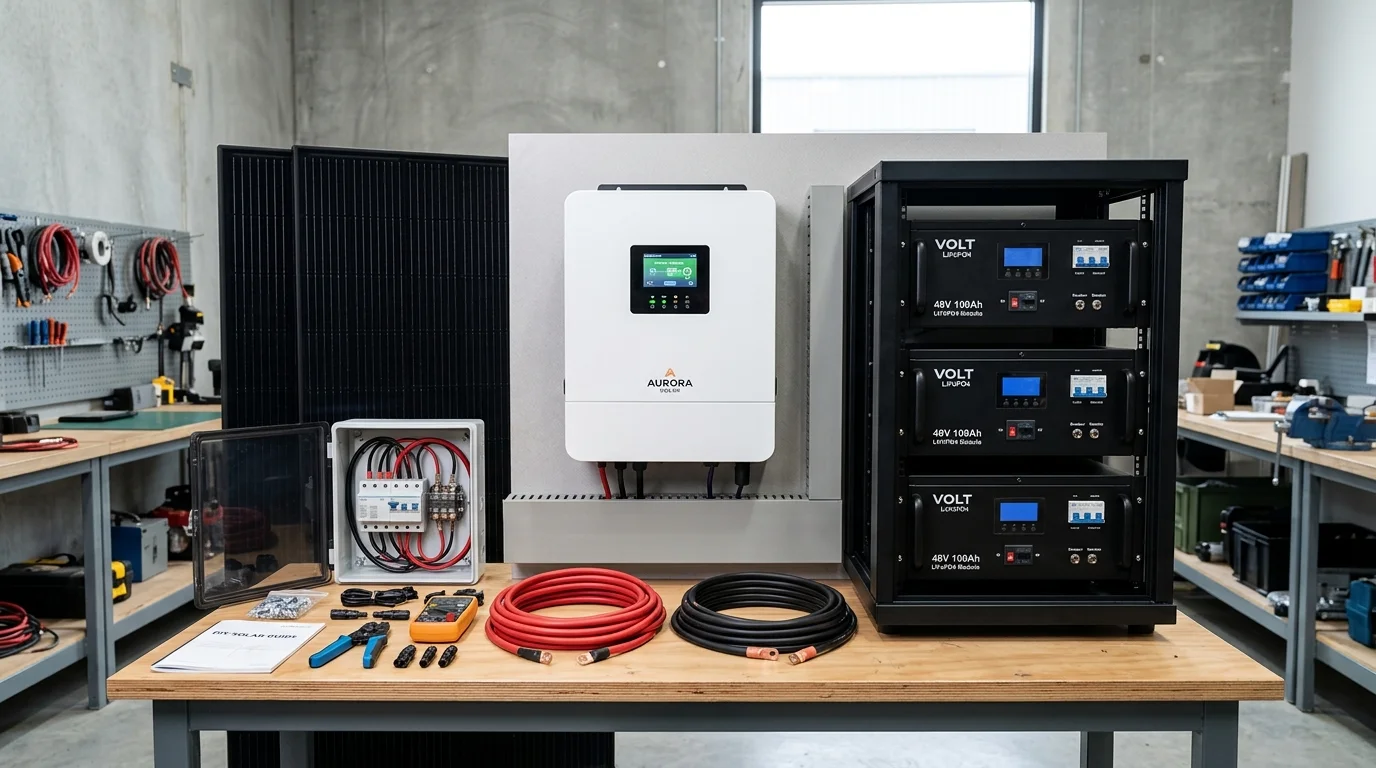
ShopSolar HBK Off-Grid Pro
6,000W Inverter • 10.2kWh Battery • 3,200W Solar
- Features the proven EG4 6000XP all-in-one inverter
- Dual 5.12kWh server rack batteries with closed-loop comms
- Eight 400W Tier-1 bifacial monocrystalline panels
Read ShopSolar Kit Review →

EcoFlow DELTA Pro 3 Bundle
4,000W AC (120V/240V) • 4,096Wh LiFePO4 • 1,000W Solar
- Pure plug-and-play setup: zero electrical permits required
- Native 120V/240V split-phase output powers dryers & pumps
- Dual MPPT inputs accept up to 2,600W solar PV
Check Best Price on Amazon →
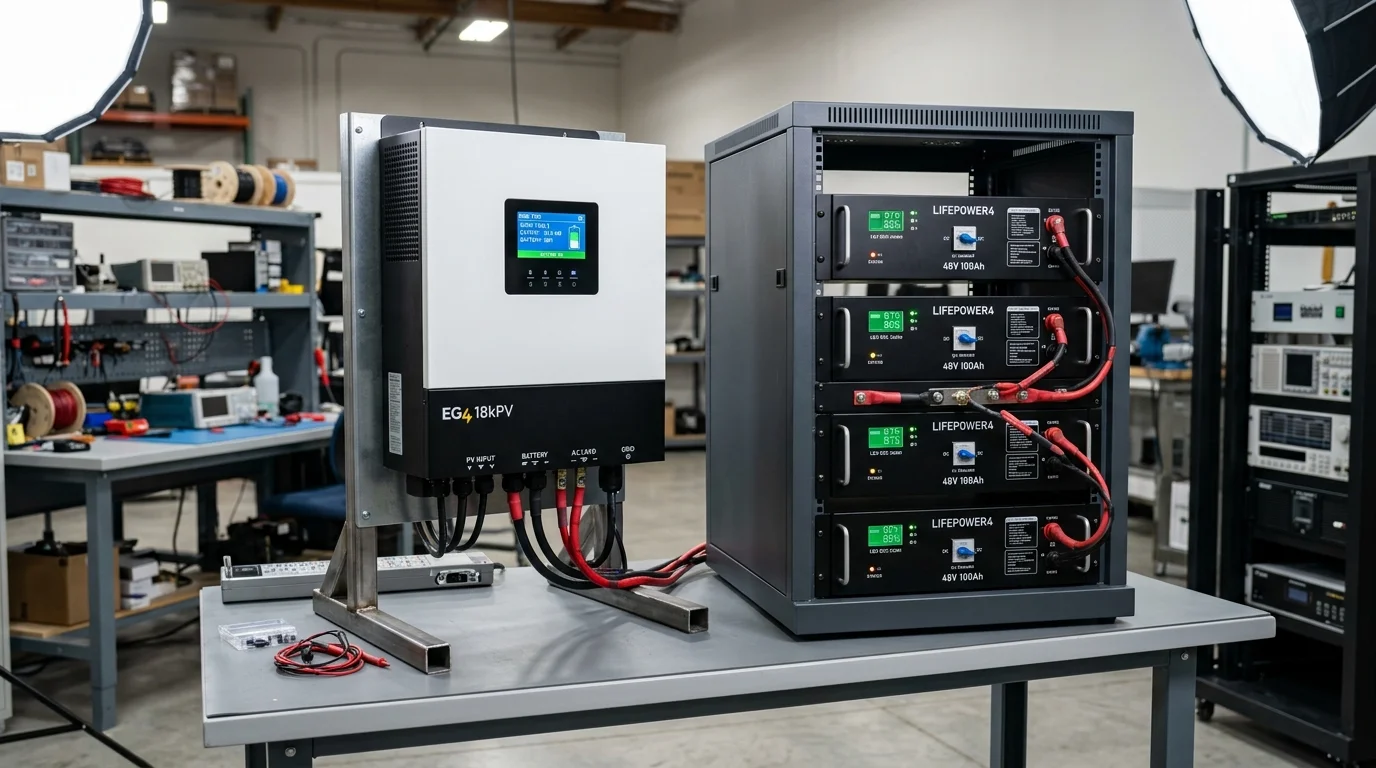
Signature Solar EG4 18kPV
12,000W Continuous • 14.3kWh PowerWall • 8kW Solar
- Full 200A whole-home service entrance grid passthrough
- Zero-export or full net-metering grid interconnection
- Powers central air conditioning, ovens, and electric vehicles
Read Signature Solar Review →
1. ShopSolar HBK Off-Grid Pro (Best Mid-Sized Off-Grid Cabin Kit)
The ShopSolar HBK Off-Grid Pro kit is engineered around the popular EG4 6000XP all-in-one inverter. For off-grid cabins, workshops, or barndominiums, it hits the sweet spot: 6,000 Watts of continuous 120V/240V split-phase power paired with two 5.12kWh server rack batteries (10.24kWh total energy). ShopSolar pre-assembles the battery communication cables and includes high-quality 2/0 welding-grade battery cables, making setup remarkably straightforward.
2. EcoFlow DELTA Pro 3 Solar Bundle (Best Zero-Wiring Plug-and-Play Kit)
If you are a renter, live in an HOA-restricted neighborhood, or lack the desire to wire 240V electrical subpanels, the EcoFlow DELTA Pro 3 Solar Bundle provides immediate power right out of the box. Featuring a 4,000W pure sine wave inverter and 4,096Wh of automotive-grade LiFePO4 storage, it can run 120V kitchen appliances or 240V well pumps via its NEMA 14-30 / 14-50 generator outlets without requiring municipal permits.
3. Signature Solar EG4 18kPV Whole-Home Kit (Best 240V Grid-Tie & Backup Kit)
For homeowners looking to replace their utility bills while having complete blackout protection, Signature Solar’s EG4 18kPV Whole-Home Kit delivers true utility-grade capacity. With a massive 200A internal grid transfer switch, it installs between your utility meter and main breaker panel. In an outage, it transfers load in under 10 milliseconds—seamlessly running 4-ton central air conditioners, electric ranges, and water heaters without blinking your lights.
Six Costly Solar Kit Mistakes to Avoid
- Buying a 12V Kit for a Whole-House Load: Connecting a 3,000W inverter to a 12V battery pulls over 280 Amps DC, requiring massive 4/0 welding cables and risking severe voltage drop. For systems over 1,500 Watts, always insist on a 48V architecture.
- Ignoring Cold-Temperature Voc Voltage Expansion: Silicon solar cells produce significantly higher open-circuit voltage in sub-zero winter temperatures. If your string voltage exceeds your inverter’s maximum MPPT voltage limit by even 2 Volts on a cold morning, the charge controller will blow its input MOSFETs. Always use our Solar Panel Voc Temperature Coefficient Guide before stringing panels in series.
- Assuming Solar Kits Include Roof Mounts: Racking hardware depends entirely on your roof type (asphalt shingle, standing seam metal, clay tile, or ground mount). Kits rarely include racking because distributors cannot predict your roof geometry. Factor an extra $400 to $1,200 for certified aluminum racking.
- Using Cheap Car Audio Fuses for Lithium Banks: Lithium battery banks can discharge over 10,000 Amps during a dead short. Inexpensive automotive ANL fuses can vaporize and arc across the terminals. Always install a Class-T fuse (20,000A AIC rating) on the positive battery terminal.
- Connecting Mismatched Solar Panels: Adding a new 400W panel with a 10A rating to an older string of 200W panels with a 5A rating will bottleneck the entire string down to 5 Amps. Keep all panels within a series string identical.
- Neglecting Equipment Grounding: Solar arrays mounted outdoors act as large lightning conductors. Always bond the aluminum panel frames to a dedicated 8-foot copper ground rod using bare #6 AWG copper wire and install a DC lightning surge arrestor.
Frequently Asked Questions (FAQ)
Can I install a 48V off-grid solar kit myself, or do I need an electrician?
Most off-grid homesteaders and handy DIYers install the solar panels, racking, and 48V DC battery connections themselves. However, if you plan to tie the inverter into your home’s main AC service panel or install an AC critical loads subpanel, hiring a licensed electrician for that final AC connection ensures compliance with the National Electrical Code (NEC Article 690 & 705) and homeowner’s insurance policies.
Do DIY solar kits qualify for the 30% Federal Clean Energy Tax Credit?
Yes! Under Section 25D of the Internal Revenue Code, equipment costs for solar panels, inverters, racking, balance-of-system wiring, and energy storage batteries (3kWh or larger) installed at a residential home qualify for the 30% Residential Clean Energy Tax Credit. Read our comprehensive Federal Solar Tax Credit 2026 Homeowner’s Guide for complete qualification details.
What is the difference between an off-grid solar kit and a hybrid solar kit?
An off-grid solar kit (like the EG4 6000XP) cannot sell surplus solar electricity back into the utility grid. It powers your appliances directly from solar and batteries, and uses grid power or a generator strictly as an auxiliary charging backup. A hybrid solar kit (like the Sol-Ark 15K or EG4 18kPV) is fully grid-interactive: it can offset utility bills via net metering, sell excess power back to the electric company, and automatically isolate itself from the grid during blackouts.
Can I expand my solar kit later with more batteries and panels?
Yes, provided your initial inverter has expansion headroom. Inverters like the EG4 6000XP feature dual MPPT inputs that let you connect an initial string of 6 panels now and add a second string later. Similarly, modern 48V server rack batteries can be wired in parallel (up to 16 units) to scale your storage capacity from 5kWh up to 80kWh over time without replacing the inverter.