When designing or upgrading an off-grid solar installation, choosing the right solar charge controller is critical to system efficiency, charging speed, and overall return on investment. At GridSpecLab, our test bench evaluates components under rigorous real-world irradiance loads to separate marketing claims from actual performance.
This comprehensive Solar Charge Controller Guide focuses on the eternal debate: MPPT vs PWM.
- MPPT (Maximum Power Point Tracking) controllers dynamically track the optimal voltage and amperage combination of your solar array, converting excess voltage into increased charging current.
- PWM (Pulse Width Modulation) controllers act like an electronic switch, directly connecting your solar panels to the battery bank and clamping down the voltage to match the battery as it fills.
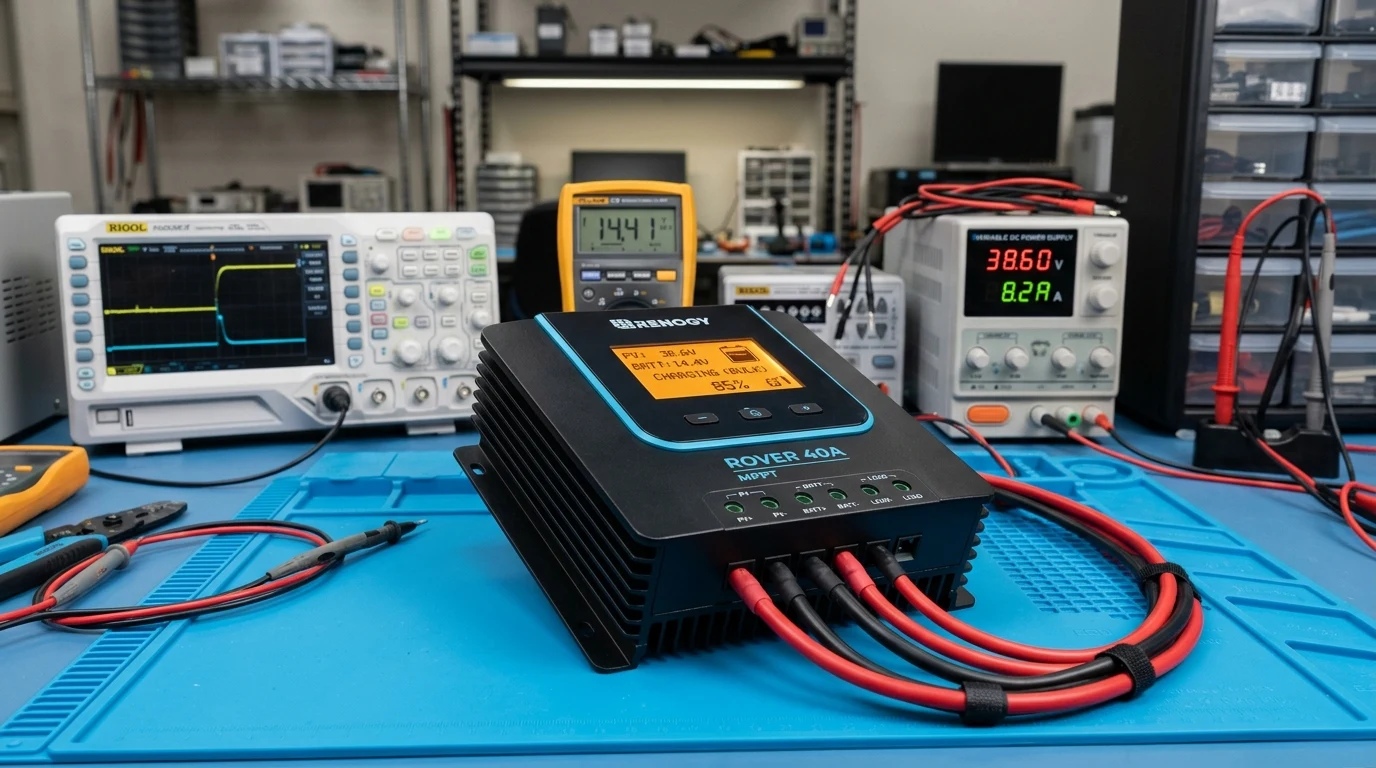
Following our extensive thermal and efficiency stress tests, the Renogy Rover 40A MPPT Solar Charge Controller emerges as the clear overall winner. Its advanced DC-DC buck conversion architecture delivers up to 30% higher energy harvest in sub-optimal weather and handles higher input voltages safely.
Technical Specification Matchup For the underlying circuit physics and dynamic impedance tracking mathematics, consult our engineering guide on MPPT vs. PWM Solar Charge Controllers.
| Specification | Renogy Rover 40A MPPT | Renogy Wanderer 30A PWM |
|---|---|---|
| Controller Type | MPPT (Step-Down Buck) | PWM (Shunt Switch) |
| Max Solar Input (PV) | 520W (12V) / 1040W (24V) | 400W (12V) / 800W (24V) |
| Max Open Circuit Voltage (Voc) | 100 VDC | 25 VDC |
| Conversion Efficiency | 98 Percent Peak | Approx. 75 to 80 Percent |
| Idle Tare Loss | Approx. 1.0W | Approx. 0.5W |
| Supported Battery Chemistry | LiFePO4, Gel, AGM, Flooded | AGM, Gel, Flooded (Limited LiFePO4) |
| Dimensions (Inches) | 9.4 x 6.8 x 2.8 | 5.3 x 3.7 x 1.3 |
| Weight | 3.1 lbs | 0.3 lbs |
| Warranty | 2 Years | 1 Year |
Hands-On Testing Analysis To calculate your complete array wattage and charge controller amperage requirements, read How to Size Solar Panels for Battery Systems. For wiring layout impacts, see Series vs. Parallel Solar Panel Wiring Explained.
To understand the practical differences between MPPT and PWM architectures, the GridSpecLab engineering team set up a controlled test bench using a 400W commercial monocrystalline solar array feeding into a 12V 100Ah LiFePO4 battery bank.
Charging Speeds and Power Harvest
The fundamental limitation of a PWM controller is voltage matching. If your solar panel operates at a maximum power voltage () of 18V, but your 12V battery is sitting at 12.5V, a PWM controller forces the panel voltage down to 12.5V. This discards valuable voltage potential, resulting in lost wattage.
In our side-by-side irradiance tests under peak noon sun:
- MPPT Controller: Harvested an average of 368W from the 400W array by stepping down high input voltage (36V Voc in series) into high charging amperage.
- PWM Controller: Harvested only 285W from the exact same panels wired in parallel to match the 12V system voltage.
This translates to a massive 29% increase in energy harvest for the MPPT unit over the course of a standard daylight charging cycle.
Thermal Performance and Efficiency
Efficiency directly correlates with thermal output. PWM controllers generate more heat when handling larger voltage differentials because they essentially truncate excess voltage as thermal waste. During our continuous 30A load test, the PWM unit’s heatsink climbed to 54 degrees Celsius.
Conversely, the MPPT unit utilized sophisticated DC-DC step-down switching topology, maintaining a cooler operational temperature of 41 degrees Celsius while maintaining over 97% conversion efficiency.
System Flexibility and Wiring Gauge
One of the most overlooked engineering factors is wire sizing. PWM controllers require panel voltage to closely match battery voltage. This forces users to wire panels in parallel, drawing high amperage and requiring thick, expensive copper cabling (e.g., 4 AWG or 2 AWG) to prevent voltage drop over long runs.
MPPT controllers allow you to wire multiple panels in series, driving up voltage (e.g., 75V to 100V) while dropping amperage. Lower amperage allows for thinner, lighter, and much cheaper wire gauges (such as 10 AWG or 12 AWG) over extended distances from roof-mounted arrays to the battery bank.
Scenario Breakdown: MPPT vs PWM
Choosing between these two controller types depends entirely on your system scale, budget, and operational environment.
Off-Grid Cabins and Residential Sheds
- The Winner: MPPT
- Why: Larger energy footprints demand every possible watt of solar harvest. MPPT allows you to scale your array using high-voltage residential grid-tie panels, reducing hardware costs and cabling complexity while maximizing generation during overcast days.
RVs, Vans, and Overlanding Rigs
- The Winner: MPPT
- Why: Space is at a premium on vehicle roofs. MPPT controllers squeeze maximum performance out of limited surface areas, ensuring your house batteries charge quickly even when parked at partial angles or under partial tree shade.
Small Portable Kits and Emergency Go-Boxes
- The Winner: PWM
- Why: For ultra-budget setups featuring a single 100W panel and a small 12V lead-acid battery, a PWM controller is lightweight, ultra-simple, highly reliable, and costs a fraction of an MPPT unit.
Pros and Cons Comparison
Renogy Rover 40A MPPT
- Pros:
- Up to 30% higher solar conversion efficiency.
- Supports high-voltage series panel configurations.
- Excellent low-light and cloudy-day performance.
- Fully programmable charging profiles for Lithium, AGM, and Gel batteries.
- Cons:
- Significantly higher initial financial investment.
- Larger physical footprint and heavier enclosure.
Renogy Wanderer 30A PWM
- Pros:
- Extremely cost-effective entry point.
- Lightweight, compact form factor for tight spaces.
- Simple, reliable solid-state design with minimal tare loss.
- Cons:
- Inefficient voltage matching wastes available solar power.
- Requires thick, heavy wiring for parallel panel arrays.
- Limited performance in cold or overcast weather.
The Verdict: Which One Should You Buy?
For the vast majority of modern solar installations, investing in an MPPT charge controller is an absolute engineering necessity. The ability to harvest up to 30% more energy, utilize smaller wire gauges, and safely charge advanced lithium battery chemistries easily justifies the higher upfront cost. PWM controllers remain viable strictly for ultra-low-budget, small-scale legacy lead-acid systems where efficiency is secondary to raw simplicity.
- Choose the Renogy Rover 40A MPPT Solar Charge Controller if you want maximum energy harvest, high-voltage array flexibility, and optimal charging speeds for lithium or AGM battery banks.
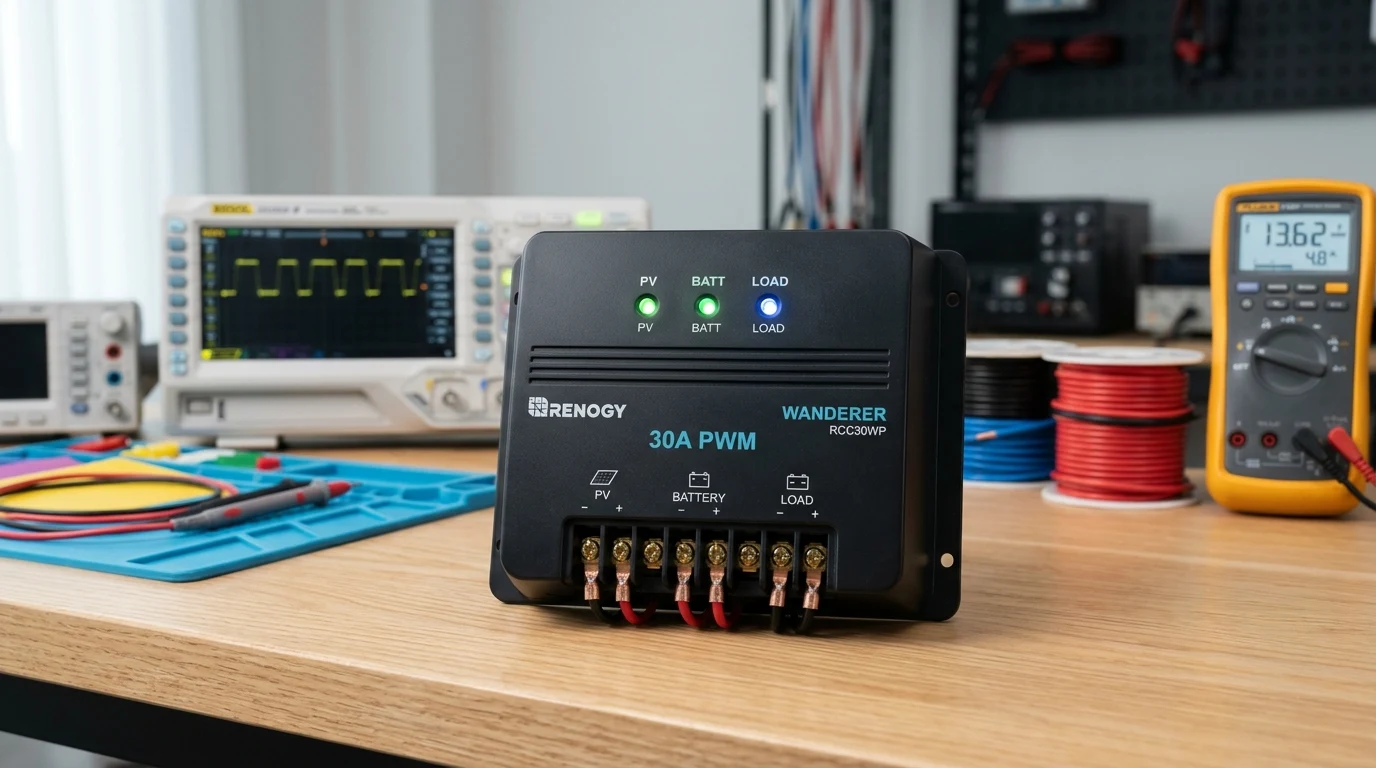
- Choose the Renogy Wanderer 30A PWM Solar Charge Controller if you are building a strict budget-limited, small-scale 12V system where panel and battery voltages match directly.