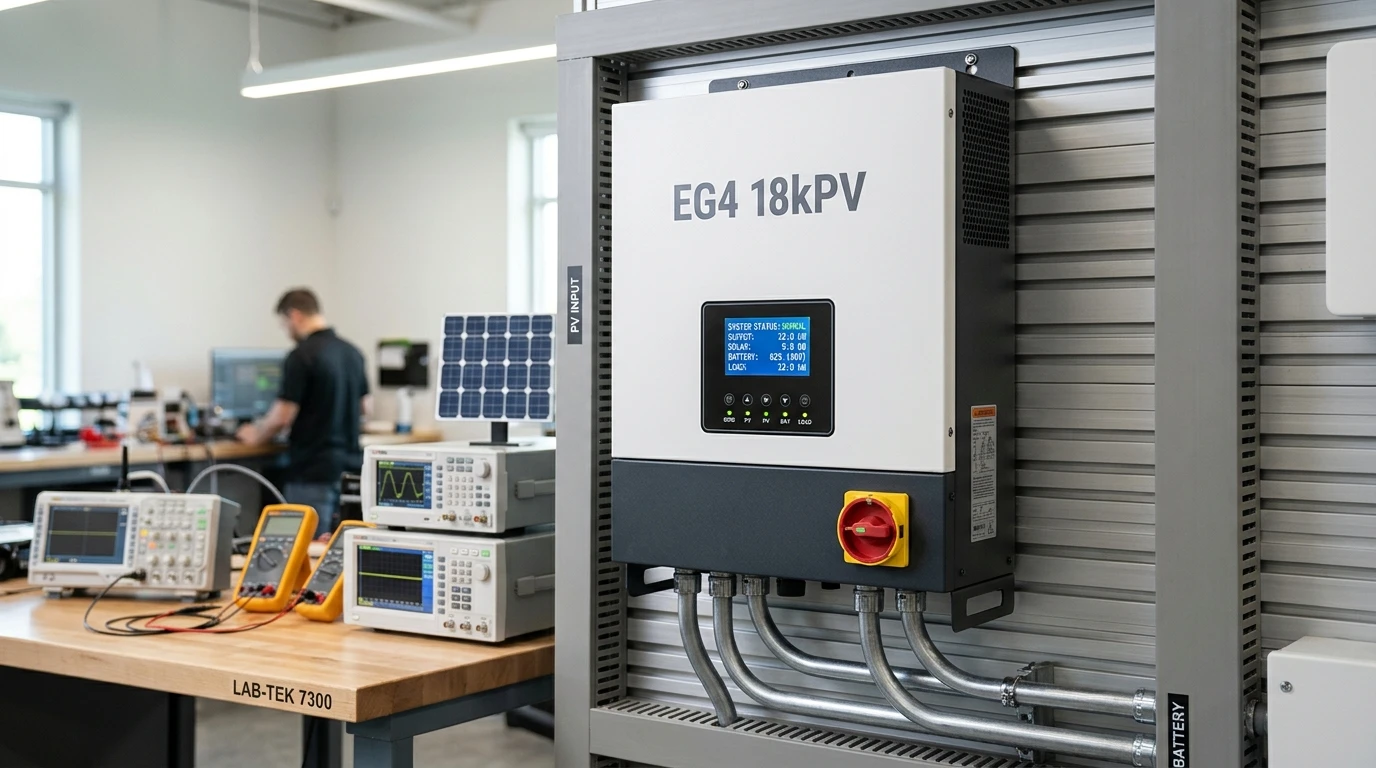
For homeowners looking to take their entire house off-grid or protect against multi-day grid blackouts, whole-home hybrid solar inverters represent the premier tier of energy storage. Instead of running portable cords through windows, a 120V/240V split-phase hybrid inverter sits inline with your utility service entrance, powering central air conditioners, electric water heaters, well pumps, and kitchen circuits automatically.
The EG4 FlexBOSS 18 and the Sol-Ark 15K are two of the most popular all-in-one residential hybrid inverters on the market. Both combine a 12,000W continuous pure sine wave inverter, three independent Maximum Power Point Tracking (MPPT) solar charge controllers, 200A grid pass-through, and battery management into an outdoor-rated cabinet.
However, key differences in solar input limits, surge behavior, standby battery drain, and upfront retail price dramatically influence which inverter delivers superior return on investment for your home.
Quick Spec Comparison
The table below breaks down the essential technical and practical differences between both units:
| Specification | EG4 FlexBOSS 18 | Sol-Ark 15K | Key Advantage |
|---|---|---|---|
| Continuous AC Output | 12,000W (120V/240V) | 12,000W (120V/240V) | Identical continuous power |
| Peak Motor Surge | 16,000W (10 sec) | 24,000W (10 sec) | Sol-Ark handles larger motor spikes |
| Max Solar PV Input | 18,000W (3 MPPTs / 6 Strings) | 17,000W (3 MPPTs / 4 Strings) | EG4 accepts 1,000W more solar |
| Grid Pass-Through | 200A Native Bypass | 200A Native Bypass | Both power entire 200A panel |
| Standby Tare Loss | 45W Idle Draw | 60W Idle Draw | EG4 saves 360Wh daily |
| Typical Price Range | 5,200 | 7,500 | EG4 saves approx. $2,000 on hardware |
Continuous Power and Whole-House Pass-Through
Both the EG4 FlexBOSS 18 and the Sol-Ark 15K feature a native 200-Amp internal transfer switch. This is a critical design feature for residential installations. Older hybrid inverters only supported 50A or 60A pass-through, which forced homeowners to buy and wire a separate “critical loads” subpanel.
With either unit, you can install the inverter between your electric utility meter and your main home panel. When the grid is active, the inverter passes through full 200A utility power. When a blackout hits:
- The internal relay disconnects from the grid in less than 10 milliseconds.
- The battery bank immediately powers your entire breaker panel up to 12,000 watts continuous split-phase (50A at 240V, or 100A at 120V).
This continuous 12kW envelope easily handles a central 3-ton to 4-ton heat pump (with soft-starter), refrigerator, microwave, lighting, and computing gear simultaneously.
Surge Capacity and Motor Starting
Where the Sol-Ark 15K pulls ahead is short-duration inductive surge capability:
- Sol-Ark 15K: Boasts a massive 24,000W (10-second) peak surge. This allows it to absorb the severe Locked Rotor Amperage (LRA) spikes of older 5-horsepower well pumps or unassisted HVAC compressors without tripping inverter protection.
- EG4 FlexBOSS 18: Delivers a 16,000W (10-second) surge. While more than adequate for modern inverter-driven AC units, variable-speed pool pumps, and standard appliances, older un-soft-started 5-ton compressors can push it near its safety cutoff threshold.
Engineering Recommendation: If you have older non-inverter compressor appliances, pairing the EG4 FlexBOSS 18 with an inexpensive Micro-Air soft starter completely resolves inrush current, saving thousands compared to buying excess inverter capacity.
Solar Array Sizing and String Flexibility
Solar input efficiency depends heavily on Maximum Power Point Tracking (MPPT) channels:
- EG4 FlexBOSS 18: Offers 18,000W of total DC solar input across 3 independent MPPT trackers with dual string inputs per MPPT (6 strings total). This provides tremendous flexibility for homes with split roof pitches (East, South, and West arrays).
- Sol-Ark 15K: Supports 17,000W of total DC solar input across 3 MPPT trackers configured as 2+1+1 (4 strings total).
Because the EG4 accepts up to 600V Voc per string with higher overall DC throughput, it allows homeowners to install up to 18kW of solar panels to maximize winter production and cloudy-day battery recovery.
Idle Tare Loss and Battery Parasitic Drain
When running off-grid 24/7, tare loss (the power the inverter consumes simply keeping its internal transistors, cooling fans, and logic boards energized) is a critical performance factor:
- Sol-Ark 15K: Consumes approximately 60W to 65W in idle standby. Over a 24-hour period, that amounts to 1,440Wh to 1,560Wh drained from your battery bank even if zero lights are turned on.
- EG4 FlexBOSS 18: Uses refined high-efficiency MOSFET topology drawing approximately 45W in idle standby, consuming 1,080Wh per day.
Over a week of stormy off-grid weather without sun, the EG4 saves roughly 3.2 kWh of usable battery storage purely in reduced background overhead.
Pros and Cons Breakdown
EG4 FlexBOSS 18 Advantages
- ✓ Exceptional Value: Roughly $2,000 less expensive than Sol-Ark 15K for identical 12kW continuous split-phase output.
- ✓ Higher Solar Input: 18,000W max DC array support across 6 string connections.
- ✓ Lower Standby Loss: Low 45W idle draw saves battery capacity overnight.
- ✓ Seamless Battery Integration: Native plug-and-play closed-loop communications with EG4 LifePower4 and WallMount batteries.
Trade-offs
- • Peak surge is limited to 16,000W (may require soft-starters for heavy 4-ton+ AC units).
- • 10ms transfer speed vs 5ms optical transfer on Sol-Ark.
Sol-Ark 15K Advantages
- ✓ Industrial Surge Muscle: 24,000W surge handles the heaviest well pumps and commercial shop motors with ease.
- ✓ Ultra-Fast Optical Transfer: 5ms switchover ensures high-end servers and sensitive electronics never reboot.
- ✓ Universal Battery Compatibility: Mature closed-loop integration with over 20 third-party battery manufacturers.
- ✓ Field Proven Reliability: Long track record in extreme climates across North America.
Trade-offs
- • Substantially higher retail price tag (over $7,000).
- • Higher continuous standby tare loss (around 60W).
The Verdict: Which One Should You Buy?
Both inverters represent top-tier engineering, but they serve distinct homeowner profiles:
-
Choose the EG4 FlexBOSS 18 if you want maximum return on investment for a standard residential home. Delivering 12,000W continuous output, 200A whole-home bypass, higher 18kW solar input, and lower tare loss for around $5,000, it is our Top Value Whole-Home Hybrid Inverter. Read our full EG4 FlexBOSS 18 Review: Just What We Needed or compare it against its higher-power sibling in Sol-Ark 18K vs EG4 FlexBOSS 21.
-
Choose the Sol-Ark 15K if you are powering a rural homestead with high-horsepower deep-well pumps, heavy woodworking or welding machinery, or mission-critical servers where 24kW surge headroom and 5ms optical switching are non-negotiable requirements. To evaluate battery bank pairings for either hybrid unit, see our lab guide on The Best 48V Server Rack Batteries in 2026 and our distributor analysis in the Signature Solar Review & Buying Guide.