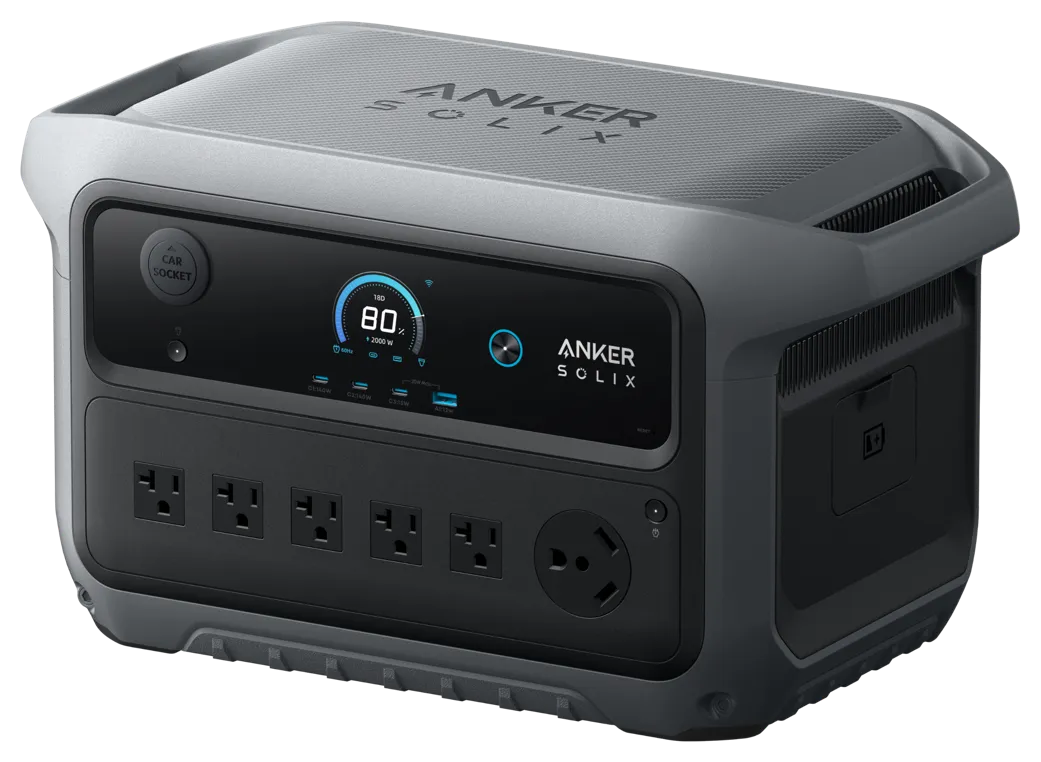
The 2-kilowatt-hour (2kWh) / 2,400W portable power station category is the most fiercely contested segment of the off-grid market. At this capacity, a generator is compact enough to roll into a trunk or camper van, yet powerful enough to run a residential refrigerator for 2 to 3 days, sustain medical CPAP equipment, or power high-draw power tools.
In this class, two next-generation models lead the industry: the EcoFlow DELTA 3 Max and the Anker SOLIX S2000 (also known as the C2000 series).
Both power stations leverage ultra-durable Lithium Iron Phosphate (LiFePO4) battery cells, provide true uninterruptible power supply (UPS) speeds under 10ms, and push 2,400W pure sine wave continuous power. But when you examine solar charging limits, surge behavior, and modular battery expansion, distinct performance differences emerge. Below is our direct engineering audit.
Quick Spec Comparison
The table below contrasts the critical metrics for both 2kWh solar generators:
| Specification | EcoFlow DELTA 3 Max | Anker SOLIX S2000 | Key Advantage |
|---|---|---|---|
| Internal Battery Capacity | 2,048Wh LiFePO4 | 2,048Wh LiFePO4 | Identical 2kWh capacity |
| Continuous Inverter Output | 2,400W (X-Boost to 3,400W) | 2,400W (SurgePad to 2,900W) | EcoFlow handles higher resistive loads |
| Peak Motor Surge | 4,800W Surge Tolerance | 4,000W Surge Tolerance | EcoFlow provides +800W surge cushion |
| Max Solar PV Input | 1,000W Dual MPPT | 800W Solar Input | EcoFlow charges faster from solar |
| Modular Expansion | Expandable to 6,144Wh | Expandable to 4,096Wh | EcoFlow supports +2kWh extra storage |
| UPS Switchover Speed | <10ms Seamless UPS | <10ms Seamless UPS | Both prevent computer reboots |
Continuous Power and Inrush Overload Management For our dedicated review of Anker’s 2kWh model, read the Anker SOLIX C2000 Gen 2 Review and explore top picks in the Best EcoFlow Power Stations Guide.
Both machines output 2,400 watts continuous pure sine wave power, which is the maximum safe threshold for a standard 120V/20A household wall circuit. You can plug in space heaters, blow dryers, or induction cooktops without issue.
However, their overload handling technologies differ:
- EcoFlow DELTA 3 Max: Features proprietary X-Boost technology, allowing it to drive resistive heating elements up to 3,400 watts without tripping an inverter error (by dynamically lowering voltage while maintaining constant wattage). It also provides a 4,800W peak surge, making it extremely reliable for refrigerator compressor kick-ins.
- Anker SOLIX S2000: Features SurgePad technology, powering equipment up to 2,900 watts. Its peak surge rating is 4,000W, which handles standard home refrigerators and sump pumps but offers slightly less cushion for heavy commercial power tools.
Solar Charging Speeds and Off-Grid Autonomy
When recharging off-grid via solar panels:
- EcoFlow DELTA 3 Max: Accepts up to 1,000W of solar input (11V–60V DC, 15A). Under ideal summer sunlight with two 500W or five 200W solar panels, the DELTA 3 Max recharges from 0% to 100% in just 2.3 hours.
- Anker SOLIX S2000: Accepts up to 800W of solar input (11V–60V DC). Under identical sunlight conditions, it takes 2.9 to 3.2 hours to reach full charge.
If you are planning multi-day off-grid camping or facing extended storm outages, the 200W solar difference on the DELTA 3 Max translates to faster battery recovery during brief windows of sun.
Modular Expansion Capabilities
Both stations feature expansion ports to connect external battery packs:
- EcoFlow DELTA 3 Max: Allows you to connect up to two 2,048Wh Smart Extra Batteries, scaling the total capacity from 2,048Wh up to 6,144Wh. This 6kWh envelope can sustain an entire household’s critical circuits (refrigerator, router, LED lighting, CPAP) for over 4 full days without sun.
- Anker SOLIX S2000: Connects to one expansion battery, doubling its capacity to 4,096Wh.
Noise Levels and Idle Tare Drain
In bedroom or indoor office environments, operating acoustics matter:
- Anker SOLIX S2000: Shines in whisper-quiet thermal design. At loads under 1,000W, fan noise stays below 30 decibels (comparable to a quiet library). Its idle tare loss is low at 16.5W, preserving battery life when left running overnight.
- EcoFlow DELTA 3 Max: Emits approximately 36 to 42 decibels under moderate load as its high-speed cooling fans maintain low internal component temperatures. Its idle standby drain measures 18W.
Pros and Cons Breakdown
EcoFlow DELTA 3 Max Advantages
- ✓ Higher 4,800W Surge: Superior headroom for starting motor-driven appliances.
- ✓ Faster 1,000W Solar Input: Recharges to 100% in approx. 2.3 hours of direct sunlight.
- ✓ Massive 6kWh Expansion: Supports up to two extra battery packs for extended home backup.
- ✓ X-Boost up to 3,400W: Runs high-draw electric heaters and cooktops without tripping.
Trade-offs
- • Slightly louder fan noise under heavy loads (around 38dB).
Anker SOLIX S2000 Advantages
- ✓ Whisper-Quiet Operation: Operates under 30dB for peaceful bedroom or tent use.
- ✓ Rugged Drop-Proof Unibody: InfiniPower structural frame built for rough job sites.
- ✓ Lower Standby Overhead: Low 16.5W tare loss preserves battery charge when idle.
- ✓ Ambient LED Light Bar: Built-in multi-mode front lighting for emergency blackouts.
Trade-offs
- • Solar charging capped at 800W.
- • Maximum expansion limited to 4kWh (one extra battery).
- • Lower 4,000W surge threshold.
The Verdict: Which One Should You Buy?
Both units are exceptional 2kWh solar generators, but their target use cases differ:
-
The EcoFlow DELTA 3 Max is our Top Pick for Versatility & Sizing. With 1,000W solar charging, 4,800W surge handling, 3,400W X-Boost capability, and expandable capacity up to 6.1 kWh, it provides greater performance and flexibility for serious off-grid travel and whole-home blackout defense.
-
The Anker SOLIX S2000 is our Top Pick for Quiet Indoor Backup. If you prioritize silent operation in living spaces, an integrated ambient light bar, and an ultra-tough structural chassis, the Anker SOLIX S2000 is an incredibly refined emergency companion.