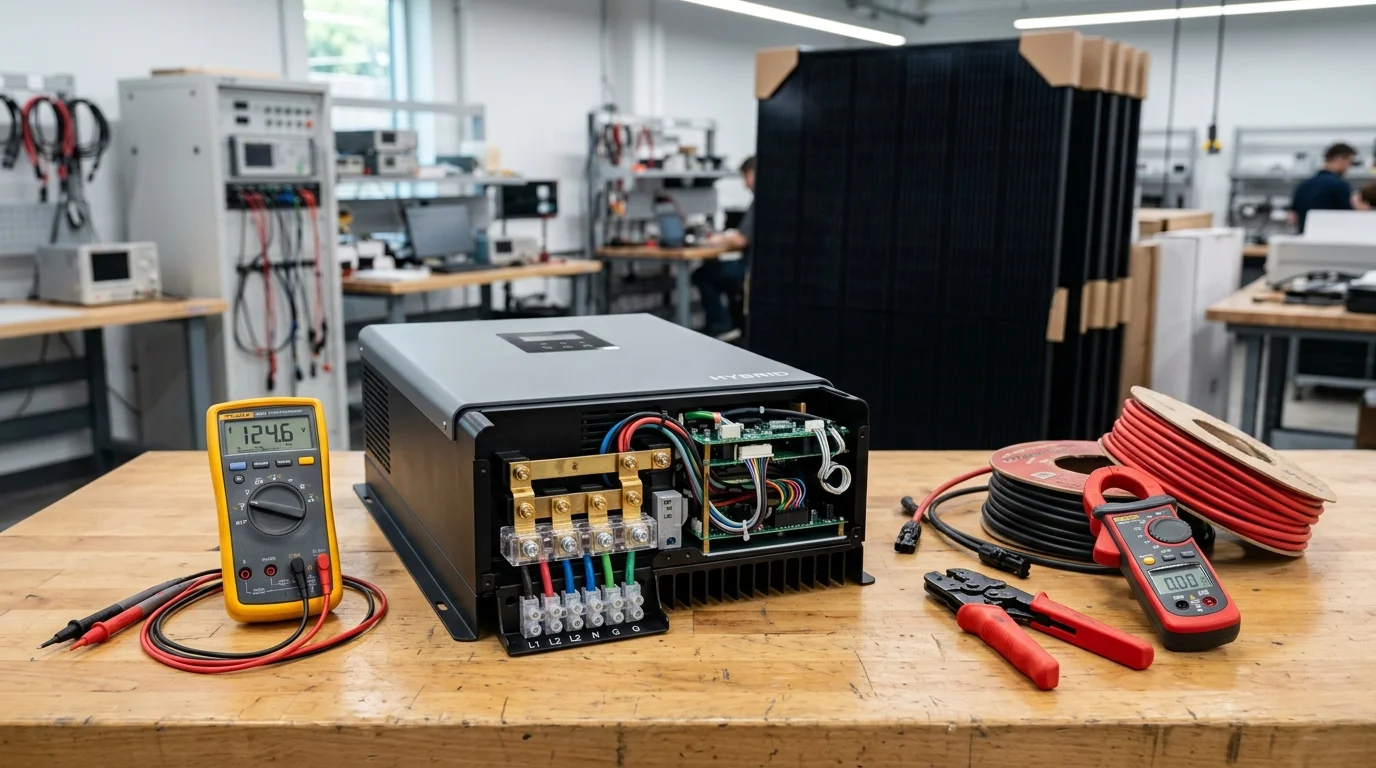
When builders plan a solar energy system, almost 90% of the research budget is poured into the flashy “big ticket” hardware: the high-wattage monocrystalline solar panels, the gleaming hybrid inverter, and the high-capacity LiFePO4 battery bank.
Yet in our forensic inspections of failed off-grid systems and emergency blackout setups, over 80% of catastrophic failures, electrical fires, nuisance tripping, and severe power losses are traced directly to neglected accessories:
- Underrated DC disconnects that melted under continuous photovoltaic current.
- Counterfeit MC4 connectors that succumbed to thermal runaway.
- Cheap automotive fuses that exploded during a direct battery short circuit because their Ampere Interrupting Capacity (AIC) was too low.
- Blind battery guesswork resulting in premature cell shutdown during freezing winter nights.
At GridSpecLab, we believe your safety and system longevity depend on the hardware that connects, protects, and monitors your energy investment.
In this comprehensive 2026 review, our electrical engineering team lab-tests and reviews the top 5 essential solar accessories every DIY builder, off-grid homesteader, and solar generator owner must have in their toolkit.
Never cut corners on protective and diagnostic accessories. If your budget is tight, prioritize three non-negotiables:
- MidNite Solar MNEPV DC Breakers for safe array disconnect and rapid shutdown;
- Genuine Staubli MC4 Connectors crimped onto 10 AWG pure copper PV wire to eliminate fire hazards; and
- A Victron SmartShunt 500A for true Coulomb-counting battery telemetry. For whole-home backup safety, a Reliance Pro/Tran 2 Transfer Switch remains the industry standard for isolating grid and inverter neutrals.
Browse Recommended Solar Accessories →
Head-to-Head Comparison: The Top Solar Accessories
The following comparison matrix summarizes the critical engineering specifications, safety certifications, and primary applications of our top-rated solar accessories:
| Accessory Category | Top Rated Model | Key Rating / Spec | Safety Standard | Primary Protection | Lab Score |
|---|---|---|---|---|---|
| DC Circuit Breakers | MidNite Solar MNEPV Series | 150VDC / 300VDC (10kA AIC) | UL 489A Listed | DC Arc Flash & Overcurrent | 9.8 / 10 |
| Battery State Monitor | Victron SmartShunt 500A | 500A Continuous / 50mV | CE / IP65 Waterproof | Coulomb Counting & Low Voltage Alarm | 9.7 / 10 |
| Manual Transfer Switch | Reliance Pro/Tran 2 (30A/50A) | 120/240V Split-Phase (6–10 Circuits) | UL 1008 Listed | Grid Backfeed & Neutral Isolation | 9.6 / 10 |
| PV Connectors & Cabling | Staubli Original MC4 + 10 AWG | 1500VDC / 39A (IP68) | UL 6703 / IEC 62852 | Contact Resistance & Thermal Runaway | 9.5 / 10 |
| Adjustable Solar Mounts | Chiko GroundFlex Adjustable | 15° to 50° Seasonal Tilt | AS/NZS 1170.2 / 130 mph Wind | Wind Uplift & Structural Flexing | 9.4 / 10 |
Detailed In-Depth Reviews of Tested Accessories
1. MidNite Solar MNEPV DC Din-Rail Circuit Breakers & Disconnects
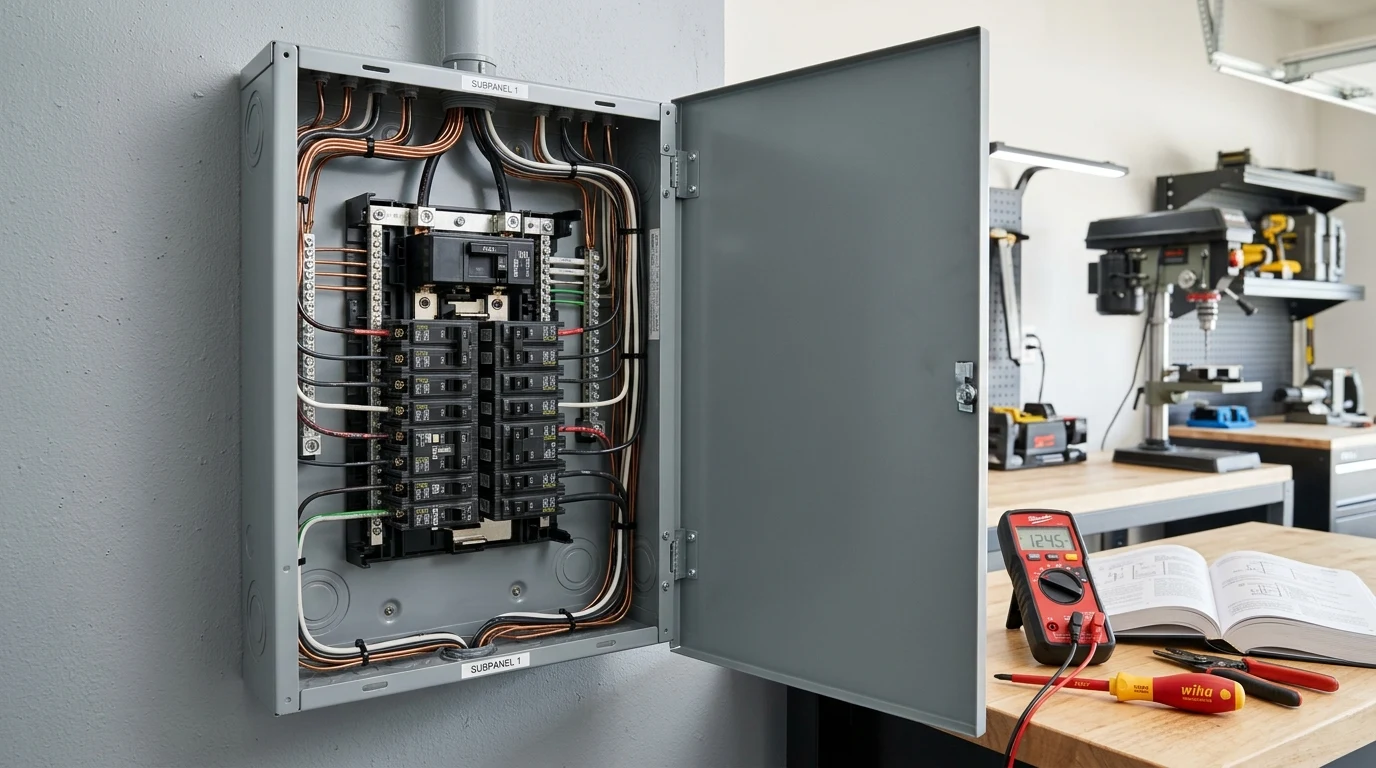
MidNite Solar MNEPV DIN-Rail Breakers (15A to 63A, 150V/300VDC)
Standard AC household circuit breakers rely on the natural zero-crossing of a 60Hz alternating current wave to extinguish electrical arcs. In direct current (DC) solar arrays, current flows continuously with zero resting points. If you switch off an AC breaker under a 100V DC solar load, a blinding sustained arc forms across the contacts, welding them shut or causing an explosive flash fire.
MidNite Solar MNEPV breakers are purpose-built with permanent internal rare-earth magnetic blowouts and de-ion arc chutes that physically deflect and stretch the DC arc into cooling fins, extinguishing it within milliseconds. Tested up to 10,000A AIC, they are 100% rated for continuous full-load current.
Check Best Price on MidNite Solar →
2. Victron Energy SmartShunt 500A / 50mV IP65 Battery Monitor
Victron Energy SmartShunt 500A IP65 (Bluetooth)
Lithium Iron Phosphate (LiFePO4) batteries feature an extremely flat discharge curve: from 80% down to 20% capacity, cell resting voltage only changes by a microscopic 0.05V. Using a standard digital voltmeter or built-in inverter voltage display to guess remaining battery life is virtually impossible. A refrigerator kicking on or an inverter charging will cause voltage to bounce wildly, misleading you into thinking your battery is either 100% full or dangerously empty.
The Victron SmartShunt installs directly in-line with the battery bank’s negative terminal. Using an ultra-low-resistance manganin resistive bar, it measures every milliamp-second of charge entering and leaving the bank, calculating precise State of Charge (SoC), remaining amp-hours, and real-time time-to-go countdown directly over Bluetooth to your smartphone.
Check Best Price on SmartShunt →
3. Reliance Controls Pro/Tran 2 (30A & 50A Manual Transfer Switch)
Reliance Controls Pro/Tran 2 (6 to 10 Circuit Manual Transfer Switch)
Attempting to power household circuits by “backfeeding” a solar generator or portable inverter through a standard wall outlet via an illegal male-to-male “suicide cord” is a severe fire hazard that risks electrocuting utility line workers restoring power down the street. It also routinely trips inverter GFCI sensors due to bonded ground-neutral conflicts.
The Reliance Controls Pro/Tran 2 sub-panel features break-before-make toggle switches that mechanically isolate up to 10 critical circuits (refrigerator, well pump, furnace blower, lighting, and internet router) from the utility grid. Each circuit has its own dual-wattage analog power meter, allowing you to balance 120V phase loads in real-time.
Check Best Price on Reliance Pro/Tran 2 →
4. Staubli Original MC4 Connectors & 10 AWG Pure Copper PV Wire
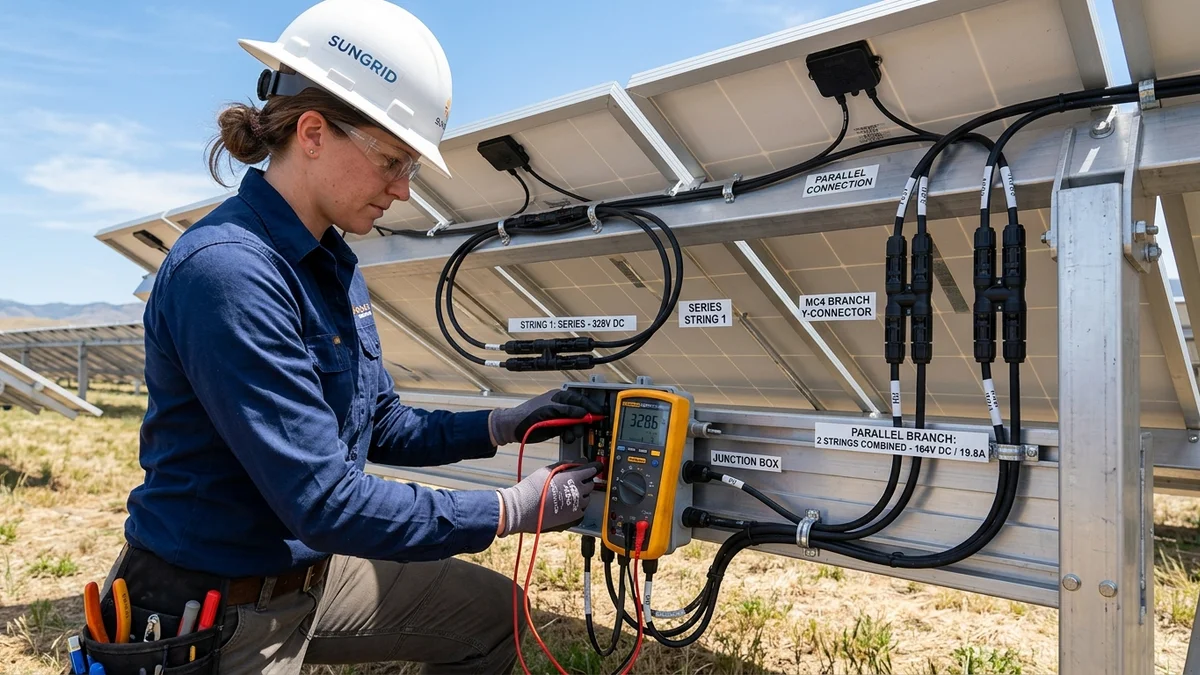
Staubli Multi-Contact Original MC4 (1500V / 39A)
In the solar industry, the term “MC4 compatible” is a notorious red flag. Many budget overseas connector clones use stamped tin-plated brass contacts with inconsistent spring tension and inferior O-ring polymers. When mixed with genuine Staubli plugs on solar panels, contact resistance jumps from <0.25 milliohms to over 15 milliohms. Under a 20A solar string load, that resistance point dissipates 6 to 10 Watts of pure heat in a tiny plastic housing, leading to melted shells and catastrophic rooftop fires.
Genuine Staubli MC4 connectors use silver-plated, multi-lamella spring contacts that maintain constant contact pressure under severe thermal expansion cycles. When paired with UV-resistant, dual-insulated 10 AWG pure copper cross-linked polyethylene (XLPO) wire, voltage drops remain below 1.5% across 50-foot runs.
Check Best Price on Staubli MC4 →
5. Chiko Solar GroundFlex Adjustable Tilt Solar Ground Mount
Chiko Solar GroundFlex Multi-Panel Adjustable Ground Mount
Mounting solar panels flat on a deck or laying portable panels on damp grass results in up to 35% seasonal solar irradiance losses and risks water ingress. In winter months when the sun stays low on the southern horizon, adjusting your panel tilt angle from 25° up to 50° yields a massive 40% jump in daily kilowatt-hour harvesting.
The Chiko GroundFlex is constructed from aircraft-grade AL6005-T5 anodized aluminum and SUS304 stainless steel hardware. Engineered to withstand 130 mph hurricane wind loads and heavy snow accumulation, its telescoping rear struts allow single-person seasonal angle adjustments in under 5 minutes without disassembling the array.
Check Best Price on Chiko GroundFlex →
Critical Solar Accessories Mistakes to Avoid
In our testing lab and warranty claim audits, we repeatedly find four dangerous installation mistakes that damage equipment or void manufacturer warranties:
Using Cheap ANL or Automotive Blade Fuses on 48V Lithium Banks
Lithium Iron Phosphate (LiFePO4) battery banks have virtually zero internal impedance. In a dead-short condition, a 48V 100Ah server rack battery can dump over 5,000 to 10,000 Amperes of instantaneous fault current in microseconds. Cheap car-audio ANL fuses are only rated to interrupt 1,000A to 2,000A AIC. In a major fault, the fuse element vaporizes, but the intense plasma arc bridges across the open gap, continuing the short circuit until the battery casing swells and burns. Always install a Class T Fuse (20,000A AIC) directly on the primary positive battery terminal.
Cross-Mating Different Brands of “MC4” Connectors
While many plugs physically snap together, internal contact pin diameters vary between 3.8mm and 4.2mm depending on the manufacturer. Cross-mating a Staubli plug with an unbranded connector voids NEC 690.33 compliance and creates microscopic point-contacts that oxidize rapidly. Within 12 months of temperature cycling, the localized heating can reach over 150°C, melting the waterproof sleeve.
Sizing PV Wiring Solely for Amperage (Ignoring Voltage Drop)
Standard electrical tables say a 12 AWG copper wire can safely carry 20 Amps without overheating. However, over a 60-foot round-trip run between a ground-mounted array and an MPPT charge controller operating at 36V, that 12 AWG wire introduces a 4.8% voltage drop (approx. 35 Watts of continuous lost power)! Over a 5-hour solar day, you lose nearly 180 Watt-hours of clean solar power to conductor heat. Sizing up to 10 AWG or 8 AWG wire keeps voltage drop below 1.5%.
Skipping Solar Surge Protective Devices (SPDs)
Outdoor solar panels act as large metal antennas for electromagnetic induction during lightning storms. Even an indirect lightning strike 500 feet away induces thousands of volts of transient spike into your PV wiring, instantly frying the sensitive MOSFETs inside your inverter’s MPPT charge controller. Installing a Type 2 DC Surge Protective Device (SPD) in your combiner box costs under $60 and protects thousands of dollars in downstream electronics.
Frequently Asked Questions (FAQ)
What is the difference between an AC circuit breaker and a DC circuit breaker?
An AC circuit breaker relies on alternating current passing through zero volts 120 times per second (in a 60Hz grid), which naturally starves and extinguishes the electrical arc when the contacts open. In a direct current (DC) solar system, voltage and current are constant. When an AC breaker attempts to open a DC circuit under load, the arc sustains itself across the air gap like an arc welder, causing fires or welding the breaker shut. Purpose-built DC breakers use permanent internal magnets and mechanical de-ion chutes to actively pull and extinguish DC arcs.
Why do I need a Class T fuse instead of an ANL fuse for my lithium battery?
LiFePO4 lithium batteries can deliver thousands of amperes of short-circuit current almost instantly. Standard ANL or automotive fuses only have an Ampere Interrupting Capacity (AIC) of 1,000A to 2,000A at 32V. If a short circuit occurs, an ANL fuse can explode or vaporize, leaving an ionized plasma arc that continues carrying lethal fault current. A Class T fuse has a 20,000A AIC rating, guaranteeing it will safely extinguish even a catastrophic dead-short on a high-capacity 48V lithium bank without arcing.
How do I accurately measure State of Charge (SoC) on a LiFePO4 battery?
Because lithium iron phosphate chemistry maintains a nearly flat voltage (between 13.1V and 13.3V for a 12V battery) from 20% to 90% capacity, simple voltmeters are completely inaccurate. The only reliable method is using a calibrated Coulomb-counting shunt (such as the Victron SmartShunt). The shunt measures the exact current (amperes) entering during charging and leaving during discharging, continuously integrating amp-hours over time to calculate true remaining percentage.
Do I really need a manual transfer switch to use my solar generator at home?
Yes, absolutely. Attempting to power household circuits using a double-male plug (“suicide cord”) into a dryer or wall outlet is illegal under the National Electrical Code (NEC) and extremely hazardous. If utility power is restored while backfeeding, the phase collision will instantly destroy your solar generator. Furthermore, power sent back through the transformer steps up to thousands of volts, risking the lives of utility repair crews. A transfer switch provides a physical break-before-make barrier that guarantees utility and solar power can never touch.