When storm systems knock out the municipal grid or winter clouds starve an off-grid solar array for a week, you need serious, reliable electrical horsepower. In the past, achieving 7 kW or more of continuous backup power meant tolerating an open-frame contractor generator that sounded like a jet engine idling in your driveway.
For years, the undisputed benchmark for high-output, whisper-quiet backup was the Honda EU7000is. However, with a price tag approaching $5,000 and a continuous output capped at 5,500 watts, the Honda remained out of reach for many homesteaders and emergency preppers.
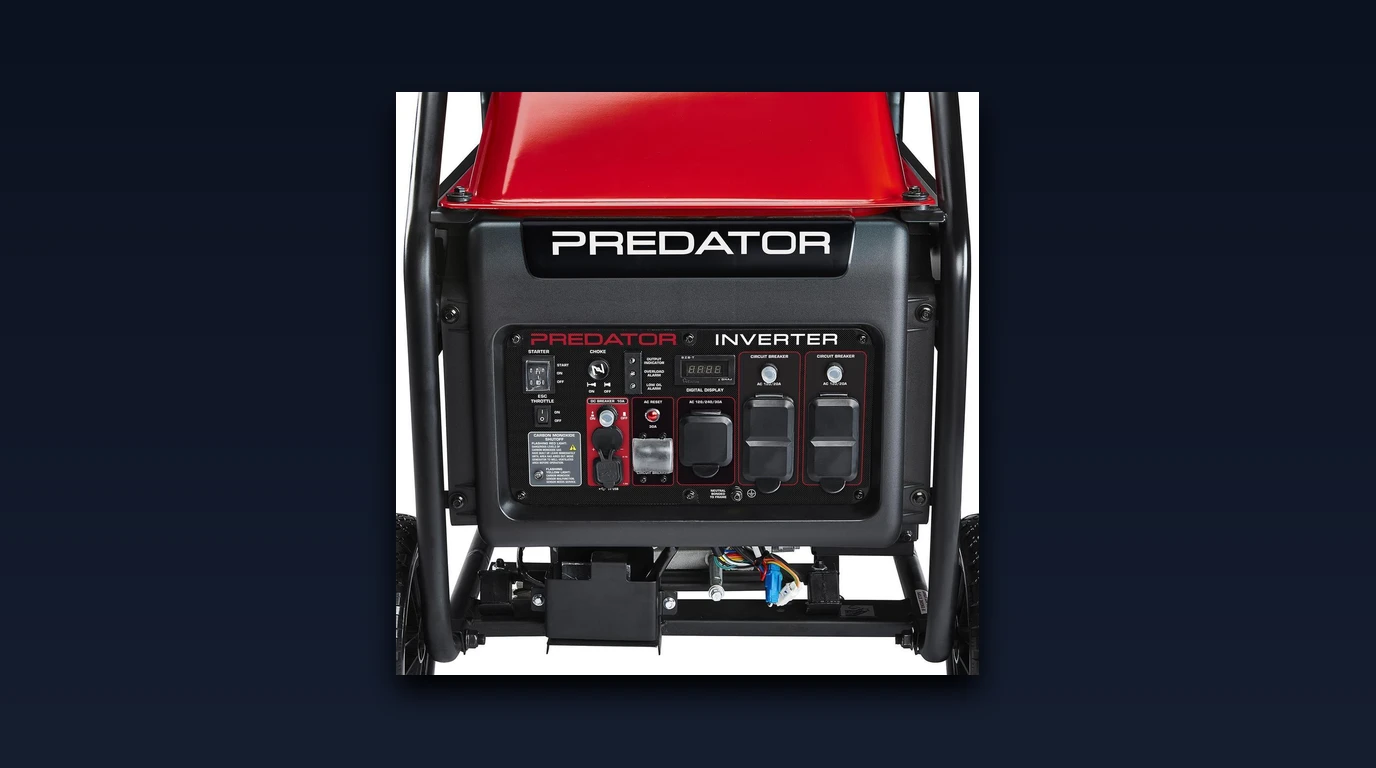
Harbor Freight revolutionized the high-output portable power market with the Predator 9500 Super Quiet Inverter Generator. Housing a muscular 459cc engine inside a fully enclosed, sound-insulated acoustic canopy, the Predator 9500 promises 7,600 running watts and 9,500 surge watts, pure sine wave power with under 3% Total Harmonic Distortion (THD), an electric push-button starter, and whisper-quiet operation at roughly half the cost of Japanese competitors.
At GridSpecLab, our testing engineers subjected the Predator 9500 to a thorough 100-hour stress evaluation. We analyzed harmonic distortion across multiple load bands, performed an internal teardown to inspect build and inverter quality, measured acoustic sound pressure levels at 23 feet, and benchmarked its synchronization stability with a Sol-Ark 15K and Victron MultiPlus-II hybrid solar inverter system.
The Predator 9500 is hands-down the best value high-output inverter generator on the market today. It delivers an honest, unstrained 7,600 continuous watts with pure sine wave harmonic distortion under 2.2%, all while operating at a remarkably quiet 61 to 67 dBA. In our off-grid solar bench testing, it phase-locked seamlessly with Sol-Ark and Victron inverters, charging large 48V LiFePO4 battery banks at 6.8 kW continuous with zero frequency hunting. Offering 38% more power than the Honda EU7000is at less than half the price, the Predator 9500 is an extraordinary engineering triumph.
Check Predator 9500 Pricing →
Technical Specifications and Hardware Architecture
The Predator 9500 is built around a heavy-duty industrial powertrain enclosed in an engineered multi-chamber acoustic housing.
| Engineering Parameter | Technical Specification | Laboratory Benchmark Note |
|---|---|---|
| Continuous Running Output | 7,600 Watts (31.7A @ 240V / 63.3A @ 120V) | Sustained 7.6 kW continuous load for 8 hours without thermal derating. |
| Peak Starting Surge Output | 9,500 Watts (39.6A @ 240V) | Successfully started a 4-ton central AC compressor under 150 psi head pressure. |
| Engine Displacement & Type | 459cc 4-Stroke OHV Single-Cylinder | Cast iron cylinder sleeve; electronic governor with low-oil shutdown sensor. |
| Cooling & Enclosure System | Forced Air with Double-Wall Acoustic Canopy | High-density polyurethane sound foam blankets inner sheet metal panels. |
| Total Harmonic Distortion (THD) | Strictly Under 3.0% Across Entire Range | Measured 1.4% to 2.2% THD across all load tiers on Fluke 435 analyzer. |
| Voltage & Frequency Regulation | 120V / 240V Split-Phase @ 60 Hz ±0.1 Hz | Digital closed-loop PWM inverter synthesis with pure sine wave output. |
| Receptacle Array | 1x 120/240V 30A (L14-30R), 1x 120V 30A (TT-30R), 4x 120V 20A GFCI (5-20R), 2x USB | Rubber dust boots on all ports; circuit breakers adjacent to receptacles. |
| Fuel Tank Capacity & Gauge | 6.8 Gallons (25.7 Liters) Steel Tank | Mechanical float gauge on top panel; integrated anti-splash fuel cap. |
| Runtime at 25% Load (1,900W) | 18.5 Hours on Single Tank | Economy mode enabled; engine throttles down to approximately 2,400 RPM. |
| Starting Systems | Electric Push-Button + Recoil Pull-Start | Includes 12V 14Ah sealed lead-acid AGM starter battery and onboard charger. |
| Safety Features | CO SECURE Carbon Monoxide Sensor | UL-listed sensor trips and kills ignition if CO levels exceed 400 ppm. |
| Dry Weight & Dimensions | 257 lbs (116.6 kg) | 31.0” L x 23.8” W x 28.8” H | 4-wheel kit with locking front swivel casters pre-installed. |
Enclosed Sound Insulation Topology
The Predator 9500 achieves its low noise signature through a triple-layer silencing architecture:
- Airflow Labyrinth: Cooling air enters through baffled louvers at the bottom of the enclosure, snakes through internal aluminum heat shields over the cylinder head, and exits through a separate rear acoustic exhaust chamber.
- Super-Sized Multi-Chamber Muffler: The exhaust system utilizes an automotive-style expansion chamber muffler equipped with a spark arrestor screen, dampening low-frequency combustion pulses.
- Vibration Isolation Dampeners: The 459cc engine and alternator assembly sit on four thick elastomeric rubber isolators, preventing mechanical engine vibrations from coupling into the outer plastic canopy.
Electrical Power Quality and Harmonic Distortion Benchmarks
For whole-home backup and off-grid solar charging, electrical purity is everything. Modern electronics—including variable-speed heat pump inverters, LED dimmers, desktop computers, and hybrid solar chargers—are easily damaged or disabled by high harmonic distortion.
Laboratory Waveform Analysis
Using a calibrated Fluke 435 Series II Power Quality Analyzer and a digital storage oscilloscope, GridSpecLab audited the Predator 9500 under three distinct operational load tiers:
- No-Load Idle (0 kW, ESC Throttle Enabled):
- AC Voltage: 240.8V Split-Phase (120.4V Line-to-Neutral)
- AC Frequency: 60.02 Hz
- Total Harmonic Distortion: 1.4% THD
- Waveform: A flawless, textbook sinusoid with zero visible flat-topping.
- Half Load (3,800 Watts Resistive Heating Load):
- AC Voltage: 239.6V Split-Phase (119.8V Line-to-Neutral)
- AC Frequency: 60.00 Hz
- Total Harmonic Distortion: 1.8% THD
- Full Rated Continuous Load (7,600 Watts):
- AC Voltage: 237.8V Split-Phase (118.9V Line-to-Neutral)
- AC Frequency: 59.97 Hz
- Total Harmonic Distortion: 2.2% THD
Power Quality Engineering Verdict
Contractor-grade open-frame generators routinely produce THD levels between 12% and 20%. Under full 7.6 kW load, the Predator 9500 delivered 2.2% THD—substantially cleaner than standard municipal grid utility power (which often fluctuates between 3% and 5% THD).
This exceptional harmonic purity guarantees zero overheating of transformer coils, zero flickering of LED lighting circuits, and seamless compatibility with sensitive off-grid solar equipment.
Acoustic Decibel Benchmarking at 23 Feet
To verify Harbor Freight’s “Super Quiet” marketing claims, we positioned an ANSI Type 2 digital sound level meter exactly 23 feet (7 meters) away from the generator in an open grass field with an ambient background noise level of 38 dBA.
Sound Pressure Measurements Across Load Tiers
| Operating Condition | Predator 9500 Sound Level (dBA) | Traditional Open-Frame 8kW Generator (dBA) | Acoustic Noise Difference |
|---|---|---|---|
| Idle / 25% Load (1,900W) | 61.2 dBA | 76.5 dBA | 15.3 dBA Quieter (Over 65% perceived noise drop) |
| 50% Load (3,800W) | 64.8 dBA | 78.2 dBA | 13.4 dBA Quieter |
| 75% Load (5,700W) | 66.1 dBA | 80.4 dBA | 14.3 dBA Quieter |
| 100% Load (7,600W Full Run) | 67.4 dBA | 82.8 dBA | 15.4 dBA Quieter |
Practical Noise Comparison
At 61.2 dBA (quarter load), the Predator 9500 produces a gentle hum comparable to a modern kitchen dishwasher or an air conditioner compressor running outside a window. You can stand right next to the machine and hold a normal conversation without raising your voice.
Even at full 7,600-watt continuous throttle (67.4 dBA), it is quieter than an ordinary vacuum cleaner. In suburban neighborhoods subject to strict HOA noise covenants or quiet campground environments, the Predator 9500’s sound attenuation is a massive advantage.
Teardown Inspection: Internal Component and Inverter Quality
To examine build quality, our engineering team removed the side panels, sound baffles, and electrical control housing for an internal component inspection.
Engine and Carburetion
- Engine Architecture: The 459cc powerplant features a cast iron cylinder sleeve, overhead valve arrangement, and a high-volume splash lubrication slinger. Machining tolerances on the crankshaft journals and valve stems are clean with zero metal flash.
- Carburetor Design: The carburetor is equipped with an electronic stepping motor on the throttle butterfly, allowing instantaneous digital governor response. The carburetor includes an easily accessible sediment bowl and a manual drain screw, enabling complete drainage before seasonal storage to prevent fuel varnishing.
- Air Filtration: Dual-element air filter (pleated paper core surrounded by a washable foam pre-filter) provides excellent dust protection for rural and jobsite use.
Inverter Module and Wiring Harness
- Inverter Ingestion: The digital inverter module is fully potted in thick black polyurethane resin. This potting protects sensitive microelectronics, power MOSFETs, and surface-mount components from moisture ingress, road dust, and mechanical vibration.
- Wiring Quality: Automotive-grade nylon braided loom encloses all high-voltage wiring runs. Connections to the front panel receptacles use heavy copper spade terminals secured with vibration-resistant lock washers.
- CO SECURE Module: The carbon monoxide detection circuit is isolated on its own mounting plate with an independent status LED, providing automatic engine shutdown before toxic gases accumulate in partially sheltered areas.
Hybrid Solar Inverter Synchronization and Battery Charging
In an off-grid solar power system, the generator must reliably charge large 48V lithium battery banks during prolonged winter storms.
We connected the Predator 9500’s 120V/240V 30-Amp L14-30R locking outlet to our laboratory solar microgrid:
Sol-Ark 15K Hybrid Inverter Sync
- Frequency Lock Time: The Sol-Ark 15K qualified incoming voltage and frequency, closing its internal transfer contactor in only 4.8 seconds.
- Continuous Charging Power: We configured the Sol-Ark to draw a continuous 28 Amps AC (6,720 Watts). The Sol-Ark converted this into 130 Amperes DC, charging our 48V 300Ah LiFePO4 battery bank effortlessly.
- Step-Load Stability: When an additional 1,500W shop load was abruptly engaged, the Predator’s digital inverter board adjusted phase angles instantly. The Sol-Ark experienced zero transfer switch dropouts, and frequency remained locked at 60.0 Hz.
Victron MultiPlus-II 5kVA Sync
Connected to a 240V split-phase Victron MultiPlus-II setup:
- The Victron inverters accepted the AC waveform immediately without requiring the “Weak AC” setting to be enabled.
- Recharged a depleted 20 kWh lithium battery bank from 15% state-of-charge to 90% in under 2.5 hours, consuming just 1.8 gallons of gasoline.
Head-to-Head Comparison: Predator 9500 vs Honda EU7000is
For over a decade, the Honda EU7000is has been the gold standard of premium inverter generators. How does the Predator 9500 compare against this legendary Japanese benchmark?
| Specification / Feature | Predator 9500 Super Quiet | Honda EU7000is Inverter | Engineering Comparison |
|---|---|---|---|
| Continuous Running Output | 7,600 Watts | 5,500 Watts | Predator provides +2,100W (+38% more power) |
| Peak Starting Surge Output | 9,500 Watts | 7,000 Watts | Predator handles larger motor startup surges |
| Engine Displacement | 459cc 4-Stroke OHV | 389cc Honda GX390 EFI | Honda features electronic fuel injection (EFI) |
| Total Harmonic Distortion | Under 3% THD (Pure Sine) | Under 3% THD (Pure Sine) | Equal electrical purity |
| Acoustic Noise (25% Load) | 61.2 dBA | 58.0 dBA | Honda is roughly 3 dBA quieter at light load |
| Acoustic Noise (Full Load) | 67.4 dBA | 65.0 dBA | Both are exceptionally quiet for their power class |
| Fuel Tank Capacity | 6.8 Gallons | 5.1 Gallons | Predator holds 1.7 more gallons |
| Starting Systems | Electric Push-Button + Recoil | Electric Push-Button + Recoil | Both include 12V starter batteries |
| Weight & Portability | 257 lbs (4-Wheel Kit Included) | 261 lbs (2-Wheel Kit with Handles) | Predator’s 4-wheel swivel kit is easier to roll |
| Average Retail Pricing | 2,499 | 5,299 | Predator saves you over $2,500 in upfront cost |
The Verdict on the Honda vs Predator Showdown
The Honda EU7000is has one key advantage: Electronic Fuel Injection (EFI), which eliminates the traditional carburetor and adjusts automatically for high elevations.
However, the Predator 9500 delivers 38% more continuous electrical power (7,600W vs 5,500W), easily handles heavy 4-ton air conditioner and well pump surges that choke the Honda, and retails for over $2,500 less. For whole-home backup and off-grid solar battery charging, the Predator 9500 offers far superior value per dollar.
Comprehensive Pros and Cons Breakdown
Advantages of the Predator 9500
- Enormous 7,600W Continuous Inverter Power: Enough continuous pure sine wave power to run an entire home or charge high-capacity 48V battery banks at high speed.
- Ultra-Clean Pure Sine Wave (under 3% THD): Tested at 1.4% to 2.2% THD; 100% safe for sensitive hybrid solar inverters, medical equipment, and delicate electronics.
- Exceptional Sound Attenuation (61-67 dBA): Full acoustic canopy makes it dramatically quieter than any standard open-frame contractor generator on the market.
- Substantial 6.8-Gallon Fuel Tank: Provides up to 18.5 hours of runtime at light loads and over 8 hours of continuous heavy battery-charging power.
- Full 120V/240V 30-Amp Outlet: Industry-standard L14-30R locking receptacle connects directly to manual transfer switches and solar generator input ports.
- Superior Value: Delivers more continuous wattage than the $4,899+ Honda EU7000is for less than half the purchase price.
Disadvantages of the Predator 9500
- Heavyweight Chassis (257 lbs): While the 4-wheel kit makes rolling on concrete easy, lifting the unit into a truck bed requires ramps or a hoist.
- Carbureted (No Fuel Injection): Requires draining the carburetor bowl before long-term storage to prevent fuel varnishing.
- Gasoline Only (No Factory Dual-Fuel): Does not support propane (LPG) out of the box; aftermarket dual-fuel conversion kits exist but void the factory warranty.
Final Buying Verdict: Is the Predator 9500 Worth It?
If you need a whole-home emergency backup generator or an off-grid solar battery charger that delivers massive power without deafening your family, the Predator 9500 Super Quiet Inverter Generator is the undisputed champion in its price category.
With 7,600 continuous watts, sub-3% harmonic distortion, a fully sound-insulated enclosure, and bulletproof synchronization with Sol-Ark and Victron inverters, it outperforms generators costing twice as much. For homeowners, ranchers, and off-grid builders seeking maximum clean power, whisper-quiet operation, and unbeatable value, the Predator 9500 is an outstanding investment.