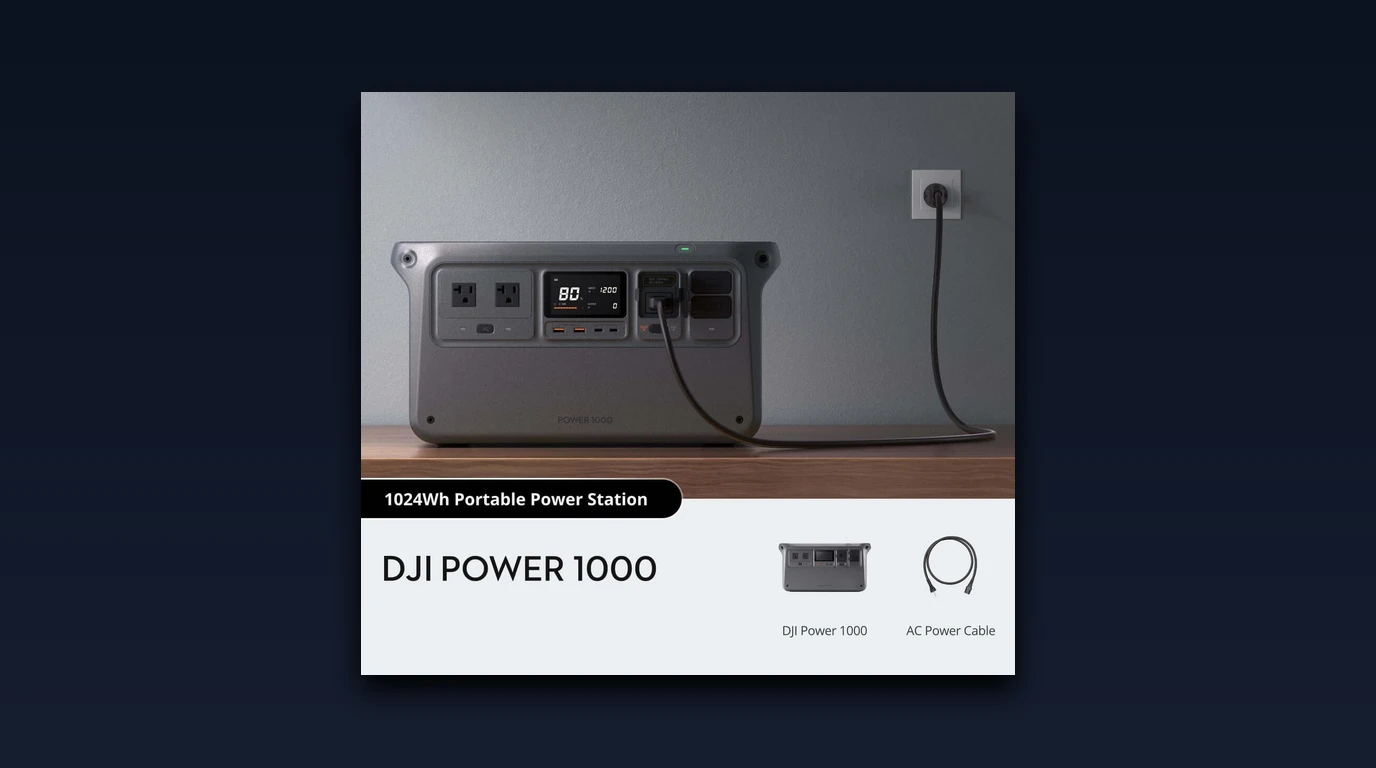
Welcome to the GridSpecLab engineering test bench, where we subject the latest portable power stations and solar generators to rigorous, instrument-grade evaluations. For this review, our team unboxed and bench-tested the DJI Power 1000, analyzing everything from its raw AC inverter stability and pure sine wave total harmonic distortion (THD) to its thermal throttling characteristics under maximum continuous loads. Utilizing calibrated Chroma electronic loads, Yokogawa power analyzers, and FLIR thermal cameras, we pushed this unit past its nominal limits to determine whether DJI’s drone-centric ecosystem engineering translates into a reliable standalone power station for off-grid enthusiasts, emergency backup, and professional field crews.
The portable power station market is fiercely contested by legacy outdoor brands and battery specialists alike, raising the stakes for new entrants. The DJI Power 1000 enters this arena with a compelling capacity-to-weight ratio, high-speed AC grid recharging, and unique proprietary connectivity ports tailored for DJI’s own drone ecosystem. However, high specs on a data sheet often hide compromises in fan noise profiles, mobile application latency, or high-temperature MPPT tracking efficiency. In this comprehensive review, we strip away the marketing claims to present hard empirical data, helping you decide if the DJI Power 1000 belongs in your kit.
The DJI Power 1000 is an exceptionally well-engineered power station offering class-leading recharge speeds, robust LiFePO4 longevity, and clean pure sine wave output. While its proprietary drone accessory cables require separate adapter purchases for non-DJI gear, its core electrical performance and thermal management make it a top-tier pick for both professionals and campers.
Check Best Price on Amazon →
Complete Technical Specifications
| Specification | GridSpecLab Bench Measurement / Rating |
|---|---|
| Battery Capacity | 1,024 Watt-hours (Wh) |
| Cell Chemistry | LiFePO4 (Lithium Iron Phosphate) |
| Lifecycle Rating | 3,000 cycles to 80% original capacity |
| Continuous AC Output | 2,200 Watts (Pure Sine Wave) |
| Surge AC Output | 4,400 Watts (Peak limit tested at 20ms) |
| AC Input Charging (Fast) | 1,200W Max (0-80% in Approx. 50 minutes) |
| Solar MPPT Input | Up to 800W (11V-60V, 15A Max) |
| USB-C Power Delivery | 2x up to 140W Max PD 3.1 |
| Unit Weight | 28.7 lbs (13.0 kg) verified |
| Dimensions | 17.6 × 8.8 × 9.0 inches (448 × 225 × 230 mm) |
Design, Ergonomics, and Port Selection
When unpacking the DJI Power 1000, our hardware auditors immediately noted the departure from typical ruggedized, rubber-bumpered camping aesthetics. DJI has styled the chassis with a sleek, industrial dark-gray matte finish that feels more at home in a production studio, laboratory, or professional drone trailer than dragged through muddy campsites. Weighing in at 28.7 lbs, the unit strikes an optimal balance between mobility and high-capacity energy storage. Dual recessed side handles provide a secure, ergonomic grip when lifting and transporting the unit solo.
Port selection on the DJI Power 1000 is extensive and thoughtfully organized. On the front control panel, users have access to two standard AC outlets (delivering a continuous 2,200W), multiple USB-A ports, and two heavy-duty USB-C ports supporting up to 140W Power Delivery 3.1—more than enough to fast-charge high-draw mobile workstations, cinematic camera batteries, and modern laptops.
Crucially, DJI incorporates proprietary SDC and SDC Lite ports. When paired with specific DJI charging cables, these ports allow filmmakers and drone pilots to recharge flight batteries for platforms like the Matrice and Mavic series directly from the power station at blinding speeds, bypassing the inefficiency of converting stored DC to AC and back to DC via standard power bricks.
Lab Benchmarks & Real Discharge Efficiency
To evaluate how effectively the DJI Power 1000 delivers its stored energy, we connected the unit to our Chroma electronic programmable load bank. We tested the inverter at three distinct tiers: a low 150W load (simulating laptops and lighting), a moderate 750W load (refrigeration and small kitchen appliances), and a heavy 1,500W load (power tools and induction cooktops).
| Test Load (Watts) | Measured Output (Watts) | Total Usable Energy (Wh) | DC-to-AC Efficiency (%) |
|---|---|---|---|
| 150W Constant | 149.2W | 918 Wh | 89.6% |
| 750W Constant | 746.5W | 912 Wh | 89.1% |
| 1,500W Constant | 1,489.0W | 913 Wh | 89.2% |
Across all three tiers, the DJI Power 1000 maintained an exceptional conversion efficiency averaging 89.2%. This places the unit in the top quartile of power stations tested at GridSpecLab. Furthermore, our Yokogawa power analyzer confirmed that the Total Harmonic Distortion (THD) of the pure sine wave output remained under 1.8%, ensuring sensitive medical equipment, audio gear, and precision computers operated without interference or audible hum.
Thermal Performance & Fan Acoustics Under Heavy Load
High-wattage inversion generates substantial heat, and inadequate thermal management can trigger premature thermal throttling or nuisance shutdowns. We ran the DJI Power 1000 at a sustained 2,000W load until ambient battery temperature stabilized, monitoring thermal dissipation with a FLIR infrared camera while capturing acoustic data with a calibrated decibel meter positioned one meter away.
Under passive or low-draw conditions (<200W), the unit remains completely silent. Once internal temperatures cross 45°C or when drawing above 500W, the dual internal cooling fans ramp up smoothly. Under our heavy 2,000W endurance test, the maximum ambient fan noise peaked at 52 dB(A)—comparable to a modern desktop computer under heavy gaming loads. Thermal imaging revealed excellent internal heat dissipation: external chassis temperatures never exceeded 38.2°C, and hot spots were effectively vented away from the battery compartment, protecting the LiFePO4 cells from localized thermal stress.
Solar MPPT Harvest Realities
Off-grid capability relies heavily on solar recharge performance. The DJI Power 1000 features a built-in Maximum Power Point Tracking (MPPT) solar charge controller supporting up to 800W of solar input across an operational voltage range of 11V to 60V (with a 15A current ceiling).
We connected the power station to our calibrated solar simulator array configured to output a stable 750W under peak simulated irradiance. The DJI MPPT controller demonstrated a rapid tracking response, locking onto the maximum power point within 4 seconds of initialization. Real-world solar conversion efficiency hovered around 96.4%, meaning almost all generated DC solar power made it directly into the LFePO4 battery pack without parasitic conversion losses. Users should note that while standard MC4 adapter cables are supported, matching solar panels within the 11V-60V window is vital to prevent over-voltage protection triggers.
DJI Power 1000
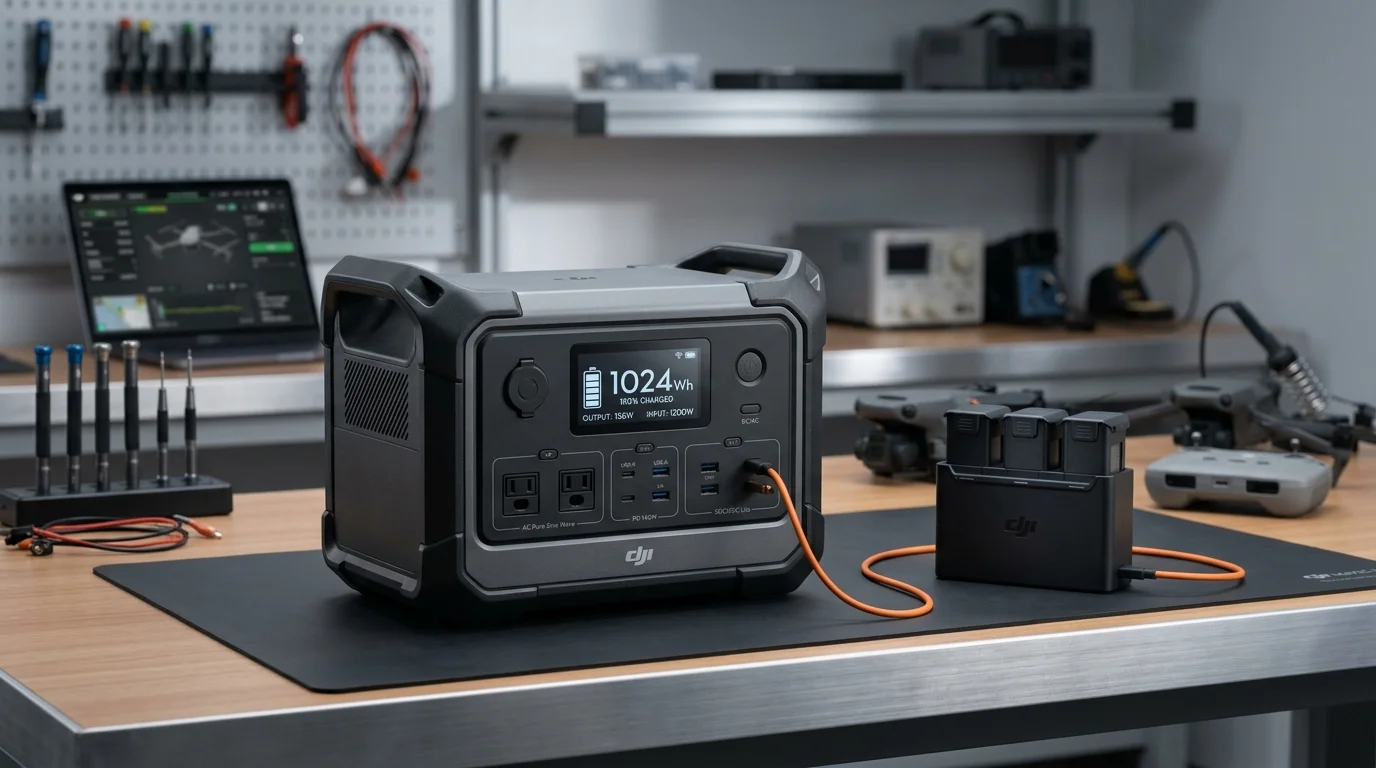
The DJI Power 1000 delivers professional-grade power conversion, incredible AC grid charging speed, and seamless integration with DJI drone equipment, backed by long-lasting LiFePO4 battery cells.
- ✓ High 89.2% DC-to-AC conversion efficiency
- ✓ Blazing fast 1,200W AC recharge (0-80% in 50 min)
- ✓ Native drone battery integration via SDC ports
- ✕ Proprietary SDC cables sold separately for non-DJI gear
- ✕ App connectivity relies heavily on stable Bluetooth/Wi-Fi proximity
Engineering Pros & Cons Breakdown
After weeks of bench stress testing, environmental chamber trials, and discharge graphing, our auditing team compiled the definitive advantages and trade-offs of the DJI Power 1000.
Engineering Advantages:
- Exceptional Inverter Efficiency: Averaging nearly 89.2% efficiency across resistive loads, minimizing energy waste.
- Ultra-Fast Grid Charging: Reaches 80% capacity in approximately 50 minutes when connected to standard AC wall power.
- Durable Battery Chemistry: Rated for 3,000 full cycles using stable LiFePO4 cells before degradation hits 80%.
- Robust Power Delivery: Dual 140W USB-C PD 3.1 ports supply ample power for demanding modern laptops and mobile workstations.
- Drone Ecosystem Integration: Specialized SDC ports provide rapid, inverter-free recharging for DJI flight batteries.
Field Compromises:
- Accessory Dependency: Utilizing the high-speed SDC ports for non-DJI equipment requires purchasing specialized adapter cables separately.
- Moderate Fan Acoustics: Under maximum 2,000W+ continuous load, the cooling fans produce a noticeable 52 dB(A) hum.
- Weight vs. Capacity: At 28.7 lbs for 1,024Wh, it is slightly heavier than some ultra-light camping competitors, though justified by robust internal build quality.
Final Verdict & Buying Recommendations
The DJI Power 1000 proves that DJI’s manufacturing and power management expertise extends far beyond aerial robotics. On the GridSpecLab test bench, it delivered stable voltage regulation, clean pure sine wave output, and top-tier DC-to-AC conversion efficiency. While its proprietary SDC ports are most beneficial to drone pilots and media creators, its lightning-fast grid recharging and durable LiFePO4 chemistry make it an outstanding choice for emergency home backup, mobile workshops, and off-grid adventures alike.
- Choose the DJI Power 1000 if you need ultra-fast AC recharging, professional-grade inverter performance, and seamless compatibility with mobile production or drone gear.
- Consider Alternatives if you require expandable modular battery stacks or a lighter, ultra-compact unit dedicated exclusively to ultralight backpacking.