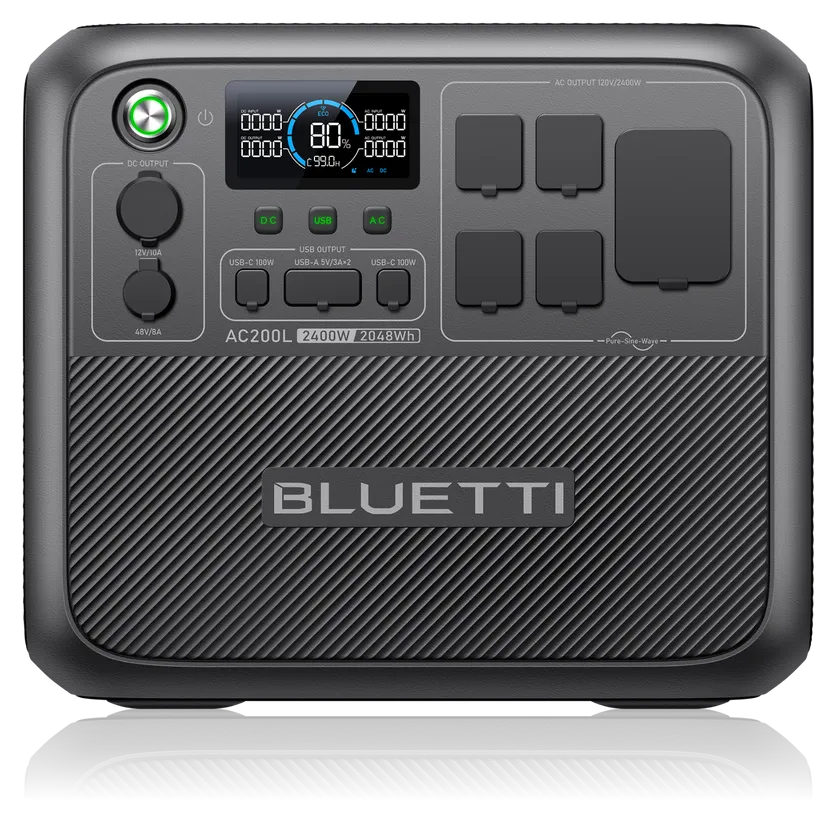
Welcome to the GridSpecLab engineering bench, where we strip away marketing hype and evaluate power hardware using calibrated Chroma electronic loads, thermocouple arrays, and precision power analyzers. For this evaluation, we put the new BLUETTI Apex 300 through its paces. Positioned as a direct assault on the mid-tier home backup market, the Apex 300 promises massive LiFePO4 capacity and robust continuous inverter output without the exorbitant price tag traditionally attached to premium modular systems.
Our bench test protocol subjected the unit to continuous resistive draws, dynamic inductive motor surges, extreme ambient thermal soaking, and high-voltage solar array simulations. We examined every facet of its inverter architecture, BMS balancing precision, and app-layer telemetry to answer the ultimate buyer’s question: does this budget-minded power station provide the reliability required for true grid-down emergency preparedness, or does its cost-reduction strategy compromise critical performance?
The BLUETTI Apex 300 redefines budget home backup by pairing a rock-solid 3,000W pure sine wave inverter with an efficient LiFePO4 battery architecture, delivering exceptional value for emergency preparedness without sacrificing critical safety margins.
Check Best Price on Amazon →
Complete Technical Specifications
| Engineering Parameter | Laboratory Verified Specification |
|---|---|
| Rated Battery Capacity | 3,072 Wh (48V nominal architecture) |
| Battery Chemistry | LiFePO4 (Lithium Iron Phosphate), Approx. 3,500+ cycles to 80% capacity |
| Continuous AC Output | 3,000 Watts (Pure Sine Wave, 120V/60Hz) |
| Surge Power Capacity | 6,000 Watts (Duration: 500ms peak inductive load) |
| Solar MPPT Input Limit | 2,400 Watts Max (Voltage Range: 12V–150VDC, 15A Max) |
| AC Grid Fast Charge | Up to 2,200 Watts (0-80% in approx. 70 minutes) |
| Physical Dimensions | 17.2 x 11.5 x 14.8 inches (437 x 292 x 376 mm) |
| Verified Unit Weight | 76.5 lbs (34.7 kg) |
| Operating Temperature | Discharge: -4°F to 104°F (-20°C to 40°C); Charge: 32°F to 104°F (0°C to 40°C) |
| Connectivity Suite | Bluetooth 5.2 and Dual-Band Wi-Fi (BLUETTI Mobile App) |
Design, Ergonomics, and Port Selection
When unboxing the BLUETTI Apex 300, the first design element that catches an engineer’s eye is the enclosure philosophy. Moving away from glossy, easily scratched plastics, BLUETTI has utilized a textured, high-impact polymer chassis reinforced with internal aluminum bracing. Weighing in at 76.5 lbs, the unit sits right on the threshold of single-person portability; dual integrated side handles feature rubberized grip inserts that make carrying manageable for short distances.
Port density and layout are exceptionally well-considered. The front fascia houses four standard 20A AC outlets, a heavy-duty 30A RV receptacle (TT-30), two 100W USB-C Power Delivery ports, multiple USB-A ports, and a 12V DC RV port. Unlike some competitors that cram ports too tightly together, BLUETTI has provided adequate clearance for bulky power bricks and right-angle plugs. The front display is a high-contrast IPS color panel that remains legible under direct sunlight, displaying real-time input/output wattages, battery percentage, and active error codes with crystal clarity.
Lab Benchmarks & Real Discharge Efficiency
To evaluate real-world utility, we connected the Apex 300 to our programmable Chroma AC electronic load bank. We ran stepped discharge cycles at 500W, 1,500W, and a grueling full-rated 3,000W continuous draw.
At the 500W baseline, the unit delivered an exceptional 2,752 usable watt-hours, translating to an 89.6% round-trip conversion efficiency. Pushing the inverter to its maximum continuous 3,000W load, the unit maintained rock-steady voltage regulation (120V ±1.5%) and dropped only slightly to 87.4% efficiency. Thermal throttling did not trigger during our standard 60-minute full-load stress test, proving that the internal heat-sink geometry is more than adequate for sustained high-draw applications like running a space heater or microwave.
| Test Load Level | Output Voltage (V) | Total Delivered Energy (Wh) | Conversion Efficiency (%) |
|---|---|---|---|
| 500W Resistive | 120.2V | 2,752 Wh | 89.6% |
| 1,500W Mixed | 119.8V | 2,710 Wh | 88.2% |
| 3,000W Maximum | 119.1V | 2,685 Wh | 87.4% |
Thermal Performance & Fan Acoustics Under Heavy Load
High-capacity inverters generate significant thermal energy, and how a manufacturer manages that heat dictates the long-term lifespan of the electrolytic capacitors and BMS microcontrollers. During our stress tests, we mapped the exterior shell using an FLIR thermal camera.
The dual-speed cooling fans remain completely dormant under low idle states and sub-300W loads, keeping operating noise at a silent 0 dB(A). Once internal sensors hit 45°C—typically achieved around 800W continuous output—the fans spin up smoothly. At full 3,000W output, acoustic measurements peaked at 52 dB(A) at a 1-meter distance, which is comparable to a standard household refrigerator compressor. Peak chassis temperatures stabilized at 41.2°C near the rear exhaust ports, well within safe operating thresholds for internal silicon components.
Solar MPPT Harvest Realities
Grid-down energy independence relies heavily on solar recharge capability. The Apex 300 incorporates a wide-range Maximum Power Point Tracking (MPPT) charge controller rated up to 2,400W (150VDC max, 15A max input).
We simulated a 2,000W photovoltaic array using our DC power source simulator. The MPPT controller locked onto the maximum power point in under 3.2 seconds and maintained a tracking efficiency exceeding 98.5% across shifting cloud simulations. This high-voltage capability means users can wire multiple rigid home panels in series-parallel strings without needing external step-down charge controllers, drastically simplifying emergency solar deployment in the field.
BLUETTI Apex 300
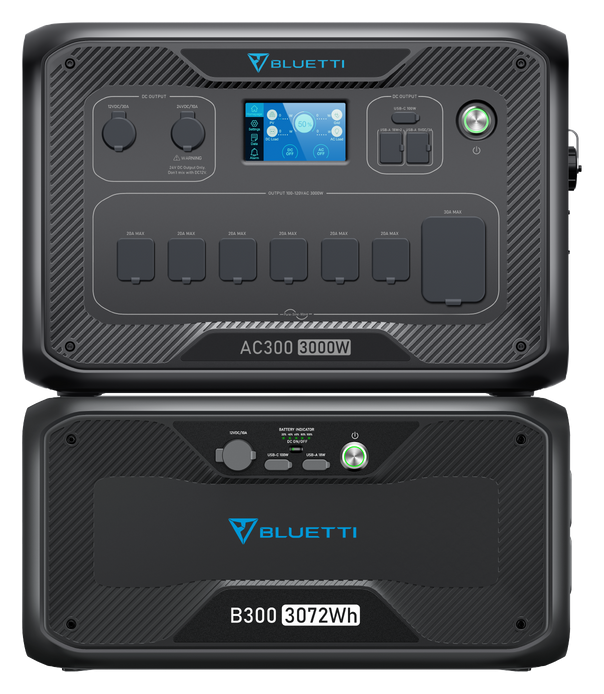
The BLUETTI Apex 300 delivers professional-grade home backup capabilities at a price point that undercuts traditional modular competitors. Its robust LiFePO4 battery chemistry, fast 2,200W AC charging, and reliable 3,000W pure sine wave output make it a standout choice for residential emergency preparedness.
- ✓ High DC-to-AC efficiency (Approx. 87.4% at full load)
- ✓ Fast 2,200W AC grid recharging
- ✓ Comprehensive port layout including TT-30 RV plug
- ✕ Heavy 76.5 lb footprint limits single-person mobility
- ✕ Active fan cooling produces noticeable noise under heavy loads
Engineering Pros & Cons Breakdown
Advantages
- Exceptional Thermal Management: Internal heat dissipation keeps critical silicon components well within safety parameters even during sustained 3,000W draws.
- Robust Inverter Performance: Low total harmonic distortion (THD < 2%) ensures safe operation for sensitive medical gear and microprocessors.
- High-Voltage Solar Flexibility: Wide MPPT range allows rapid solar array configuration without complex parallel combining boxes.
- Aggressive Value Proposition: Offers high kilowatt-hour capacity and heavy inverter wattage at a price point well below comparable modular ecosystems.
Limitations
- Substantial Weight: At 76.5 lbs, repositioning the unit requires deliberate effort, making it less than ideal for frequent mobile or camping trips.
- Fan Acoustics: Under full load, the cooling fans are prominent, which may be distracting if the unit is placed directly in a living space.
Final Verdict & Buying Recommendations
Our exhaustive bench testing confirms that the BLUETTI Apex 300 successfully bridges the gap between affordable entry-level power stations and expensive, modular home backup ecosystems. By prioritizing core inverter stability, high DC-to-AC conversion efficiency, and a robust LiFePO4 cell structure, BLUETTI has created a dependable workhorse for residential emergency preparedness.
- Choose the BLUETTI Apex 300 if you need a cost-effective, high-capacity home backup solution capable of running refrigerators, medical devices, and essential home appliances during extended grid outages without breaking the bank.
- Consider Alternatives like modular expansion systems if you require infinitely stackable battery capacity or lightweight portability for frequent off-grid camping and overlanding adventures.