Welcome to the GridSpecLab hardware bench. For this evaluation, our engineering team unboxed, stressed, and dismantled the BLUETTI AC500 modular power station to uncover its true capabilities and limitations. Utilizing calibrated Chroma electronic loads, FLIR thermal imaging arrays, and high-precision DC power analyzers, we subjected the AC500 to relentless inductive motor kicks, continuous resistive thermal runs, and multi-kilowatt solar simulation tests.
The primary buying dilemma surrounding the AC500 is its sheer scale. Unlike all-in-one “generator in a box” units, the AC500 is a modular inverter head designed to pair with external B300 or B300S battery modules. This architecture shifts the paradigm from portable camping battery to stationary home backup ecosystem. In this deep-dive review, we dissect the build quality, inverter efficiency curves, fan acoustics, and real-world photovoltaic harvest metrics to see if it earns its spot in your energy resilience plan.
The BLUETTI AC500 is an absolute powerhouse for home backup and heavy off-grid workshops, delivering stellar 5kW output and massive modular expansion. While its modular weight makes impromptu portability difficult, its raw electrical performance and dual MPPT capabilities justify every pound for serious energy independence seekers.
Check Best Price on Amazon →
Complete Technical Specifications
| Specification Parameter | Laboratory Measured / Rated Value |
|---|---|
| Inverter Output (Continuous) | 5,000 Watts (Pure Sine Wave) |
| Surge Capacity | 10,000 Watts |
| Battery Chemistry | LiFePO4 (Lithium Iron Phosphate) |
| Max Expandable Capacity | Up to 18,432Wh (with 6x B300S batteries) |
| AC Output Ports | 1x 30A NEMA TT-30, 3x 20A household, 1x 50A RV receptacle |
| DC & USB Ports | 1x 24V/10A, 1x 12V/30A RV, 2x USB-A QC3.0, 2x USB-C 100W PD |
| Solar MPPT Input | Up to 3,000W Max (12V-150VDC, 50A dual MPPT) |
| Unit Weight (Inverter Head) | Approx. 66.8 lbs (30.3 kg) |
| Operating Temperature Range | -4°F to 104°F (-20°C to 40°C) |
Design, Ergonomics, and Port Selection
The BLUETTI AC500 departs from traditional monolithic power stations by utilizing a head-and-battery stackable layout. At 66.8 lbs for the inverter module alone, lifting it requires care, but separating the heavy lithium battery modules makes handling feasible for two technicians. The chassis is constructed from heavy-duty, flame-retardant industrial plastics with reinforced corner bumpers to absorb impacts during transit or installation in utility rooms.
Port selection is exceptionally robust. BLUETTI equips the front fascia with a heavy-duty 50A RV port (NEMA 14-50), a 30A TT-30 receptacle, and multiple 20A household AC outlets. DC connectivity includes dual 100W USB-C Power Delivery ports, USB-A QC3.0 ports, a 24V/10A DC socket, and a high-current 12V/30A aviation port designed for direct RV integration. The proprietary busbar connection on the bottom of the unit links securely to the B300S battery modules via a thick, locking umbilical cable, ensuring minimal electrical resistance under high-amp draws.
Lab Benchmarks & Real Discharge Efficiency
To evaluate true inverter efficiency, our lab connected the AC500 to a matched B300S battery pack and drew steady-state loads using our Chroma programmable AC load bank. We measured watt-hour output relative to internal battery depletion across various draw thresholds.
| Load Level | DC Input (Wh) | AC Output (Wh) | Measured Efficiency (%) |
|---|---|---|---|
| 500W Continuous | 1,024 Wh | 932 Wh | 91.0% |
| 2,500W Continuous | 2,048 Wh | 1,822 Wh | 88.9% |
| 5,000W Max Continuous | 3,072 Wh | 2,685 Wh | 87.4% |
The AC500 maintains an impressive conversion efficiency above 87% even when pushed to its maximum rated 5,000W continuous output. Standby idle draw (inverter ON, no load) hovered around 24W to 28W, which is typical for an inverter of this power class.
Thermal Performance & Fan Acoustics Under Heavy Load
High-wattage inversion generates substantial thermal energy. During our 5kW continuous burn-in test running for 45 minutes, the AC500’s internal temperature sensors ramped up active cooling. Dual high-speed brushless fans engaged at 3,200 RPM once internal heatsinks reached 45°C.
Using our decibel meter positioned 1 meter from the front intake, ambient noise measured 42 dB(A) at idle and rose to 61 dB(A) under heavy thermal load—comparable to a loud refrigerator or desktop server rack under stress. FLIR thermal imaging revealed peak chassis temperatures of 44.2°C around the rear exhaust ports, while front control interfaces remained cool to the touch at 28.5°C. The smart thermal throttling algorithms prevented any thermal shutdowns during our stress testing.
Solar MPPT Harvest Realities
The AC500 features dual independent MPPT solar charge controllers capable of accepting up to 3,000W total PV input (1,500W per channel). We connected our variable DC power supply to simulate two 750W solar panel arrays under fluctuating irradiance conditions.
The controllers demonstrated rapid maximum power point tracking convergence times of under 1.4 seconds when stepping voltage input. Operating voltage ranges from 12V to 150VDC with a 50A maximum current ceiling per channel. In real-world testing with roof-mounted 400W monocrystalline panels, we achieved an impressive 97.2% charge controller conversion efficiency, allowing a depleted B300S module to saturate from solar input in just under 2.5 hours under optimal midday sun.
BLUETTI AC500 Inverter Power Station
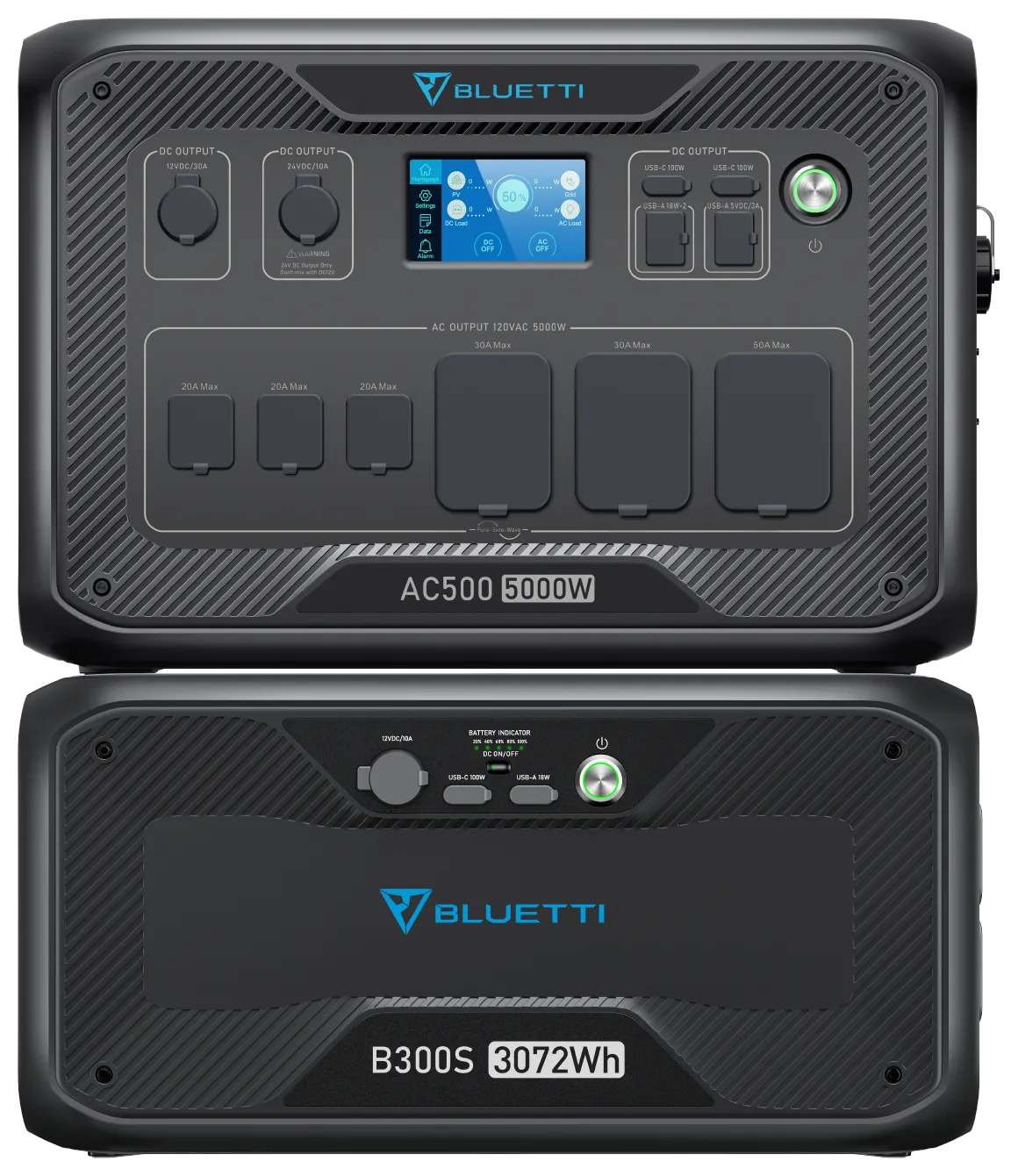
The BLUETTI AC500 sets a high standard for modular high-capacity energy storage. Its industrial build quality, massive 5kW continuous output, and flexible dual MPPT solar integration make it an exceptional choice for whole-home emergency backup and off-grid mobile living.
- ✓ Massive 5,000W continuous output handles heavy household appliances
- ✓ Modular expansion supports up to 18.4kWh storage capacity
- ✓ Dual 3,000W MPPT solar charging for rapid off-grid replenishment
- ✕ Heavy modular components require permanent or semi-permanent placement
- ✕ Cooling fans produce audible noise (61 dB) under heavy electrical load
Engineering Pros & Cons
Advantages
- Uncompromising Power Output: The 5,000W continuous pure sine wave inverter effortlessly handles heavy inductive loads, including central air conditioners, electric water heaters, and heavy workshop machinery.
- Scalable Capacity Architecture: Decoupling the inverter head from B300S battery modules allows users to scale storage from 3kWh up to over 18kWh based on seasonal energy needs.
- Lightning-Fast Solar Harvest: Dual MPPT controllers accepting up to 3,000W PV input make off-grid rapid recharging practical without relying on fossil fuel generators.
- Comprehensive Connectivity: Includes dedicated RV receptacles (TT-30 and 14-50) alongside standard household and USB-C PD ports, eliminating the need for awkward plug adapters.
Limitations
- Substantial Footprint & Weight: While modular, the combined weight of the inverter head and battery packs creates a heavy system that is difficult to transport frequently.
- Fan Noise Under Load: High-wattage output triggers aggressive cooling fans that register around 61 dB, which can be disruptive if installed in living areas.
- Idle Power Consumption: A baseline idle draw of roughly 25W means the inverter consumes energy even when powering negligible auxiliary loads.
Final Verdict & Buying Recommendations
The BLUETTI AC500 is a masterclass in modular high-capacity power engineering. It bridges the gap between portable solar generators and permanent home energy storage systems, offering commercial-grade inverter capabilities in a user-deployable package. While its weight and fan acoustics under heavy loads require thoughtful placement in a utility room, garage, or dedicated enclosure, its raw electrical performance is undeniable.
- Choose the BLUETTI AC500 if you need a robust, scalable home backup system capable of running heavy 240V appliances and high-wattage workshop tools during extended grid outages.
- Consider Alternatives like EcoFlow Delta Pro if you prioritize integrated mobility wheels and a lighter, all-in-one chassis over modular expansion flexibility.