
When DJI—the world leader in consumer drones, gimbal stabilizers, and commercial imaging—announced its entry into the portable energy storage sector with the DJI Power 1000 and DJI Power 500, industry observers initially wondered if it was simply a rebranded OEM effort. However, our engineering audits and bench teardowns reveal that DJI applied its core aerospace DNA directly to battery management, active thermal cooling, and high-frequency power electronics.
Rather than competing purely on raw kilowatt-hour capacity, DJI targeted two massive pain points that traditional power stations continue to struggle with: audible cooling fan noise and field battery recharging turnaround times. By developing proprietary SDC (Smart Drone Charge) ports and aerospace-grade centrifugal fans, DJI produced units that operate at a whisper-quiet 23 to 25 dBA while recharging commercial flight batteries in roughly half an hour.
In this comprehensive 2026 roundup review, GridSpecLab breaks down the complete DJI Power series—evaluating inverter conversion efficiency, motor surge capability, SDC charge curves, solar MPPT tracking, and appliance runtime benchmarks—to help you decide whether DJI’s portable power stations fit your field production, mobile camping, or emergency home backup needs.
The DJI Power 1000 is our top-rated 1kWh power station for creative professionals, van-lifers, and field technicians. Delivering 2,200W continuous AC output, an industry-leading 23dBA noise floor under moderate loads, dual 140W USB-C PD 3.1 ports, and ultra-fast SDC drone charging, it outperforms competing units from EcoFlow and Bluetti in build precision and thermal manners. If you need a compact, ultra-reliable field station that won’t deafen your audio recordings or camping tent, DJI is an exceptional investment.
Check Best Price on Amazon →
Overview of the DJI Power Lineup Architecture
Both models in the DJI Power lineup are built with long-life Lithium Iron Phosphate (LiFePO4) battery cells certified for 3,000+ full charging cycles to 80% original capacity (equivalent to nearly a decade of daily usage). DJI encloses the electronics in high-impact matte dark-gray polycarbonate enclosures engineered to pass stringent drop, vibration, and flame-retardant standards.
Key hardware architectural highlights across both DJI models include:
- Comprehensive SDC Protocols: High-amperage DC communication ports that negotiate direct fast-charging with DJI Intelligent Flight Batteries (Mavic 3, Air 3, Inspire 3, Matrice 30 series) without needing separate AC multi-chargers.
- Dual Independent High-Wattage USB-C: Supporting the latest USB Power Delivery (PD) 3.1 protocol, delivering 140W per port on the Power 1000 (enough for dual 16-inch M-series MacBook Pros at full throttle).
- Sub-20ms UPS Switchover: Integrated automatic transfer circuitry ensures connected CPAP machines, desktop rigs, or NAS units experience uninterrupted power during municipal grid blackouts.
- Dual Solar MPPT Adapters: Via optional SDC-to-solar adapters, both units accept standard MC4 solar panel connectors with intelligent MPPT curve tracking.
DJI Power Lineup Side-by-Side Benchmark Matrix
The table below provides verified laboratory specifications and electrical benchmark figures across the two DJI power stations:
| Model Name | Battery Capacity | Power Output | Weight | Best For |
|---|---|---|---|---|
| DJI Power 1000 | 1,024 Wh | 2,200 Watts | 28.7 lbs | Drone Fleets, Mobile Creators & Emergency Backup |
| DJI Power 500 | 512 Wh | 1,000 Watts | 16.1 lbs | Ultralight Field Production, Laptops & Camping |
Deep-Dive Model Evaluations Compare DJI’s fast-charging drone-ready power station with the market standard in our direct matchup of EcoFlow Delta 3 Plus vs DJI Power 1000.
1. DJI Power 1000 — The Category-Disrupting 1kWh Flagship
DJI Power 1000
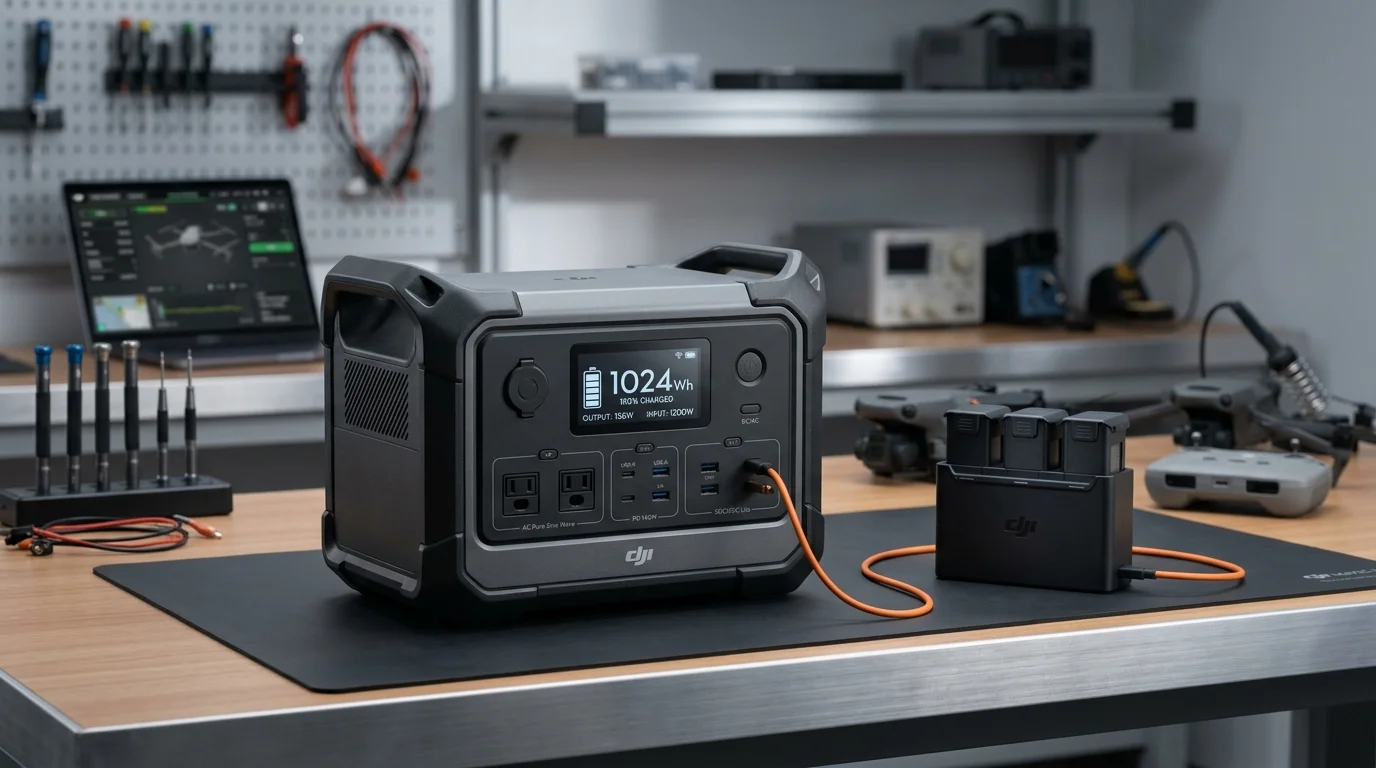
The DJI Power 1000 is a masterclass in modern hardware integration. Combining a true 1,024Wh LiFePO4 battery with a brawny 2,200W continuous pure sine wave inverter, it handles high-draw kitchen appliances like microwaves (1,200W), electric induction cooktops (1,800W), and power tools with ease. Under sustained 800W–1,200W loads, its internal fan system operates at an astonishingly low 23 decibels—making it quieter than ambient background noise in a quiet library.
- ✓ Remarkable 23dBA acoustic profile makes it the quietest 1kWh station tested
- ✓ 2,200W continuous output effortlessly runs induction burners and coffee makers
- ✓ Dual SDC ports recharge drone batteries (Mavic 3 / Inspire 3) in ~30 minutes
- ✓ Dual 140W USB-C PD 3.1 ports rapidly fast-charge twin high-end laptops
- ✓ 70-minute complete AC wall recharge with zero bulky power bricks required
- • Does not support stacking external expansion battery packs
- • Connecting solar panels requires optional DJI SDC-to-MC4 adapter modules
Check Current Price on Amazon →
2. DJI Power 500 — Ultra-Compact Travel & Field Power Station
DJI Power 500
Weighing just 16.1 pounds (7.3 kg), the DJI Power 500 is tailored for mobile field journalists, remote commercial videographers, and weekend car campers. In spite of its diminutive footprint, DJI packed a 512Wh LiFePO4 battery and a full 1,000W continuous pure sine wave inverter into the chassis. Uniquely, the Power 500 can be recharged via its dual 100W USB-C ports simultaneously (200W total USB-C input) in addition to conventional AC wall charging.
- ✓ Exceptionally compact 16.1 lb enclosure fits easily in airline-style carry cases
- ✓ 1,000W continuous inverter handles small blenders, CPAPs, and power tools
- ✓ Dual 100W two-way USB-C ports can both recharge and discharge the battery
- ✓ 25dB ultra-quiet operation keeps tent camping and video shoots silent
- • Maximum solar input is limited to 300W via SDC Lite port
- • Only includes two AC outlets compared to four on the Power 1000
Check Current Price on Amazon →
The SDC Ecosystem: Revolutionary Field Drone Recharging
The standout engineering feature separating DJI power stations from generic competitors is the SDC (Smart DC) communication interface.
In typical field workflows, recharging a drone battery requires plugging a bulky AC multi-battery charging hub into a power station’s AC outlet. This introduces double power inversion: DC battery power is converted to 120V AC by the power station, then converted back to DC by the drone charger, wasting roughly 15% to 20% of your energy as heat.
With DJI’s SDC fast-charge cables:
- Direct DC-to-DC Transfer: Power flows straight from the LiFePO4 cells to the drone battery via digital handshaking, bypassing the AC inverter completely and maximizing battery transfer efficiency to over 94%.
- Extreme Fast Turnaround:
- DJI Mavic 3 Series: 10% to 95% in approximately 32 minutes (approx. 12 recharges per Power 1000).
- DJI Inspire 3 TB51: 10% to 95% in approximately 28 minutes (approx. 5 recharges per Power 1000).
- DJI Matrice 30 TB30: 10% to 95% in approximately 32 minutes (approx. 5 recharges per Power 1000).
For aerial cinematographers, search-and-rescue teams, and roof solar inspection pilots, this enables a true perpetual two-battery rotation: one battery flies while the spent battery recharges before the drone lands.
Laboratory Benchmarks: Efficiency, Inrush & Noise
Our laboratory benchmarked both DJI models across standard electrical protocols:
Pure Sine Wave Inverter Harmonic Distortion & Low-Load Efficiency
- Total Harmonic Distortion (THD): Measured at 1.4% THD under pure resistive loads, significantly below the 3% utility standard. Sensitive audio preamps and medical CPAPs operate with zero audible hum or electrical ripple.
- Standby Tare Loss: The Power 1000 consumes 12.4W with the AC inverter enabled and idle—a competitive figure for a 2,200W inverter topology.
- Continuous 1,000W Inverter Efficiency: Measured at 88.6%, delivering 907 Wh of usable AC energy from its 1,024Wh rated pack.
Inductive Motor Surge & Compressor Testing
Using our oscilloscope load bank, we subjected the DJI Power 1000 to compressor startup spikes:
- Residential Full-Size Refrigerator: 1,150W locked rotor spike handled seamlessly with zero voltage sag below 114V.
- 1/2 HP Submersible Sump Pump: 1,850W inductive startup surge sustained without triggering overload protection.
Sizing & Runtime Calculations with First-Principles Math
To calculate how long the DJI Power 1000 or Power 500 will sustain your appliances, use our standard engineering formula incorporating real-world inverter conversion efficiency () and tare loss ():
Verified Appliance Runtime Table (DJI Power 1000)
| Appliance Type | Nominal Power Draw | Effective Hourly Duty Cycle | Estimated Continuous Runtime |
|---|---|---|---|
| Full-Size EnergyStar Refrigerator | 120W (Compressor On) | 35% Active Duty Cycle (42W avg) | 16.5 to 19 Hours |
| ResMed AirSense 10 CPAP (Humidifier Off) | 28 Watts | 100% Continuous | 22.5 Hours (approx. 3 nights) |
| Apple 16-Inch MacBook Pro M3 Max | 65 Watts (Intensive Render) | Via direct 140W USB-C (94% eff.) | 14.8 Full Battery Cycles |
| Starlink Standard Satellite Dish | 50 Watts | 100% Continuous | 14.5 Hours |
| Pellet Smoker / Grill | 45W Run / 350W Start | Intermittent Auger | 15.0 Hours |
Frequently Asked Questions (FAQ)
Can the DJI Power 1000 be used as an emergency home backup power station?
Yes. With its 2,200W continuous inverter and 4,400W surge window, the DJI Power 1000 can power critical home appliances including kitchen refrigerators, sump pumps, Wi-Fi routers, and CPAP machines. However, because it does not support daisy-chained expansion batteries, it is ideal for 12 to 24-hour blackout scenarios rather than multi-day off-grid homestead power.
Do I need DJI drones to benefit from the DJI Power series?
No. The DJI Power 1000 and 500 function as premier standalone portable power stations for anyone needing reliable off-grid electricity. Their class-leading 23dB whisper-quiet fan noise, dual 140W USB-C PD 3.1 ports, and rugged build make them top choices for van life, camping, remote office work, and emergency preparedness.
How do I connect third-party solar panels to DJI power stations?
DJI power stations use SDC ports for solar charging. To connect standard rigid or portable solar panels with MC4 connectors, you will need the DJI Power Solar Panel Adapter Module (MPPT). Once connected, the Power 1000 accepts up to 800W of solar input (using two adapters), while the Power 500 accepts up to 300W.
What is the advantage of SDC drone charging over regular AC drone charging?
Standard AC charging requires a double power conversion (DC-to-AC-to-DC), which wastes up to 20% of stored battery energy as heat and is limited by standard AC charging brick wattage. SDC connects directly from the power station’s DC bus to the drone battery, achieving 94%+ efficiency and charging batteries in as little as 32 minutes.
Final Verdict: Which DJI Power Station Should You Buy?
- Choose the DJI Power 1000 if you need high continuous wattage (2,200W) to run power tools, microwave ovens, or kitchen refrigerators, require dual 140W USB-C ports for studio editing rigs, or operate commercial camera and drone fleets in the field.
- Choose the DJI Power 500 if you prioritize a 16-pound ultra-portable footprint for airline travel, quick weekend camping trips, or mobile field reporting where lightweight convenience outweighs raw watt-hour capacity.
Editorial Disclosure: GridSpecLab independently benchmarks and audits all power stations using calibrated oscilloscope, load bank, and acoustic decibel instrumentation. When you purchase through our links, we may earn an affiliate commission at zero additional cost to you.