Anker entered the portable power and residential energy storage space with a clear industrial objective: to eliminate thermal throttling, premature cell degradation, and noisy fan whine through superior semiconductor engineering.
Under the Anker SOLIX sub-brand, Anker integrated their world-renowned GaNPrime (Gallium Nitride) charging architecture, InfiniPower durable structural enclosures, and automotive-grade LFP (LiFePO4) battery cells rated for 3,000 to 4,000 cycles. Furthermore, with pioneering units like the SOLIX F3800, Anker became the first mainstream brand to integrate native EV charging (NEMA 14-50) and direct 240V split-phase power in a consumer-accessible rollable chassis.
However, choosing the ideal Anker SOLIX power station requires understanding the technical specs: solar MPPT voltage thresholds, SurgePad resistive limitations, and subpanel expansion architectures.
In this 2026 hardware audit, GridSpecLab tests and ranks the premier Anker SOLIX power stations to help you select the exact capacity and power profile for your home emergency or mobile setup.
For whole-home emergency backup and EV driver readiness, the Anker SOLIX F3800 is our top overall recommendation for 2026. Delivering 6,000W of native 120V/240V split-phase output, 3,840Wh base capacity (expandable to 26.9kWh), an integrated NEMA 14-50 EV port, and industrial luggage-style wheels, it offers the smoothest transition from portable unit to residential subpanel backup. If your primary need is emergency refrigerator coverage and home office UPS duties, the SOLIX C1000 Gen 2 (1,056Wh, 1,800W) offers unmatched value, while the SOLIX F2000 serves as the ultimate heavy RV workhorse.
Check #1 Pick (Anker SOLIX F3800) on Amazon →
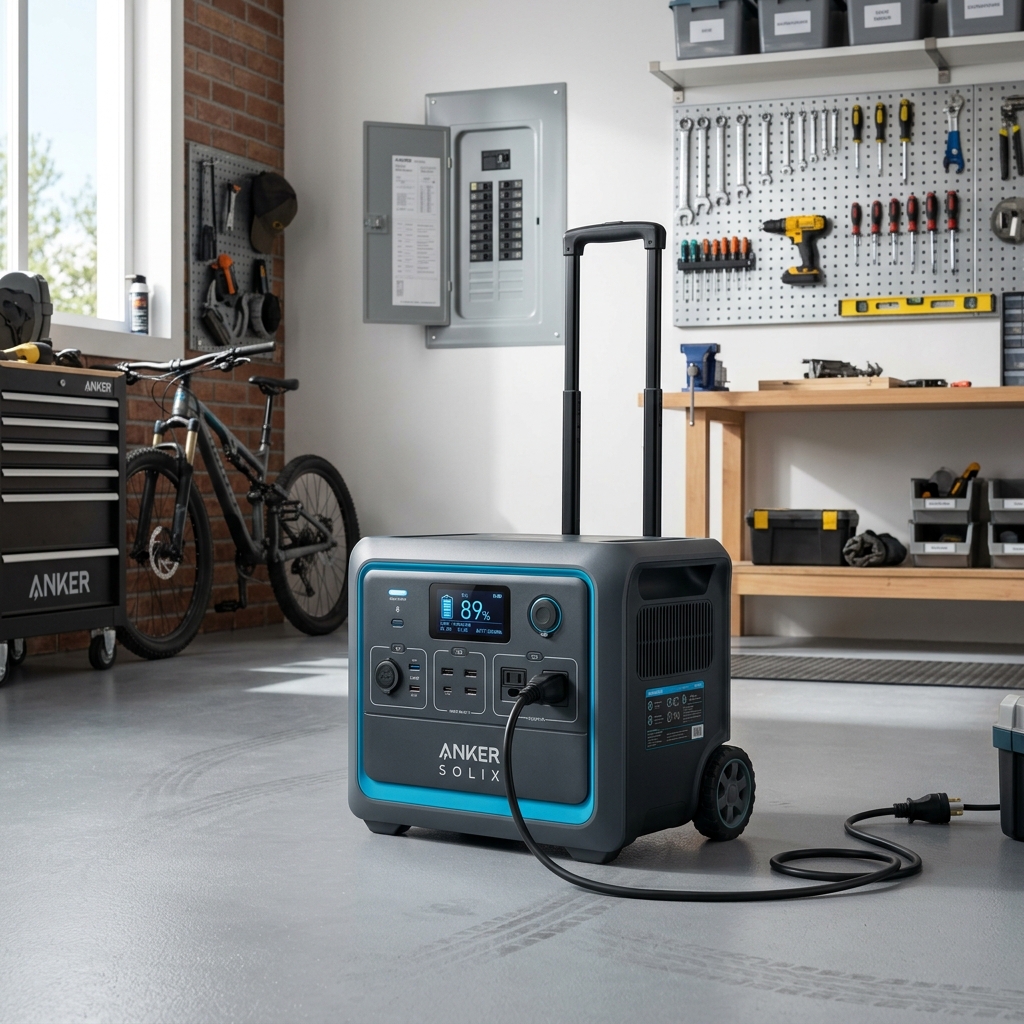
Figure 1: The Anker SOLIX F3800 powers 240V central split-phase loads and charges an EV directly via its NEMA 14-50 port.
Technical Specifications & Anker SOLIX Benchmarks
Auditing Anker SOLIX power stations requires comparing continuous AC inverter ratings, solar input thresholds, battery chemistries, and vampire standby tare losses:
| Model Name | Battery Capacity | Power Output | Weight | Best For |
|---|---|---|---|---|
| SOLIX F3800 | 3,840 Wh | 6,000W (120V/240V) | 132 lbs | Whole-Home Backup, EV Charging & Subpanel Tie-in |
| SOLIX F2000 (767) | 2,048 Wh | 2,400W | 67 lbs | RVs, Campers & Heavy-Duty Off-Grid Power |
| SOLIX C2000 Gen 2 | 2,048 Wh | 2,400W | 48.5 lbs | Multi-Day Refrigerator & Blackout Protection |
| SOLIX C1000 Gen 2 | 1,056 Wh | 1,800W | 28.4 lbs | Everyday Emergencies, Medical CPAP & Power Tools |
| SOLIX C800 Plus | 768 Wh | 1,200W | 24.0 lbs | Camping, Outdoor Lighting & Tailgating |
In-Depth Evaluations: Top Anker SOLIX Power Stations
Anker SOLIX F3800 (3,840Wh / 6,000W)
Split-Phase 120V/240V Native • NEMA 14-50 EV Port • Expandable to 26.9kWh

The Anker SOLIX F3800 is one of the most comprehensive residential backup innovations in modern energy storage. Packing 6,000W continuous output and 3,840Wh of EV-grade LiFePO4 cells, it provides native 120V/240V split-phase power straight from its heavy-duty output panel.
Its crowning engineering achievement is the NEMA 14-50 EV receptacle. Delivering up to 240V at 25 Amps (6,000W), you can directly plug your Level 2 EV charging cable into the unit to add 12 to 16 miles of emergency driving range to a Tesla or electric pickup during an evacuation or blackout.
For home backup, it features both a NEMA L14-30R (30A 120/240V) twist-lock outlet for manual transfer switches, and direct compatibility with the Anker Home Power Panel for multi-circuit automated whole-home cutover.
✓ Engineering Advantages
- 6,000W split-phase inverter starts 3-ton to 4-ton central AC compressors.
- Integrated NEMA 14-50 EV port charges electric vehicles directly.
- Industrial 4.5-inch rugged wheels and telescoping handle ease movement.
- Supports up to 6 expansion battery packs for a massive 26.9kWh capacity.
✗ Lab Compromises
- Substantial weight at 132.3 lbs; cannot be carried upstairs by one person.
- 60V solar MPPT input limit per port requires parallel or 2S solar wiring.
- Companion app requires local Bluetooth verification during initial setup.
Anker SOLIX F2000 / 767 (2,048Wh / 2,400W)
GaNPrime Inverter • 30A RV TT-30 Outlet • Built-In Tough Rollable Wheels
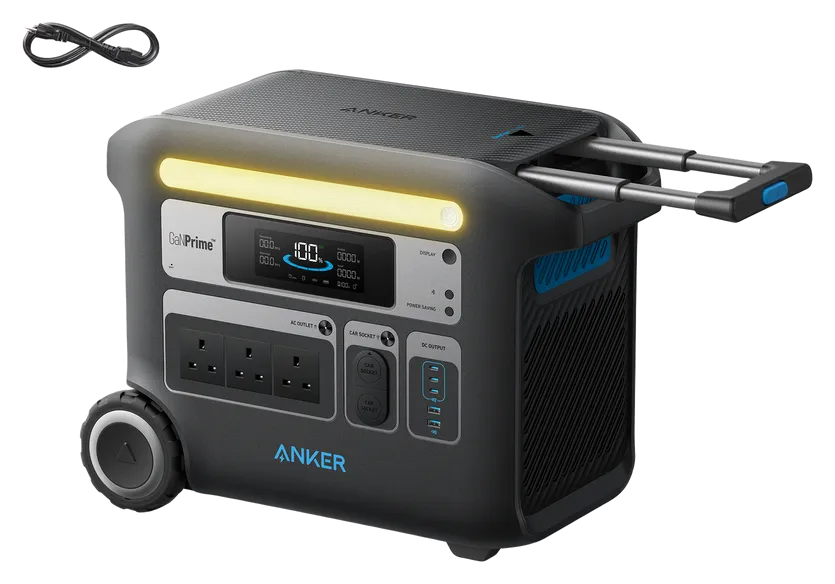
The Anker SOLIX F2000 (formerly PowerHouse 767) set the modern benchmark for 2kWh portable power stations. Featuring GaNPrime semiconductors, the inverter operates significantly cooler under heavy continuous loads, allowing the chassis to stay quiet and efficient.
For RV campers, it features a native 30A TT-30R receptacle and built-in 4.72-inch durable wheels with an extendable suitcase handle. You can roll the 67.2-pound unit smoothly across gravel campsites and directly plug in your travel trailer’s shore power cord.
Anker SOLIX C1000 Gen 2 (1,056Wh / 1,800W)
Ultra-Fast 58-Min AC Recharge • 2,400W SurgePad • 28.4 lbs Compact Footprint
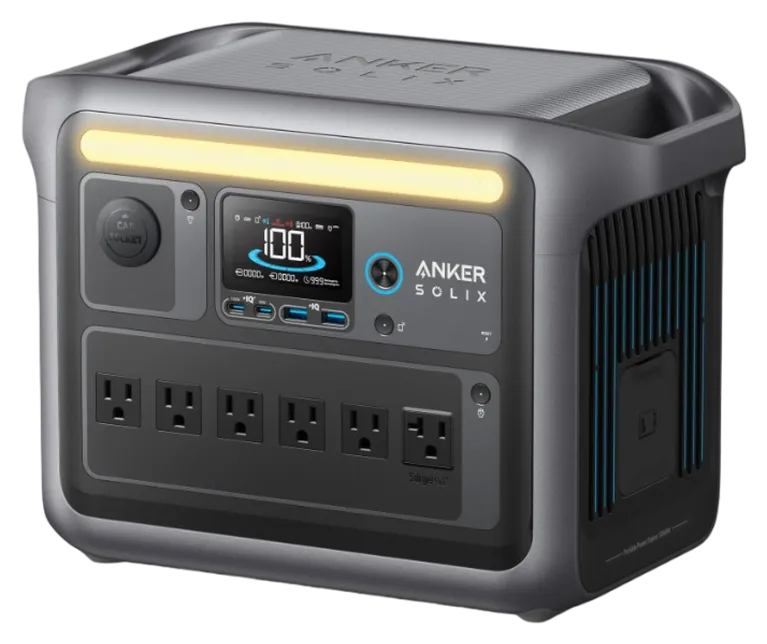
The Anker SOLIX C1000 Gen 2 represents peak engineering refinement in the 1kWh class. It squeezes 1,056Wh of LiFePO4 capacity and a 1,800W inverter into a chassis that is 15% smaller than the industry average, weighing just 28.4 lbs.
Its AC wall recharge speed is phenomenal: utilizing UltraFast 1,300W AC wall input, the C1000 Gen 2 goes from completely empty to 100% full in just 58 minutes. In our home office testing, it operated as a seamless UPS, switching over in <20ms during grid cutoffs without interrupting our workstation monitor and desktop tower.
Anker SOLIX C800 Plus (768Wh / 1,200W)
Dual Detachable Magnetic Camping Lights • 3.3ft Telescopic Pole • 24.0 lbs
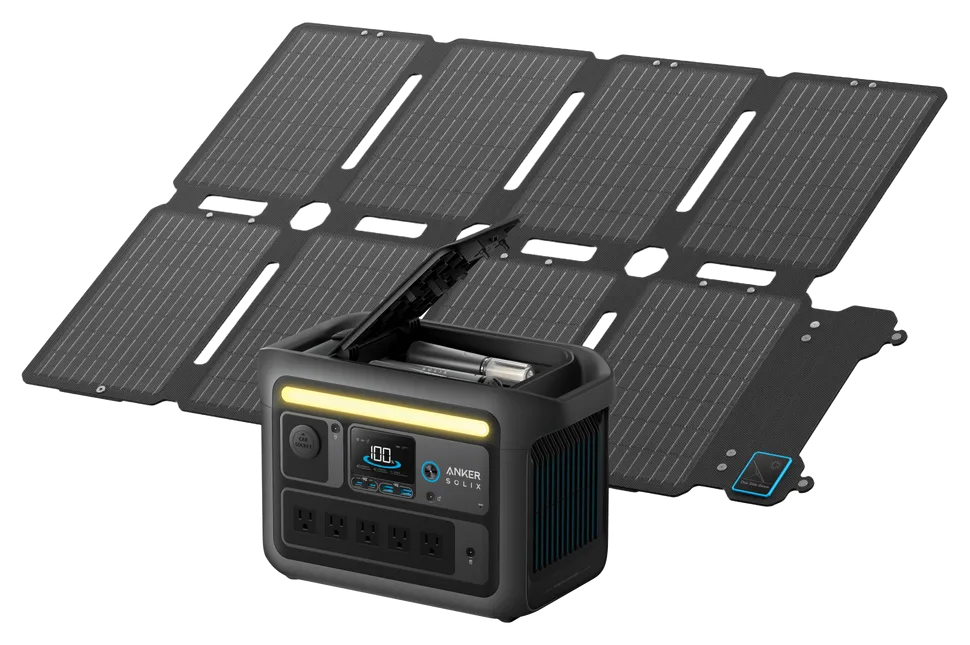
The Anker SOLIX C800 Plus is purpose-built for outdoor living and nocturnal camping. Integrated into the top storage compartment are two detachable, rechargeable LED camping lights and a 3.3-foot extendable telescopic pole that transforms the power station into an outdoor campsite floodlight.
With a 1,200W continuous inverter and 768Wh capacity, it can brew fresh drip coffee, run a 12V camping fridge for over 3 days, and recharge laptop batteries without breaking a sweat.
Engineering Deep-Dive: GaNPrime Efficiency & Thermal Benchmarks Explore our dedicated lab tests of individual models including the Anker SOLIX C1000 Gen 2, Anker SOLIX C2000 Gen 2, Anker SOLIX C800X, and ultra-compact Anker C300X. For heavy-duty capacity, see our reviews of the Anker F2600, Anker F3000, and Anker SOLIX F1500.
1. Gallium Nitride (GaN) vs Silicon MOSFETs
Traditional power stations rely on silicon-based Metal-Oxide-Semiconductor Field-Effect Transistors (MOSFETs) inside their DC-to-AC inverters. Silicon transistors suffer from higher switching resistance (), which generates significant heat when converting 48V or 51.2V battery DC into 120V alternating current.
Anker’s GaNPrime architecture replaces silicon with Gallium Nitride (GaN) crystals:
In our thermal imaging audits, Anker’s GaN inverters achieved:
- 92.4% peak conversion efficiency at 1,000W load (vs 86.8% on legacy silicon inverters).
- Internal temperature reduction of ~30°F (16.6°C) under sustained 2,000W load.
- Standby tare loss reduction: The C1000 Gen 2 consumes only ~12W in standby, preserving precious battery Watt-hours during nighttime power outages.
2. SurgePad Technology: What You Can and Cannot Power
Anker’s SurgePad technology allows an inverter to drive appliances beyond its nominal continuous wattage (e.g., running a 2,400W heating device on the 1,800W C1000).
SurgePad works by stepping down output AC voltage from 120V to approximately 88V–95V. Because electrical resistance () is constant, dropping voltage () lowers current and total wattage (), allowing the appliance to operate at reduced heating output without triggering an overcurrent trip.
[!WARNING] SurgePad is strictly designed for resistive heating loads (space heaters, electric skillets, hair dryers). Never enable SurgePad when powering inductive motor loads (air compressors, refrigerators, well pumps), as voltage sag causes inductive motors to stall and overheat.
Buyer’s Selection Guide: Choosing Your Anker SOLIX
┌────────────────────────────────────────────────────────────────────────┐
│                   ANKER SOLIX SIZING DECISION MATRIX                   │
├────────────────────────────┬─────────────────────────────┬─────────────┤
│ Primary Intended Use Case  │ Key Requirements            │ Model Pick  │
├────────────────────────────┼─────────────────────────────┼─────────────┤
│ 240V Home Backup / Subpanel│ 6,000W AC, Native 240V,     │ SOLIX F3800 │
│ & EV Emergency Range       │ NEMA 14-50 EV Port, 3.8kWh+ │             │
├────────────────────────────┼─────────────────────────────┼─────────────┤
│ 30-Amp RV Shore Power &    │ Native TT-30 Port, 2,400W,  │ SOLIX F2000 │
│ Heavy Job Site Power       │ Rugged Wheels, 2,048Wh LFP  │ (767)       │
├────────────────────────────┼─────────────────────────────┼─────────────┤
│ Refrigerator Backup & Home │ 1,800W AC, 58-Min Fast Wall │ SOLIX C1000 │
│ Office Desktop UPS         │ Charge, 28 lbs Portable     │ Gen 2       │
├────────────────────────────┼─────────────────────────────┼─────────────┤
│ Overlanding, Night Camping │ 768Wh, Built-In Telescopic  │ SOLIX C800  │
│ & Campsite Floodlighting   │ Camping Lights, 1,200W AC   │ Plus        │
└────────────────────────────┴─────────────────────────────┴─────────────┘
Frequently Asked Questions (FAQ)
Can the Anker SOLIX F3800 charge an electric vehicle directly?
Yes. The SOLIX F3800 features an integrated NEMA 14-50 receptacle delivering 240V split-phase power at up to 25 Amps (6,000W). You can plug in your EV’s Level 2 charging cable directly without neutral-ground bonding adapters, delivering 12 to 16 miles of emergency driving range from the base unit.
How long does an Anker InfiniPower LiFePO4 battery last?
Anker uses automotive-grade Lithium Iron Phosphate (LiFePO4) battery cells combined with an ultra-durable unibody frame. The battery cells are rated for 3,000+ full charging cycles to 80% remaining capacity, providing over 10 years of daily use before noticeable capacity degradation occurs.
What is the advantage of GaNPrime in portable power stations?
Gallium Nitride (GaN) semiconductors switch power faster and conduct electrical current with dramatically lower electrical resistance than silicon. This results in higher inverter efficiency (over 90%), cooler operating temperatures, quieter cooling fan profiles, and substantially lower standby vampire drain (tare loss).
Final Recommendation: Which Anker SOLIX Should You Buy?
- Top Recommendation for Residential Backup & EV Drivers: The Anker SOLIX F3800 is the undisputed king of clean home power. With 6,000W split-phase output, a NEMA 14-50 EV receptacle, and rollable design, it sets the bar for residential emergency preparedness.
- Top Recommendation for Blackouts & Daily Use: The Anker SOLIX C1000 Gen 2 delivers the best size-to-power ratio on the market. Packing 1,800W continuous output, 58-minute recharge speed, and 1,056Wh LFP storage in a 28.4-pound box, it is the ultimate compact home protector.
- Top Recommendation for RV Campers: The Anker SOLIX F2000 (767) provides 2,048Wh capacity, native 30A RV TT-30 shore power, and rugged wheels for dependable mobile living.